Roof Beam Reader
Adam Burgess
TKAM Read-Along: Part 1 (Ch. 1-11) (#MockingbirdReads)
 Hi, Everyone!
This is the first check-in post for our read-along of Harper Lee’s To Kill a Mockingbird. In this post, we cover chapters 1-11 (or “Part One” of the book).
Check-in #2 will cover chapters 12-21 and will go live on Thurs., July 25th.
Check-in #3 (or final review) will cover chapters 22-31 and will go live on Weds., July 31st.
If you want to link-up your own thoughts, your answers to my questions (below), or, eventually, a review of the book, you can do so at This Post. You can also still sign-up to join us in this read-along by visiting This Post.
Participation is totally voluntary, of course. Linking-up to your check-in posts and “registering” is just a way for those of us who are reading the book to visit one another, see what we all think, and engage in some fun conversations about this piece of classic American literature. I’m sure we’ll all have different experiences with this one, and I look forward to reading your thoughts!
Summary of Part One:
At the beginning of the book, we meet our narrator, Jean Louise (“Scout”) Finch, as well as her older brother, Jeremy Atticus (“Jem”) Finch. Scout is entering the first grade and her brother is almost ten, but they seem to be close friends and playmates, despite the age difference and differences of temperament. Scout is a tomboy who does not take kindly to be called a “girl” and Jem seems to be something of the All-American boy type. He respects his father, Atticus, immensely, and wants to be a gentlemen, just like his dad. We also meet their friend, Charles Baker (“Dill”) Harris, who stays with his aunt, Miss Rachel. We later learn that he might not have much of a permanent home at all – he is creative, dramatic, and imaginative, and he becomes obsessed with the mystery of Scout & Jem’s neighbor, Arthur “Boo” Radley.
In this first part, Jem and Scout (and sometimes Dill) are at the center of the story. We readers see much of their world, Maycomb, through their eyes – but we see more clearly the racism, myths, and legends than they do, and particularly more than Scout as she is so young and in many ways quite naive. The child’s play (and especially the presence of Dill) seems to be the central focus – youth, innocence, and playfulness. There are hints, as the chapters go along, of darker things to come – which leads me to believe that this will be a coming-of-age story for both Scout and Jem.
Some of the other interesting interactions include Scout’s relationships at school, both with her classmates and with her teacher. Scout shows herself to be quite bright, thanks to instruction from her father, but the teacher is clearly threatened by her intelligence and her ability to read. Jem is balancing between childhood and adulthood, viewing his father in ways that Scout can’t, yet. He still grasps childhood in many ways, as demonstrated by his playtime with Dill and Scout, but he longs to know more about and be more like his father, Atticus.
The mystery of Boo Radley is dangled in front of the reader in many ways, but mostly through a child’s somewhat mystified view. There is no clear reason given to us to fear Boo Radley, but his private nature, the history of his father and family, and the supernatural wonderment of childhood in general all help to construct an eerie, ominous aura around his character. Some of the more clear-headed and just adults, like Atticus and Miss Maudie, try to help guide the children toward compassion and hint at deeper troubles in the Radley family’s past.
Near the end of Part One, a fire takes Miss Maudie’s house and threatens the entire neighborhood. Though Miss Maudie takes the events in stride, this fire seems to be a turning-point of sorts. Immediately afterward, Scout begins to learn more about what her father does for a living, and about the troubling case he will soon be involved with (as a lawyer). People’s darker natures – racism, bigotry, and ignorance- begin to show, and in such a way that Scout, who is growing up, can begin to comprehend and feel threatened by it. The trial of Tom Robinson is clearly going to change Scout’s world forever.
My Thoughts:
Well, the first eleven chapters cover approximately two years, which is already a departure from what I remembered of my first read, years ago. I thought the entire book took place during one summer. Oops! I also remembered the book being narrated entirely from a child’s (Scout’s) point of view, but while it is Scout’s POV, the narrative voice seems to fluctuate between adult, past tense, and childlike in-the-moment, such as in dialogue. This is interesting – it really does make it feel like an adult’s recollection of her childhood, which is exactly what the narrative is.
I’m also enjoying the narrative structure more than I remembered (or perhaps more than I was able to appreciate the first time). The use of ellipses in Scout’s tales of Boo Radley, for instance, create an interesting sense of positive mystery. We learn that Boo is probably the one responsible for doing nice things for the kids, such as mending Jem’s pants and creating soap figurines of Scout and Jem, but this is never implicitly stated. It adds a complexity to the story, a sort of guessing game that makes us sympathize with Boo (in a way that Atticus and Miss Maudie probably do) without even having met him, yet.
Finally, I really enjoy the gothic elements of this story. It was not something I remembered at all, and I rarely see it talked about. We get the sense of the gothic from the legends and secret tales of Boo Radley (all great gothic stories have ancient and scary word-of-mouth tales at their core), and also the superstitions that fill Part One. These are all childlike in nature, so it may be something that fades away in the rest of the book, but I enjoy it here. The gothic mood is intensified with the extraordinarily cold temperatures and snow that arrive in Maycomb for the first time in anyone’s memory (an exhausted technique, but still wonderful!), the fire, and the mad dog (which reminded me of something out of E.A. Poe). All of this, I think, leads up to the danger that will be Tom Robinson’s trial.
Overall, I’m enjoying To Kill a Mockingbird quite a bit – much more than I did when I read it the first time, about 5 or so years ago. I still find the prose somewhat dry, but I love the characters and I’m interested to see how the rest of the book will compare to this “Part One,” which is clearly constructed to present a childlike “before” picture to what will be happening “after.”
Questions:
“When we were small, Jem and I confined our activities to the southern neighborhood, but when I was well into the second grade at school and tormenting Boo Radley became passé, the business section of Maycomb drew us frequently up the street past the real property of Mrs. Henry Lafayette Dubose” (114).
1. What are your impressions of Scout as narrator? We know she is young, but clearly the narrative voice is quite sophisticated. Do you see any conflicts or problems with this? Or do you find it effective?
“[Miss Caroline] discovered that I was literate and looked at me with more than faint distaste. Miss Caroline told me to tell my father not to teach me any more, it would interfere with my reading” (19).
2. This book, though perhaps most widely known for its statements about equality and civil rights, also clearly has something to say about education. Given what we know about Scout’s “learning,” her teacher’s reprimands, and the state of children such as the Ewells, what does To Kill a Mockingbird seem to say about education? What are the other (higher?) priorities?
“You never really understand a person until you consider things from his point of view – until you climb into his skin and walk around in it” (32).
3. And, just for fun: Who is your favorite character so far? Least favorite? Why?
TBR Pile Checkpoint #7 – July Progress!
Hi, Hey, & Hello There, all TBR Pile Challengers!
It is July 15th, which means we have crossed the half-way point and are now officially on the downslope for our 2013 TBR Pile Challenge! So far, the overall progress and participation in this year’s challenge has been outstanding! I really have been impressed by you guys – even just reading one or two of your twelve, to this point, is great. Keep at it!
Where I’m At: I have read 9 of my required 12 books. I have made absolutely ZERO progress in the last two months, but I will blame that on my recent relocation, plus reading some chunksters like Don Quixote and The Odyssey, as well as working on events like The Beats of Summer, The read-along of To Kill a Mockingbird, and, of course, the ever-popular and soon-to-be here Austen in August!
My Progress:
Book #1: O Pioneers! by Willa Cather
Book #2: The Alchemyst by Michael Scott
Book #3: Orlando by Virginia Woolf
Book #4: The Gunslinger by Stephen King
Book #5: The End of the Affair by Graham Greene
Book #6: Sodom on the Thames: Sex, Love, and Scandal in Wilde Times by Morris Kaplan
Book #7: A Streetcar Named Desire by Tennessee Williams
Book #8: Shine by Lauren Myracle
Book #9: Gods and Monsters by Christopher Bram
Below, you’re going to find the infamous Mr. Linky widget. IF you have completed any reviews for books on your challenge list, please feel free to link them up here so that we can easily find your posts, encourage one another, see what progress is being made on all these piles, etc. Also, feel free to link-up to your own checkpoint post, should you decide to write one (not required – but feel free!)
Master Post: To Kill a Mockingbird Read-Along

Welcome to the Master Post for our read-along of Harper Lee’s To Kil a Mockingbird. This is one of America’s most well-known and beloved pieces of classic literature, so I am excited to revisit it with you all.
To see who else is participating (or, if you just stumbled across this read-along for the first time, to sign-up), you can visit This Post.
Below, I have outlined my own posting schedule. Feel free to post on your own blogs following this schedule as well, but also feel free to do whatever you want. You can post more often, or wait until the end and just post a final review (which I will also be doing). There is a Mister Linky widget at the bottom of this post which we can all use to update each other on the posts that have gone up, and to visit others to see what they are thinking / how they are doing with the book.
About the Book:
“The unforgettable novel of a childhood in a sleepy Southern town and the crisis of conscience that rocked it, To Kill A Mockingbird became both an instant bestseller and a critical success when it was first published in 1960. It went on to win the Pulitzer Prize in 1961 and was later made into an Academy Award-winning film, also a classic.
Compassionate, dramatic, and deeply moving, To Kill A Mockingbird takes readers to the roots of human behavior – to innocence and experience, kindness and cruelty, love and hatred, humor and pathos. Now with over 18 million copies in print and translated into forty languages, this regional story by a young Alabama woman claims universal appeal. Harper Lee always considered her book to be a simple love story. Today it is regarded as a masterpiece of American literature.” -indiebound.org
Posting Schedule:
Friday, July 19th: Thoughts on Chapters 1-11
Thursday, July 25th: Thoughts on Chapters 12 – 21
Wednesday, July 31st: Thoughts on Chapters 22 – 31 and/or Final Review
So, there we have it! The book is not too long (31 chapters / 323 pages) so I am hopeful that 17 days is long enough for everyone to complete it. That comes out to about 19 pages a day – so I think we can do it! Best of luck to you all – can’t wait to read everyone’s thoughts!
Reminder: To discuss on Twitter, use #MockingbirdReads
Review: Joyland by Stephen King
.
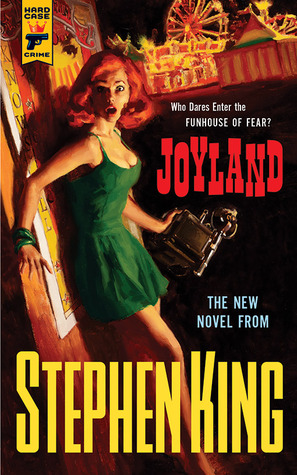
Joyland by Stephen King
Final Verdict: 3.75 out of 4.0
YTD: 43
Plot/Story:
4 – Plot/Story is interesting/believable and impactful.
Stephen King’s Joyland is the latest in his massive repertoire of what I will hereafter describe as “really cool reading stuff.” In this supernatural mystery crime thriller (yep, it is all of that), young Devin Jones, fresh out of his first year of college, heads down the eastern U.S. coastline to take a summer job at an old-fashioned amusement park called, you guessed it, Joyland. While trying to get over “that” girl, the devastatingly beautiful tease who became his first love and who broke his heart for the first time, Devin soon finds himself involved in the very peculiar life of a dying boy, his bombshell mother, and a decades old murder that all of them must somehow solve together, or else. What starts off as a curiosity – a folk legend and a hobby- for Devin and his Joyland friends, soon turns into a terrifying nightmare which will change Devin’s life forever.
Characterization:
3 – Characters well-developed.
One of the areas where I tend to find King lacking is in his character development. His stories and their connection with the reader are always at the forefront, so his characters seem to be there only as means to an end. What King wants for his reader is self-immersion – the stories should be happening to you. He does manage to accomplish this, better than most, but, still, characters are one of my favorite (and, in my opinion, one of the most important) aspects of any good novel, so I do look for their strengths, weaknesses, growth, etc. Joyland is a short novel, without much room for growth, but King does allow his main character, Devin, to experience certain major life events and to learn from them. Most of the minor characters (which includes everyone except Devin) are relatively flat throughout, except for Annie. Her story, along with that of her sick son, Mike, are the very touching secondary support that the primary story needs to make this book just complicated enough – just emotional enough- to touch the reader on a deeper level. Devin’s growth coincides with his relationship with these two, and Annie’s growth, too, happens only because Devin comes into their life. The other friends, park workers, and even the primary antagonist are sidelined for the majority of the story but, in the end, it really doesn’t matter.
Prose/Style:
4 – Excellent prose/style, enhancing the story.
Stephen King obviously knows how to write a story – his prolific body of work, permanent best-seller status, and massive personal wealth (not to mention all those page-to-screen adaptations) can attest to this. Typically, though, something about King’s writing will irk me. I sometimes find it a little bit too pedantic, or a little bit too graphic, or a little bit trying-to-hard-to-be-shocking. This time, though, King seems to be deeply in love with his story, and his writing reflects that. The book is a page-turner, not because it is an edge-of-your-seat suspense thriller or horror novel, like so many of his others. Yes, you do want to find out what happens next, but it is because you are engrossed with Devin’s life. Sure, you realize there are things happening beneath the surface – secrets that are bound to be revealed, soon. But, also, you just want to be a part of Devin’s life. You are happy for him when he finds enjoyment in perhaps the most un-enjoyable job imaginable. You are thrilled when his relationship with Annie starts to progress, and when you learn more about Mike. King’s dialogue is believable, Devin’s awkwardness is believable, and the descriptions of people, places, etc. are interesting enough to engage the reader and drive the plot forward.
Additional Elements: Setting, Symbols/Motifs, Resolution, etc.
4 – Additional elements improve and advance the story.
Joyland is not as scary, nor as suspenseful, nor as gory, nor as crude as I expected it to be. I mean, this is King, after all. Where is the horror? Where are the blatantly graphic sexual episodes? I realize that I always anticipate something from King, and yet he always manages to surprise me. This has happened with every King book I’ve read, from Christine to Gunslinger, from Carrie to “The Body.” Although King sometimes uses the fantastical, the terrifying, and the unbelievable to get his point across, his stories are, at heart, very much about human nature and the human experience. Joyland is no exception; in fact, it might just be King at the peak of his storytelling ability. This book left me with a sense of nostalgia that I haven’t felt since seeing the Spielberg film Super 8 just a few years ago. It reminds one of “the good old days” – where innocence and experience begin to meet, where love has crushed us, but the future still shines bright; where mystery entices us and, despite our better judgment, we dive for it only to find ourselves in over our heads. The book was, really, a delight. It is sad, but hopeful; fantastic, but real; and current, but elegiac.
Suggested Reading for:
Age Level: High School+
Interest: Crime Thriller, Mystery, Supernatural, Coming-of-Age.
Notable Quotes:
“Age looked at youth, and youth’s applause first weakened, then died.”
“The mind defends itself as long as it can.”
“Even when what you’re holding onto is full of thorns, it’s hard to let go.”
“Some people hide their real faces. Sometimes you can tell when they’re wearing masks, but not always.”
“The last good time always comes, and when you see the darkness creeping toward you, you hold on to what was bright and good. You hold on for dear life.”
Review: Divergent by Veronica Roth

.
Divergent by Veronica Roth
Final Verdict: 3.5 out of 4.0
YTD: 41
Plot/Story:
3 – Plot/Story is interesting and believable.
In Chicago, sometime in the (not too distant) future, society has been torn apart by war, and those who remain have separated into factions: Dauntless, The Brave. Those who believe in justice and freedom from fear. Erudite, The Intelligent. Those who believe in peace through education and growth from knowledge. Amity, The Peaceful. Those who believe in kindness, forgiveness, and self-sufficiency. And Abnegation, The Selfless. Those who believe in self-sacrifice, altruism, and love of God and others before one’s self. And then there are The Divergent. The most dangerous of all, these are the ones who seem to belong to all of the factions, and none. Their skill sets are wide, which makes them feared by many.
Upon coming of age, every young adult must choose a faction, usually the one they are born into, but also with guidance from certain tests that take place the day before selection. Those who change factions are often shunned by their families forever, and those who do not make it through their faction’s initiation, become factionless – loners – as good as dead and only cared for by the Abnegation. Sixteen-year-old Beatrice (Tris) Prior is one of the Divergent – a secret she must discover for herself, and then protect from all others, or risk certain death. While training with her faction, she uncovers other secrets, secrets that will tip the balance of power and cause great unrest – even war- among the four factions, unless she and her small group of friends can stop it.
Characterization:
3 – Characters well-developed.
One of the things Divergent has going for it, unlike some of its contemporaries (such as The 5th Wave) is a good deal of substantive character development and relationship-building. Sure, you have the “good guys” and the “bad guys,” but there are also characters who remain somewhat mysterious, with the potential to go either way. Beatrice is a flawed protagonist – a heroine we can root for, but one with realistic faults and challenges, which makes her all the more endearing and relatable. You also get subtle hints, early on and then throughout, that many of the minor characters have back-stories of their own. Some of these are discovered, some remain mysteries (possibly to be explored later in the series?).
In addition to Tris, another interesting character is her mentor and love-interest, Four. He and Tris have much in common, though they (or Tris, at least) cannot be entirely sure of their connection. Their relationship is interesting to watch and adds a decent side-story to the main plot. The minor characters, like Tris’s family, Peter, Drew, Al, Molly, and others from the faction are necessary but not terribly memorable. Even the major antagonist(s), including the leaders of two factions, as well as a mentor in Tris’s faction, serve their purpose, but their backgrounds and motives are not very well explored. Meaningful and/or believable motivation always makes a “bad guy” more interesting, but the explanations, here, seemed more convenient than anything.
Prose/Style:
4 – Excellent prose/style, enhancing the story.
Roth’s style is well-crafted and fast-paced. The interplay of action/violence, romance, and mystery/self-discovery keep the story interesting and allow it to progress with intrigue – a classic bait-and-hook technique which keeps the reader asking “What happens next?” Although Tris’s story was interesting enough to keep the reader engaged, the minor characters and subplots were not as richly crafted. It is unfortunate that some of the glazed-over moments (such as the rising tension between the Erudite and Abnegation factions, witnessed through newspaper/press releases which are read by (or to) Tris) are not treated with as much intricacy and delicacy as the main plot. Developing these subplots further and truly integrating them into the overall story, rather than crafting them in such a way as to leave them sort of floating on top, would have added great depth and richness to the story.
This is a similar failing as is made, in my opinion, by Suzanne Collins in Mockingjay. Whereas The Hunger Games and Catching Fire were rather nuanced, the third book seemed to be a slap-on ending to a series that, ultimately, did not need to be a series. So, too, do the subplots in Divergent sometimes stick out as sore thumbs – there, but not nearly developed enough to care about. That being said, the writing is fluid and gripping; the prose is appropriate to the genre and intended reading level; and the overall experience of reading it is a positive one, which does make one interested in finding out what else Roth can do with Tris, the factions, and the development of this world.
Additional Elements: Setting, Symbols/Motifs, Resolution, etc.
4 – Additional elements are present and enhance the story.
Divergent is one of the first young adult dystopian stories that I have enjoyed in quite some time. Not since Ender’s Game have I been enticed enough by a story to truly want to pursue its sequels. While I have read and enjoyed other recent books/series of this type, such as The Hunger Games, Veronica Roth’s series is a fresh idea, delivered in a clean, entertaining way, and seems to stand out in a genre which has many overlapping elements and borrowed ideas (The Hunger Games, for instance, having been very much a reimagining of Battle Royale, to give one example). All that being said, the idea of the factions and what they stand for; the loathing of “outsiders,” as well as who should care for them (and why); and the fear of those who do not fit into a predefined mold – Roth has taken these very natural, every day challenges and molded them to fit a dystopian world, one which was built on human limitations and which will be threatened by distinctly human evils.
Above all of this, though, is the simple coming-of-age story. The fear and anxiety that we all have, upon reaching adulthood, that we are not quite ready to handle these new responsibilities – that we might make bad decisions which, now that we are in the real world, could have disastrous consequences. We begin to define who we are not in relationship to the family (or faction) we are born into, but the friends and families we choose. This is a simple, age-old theme that dates back to the beginning of storytelling, but in Roth’s hands it feels new and exciting again. Divergent, despite some faults, was a page-turner, and I look forward to reading the rest of the series.
Suggested Reading for:
Age Level: High School+
Interest: Dystopia, YA, SciFi, Coming of Age.
Notable Quotes:
“To live factionless is not just to live in poverty and discomfort; it is to live divorced from society, separated from the most important thing in life: community.”
“Valuing knowledge above all else results in a lust for power, and that leads men into dark and empty place.”
“I believe in ordinary acts of bravery, in the courage that drives one person to stand up for another.”
“Becoming fearless isn’t the point. It’s learning how to control your fear, and how to be free from it, that’s the point.”
“Why do people want to pretend that death is sleep? It isn’t.”
“They try to make you think they care about what you do, but they don’t. They don’t want you to act a certain way. They want you to think a certain way. So you’re easy to understand. So you won’t pose a threat to them.”
 Roof Beam Reader