Roof Beam Reader
Adam Burgess
The Beats of Summer: A Reading Event! (Sign-Up Post)
Welcome to the sign-up post for:
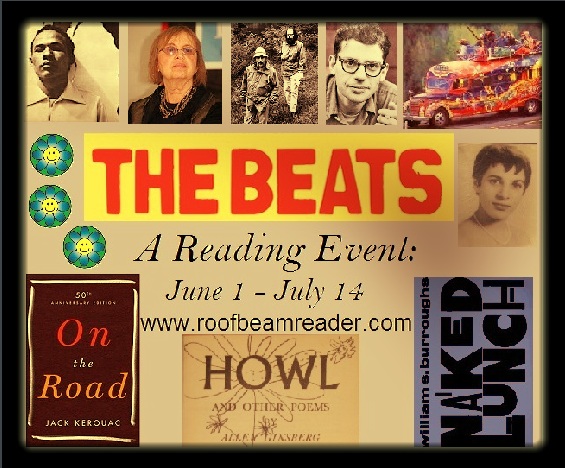 The Beats of Summer: A Reading Event!
Summertime is coming, and what better time than Summer to immerse ourselves in the works of the most rebellious, daring, and “hot” generation of American writers??
For this event, the goal is to read as many pieces of “Beat Generation” literature as you want to, from June 1st through July 14th. Audiobooks, fiction, poetry, and non-fiction all count, as long as the writer is considered to be a part of the Beat Generation. Memoirs, biographies, essays, theory/criticism or other works of non-fiction written about The Beats are also acceptable!
Update: We are looking for volunteers to provide Guest Posts and/or offer Giveaways throughout the event. If you would be interesting in participating in this capacity, please fill out This Form. And Thanks!
What is the Beat Generation?
“In American in the 1950s, a new cultural and literary movement staked its claim on the nation’s consciousness. The Beat Generation was never a large movement in terms of sheer numbers, but in influence and cultural status they were more visible than any other competing aesthetic. The Beat Generation saw runaway capitalism as destructive to the human spirit and antithetical to social equality. In addition to their dissatisfaction with consumer culture, the Beats railed against the stifling prudery of their parents’ generation. The taboos against frank discussions of sexuality were seen as unhealthy and possibly damaging to the psyche. In the world of literature and art, the Beats stood in opposition to the clean, almost antiseptic formalism of the early twentieth century Modernists. They fashioned a literature that was more bold, straightforward, and expressive than anything that had come before.” –The Literature Network
I will post throughout the event to discuss different subjects related to The Beat Generation, its writers, and its influences on later movements in literature, film, and music, as well as my own reviews of the Beat Generation books that I finish. I will also be offering giveaways, and I am hopeful that some participants will be interested in writing guest posts or hosting giveaways of their own, to make this more interactive!
Below is a list of writers and works of The Beat Generation. This list is by no means comprehensive, it is simply a starting point.
Major Writers:
Richard Brautigan
William S. Burroughs
Neal Cassady
Gregory Corso
Diane DiPrima
Lawrence Ferlinghetti
Allen Ginsberg
John Clellon Holmes
Joyce Johnson
Hettie Jones
Jack Kerouac
Joanne Kyger
Gary Snyder
Carl Solomon
Important Works:
Dharma Bums
Gasoline (poetry)
Howl (poetry)
Minor Characters (memoir)
Naked Lunch
On the Road
Queer
The Electric Kool-Aid Acid Test (memoir)
Affiliated Writers/Biographers:
James Campbell (This is the Beat Generation)
Carolyn Cassady (Off the Road)
Ken Kesey (One Flew Over the Cuckoo’s Nest)
Brenda Knight (Women of the Beat Generation)
Matt Theado (The Beats: A Literary Reference)
Tom Wolfe (The Electric Kool-Aid Acid Test)
In the meantime, if you would like to host a giveaway or provide a guest post, please: CLICK HERE.
And if you want to sign-up to participate in The Beats of Summer (yay!), just leave a comment on this post saying YOU’RE IN! Maybe include some of the books you hope to read. I plan to read Sometimes a Great Notion by Ken Kesey, Howl by Allen Ginsberg, and Desolation Angels by Jack Kerouac.
Please also post the button somewhere on your blog (in an announcement post or in your blog’s side-bar) so that we can spread the word, gather excitement, and encourage participation. It goes without saying that this is meant to be a positive, fun, and educational event – it’s an at-will project, so negativity is a no-go!
Sign-ups are open from now through June 15th. If you sign-up after June 15th, you can still absolutely participate, but you may not be eligible for some of the early giveaway prizes.
To Share/Discuss on Twitter, Use Hashatag #BeatsOfSummer
Thoughts: Gods and Monsters by Christopher Bram
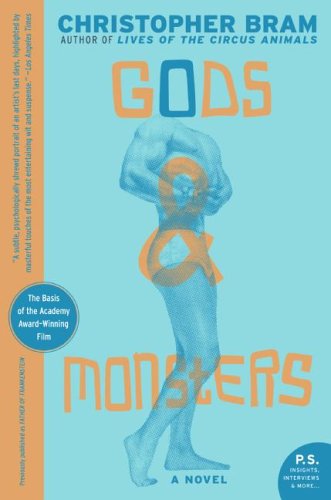 Gods and Monsters by Christopher Bram
Final Verdict: 3.75 out of 4.0
YTD: 34
Plot/Story:
4 – Plot/Story is interesting/believable and impactful (socially, academically, etc.)
Gods and Monsters, originally published under the title Father of Frankenstein is a creative retelling of the life of Hollywood director James Whale, who is responsible for films such as Frankenstein, Bride of Frankenstein, Show Boat, and The Man in the Iron Mask. The story focuses specifically on the last two weeks of Whale’s life, after he has suffered from stroke, but also includes many flashbacks which give the reader insight into Whale’s boyhood in England, his rise to fame and glory in theater and Hollywood, and his sad decline following the studio butchering of what may have been his crowning achievement, The Road Back. Whale was an open homosexual in a time when homosexuality in the industry was both accepted but also ignored. Later in his life, after retiring from Hollywood and after the industry had become much more conservative following the war, Whale separated from his long-time partner and attempted to find himself as a secluded painter. Bram tells his story by introducing a gardener, Clayton Boone, whom Whale admires physically and whom sits for Whale, as a life model. Their unlikely friendship is both sad and touching, one which, perhaps, gives Whale the courage he needs to exit life on his own terms, and which gives Boone the human connection, mentorship, and guidance he had been lacking all his life. Although this relationship is fictional and Clayton Boone, as far as anyone can tell, is a figment of the author’s imagination, still it provides for a gut-wrenching and heartwarming inside-look at Classic Hollywood and the sad realities that touched even its greatest icons.
Characterization:
4– Characters very well-developed.
As one who knows very little about cinema, film studies, or “insider” Hollywood during the 1930s, it is impossible for me to judge how realistic the story and its characters are; however, as a story in itself, with fictional characters (based on real ones), it is at the top of the class. James Whale is a fascinating man – his decision to create a sequel to Frankenstein (the film that became Bride of Frankenstein) was a difficult one for him to come to, as he was not, by nature, a “horror” director. He was, however, gay man in a powerful position and with powerful gay and lesbian friends, all of whom (Whale included) were nonetheless marginalized –tolerated only as long as their private lives and actions were kept quiet. With Bride of Frankenstein, Whale’s personality truly comes through, and Bram does an exception job of showing that personality in Gods and Monsters. Jimmy Whale was charismatic, clever, quick-witted, and extremely playful. Bride was a true subversion, cloaked in a campy horror film. The addition of Clayton Boone, an all-American heterosexual man, allows for the character Whale to be fully flushed by giving someone to oppose him but also by giving him someone to talk to. The other characters, such as Whale’s maid, Maria; and a young film student, Edmund; or his first romantic love interest and other Hollywood contemporaries (David Lewis, Boris Karloff, Colin Clive, Elsa Lanchester, etc.) provide wonderful context, both in the book’s present setting and in flashbacks to Whale’s Hollywood and pre-Hollywood days.
Prose/Style:
3 – Satisfactory Prose/Style, conducive to the Story.
This is the first Christopher Bram novel that I have read, but it will not be the last (The Notorious Dr. August and Lives of the Circus Animals, in particular, look fascinating). He is a wonderful storyteller and his artistic choices are nearly perfect in every instance. The book read almost as if it was intended for the screen, which would be appropriate considering the book is about the director of one of Hollywood’s most iconic films of all-time. Bram’s language and prose are almost spellbinding – complicated enough to match the intricate and emotional plot, and distinct enough to raise the text above that of standard popular fiction. His choices in point of view, alternating chapters from Whale to Boone, to flashbacks or intermediaries (such as present third-person), allows the story much more depth and opportunity than it would have had, were it to be told from any one person’s narrative perspective. There were some moments, particularly with Boone, that seemed a bit weaker, and there were a few proofing errors (very few and very minor) which should have been cleaned up, particularly considering this edition was in its third printing; but these were small flaws to an otherwise gripping narrative.
Additional Elements: Setting, Symbols/Motifs, Resolution, etc.
4 – Additional elements improve and advance the story.
Few stories match the power of a dying man’s and even fewer can match the poignancy of a story-teller’s final production. Gods and Monsters is about a man, at the end of his days, experiencing life all over again. Whale, notorious for embellishing his past, is given, in this fictionalized account, the opportunity to come to terms with who he truly is and with where he really came from – including the lovers he had and lost along the way, the successes and failures that made and broke his career, and the friends and monsters he surrounded himself with, throughout it all. How many of us bury the more painful parts of our own histories? How many of us ignore what we can’t or won’t acknowledge? Gods and Monsters is much more than a story about a Hollywood director, though much of its fascination is absolutely in imagining what Whale’s life in 1930s Hollywood would have been like; still, the true tale is of life and death – of honesty and illusion. The friendship between an old “fairy” and a young, “man’s man” is strained, confusing, uncomfortable, kind of horrible, but incredibly beautiful. Bram gives us a glimpse of what the reality of Hollywood, if there is such a thing, might be like – but he also drives home the point that we are all directors of our own lives, making editing choices and casting decisions which, in the end, might come back to haunt us.
Suggested Reading for:
Age Level: 16+
Interest: Film History, Classic Hollywood, Fictional Biography, Gay Fiction, Friendship, Death and Dying.
Notable Quotes:
“Imitation is a form of understanding” (11).
“Sex is as bad as drink for the way it consumes energy . . . it squanders the passion he needs to climb out of the common life into the greater world” (24).
“It hangs on him like a suit of clothes he’s too thin to wear anymore. The truth stands closer to him now, peering over his shoulder” (33).
“He wants to burn his soul clean by being part of something terrible and real, an intense experience that would prove he’d been somewhere” (128).
“We should never let the opinions of others stand between us and what we want” (188).
Gods and Monsters is Book #9 completed for my 2013 TBR Pile Challenge
Thoughts: Shine by Lauren Myracle
 Shine by Lauren Myracle
Final Verdict: 3.5 out of 4.0
YTD: 31
Plot/Story:
4 – Plot/Story is interesting/believable and impactful (socially, academically, etc.)
Cat and Patrick are best of friends. Cat is a tomboy who doesn’t mind getting a bit dirty and who doesn’t realize just how pretty she is. Patrick is a bit of a nerd and an introvert, though he does have friends. He’s also openly gay, which is brave considering he and Cat live in very rural North Carolina. As Cat becomes a teenager, she learns, in a terrible way, just how much her body has changed and how she has begun to catch the eye of boys her age (and older). Although the disturbing thing that happens to her is only alluded to during the first part of the story, it clearly affects her relationship with her family and with her friends – she, too, becomes introverted and, because of this, is not with her best friend Patrick when the book’s major tragedy strikes. She blames herself for not being there to help and, on her quest to find out what happened and to bring the criminal to justice, she also begins to repair herself and her old friendships, and even to seek out new ones.
Characterization:
3 – Characters well-developed.
Although some of the characters, such as Jason, a friend of Patrick’s who, like Cat, is determined to find out what happened to him, seem a bit too conveniently placed to be believable, most of them are integral to the plot, work well with the story, and fit in with the particular group of people in this particular place that Myracle has created. Mama Sweetie, Patrick’s grandmother, leaves a legacy for Patrick and Cat even after she is gone; Cat’s father, brother, and aunt, all play pivotal roles in developing her character and her response to Patrick’s tragedy; her friends (The Redneck Posse) are realistic in their actions, good and bad, and in the ways they treat one another, as well as any outsiders. They are complex enough, too, to add further mystery to the plot and to complicate Cat’s investigation, not to mention her own attempt at reintegrating herself with the group. The minor characters, such as the church ladies, the meth cooker, and the bar tender, are static (some might say cliché), but they do round-out the community environment and serve their purposes.
Prose/Style:
3 – Satisfactory Prose/Style, conducive to the Story.
For the most part, I found Myracle’s prose to be perfectly suited to the reading level and the tone of the novel. She clearly knows a great deal about this particular region (or areas like it) or has researched it enough to portray it in a realistic way. That being said, the dialogue (and internal monologues) sometimes came across as less than natural. Still, it was well-written and well-executed. Allowing Cat to be the narrator post-incident, and to reflect on those incidents (her major pain as well as Patrick’s) while she was investigating what happened, was a great approach, as it allowed the protagonist to grow and mature in a recognizable way. Seeing Cat as a child, through her own memory, and watching her come to terms with difficult things in her life, particularly when she begins to understand the reasons why some of the people in her life may have let her down, provides much of the power and depth of the story, so crafting the plot this way and then delivering it so that it unfolds naturally and slowly was a smart, creative choice.
Additional Elements: Setting, Symbols/Motifs, Resolution, etc.
4 – Additional elements improve and advance the story.
Cat, though the hero and protagonist of this book, also has her own demons to deal with and personality flaws to overcome. Part of what makes this story such a good one is that it is not just about one mysterious hate crime or one person’s attempt to solve it. Cat learns a lot about herself along the way – she is forced to admit to herself that even she was sometimes guilty of silent acquiescence, allowing others to bully her friend Patrick because she was afraid that, if she stood up for him, she might become the target. Similarly, Beef’s story is also moving and doubly complex because of the two major secrets he carries. This story isn’t just about friendship or a rural town’s bigotry; it’s not just about the rich versus the poor; it’s not about underground drug cartels or incompetent police forces. It’s about a community steeped in tragedy, a community that is all of those things and more, all at the same time, and about a group of people who are trying to live as best they can when faced with obstacles great and small.
Suggested Reading for:
Age Level: Young Adult (13+, with some mature elements)
Interest: Coming-of-Age; Friendship; Homophobia; Rural South; Identity Issues; Family; Poverty; LGBT; Mystery; Drugs; YA.
Notable Quotes:
“I loved everyone who said yes to the world and tried to make it better instead of worse, because so much in the world was ugly.”
“Knowledge was more powerful than fear. Love was stronger than hate.”
“Girls kept their bodies tucked in tight, while boys took up every inch of room they could.”
“We all mess up. It’s what we learn from our mistakes that matters.”
“You know it’s them books what make you talk funny.”
Blog Post: On Horrors and Heroes

“Grief remains one of the few things that has the power to silence us. It is a whisper in the world and a clamor within. Grief is unspoken, publicly ignored except for those moments at the funeral that are over too quickly, or the conversations among the cognoscenti, those of us who recognize in one another a kindred chasm deep in the center of who we are.” -Anna Quindlen
When I find myself overwhelmed by the weight of terrible tragedies, I often seek out a quiet place where I can sit, and mourn, and reflect. Sometimes that quiet space provides all the peace I need to recover from the sadness and to move on with the day.
But this morning, sitting in my car, I realized that the tragedies of Boston and West, Texas, so quick on the heels of the terror at Sandy Hook and all too soon since 9/11 and Oklahoma City before it, have besieged my heart and mind with a profound sorrow that is impossible to shake in silence.
It is natural to become depressed and fearful, in times like this. It is easy to look at the world as a desolate place and to look at humanity as beyond repair when we have suffered through horror after inexplicable horror. Yet, I am reminded that each single act of terror and every uncontrollable tragedy, throughout our history, has been met head-on by heroes immeasurable – by countless numbers of people who band together to help the injured, to console the grieving, and to rebuild shattered lives, homes, and communities.
Terror, hatred, and fear have always been a reality, but they have never been the answer. Terror, hatred, and fear will always fail, because, despite all of our political, religious, and cultural differences, people still believe in each other, still care for one another, and continue to show it in the most extraordinary ways and in the most terrible of times.
When a small group of people, motivated by hatred and fear, attacked the Twin Towers in an attempt to terrorize a nation, and when their attempt was met by hundreds of men and women who ran into the burning buildings – ran into the fires – to save others: Courage has won.
When a marathon was shattered by bomb blasts in an incomprehensible act of madness, and when spectators were quick to cover others’ wounds or hold the injured in their arms until help arrived; and when those exhausted legs, having already run 26 miles, got up and ran another 3 miles to the nearest hospital to donate blood: Compassion has won.
When a deranged gunman enters a University lecture hall or a crowded movie theater and starts firing at random, and when parents dive onto their children and boyfriends shield their girlfriends – when one willingly surrenders herself so that another might live: Love has won.
When a bus monitor, whose life work is ensuring the safety of school children, is viciously taunted and abused by those same children, and when the country and the world rally around her, donating enough money for her to retire – and when that very same bus monitor takes the money and donates it to charities in need, rather than spending it on herself: Goodness – so much goodness – has won.
So, when I think about the world and all its horrors, I find the question “Why?” is the first that comes to mind. Why do bad things happen to good people? Why would someone go to such lengths to injure or kill innocent people? Why do they hate us? Why couldn’t we stop it?
But the “Why” questions will be forever unanswerable. It is the “What Now?” that we need to remember. Maybe we can’t stop all of these tragedies and all of these madmen, and maybe we’ll never understand their motives. But we can control how we respond – we can look to our neighbors, our friends, our family, and even to perfect strangers, in times of great trauma, and say: “I am with you.”
We can remember that for every tragedy or unspeakable act, dozens, hundreds, thousands, of extraordinary people will rise up as one to remind the rest of the world of everything that is good and great in it, to remind us of all the reasons why there is still hope for a better tomorrow.
In my work as a student and an educator, “Why?” is always of great consequence. But in my life, “What’s Next?” “What Now?” and “What Can I Do for You?” will be the most important questions.
 Roof Beam Reader