Roof Beam Reader
Adam Burgess
Thoughts: Mansfield Park by Jane Austen

 Mansfield Park by Jane Austen
Final Verdict: 3.75 out of 4.0
YTD: 10
Jane Austen is perched on a curious point in the literary timeline, caught somewhat between the eighteenth and nineteenth centuries, both of which influenced her work. She greatly admires Samuel Johnson (as demonstrated by the many Johnson quotes & references that can be found in her various works), and many, if not most, of her works are about a woman attempting to –or somehow finding herself- climbing the social ladder, out of her station and, through marriage, into a higher one. This is largely an influence of eighteenth century works, such as Pamela. Still, there is much of Romanticism and the nineteenth century in her works, as in their preference for intelligence and natural beauty over traditional wealth and caste systems. Austen’s work also dips into the Victorian concerns of sensational-realism, which is where Mansfield Park and its Pragmatism are mostly situated. In its exploration of modernity, shifting family dynamics, city and suburban lifestyles supplanting the country manors, parties, and public scandals, and politics (such as the Slave Trade and aristocratic corruption), Mansfield Park is much wider-reaching and more concerned with society and the world-at-large than her earlier works (whose simplicity and blind-eye caused her to be much maligned).
At the center of the story is Fanny Price, who leaves her parents’ home to live with her aunt and uncle at Mansfield Park. Fanny’s mother, though once beautiful, has been run ragged. She married beneath her and, soon after her marriage, her husband became permanently disabled and a drunk. Fanny, at first, is a black sheep at Mansfield. Although she is kind and mild in temperament, her female cousins tease her mercilessly and her ridiculous Aunt Norris spites her at every occasion. Eventually, through natural charm and beauty, Fanny does manage to win over her hosts, Sir Bertram and Lady Bertram (who is her mother’s sister) and also her cousin, the youngest brother of the family, Edmund.
Unlike Austen’s other works, which are largely episodic (likely because they were originally written or imagined in epistolary form), the style and structure of Mansfield Park is much more aligned with the traditional novel, with lengthy chapters and regular progression of time. Austen manipulates time and chronology in clever and subtle ways, so that the reader is navigated through the story without being given many direct reminders of where she is in the calendar. This is something typically Austen and can be seen in her other novels, particularly Pride and Prejudice; and though a simple thing, this control of time and keeping it both relevant and in the background truly helps hold the story together by maintaining the fictive illusion and also the structural integrity of the work.
In Mansfield Park there are balls and plays, flirtations and scandals. While most of Austen’s novels are rather complex, Mansfield Park is perhaps the most complex of all her work and is probably an inspiration for later Victorian novels (many of which are concerned with child orphans, their patronage and rise from nothingness into seemingly-unachievable stations). Fanny, like other Austen heroines, is a young woman on the verge of adulthood and who will find her place through her soon-to-be husband. Unlike other of Austen’s novels, though, which are primarily interested in the act of courtship, family, and love, Mansfield Park also tackles ideas of nature vs. nurture (what makes a person who they are?) and true positive qualities, in family and friends (both Edmund and his father, Lord Bertram, learn much about themselves and about others, by the end of the story – because of their growing appreciation for and admiration of the quiet but naturally classy Fanny). The book is also interested in the nature of vice and it uses two polar locales, the city and the country, as backdrops for “bad” and “good.” Surprising, for readers of Austen’s other works in particular, are the inclusions, though subtle, of sexuality (what we will eventually see from Freudian symbolism), of social and political morality, and of graphic poverty.
Ultimately, I found Mansfield Park to be one of the least exciting, most dense of Austen’s novels; however, it is also the most complex, the most daring, and the most revolutionary of her works. She takes many risks, borne out of disillusionment and hardship, which would likely inspire the next generation of Victorian novelists who would champion the lower classes and write for social justice. It was a difficult read, being slow-paced and simultaneously familiar to and wildly different from other Austen works, but while it may not be as perfectly constructed, entertaining, or accessible as her most popular work, Pride and Prejudice, it might just be her most important.
Suggested Reading for:
Age Level: High School +
Interest: Pre-Victorian Novel, Nature vs. Nurture, City vs. Rural, Caste System, Scandal, Slave Trade, Pragmatism, Romanticism.
Notable Quotes:
“I think it ought not to be set down as certain, that a man must be acceptable to every woman he may happen to like himself.”
“We do not look in great cities for our best morality.”
“Good-humoured, unaffected girls, will not do for a man who has been used to sensible women. They are two distinct orders of being.”
“Life seems but a quick succession of busy nothings.”
“She was not often invited to join in the conversation of the others, nor did she desire it. Her own thoughts and reflections were habitually her best companions.”
“I was so anxious to do what is right that I forgot to do what is right.”
“Let other pens dwell on guilt and misery. I quit such odious subjects as soon as I can, impatient to restore everybody not greatly in fault themselves to tolerable comfort, and to have done with all the rest.”
“Varnish and gilding hide many stains.”
“When I am out of doors, especially when I am sitting out of doors, I am very apt to get into this sort of wandering strain. One cannot fix one’s eyes on the commonest natural production without finding food for a rambling fancy.”
“A Modern March” Reading Event

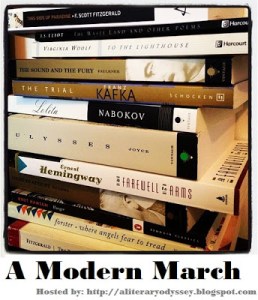 I’ve been waiting for this! Allie (A Literary Odyssey) is hosting a Modernist Literature event this March, and I’ve been saving two books specifically for it. Now, the announcement post is up and I can officially “plan” my reading. I will absolutely get through these two texts, but hopefully I’ll manage to get through one or two extra. Spring Break is in March, but I have papers and presentations due for class that month, too, so who knows?
Important Note: This is for Modernist Literature / Literature of the Modernist Period. It is not for contemporary fiction, what some might call “modern” or “current.”
ANYHOO! The books I plan to read are:
A Room of One’s Own by Virginia Woolf
Miss Lonelyhearts by Nathanael West
If I have time, I might also tried to read some poetry, perhaps The Waste Land by T.S. Eliot.
Allie says of Modernism:
If you have no idea what constitutes a piece of “Modern” literature (and whenever I say Modern, I don’t mean contemporary lit), it generally refers to literature written between the very late 19th century and the halfway point of the 20th century. In general, Modernist writers experimented with style, form, and theme. They broke away from the traditional viewpoints found in literature until that point and strove to focus on the darker and more unpleasant sides of life. This is also the time period where stream-of-consciousness made its roaring appearance.
I would also add, some things to look for are the lack of religion in these works (conspicuous, given the fact that much of the literature in periods before Modernism were rife with religion & religious morality) and also the fascination with “the new.”
Thanks to Allie for hosting – I’m ready to go!
Brief Thoughts: 3 Texts on Literary Theory
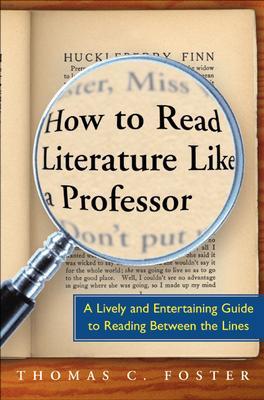
 How to Read Literature like a Professor by Thomas C. Foster
YTD: 07
Goodreads Summary:
What does it mean when a fictional hero takes a journey? Shares a meal? Gets drenched in a sudden rain shower? Often, there is much more going on in a novel or poem than is readily visible on the surface — a symbol, maybe, that remains elusive, or an unexpected twist on a character — and there’s that sneaking suspicion that the deeper meaning of a literary text keeps escaping you.
In this practical and amusing guide to literature, Thomas C. Foster shows how easy and gratifying it is to unlock those hidden truths, and to discover a world where a road leads to a quest; a shared meal may signify a communion; and rain, whether cleansing or destructive, is never just rain. Ranging from major themes to literary models, narrative devices, and form, How to Read Literature Like a Professor is the perfect companion for making your reading experience more enriching, satisfying, and fun.
My Thoughts:
Lots of helpful tips, useful references, and practical advice. It’s certainly not critical theory, but that shouldn’t be what one expects going into this text. It’s a “literature made easy” type of guide, but it’s good for what it is. Easy to read & added plenty of texts to my “to read” list. For English majors early in their programs or for casual/recreational readers who would like to get more from their reading experience, this book could offer some valuable tips. It also added quite a few titles to my wish list!
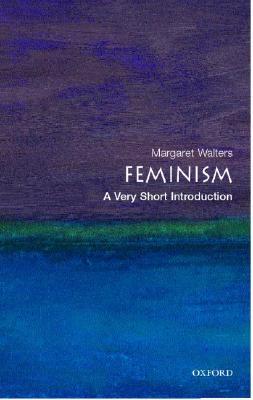 Feminism: A Very Short Introduction by Margaret Walters
YTD: 08
Goodreads Summary:
“This is a historical account of feminism that looks at the roots of feminism, voting rights, and the liberation of the sixties, and analyzes the current situation of women across Europe, in the United States, and elsewhere in the world, particularly the Third World countries. Walters examines the difficulties and inequities that women still face, more than forty years after the “new wave” of 1960s feminism–difficulties, particularly, in combining domesticity, motherhood and work outside the home. How much have women’s lives really changed? In the West, women still come up against the “glass ceiling” at work, with most earning considerably less than their male counterparts. What are we to make of the now commonplace insistence that feminism deprives men of their rights and dignities? And how does one tackle the issue of female emancipation in different cultural and economic environments–in, for example, Islam, Hinduism, the Middle East, Africa, and the Indian sub-continent?”
My Thoughts:
“I myself have never been able to find out precisely what feminism is. I only know that people call me a feminist whenever I express sentiments that differentiate me from a doormat or a prostitute.” This quote by Rebecca West seems to sum up the history and mentality of Feminism; that is, by virtue of defining it, one practically undermines it. Labels are almost exclusively heteronormative and patriarchal, so to use them is to counter the work of feminist thought. All-in-all, I find the Oxford “Very Short Introductions” extremely helpful, useful, and accessible. Feminism was no exception. Walters outlines the history of feminist thought from the 11th Century and up to modern-day. The major theorists, such as Judith Butler and Mary Wollstonecraft, are given ample attention, as are more obscure writers and historical figures. Walters also includes many of the opposing forces as well as the “in-fighting” between different branches of feminism, all of which helps one to understand the larger theory and its place in time, history, and relation to other schools of thought. Highly recommended for those interested in literary and or feminist theory.
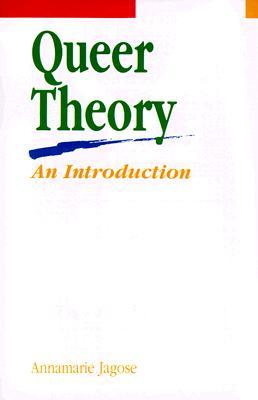 Queer Theory: An Introduction by Annamarie Jagose
YTD: 09
Goodreads Summary:
In Queer Theory: An Introduction, Annamarie Jagose provides a clear and concise explanation of queer theory, tracing it as part of an intriguing history of same-sex love over the last century, from mid-century homophile movements to gay liberation, the women’s movement and lesbian feminism, to the re-appropriation of the term “queer.” Carefully interrogating the arguments of supporters and opponents of queer theory, Jagose suggests that its strength lies in its questioning of the very idea of sexual identities. Blending insights from prominent queer theorists such as Judith Butler and David Halperin, Jagose argues that queer theory’s challenge is to create new ways of thinking, not only about fixed sexual identities such as heterosexual and homosexual, but also about other supposedly essential notions such as “sexuality” and “gender” and even “man” and “woman.”
My Thoughts:
Plenty of useful information and great discussion of various arguments surrounding gay/lesbian studies, feminism, gender, and identity – but the text seemed to be much more about those elements than about Queer Theory, specifically. Granted, there’s a history leading up to Queer Theory & the fact that Queer Theory is ever-changing (by virtue of its being “queer” and therefore resistant to definition, a characteristic it shares with feminism) would make it hard to write an “About Me” book on Queer Theory. Still, I was slightly troubled by the overwhelming amount of time spent on discussing lesbian(ism) and their perpetual outsider status (outside feminism, outside queer theory, outside heteronormativity, etc.), especially the arguments which made homosexual (or gay, or queer, depending on whom is identifying as what) men the greatest “enemy” to the lesbian woman. Those arguments were not the author’s (Jagose) but there was much attention paid to them by her. And I realize I’ve littered this response with pronouns and descriptors galore, which means I’m an enemy of the queer and the feminist schools, for sure.
Thoughts: The Gunslinger by Stephen King
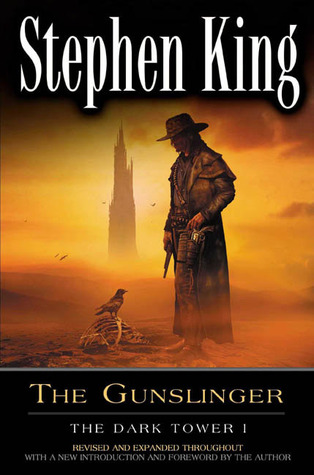

The Gunslinger by Stephen King
Final Verdict: 3.5 out of 4.0
YTD: 6
The Gunslinger is Book 1 in Stephen King’s self-proclaimed magnum opus, the Dark Tower series. King was heavily influenced by Tolkien’s epic fantasy, The Lord of the Rings but, though he had the early inklings of this story when he was very young, he waited decades to write it because he wanted to make sure it was his own story, and no one else’s. Although this is just book one of seven, I can already say with some confidence that he has succeeded; this is certainly going to be an epic fantasy series, but one which is uniquely Stephen King (which means, utterly different from fantasy series’ most of us would think of, when we think of the genre as a whole). In this book, we meet Roland Deschain, the protagonist and last Gunslinger – a highly trained part-assassin, part-demigod. Roland is tracking a powerful and dangerous adversary, the “man in black” (who readers of King will recognize as the face of evil in certain other books). He is also searching for the Dark Tower, the image of which comes to him in his dreams and hallucinations – he knows it is a source of ancient power, but he does not know what he will find there, who built it, who lives there, or what will happen to him when he finds it.
At its core, The Gunslinger is a quest novel with fantasy elements, inspired by Lord of the Rings, sure, but also by Le Morte D’Arthur and the original quest tales. Roland must overcome obstacles and slay dragons (metaphorically) in his chase to reach the tower. The reader will also see that the landscape, resembling earth but a different one, perhaps out of time or of another dimension, plays a large part in the fantasy and, likely, in the magical abilities that some of these characters have.
Roland’s character is interesting and though an unlikely hero, King’s ability at constructing background stories and introducing flashbacks at critical points in the narrative definitely helps the reader empathize with him. Although I was highly troubled by one of Roland’s decisions near the end of the book (we are expecting it – but still hoping that there might be another way), the earlier exploration into Roland’s background and the later ten-year hallucination he experiences in the desert helps us understand why he did what he did.
The language, prose, and structure are all classic King. He is crude, raw, and fluid. The pages turn because the story is fast-paced and formulaic – short chapters introducing major and minor characters in various episodes which advance the plot. Of course, it is all device, but it works and King is a master of it.
This first book in the series explores, as later books likely will, the nature of good and evil and how people are largely capable of both the good and the bad and although there may be some pure good and some pure evil, most are found along a spectrum of sorts. It also comments on modernity, religious fanaticism, alcoholism, power, and sacrifice. It is an enjoyable, interesting, and sometimes uncomfortable read – a good introduction to what will likely be a great series. I am excited to read the rest.
Suggested Reading for:
Age Level: High School+
Interest: Epic Fantasy, Quest Narratives, Good/Evil, Holy Grail.
Notable Quotes:
“The mystery of the universe is not time but size.”
“Few if any seemed to have grasped the Principle of Reality; new knowledge leads always to yet more awesome mysteries. Greater physiological knowledge of the brain makes the existence of the soul less possible yet more probable by the nature of the search.”
“Do any men grow up, or do they only come of age?”
“They had discovered one could grow as hungry for light as for food.”
“Was there ever a trap to match the trap of love?”
The Gunslinger is Book 4 for my 2013 TBR Pile Challenge.
TBR Pile Checkpoint #1: January Progress!

Hello, TBR Pile Challengers!
It is January 15th (or not, depending on when you’re reading this) and we have hit Checkpoint #1 for the 2013 TBR Pile Challenge! I know many of you have been making fantastic progress through your challenge lists already – so congratulations to you!
I have currently read 4 of my required 12 books, which is actually quite shocking. There will probably be quite a lull in my challenge reading, now that classes for the Spring semester have started, but I’m definitely glad to have gotten a jump-start (technically, I guess you could say I’m 3 months ahead of schedule!). I’ve only written 3 of the 4 reviews, so far, so the review for Book 4 will be linked-up to our February check-in.
Book #1: O Pioneers! by Willa Cather
Book #2: The Alchemyst by Michael Scott
Book #3: Orlando by Virginia Woolf
Book #4: The Gunslinger by Stephen King
How are YOU all doing? How many books have you completed? I know we’re just 2 weeks into the challenge, but do you have any favorites, yet? Any books on your list that you’re really excited to read? Any that you’re dreading?
Below, you’re going to find the infamous Mr. Linky widget. IF you have completed any reviews for books on your challenge list, please feel free to link them up here so that we can easily find your posts, encourage one another, see what progress is being made on all these piles, etc. Also, feel free to link-up to your own checkpoint post, should you decide to write one (not required – but feel free to do so, if you want!)
There’s no giveaway for this month, since we’ve just begun, but here’s a big hint: Any challenge books that you read and review between this checkpoint and the next one (February 15th), and which you link up on next month’s widget, will count as entries toward…. something. 😉
So, onward! Keep up the great work, best of luck to you in the coming months.
Oh, and congratulations again to our 2012 TBR Pile Challenge winner, Jenny of Jenny and Kelly Read Books! Jenny received a $50 gift certificate to Amazon.com.
Happy Reading!
LINK UP YOUR REVIEWS JAN 1 – JAN 20
(Please wait until February to link-up posts written after Jan. 20)
 Roof Beam Reader