Roof Beam Reader
Adam Burgess
Review: Play It as It Lays by Joan Didion

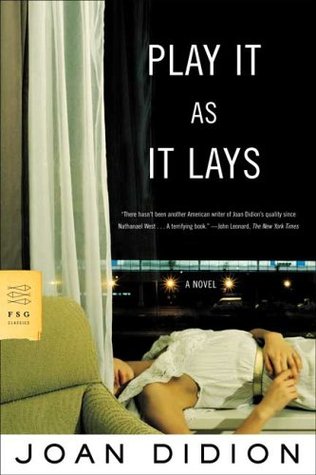 Play It as It Lays by Joan Didion
Final Verdict: 3.5 out of 4.0
YTD: 43
Plot/Story:
3 – Plot/Story is interesting & believable.
Joan Didion’s Play It as It Lays is included in Time magazine’s “100 Best English-Language Novels from 1923 to 2005.” The protagonist (although, from here out I may call her simply “main character,” as protagonist implies a positive agency of some sort) is Maria Wyeth, a disillusioned, mentally troubled, emotionally scarred 31-year-old woman. The story begins at the end, with Maria writing down episodes from her life in an attempt to reconcile certain events and to heal, mentally and emotionally (think Catcher in the Rye). The crux of the story seems to be Maria’s lack of purpose in life, coupled with the loss of her daughter (who is alive but who has been institutionalized, something Maria likens to a type of imprisonment). The primary conflict is Maria’s desire to reconnect her daughter, to bring her home and take care of her, but it is usually clear that, even if Maria were to gain custody of her daughter again, there’s no way she would be in a condition to care for her, or for anybody. The story’s resolution can be read in two ways, either as hopeful or as perpetually doomed – arguments for both readings can absolutely be made (and this is, perhaps, an Americanized complexity –or playful approach- to the French Existentialist problem).
Characterization:
3 – Characters well-developed.
Most of the narrative time is spent with Maria, which makes sense as she is writing a journal of sorts, remembering certain events from her own life. She comes across as submissive, physically and sexually, to strong male characters; but, the irony is that she truly admires strong females, such as a powerful Italian woman she reads about in a magazine, and also the resolute character she herself plays in a minor movie. All of the other characters are minor ones which serve the novels larger purpose, which is to expose a type of American existentialism, wherein all meaning and purpose in life has been lost (or the meaning of life, which is that there is no meaning, has been discovered). The thing to take away from these characters is the sense of resignation to a disappointing fate – a theme present in other “Hollywood” novels, such as West’s Day of the Locust and Fonte’s Ask the Dust. There is a clear commentary on Hollywood culture (fake, detached, sad, and superficial) and also on the realization that the great west, the final frontier, is gone, leaving nothing left to be discovered, no hope to cultivate, and no dreams to believe in.
Prose/Style:
4 – Extraordinary Prose/Style, conducive to the Story.
Most of the novel is made-up of short, episodic chapters of stringently controlled third-person narration which is strengthened by rather visual and biting prose. Near the end of the novel, the third-person chapters are interrupted by very short first-person reflections, inner-monologue of a sort, which represent Maria’s emotional awakening and new (or relearned) consciousness. Maria Wyeth is, for most of the book, emotionally disconnected and sees things in simplistic ways. This suits Didion’s style, one which is clearly inspired by Hemingway (Didion’s literary hero), Fitzgerald, and other American modernists, particularly those of the ex-patriot Lost Generation. The reductive, sparse prose is striking and powerful, particularly in the most intense moments, such as the description of Maria’s abortion and the suicide of Maria’s friend. These types of scenes would traditionally be either inferred, but not described, or described in detail (with or without metaphor – but in a highly descriptive way). Didion lays them out in a bare, straightforward way, which make them all the more real and terrifying.
Additional Elements: Setting, Symbols/Motifs, Resolution, etc.
4 – Additional elements are present and enhance the Story.
For such a sparse novel, it is absolutely littered with meaningful symbols and motifs. The most obvious and recurrent of these is probably the rattlesnake. As would be expected, they’re typically present in times of danger, but they also represent the male dominance, mimicked in Maria’s relationship with all men in this book (men who are ultimately responsible for the destruction of female relationships and the separation of mothers and daughters). There is also the symbol of the Hummingbird, which might represent Maria’s re-awakening to “real” life and emotions. There are many times throughout the book where people, Maria and others, feel suffocated by “fake” items, such as an artificial lemon (which someone almost eats) and plastic plants, which Maria believes suck away the oxygen, rather than giving off oxygen as actual plants would. This is clearly another indication of the suffocating non-reality of Hollywood life, where everything is a copy of a copy of… etc. There is also the motif of the freeway/roadways and Maria’s attempt to find meaning and direction by driving aimlessly which, in true existential fashion, does not work. Games, gambling, and “playing” work in the same way that plastic copies of living things do, in that they are moments which pretend to be meaningful real life events, but which are actually avoidances. Other things to look for are the presence and meaning of dreams, the nature of madness, and Maria’s obsession with whiteness and cleanliness.
Suggested Reading for:
Age Level: 16+
Interest: American Existentialism, Modernism, Hollywood, Abortion, Sexuality, Gender Dynamics, Cultural Studies.
Notable Quotes:
“What makes Iago evil? Some people ask. I never ask.”
“I am not much engaged by the problems of what you might call our day but I am burdened by the particular, the mad person who writes me a letter. It is no longer necessary for them even to write me. I know when someone is thinking of me. I learn to deal with this.”
“By the end of the week she was thinking constantly about where her body stopped and the air began about the exact point in space and time that was the difference between Maria and other.”
“One thing in my defense, not that it matters: I know something Carter never knew, or Helene, or maybe you. I know what “nothing” means, and keep on playing.”
Review: The Good Soldier by Ford Madox Ford

 The Good Soldier by Ford Madox Ford
Final Verdict: 3.5 out of 4.0
YTD: 42
Plot/Story:
3 – Plot/Story is interesting and believable.
The Good Soldier: A Tale of Passion is considered to be (by its narrator) “the saddest story” ever told. The implication is that it is sad because of what happens to the narrator, or because he missed (and misunderstood) so many important things in his own life – events, situations, etc. which were hidden from him and which, had he known about, may have changed his life for the better, even though these things were not-so-great things. This isn’t the real reason why it’s the saddest story, though. It’s sad – so sad – because, well, I’ll let other readers figure that out (it’s NOT because people die). The story’s “good soldier” is Edward Ashburnham, who might be a decent soldier, but is a rather terrible person and a very terrible husband and friend. The story revolves around two adulterous events and how those events eventually impact John Dowell (the narrator), who only learns about them much later – he must go back and reconstruct events, out of sequence, to find out what he never knew he knew, all along. The title is sarcastic (it was changed after World War I from “The Saddest Story” due to the possibility that the original title might have seemed insensitive or pandering, considering recent events), the story is depressing, and the delivery is groundbreaking.
Characterization:
3 – Characters well-developed.
Nothing in this book is as it originally appears, and this includes the characters. This is also the point. John Dowell is looking back on the events of his life, looking back on his friendship with Edward Ashburnham and his wife, Leonora, in particular, and trying to figure out what the heck happened. John and his wife, Florence, plus the two Ashburnhams were all such good friends! Except, they really weren’t. The story that unfolds is John trying to figure out who exactly these people were, why and how they deceived him, and what it meant for his life – for the time he ultimately wasted on them all. There’s also a tricky little twist wherein John would lead us to believe these four characters are the main four – but guess what? They’re not! There’s a mystery fourth who is mentioned modestly throughout the first half of the book and then shows up in the latter half to become largely important to Dowell (and to eventually sort of explain why this is such a sad story). We get plenty of characteristics about each of the characters, but all through John Dowell’s eyes, and it’s not long before you realize that you can’t exactly trust anything Dowell is saying – not because he’s a liar. He’s not necessarily “untrustworthy,” but he is absolutely unreliable. If he doesn’t ever know what’s going on, how can we expect him to tell us? Still, the Ashburnhams, Florence, young Nancy, and the few minor characters who show up (Edward’s lovers, Florence’s lovers, family members of the “main four,” etc.), are clearly who they are – distinct personalities, but all subjected to the delusional gaze of a bizarre narrator.
Prose/Style:
4 – Extraordinary Prose/Style, enhancing the Story.
This was my first experience with Ford Madox Ford, and the first impression about his style amounts to two reactions: 1) What. The. What?! and 2) Brilliant! Ford was clearly a precursor to (or co-conspirator with?) Joseph Conrad, in terms of style and structure. These two, together, created what is perhaps, now, one of the most important characteristics of modernist narratives (think The Great Gatsby), by which I mean: The Unreliable Narrator. Conrad and Ford collaborated on some projects early in their careers and they certainly continued to work together and likely worked for each other, bouncing philosophies and theories off one another. This is maybe one of the most underappreciated literary relationships. Did Ford and Conrad like each other? Probably not. Did they respect each other? I think so. Did they become better writers because of the works of the other writer? Absolutely! All of this shows up in the work of The Good Soldier, which comes to be about fifteen years after the two first collaborated in 1897. The book is almost a cut-up style narrative, except not quite. Ford employs a narrator who speaks to the reader as if they’re sitting by the fire together, telling tales. True to this fashion, the narrator will drop bits and pieces of his story, only to then go off on tangents and come back again, sometimes much later, to the main point – which he had distracted himself from. He will come to “realize” things as the story unfolds, discovering meaning as he thinks about things that have already happened. The narration is happening in the present, but the narrative is in the past. The narrator is entirely unreliable in many ways, and yet he pays particularly close attention to time, making sure the reader can determine exactly when certain things took place (Why? In an attempt to reaffirm his reliability and lucidity?). It’s strange, frustrating, annoying, maddening! But it is also shockingly innovative.
Additional Elements: Setting, Symbols/Motifs, Resolution, etc.
4 – Additional elements are present and enhance the story.
The most interesting aspect of this narrative is that the narrator itself is the primary theme! How fun and ironic it is that a story about the nature, construction, and use (or usability) of an unreliable narrator employs an unreliable narrator, perhaps the best of them, to tell the very story. It’s certainly a pure example of the old adage, “practice what you preach.” The central theme of unreliability also relates to how impossible it is to tell the truth, because the question always arises: Whose truth is it? Your truth? Mine? Someone else’s, whom we are speaking for? How can we trust someone (a narrator) to accurately and effectively relay anybody else’s truth? This is reflected in the many digressions from the main story, and in the constant undermining of Dowell’s own truth by his discoveries that what he thought at the time, which he is narrating now, turns out to be not at all what he thought, then – which changes everything he understands now (and in retrospect). There’s also a heavy-handed motif, consistent throughout, which is the heart and its health. The narrator is infatuated by peoples’ heart conditions, and many of the characters do seem to have weak hearts. There is irony again, here, in that Dowell – who the reader would expect to be the most sympathetic character, turns out to be the most coldly disconnected; meanwhile, Edward and Florence, the adulterers, are always pretending to suffer from heart ailments but are, in fact, the most robustly healthy and passionate of the cast (and their vitality ultimately betrays Dowell, who is in actuality the weak/pathetic character). Finally, there is the hero-worshiping of Edward Ashburnham, by Dowell. This is one of the strangest characteristics of the narrative (and seems somewhat homoerotic, or at least homosocial) because Edward betrays Dowell in the worst way a friend can, but Dowell defends him throughout as one of the greatest men he’s ever known. The question arises, though: Did Edward hope for this betrayal all along?
Suggested Reading for:
Age Level: High School+
Interest: Modernism, Unreliable Narrator, British Literature, Adultery, Retrospection
Notable Quotes:
“This is the saddest story I have ever heard.” (3)
“Society can only exist if the normal, if the virtuous, and the slightly deceitful flourish, and if the passionate, the headstrong, and the too truthful are condemned to suicide and madness.” (253)
“Steel is a normal, hard, polished substance. But, if you put it in a hot fire it will become red, soft, and not to be handled. If you put it in a fire still more hot it will drip away. It was like that with Leonora.” (276)
“You may well ask why I write. And yet my reasons are quite many. For it is not unusual in human beings who have witnessed the sack of a city or the falling to pieces of a people to set down what they have witnessed for the benefit of unknown heirs or of generations infinitely remote; or, if you please, just to get the sight out of their heads.” (5)
“If for nine years I have possessed a goodly apple that is rotten at the core and discover its rottenness only in nine years and six months less four days, isn’t it true to say that for nine years I possessed a goodly apple?” (7)
Review: Vintage: A Ghost Story by Steve Berman (#OthersLitLGBT)
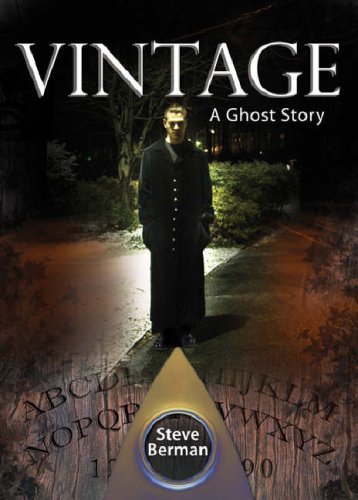
 Vintage: A Ghost Story by Steve Berman
Final Verdict: 3.25 out of 4.0
YTD: 50
Plot/Story:
3 – Plot/Story is interesting & believable.
The premise of Berman’s Vintage is just a bit silly. The main character, an un-named 17-year-old boy, runs away from home after somewhat accidentally (or on purpose, but with bad judgment) “outing” himself as gay. His parents both freak-out, so he takes off to live with his aunt. Not silly or unbelievable so far, right? But then, this guy soon stumbles into the ghost of a teenager who was killed decades earlier. And they fall in lust with each other. Not long after, the main character discovers that he is a medium – ghosts that are wandering in limbo, with unfinished business, can sense him and talk to him. To add even more complexity to his life, he realizes that he’s actually falling for another boy, one who’s alive – but also, possibly, off-limits. Poor guy – he has to somehow learn to control his abilities so that ghosts are not constantly haunting, while juggling his friendships, relaying the truth about himself to his aunt, building a new relationship, and helping the 1950s ghost boy to find closure, so that he can move on from this world. If all of this sounds ridiculous, well, it is – but the strangest part is that it all works. The story is moving, funny, tragic, and rewarding.
Characterization:
4 – Characters extraordinarily developed.
Although Berman gives very limited information about our narrator (we never learn his name, and he is only described physically one time, briefly), we seem to get to know him all the same. Not just that, but we get to know the important parts of him, as if Berman is making a point about what is and is not important – looks, names, ages, who cares? It’s what’s inside of a person that really matters. He does this with other characters, too, although we do get the names and physical descriptions of anyone else. Still, their real nature comes across in dialogue and in actions – “Second Mike,” for example, is described physically as a younger, smaller version of his eldest brother, but it’s not the physical description that is interesting, it’s his personality, his artistry, his talents and soft-spoken nature. Similarly, the main character’s aunt, his parents, and his best friends (and even his boss at the Vintage clothing shop where he works), are named and described “in passing,” as it were – but come to life through their reactions to situations and through their interactions with other characters. This is, in my opinion, the best way to develop characters – to let them live.
Prose/Style:
4 – Extraordinary Prose/Style, enhancing the Story.
Unfortunately, this book has quite a few proofreading errors which were at times distracting, and which really should have been caught and corrected in the editing process. I am not certain about the publication history of this book, but each chapter’s first page has its copyright information on it, so my conjecture is that it was originally published in electronic and/or serial form. The chapters are each episodes in the larger story – each chapter is titled after the day taking place in that scene, starting with “Friday” and progressing forward so that they are each literally “a day in the life” of the main character. This makes a rather odd story easy to follow and the episodes in themselves also keep the story on track and help the reader focus about each of the important elements happening, as well as how the main character is awakening to his own abilities, desires, and needs, over time. The larger structure is not even the best part, though. The prose and dialogue are very well done – engaging and well-paced, suspenseful when necessary and relaxed in lighter moments. Character dialogue is believable (not always easy to do when adult writers are working with younger characters), but there is a bit of a discordance in the language of the 1950s characters – they lived decades earlier but speak generally like the contemporary characters, which is a bit of an issue. Otherwise, though, the prose and style are fantastic. The moments when our main character is experiencing the past, through the ghosts memories, are particularly poignant and well-crafted.
Additional Elements: Setting, Symbols/Motifs, Resolution, etc.
3 – Additional elements are present and cohesive to the Story.
Supernatural/Paranormal (and especially paranormal romance) books are not ones I traditionally read or enjoy. The plot of this one, though, sounded interesting. It also seemed an appropriate read for late-October, as it has a Halloween feel to it and it suits the Literary Others event, which is just coming to a close. I am absolutely glad that I decided to take a risk and try something out of my comfort zone – although it’s an unusual paranormal romance, in that the romance involves gay teenagers (one of whom is a ghost, not a vampire/werewolf, etc.), it is a good one. The friendships and personalities are interesting and believable – quick-witted, angsty teenagers combine with a spooky and sometimes suspenseful ghost story and then conjoin to a boy’s journey toward self-acceptance and finding love. It’s a mix of great individual components that come together surprisingly well to create a fun and silly story that, despite its goofy unbelievability (I mean, come on, it has ghosts – and not only ghosts, but sexually desirable, horny ghosts who “do it” with the main character!), it is actually quite moving and important. Commentary on familial relationships, friendships, urban legends, and suicide all add to the primary plot, giving complexity to a bizarre but enticing paranormal romance. I was expecting to “enjoy” this book – but I might have actually fallen in love with it. Oops.
Suggested Reading for:
Age Level: High School+
Interest: Gay Fiction, Fantasy, Paranormal, Coming Out, Ghost Stories, YA, Suicide
Notable Quotes:
“It’s autumn. Everything happens in the autumn.” (16)
“Public displays of emotion are like chicory. Seeing too much leaves me with a bitter taste in my mouth and a sour stomach.” (22)
“He came nearer and lowered his head until his face brushed mine and it seemed as if winter pressed against my mouth and a cold gust broke through my parted lips. Such kisses break laws.” (39)
“We start with people that aren’t right for us. We’re so busy wanting love that we never even thank what the hell love needs back.” (99)
“No one ever resists what’s bad for them.” (137)
Guest Post: Reading Through Life (#OthersLitLGBT)
 Carina is a 20-something teacher from Toronto, currently living and working in Abu Dhabi. She blogs over at Reading Through Life, mostly reviewing what she reads and discussing other book-related things. She “came out” for the first time at 14, and has never looked back. Though the labels she chooses to use have changed, they’re really just words that attempt to describe a fluid and complex identity. Nobody’s ever suggested one label that encompasses everything that matters most to her, so she usually just omits them entirely and lets people figure things out on their own.
Freaks Like Me … in Books!
Depending on who I’ve spoken to, my experience with queerness[1] is either pedestrian or extraordinary. Somehow, this is the first time that I’ve really and truly told the whole story, including the literary encounters that helped to shape my early self-image.
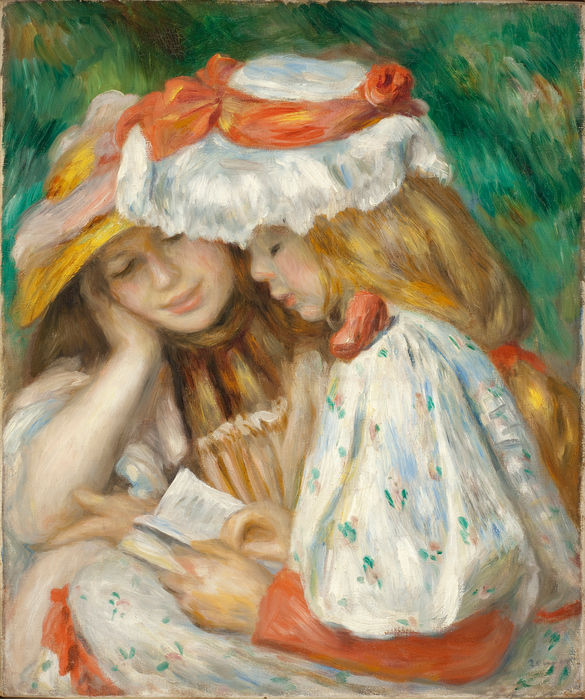 I first knew that there was something different about me when I was maybe in 4th or 5th grade. I remember sitting outside during recess with a bunch of girls, watching another group of kids playing soccer. Now, I didn’t really like soccer, mind you, but watching other people play across the school grounds was fine. The other girls that I was sitting with were ogling a couple of the older boys – maybe 7th or 8th graders. They were making comments about who knows what, maybe their cute faces? We were pretty innocent back then, and I can’t imagine that anything they found attractive then would be the same as things we would find attractive even 7 or 8 years later.
“What about her?” I remember saying to them, pointing at an older girl. They were quiet pretty much immediately. It was clear that I’d said something wrong. After an awkward silence, someone else pointed out another older boy, and it was pretty much as if I’d never said anything.
But even though the experience taught me not to voice my opinions on the matter in the future, my eyes were still caught just as easily by girls as they were of boys. Since it had become clear that my friends thought that was weird, I didn’t say anything to them. And I’d never even heard of people being gay at that point, except in the meaningless slurs flung around the schoolyard by children. Despite the fact that I was born in the mid-80s, I went to Catholic school, didn’t have cable television, and my parents heavily vetted the movies we rented, so it didn’t occur to me in the slightest that there were other people like me.
That is, until I went to high school. I had my first girlfriend when I was in 9th grade, and was opened up to another world. One that was interesting, and where I found some people who seemed a little bit like me … but I still didn’t really feel like I was “normal”.
 Skip ahead to grade 10. I don’t know about in other places, but in our school district, we read one Shakespeare play every year in English class. In my school that year, some of the classes read The Merchant of Venice and the others, like my class, read Twelfth Night. I probably don’t need to tell you that this play was the first experience of sexual otherness that I experienced in literature. Twelfth Night opened up to me a new world of people living as the opposite gender, and of same-sex lust – or, at least, people who seemingly fell in love with people of the same sex on the surface.
Now, this wasn’t me, exactly, but it was something outside of the heteronormativity that I was surrounded by. It was a start!
The following year, we had to choose books from a list to read independently. We only had to choose one book, but (being me) I bought and read more than that. I have struggled for years to remember the title or author of the book I read and wrote about in my report, but I can’t. What I do remember is that there was a female protagonist, that she spent most of the book in a relationship with a man named Mike … and that she was sexually active. This, on its own, was a first for any book that I had read. There was sex! And not only that, but she also had a sexual encounter with a woman. Finally, I was reading a book about someone like me, who was attracted to people from “both” genders[2], even if I wasn’t actually doing much about it at that point. And I started to feel a little bit less like a freak, because now there was Written Proof that there were other people like me out there, people common enough to have books written about them.
 Another one of the books on the list was Fall On Your Knees. (Seriously, I think my grade 11 teacher must have been a bit subversive; I have no idea how she managed to get these books approved by my very conservative, very Catholic school administration.) This book has stuck with me for all these years as yet another book that treated “other” sexuality as just as valid and normal as any other relationship. I seem to remember not realizing that one of the characters in a courtship story arc was female for a while – and was pleasantly surprised when it turned out that she was, because it meant that everything could be just the same for her and her female lover as it could be if she had been male.
After that, it wasn’t until university that I managed to encounter another queer character in a book. Those later books simply reiterated what I had learned through earlier experiences – that there really were people “like me” out there. These books also taught me about the breadth of these identities and experiences, often long before I had managed to come across them outside of books. They helped me to be both more accepting of myself and of other queer people when I met them, because I felt almost as if I already understood them in some way.
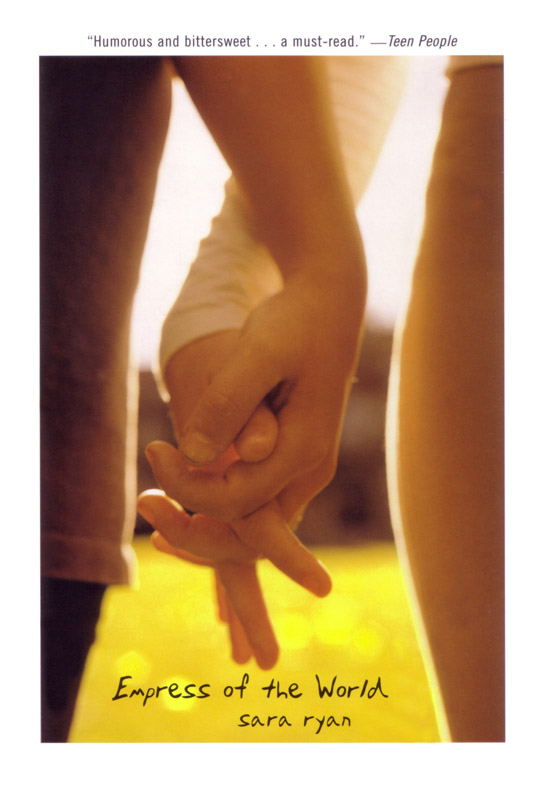 In retrospect, I’m both thankful for these experiences, and sad that I wasn’t exposed to more of them. I would’ve loved to have read a book like Boy Meets Boy or Empress of the World when I was a teenager. Reading age-appropriate books that discussed queerness, curiosity about sexual identity, and the specific issues that affect queer teens, would have made me feel even more comfortable in my own skin.
But in the end, I’m grateful for the self-acceptance that these books brought me, the knowledge that I wasn’t so strange, that there were other people like me in the wider world. This knowledge helped me through many a crisis, reminding me that I wasn’t alone. That my identity didn’t make me any less normal, just not the same as everyone else.
If I was going to be a “freak”, at least I knew there were others out there. That made all the difference.
[1] I use the word “queer” to denote any sexual identity that varies from the heternormative, cisgendered “ideal” presented by society and the media. If you’re interested/confused, here’s some (very) basic information on the word “queer” and why some people – like me – choose to use it.
[2] This is obviously long before I became politically and sexually conscious enough to reject the idea of two distinct and obvious genders.
Review: The Swimming-Pool Library by Alan Hollinghurst (#OthersLitLGBT)
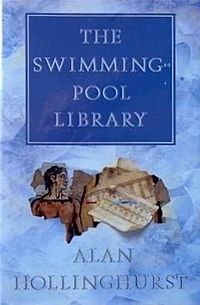
T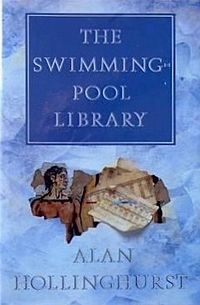 he Swimming Pool Library by Alan Hollinghurst
Final Verdict: 3.5 out of 4.0
YTD: 45
The Swimming-Pool Library is somehow both more and less than it would first appear. Its main character, William Beckwith, is a wealthy, privileged young man – an inheritor of much fortune and likely future possessor of his grandfather’s aristocratic title (his grandfather being a Viscount). The theme of the Swimming Pool Library, a title which at first glance would seem somewhat romantic and erudite, comes up throughout the book, but rather than referring to a man’s scholarly journal , it actually relates to sexual exploits. And sex generally dominates the book, from the moment it opens and up to its very end. Will, being young, attractive, and gay, seems obsessed with the physical. Almost any situation can be turned into an opportunity to flirt or more. One of these opportunities – a visit to a local men’s room, notorious for “cottaging” (meeting for anonymous sex) sets Will’s life on a new course. An old man, who turns out to be a mysterious and powerful Lord, has a heart attack in the men’s room and Will saves his life. Thus the real journey begins.
Throughout the book, Will is struggling to find purpose in his life. He does not have to work, because he has inherited wealth and property, but he and his friends think that he should be doing something with his life. The chance meeting with Lord Nantwich provides an opportunity for Will to potentially pursue his calling: writing. Will is clearly interested in writing, and others seem to think he should be writing professionally. Nantwich asks Will, after getting to know him a bit, to write his biography , providing Will with various journals, diaries, and stories about his life. During the course of his “research,” Will discovers much about Nantwich’s past, but also about his own history and the history of London. The violence, shame, and sexual explorations of these historical figures mimics what Will is experiencing in his own life, and leads him to discover a deeply troubling truth about his own family.
 Overall, I quite enjoyed The Swimming-Pool Library. Hollinghurst creates an interesting story about the life and history of a gay man (and a gay culture), one which is interesting and eccentric, but still honest. The feel of London, in particular, comes across quite well, making one feel as if they are there, even though the reader is, now, thirty years distant from the action of the plot (and even further from those moments of journal reading, which date back decades earlier). The exclusion of HIV/AIDS issues was somewhat refreshing, but also conspicuously absent – that such a promiscuous gay man, living in such a promiscuous world (sexual “hook-ups” seemed to be the norm, and the “public bath” as well as the private member’s only club where much of the story takes place are littered with men having sex with men) would have had no contact with illness. It is even more glaring when one considers the fact that Will’s best friend is a doctor. The story does take place only two years after what most would consider to be the starting point of the epidemic, and in 1983, when this book takes place, the tests for the virus were just being developed, so the lack of concrete illness is understandable, but perhaps a meaningful allusion could have been made (although, perhaps that is what the presence of the doctor and the decline of the “decadent generation” were all about?). The honesty of the story, the beauty of the prose, and the historical/cross-generational look into gay culture are great strengths for this book – I will definitely be reading more Hollinghurst.
Quotes:
“There are times when I can’t think of my country without a kind of despairing shame. Something literally inexpressible, so I won’t bother to try and speechify about it.”
“There is nothing worse than making a bid for someone’s body & getting their soul instead.”
 Roof Beam Reader