Roof Beam Reader
Adam Burgess
Review: The Golden Compass (Northern Lights) by Philip Pullman
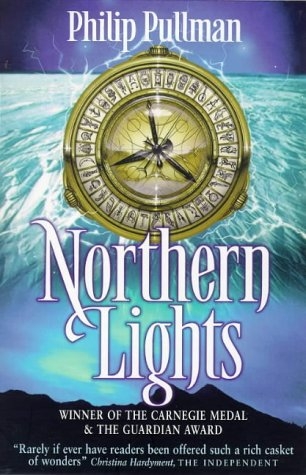

The Golden Compass by Philip Pullman
Final Verdict: 3.75 out of 4.0
YTD: 27
Plot/Story:
4 – Plot/Story is interesting, believable and impactful.
The Golden Compass (also known as Northern Lights and/or His Dark Materials, Book 1) is the first in the world-famous fantasy trilogy by English writer Philip Pullman. This book won the Carnegie Medal in Literature in 1995, then was named the “Carnegie of Carnegies” in 2007, after a public vote on the best Carnegie-winning books of the past 70 years. The first impression one gets while (and after) reading this book is that it is not a typical Young Adult fantasy novel, though it is often described as such. Author Christopher Hitchens (God Is Not Great) described Pullman as being an author “whose books have begun to dissolve the frontier between adult and juvenile fiction.” This is certainly true with The Golden Compass. The story tackles deeply philosophical themes and widely cherished traditions, putting its main character, Lyra, in direct conflict with two powerful schools of thought: Christianity and Humanism. Though the main character might be a child, the dangers are very real; indeed, some scenes are shockingly adult in nature. Largely an adventure story, Lyra finds herself companion to Gyptians (gypsies), armored bears, witches, and clockwork spies. She sets off to save a friend of hers, who has been captured by “the Gobblers” and, along the way, learns more about the world and herself than she could have ever imagined.
Characterization:
3 – Characters well-developed.
The only somewhat disappointing element to this largely enjoyable and thought-provoking story was its characterization. While there are absolutely a wide-range of characters, including those of different species, different political and philosophical viewpoints, and different temperaments, none of them (with the exception, perhaps, of Lyra’s parents – who might somewhat surprise the reader, in the end) are expressly or purposely developed, including Lyra. For some reason, it is hard to connect with Lyra, except, perhaps, in the moments when she and her daemon, Pantalaimon, are at risk of separation. Perhaps this is intentional, considering the major conflict in this story is the idea of intercision – the separating of a youth’s physical body from their daemon, the animal aspect indicative of their soul. In general, though, the interaction between characters was believable and interesting. One of the most fascinating elements of the story is the relationship between humans and their daemons – Pullman truly captures what a special relationship this is, and creates certain rules that are never expressly spoken (such as the fact that all daemons are the opposite gender from their humans), but which add wonderful layers to the story and the fantasy world overall.
Prose/Style:
4 – Extraordinary Prose/Style, enhancing the Story.
After reading The Golden Compass, it is safe to say that this series may become my second-favorite “YA” (I use that descriptor very cautiously) fantasy series, after Harry Potter. This is partially because the story itself is deep, interesting, and unique, but also largely because of how well it is written. Pullman’s style is refreshing – it comes across as serious and important, which is sometimes lacking in the fantasy genre, particularly in fantasy for younger readers (Tolkien, Salvatore, etc. excluded). What is genius about the prose and language is that it somehow manages to match the tone of the story, which is complex and dangerous, while also keeping in mind the youth of its main character. Pullman has created a beautifully vivid, well-imagined world, where multiple-universes are possible, and his talent for translating that world onto the page and into the readers’ minds is superb.
Additional Elements: Setting, Symbols/Motifs, Resolution, etc.
4 – Additional elements improve and advance the story.
The trilogy is perhaps best known as the athiest’s answer to C.S. Lewis’s Chronicles of Narnia series. Pullman, a self-described “agnostic atheist” and Humanist told The Washington Post in an interview that the trilogy was not created “to offend people;” instead, he saw them as “upholding certian values that . . . are important, such as life is immensely valuable and this world is an extraordinarily beautiful place.” He went on to say that he thought “we should do what we can to increase the amount of widom in the world.” Ultimately, Northern Lights is the entryway for these ideas – a pursuit of knowledge, a questioning of traditional doctrine and authority figures, and a commitment to one’s self and one’s own personal growth and development. We see these ideas at work in the main character, Lyra, especially in her bold individuality but also in her devotion to her daemon, Pan, and in her willingness to listen and to learn (if not always to obey).
Suggested Reading for
Age Level: 13+
Interest: Fantasy, Multiple Universes, Atheism, Humanism, Spirituality, Independence, Good & Evil
 Notable Quotes:
“You cannot change what you are, only what you do.”
“That’s the duty of the old,’ said the Librarian, ‘to be anxious on the behalf of the young. And the duty of the young is to scorn the anxiety of the old.”
“Human beings can’t see anything without wanting to destroy it. That’s original sin. And I’m going to destroy it. Death is going to die.”
“Being a practiced liar doesn’t mean you have a powerful imagination. Many good liars have no imagination at all; it’s that which gives their lies such wide-eyed conviction.”
“Men and women are moved by tides much fiercer than you can imagine, and they sweep us all up into the current.”
“We are all subject to the fates. But we must act as if we are not, or die of despair.”
DISCUSSION: STICK BY ANDREW SMITH (PART 3)
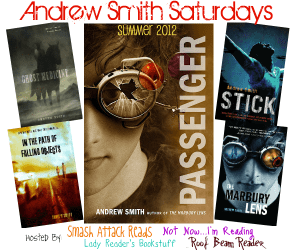
Welcome to the Discussion Post for Part 3 (Pages 107-216) of Stick by Andrew Smith.
1. In the first part of “Next”, we meet three new characters: Aunt Dahlia, Evan and Kim. These three seem clearly different from those in Bosten & Stick’s home world (even different from the characters who aren’t as crazy as the boys’ parents). Is Smith drawing some kind of distinction between regions? Is there something distinctly “Californian” and something distinctly “Washingtonian” about these worlds – and, if so, where do the boys belong? Wherever it is, do they still belong together?
2. Paul & Bosten break-up. Paul & Bosten get back together. Paul is gay, then bisexual. He is with Bosten, then he is with a girl and can’t have that kind of relationship with Bosten ever again. But, then they get back together. Is the back-and-forth here believable – why or why not? Is this normal teenage exploration/confusion? Does the difficulty do anything (positive or negative) for the story overall?
3. The boys’ parents split up and, while Stick is staying with Emily, he gets a phone call from his mother. On the call, she sounds somewhat different – more parental than we have seen her in the past. Is this an expected change? We see “Dad’s” rage in full force not much later, so he clearly hasn’t changed, but is it possible that “Mom” might have been molded by Dad? Or are they both equally brutal, separate or apart?
4. And, all hell breaks loose. Bosten is gone, Stick hits the road to find him & encounters a world of danger. Willie and April are creepy from the start, and the old cracked-out dudes who want stick to “pay” his way to California are certainly just as disgusting as the boys’ Dad, which begs the question: Are so many perverts necessary to the success of this plot? The book is meant to have some shock value, but how believable is it that the boys would each run into pedophiles at nearly every turn?
That’s it for this week! Looking forward to a great discussion! Feel free to add anything else you feel is valuable, or ask any other questions you might have yourself, now that we’re two-thirds of the way in… Don’t forget to check back next Saturday, when we will be discussing the end of the book, “Last” (Pages 216-End).
July: Stick (Hosted by Roof Beam Reader)
7/7: First (Part 1): Pages 2-597/14: First (Part 2): Pages 60-1037/21: Next (Part 1): Pages 107-216- 7/28: Last (Part 2): Pages 216-292
So, we are coming to the end of Stick. Up next is Ghost Medicine, which will be hosted in August by Not Now, I’m Reading!
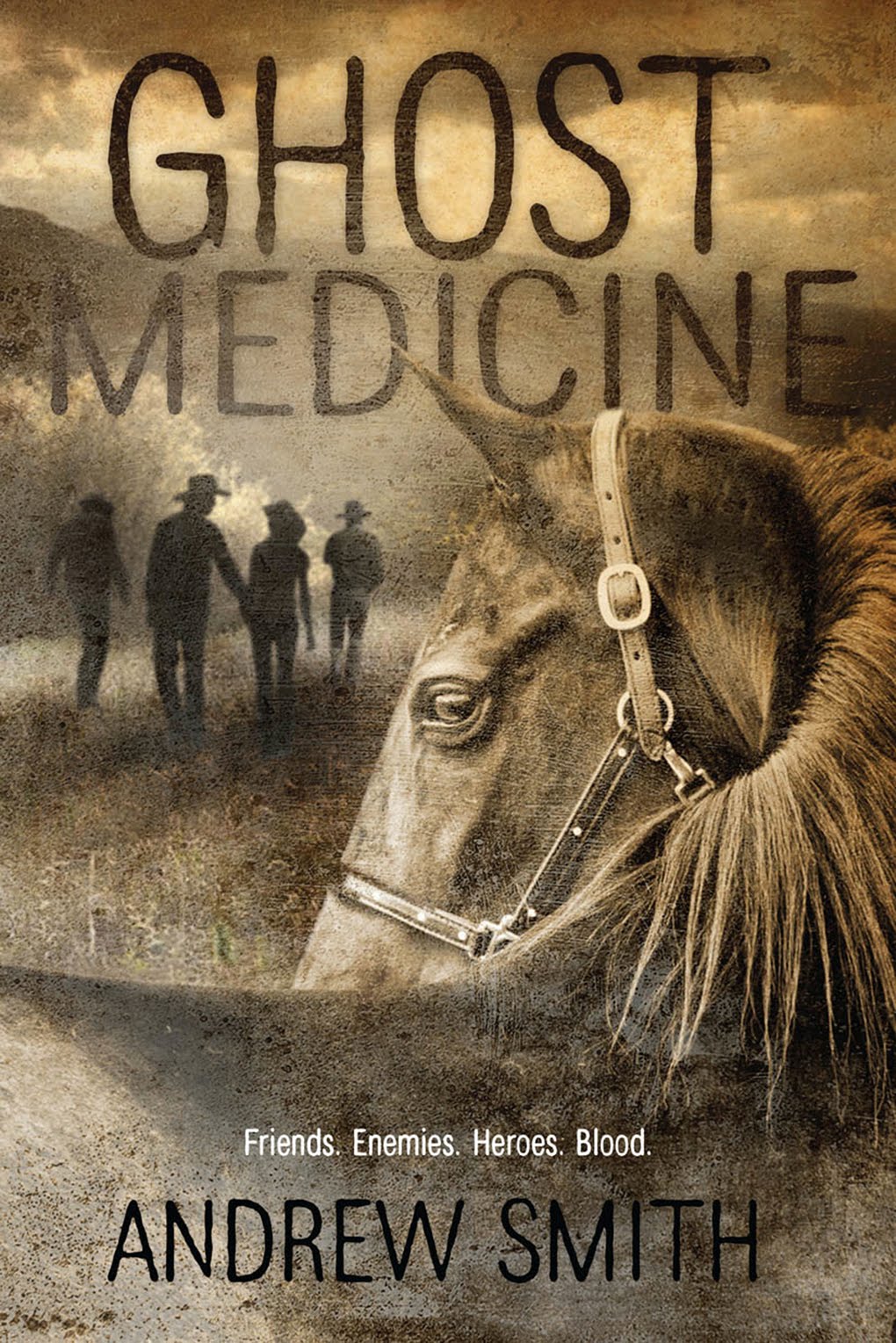
August: Ghost Medicine (Hosted by Not Now…I’m Reading)
- 8/4: Chapter 1 – 8
- 8/11: Chapter 9 – 15
- 8/18: Chapter 16 – 22
- 8/25: Chapter 23 – 29
My Life in Literature (Meme)

 Jillian posted this a few days ago, and I always have fun with these types of things, so I thought I’d participate. According to her post, the original seems to have been a “year in review” type thing, but I’m just going to choose any book that suits the answer, based on everything I’ve ever read. Mainly because it’s easier but also because it allows for more options. I like ease and variety, man.
- Describe yourself: The Boy with the Cuckoo-Clock Heart
- How do you feel: Lost in the Funhouse
- Describe where you currently live: Little Chicago
- If you could go anywhere, where would you go: Death in Venice
- Your favorite form of transportation: The Wings of Merlin
- Your best friend is: A Lost Lady
- You and your friends are: It’s Kind of a Funny Story
- What’s the weather like: Inferno
- You fear: The Vast Fields of Ordinary
- What is the best advice you have to give: Lust for Life
- Thought for the day: Nothing Like the Sun
- How I would like to die: The Once and Future King (hehe)
- My soul’s present condition: The Realm of Possibility
Fall Reading List (Ph.D.)

Hi, Folks!
This is just a quick post, listing my reading lists for this Fall. I’m starting my Ph.D. program and these are the texts that my classes will be reading/discussing. If anyone sees something interesting here (what’s NOT interesting on this list, I must ask?), maybe you could read along with me?
I’ll try to post thoughts and reviews on these as I go along – since it will help me gather thoughts for essays and research papers. There are quite a few books that will be re-reads for me, but I look forward to revisiting them all (I list these at the bottom of this post).
I must say – I am actually really, really excited about my classes for the Fall, now. These text selections are outstanding!
All descriptions are taken from Amazon.com, unless otherwise specified.

Title: Egil’s Saga by Anonymous
Written: 1240A.D. (Approximately)
Description:
“Egil’s Saga tells the story of the long and brutal life of tenth-century warrior-poet and farmer Egil Skallagrimsson: a psychologically ambiguous character who was at once the composer of intricately beautiful poetry and a physical grotesque capable of staggering brutality. This Icelandic saga recounts Egil’s progression from youthful savagery to mature wisdom as he struggles to defend his honor in a running feud with the Norwegian king Erik Bloodaxe and fight for the English king Athelstan in his battles against Scotland. Exploring issues as diverse as the question of loyalty, the power of poetry, and the relationship between two brothers who love the same woman, Egil’s Saga is a fascinating depiction of a deeply human character.”

Title: The Emigrants by W.G. Sebald
Published: 1996
Description:
“A meditation on memory and loss. Sebald re-creates the lives of four exiles–five if you include his oblique self-portrait–through their own accounts, others’ recollections, and pictures and found objects. But he brings these men before our eyes only to make them fade away, “longing for extinction.” Two were eventual suicides, another died in an asylum, the fourth still lived under a “poisonous canopy” more than 40 years after his parents’ death in Nazi Germany.
Sebald’s own longing is for communion. En route to Ithaca (the real upstate New York location but also the symbolic one), he comes to feel “like a travelling companion of my neighbor in the next lane.” After the car speeds away–“the children pulling clownish faces out of the rear window–I felt deserted and desolate for a time.” Sebald’s narrative is purposely moth-holed (butterfly-ridden, actually–there’s a recurring Nabokov-with-a-net type), an escape from the prison-house of realism. According to the author, his Uncle Ambros’s increasingly improbable tales were the result of “an illness which causes lost memories to be replaced by fantastic inventions.” Luckily for us, Sebald seems to have inherited the same syndrome.” –Kerry Fried

Title: The Good Soldier by Ford Madox Ford
Published: 1915
Description:
“First published in 1915, Ford Madox Ford’s The Good Soldier begins, famously and ominously, “This is the saddest story I have ever heard.” The book then proceeds to confute this pronouncement at every turn, exposing a world less sad than pathetic, and more shot through with hypocrisy and deceit than its incredulous narrator, John Dowell, cares to imagine. Somewhat forgotten as a classic, The Good Soldier has been called everything from the consummate novelist’s novel to one of the greatest English works of the century. And although its narrative hook–the philandering of an otherwise noble man–no longer shocks, its unerring cadences and doleful inevitabilities proclaim an enduring appeal.”

Title: Narrative Discourse Revisited by Gerard Genette
Published: 1989
Description:
“As the title suggests Genette revisits his narrative theory expounded in his earlier work “Narrative Discourse”. This book focuses on criticism directed at Genette’s earlier work. Genette does not elaborate on his narrative theory. Readers will need to be familiar with terms such as paralepsis, prolepsis, analepsis, syllepsis and achronies. For university students studying narrative ideology. Genette’s earlier work is recommended before endeavouring to read what is essentially an extended ‘afterword’.”

Title: Narrative Discoursse: An Essay in Method by Gerard Genette
Published: 1979
Description:
“This book should be required reading for anyone who wants to look seriously at narrative theory. Genette’s analysis of the construction of time in narrative discourse is the still the model for theorists writing since then. Such categories as order, frequency, and duration in the narrative presentation of story-time show how narrative decisions on the part of authors can have dramatically different rhetorical effects. Genette views these narrative strategies as a form of rhetorical figuration and gives them terms drawn from classical rhetoric (e.g., “prolepsis” for a flashing forward, “analepsis” for a flashback). Genette’s work is one of the clearest of all the French theorists of the 1970s and 1980s who became popular among literary critics and theorists in the US. His work is easily the most empirical of his academic geration of French theorists and perhaps the most likely to be useful in generations to come.” – Adirondack Views

Title: Narratology: An Introduction by Wolf Schmid
Published: 2010
Description:
“This book is a standard work for modern narrative theory. It provides a terminological and theoretical system of reference for future research. The author explains and discusses in detail problems of communication structure and entities of a narrative work, point of view, the relationship between narrator’s text and character’s text, narrativity and eventfulness, and narrative transformations of happenings. This book outlines a theory of narration and analyses central narratological categories such as fiction, mimesis, author, reader, narrator etc. A detailed bibliography and glossary of narratological terms make this book a compendium of narrative theory which is of relevance for scholars and students of all literary disciplines.”

Title: Pride and Prejudice by Jane Austen
Published: 1813
Description:
“Pride and Prejudice is a novel by Jane Austen, first published in 1813. The story follows the main character Elizabeth Bennet as she deals with issues of manners, upbringing, morality, education, and marriage in the society of the landed gentry of early 19th-century England. Elizabeth is the second of five daughters of a country gentleman living near the fictional town of Meryton in Hertfordshire, near London.
Though the story is set at the turn of the 19th century, it retains a fascination for modern readers, continuing near the top of lists of ‘most loved books’ such as The Big Read.[1] It has become one of the most popular novels in English literature and receives considerable attention from literary scholars. Modern interest in the book has resulted in a number of dramatic adaptations and an abundance of novels and stories imitating Austen’s memorable characters or themes. To date, the book has sold some 20 million copies worldwide.[2]” – Wikipedia

Title: The Sense of an Ending: Studies in the Theory of Fiction by Frank Kermode
Published: 2000
Description:
“Frank Kermode is one of our most distinguished critics of English literature. Here, he contributes a new epilogue to his collection of classic lectures on the relationship of fiction to age-old concepts of apocalyptic chaos and crisis. Prompted by the approach of the millennium, he revisits the book which brings his highly concentrated insights to bear on some of the most unyielding philosophical and aesthetic enigmas. Examining the works of writers from Plato to William Burrows, Kermode shows how they have persistently imposed their “fictions” upon the face of eternity and how these have reflected the apocalyptic spirit. Kermode then discusses literature at a time when new fictive explanations, as used by Spenser and Shakespeare, were being devised to fit a world of uncertain beginning and end. He goes on to deal perceptively with modern literature with “traditionalists” such as Yeats, Eliot, and Joyce, as well as contemporary “schismatics,” the French “new novelists,” and such seminal figures as Jean-Paul Sartre and Samuel Beckett. Whether weighing the difference between modern and earlier modes of apocalyptic thought, considering the degeneration of fiction into myth, or commenting on the vogue of the Absurd, Kermode is distinctly lucid, persuasive, witty, and prodigal of ideas.”

Title: Transparent Minds: Narrative Modes for Presenting Consciousness in Fiction by Dorrit Cohn
Published: 1984
Description:
“This book investigates the entire spectrum of techniques for portraying the mental lives of fictional characters in both the stream-of-consciousness novel and other fiction. Each chapter deals with one main technique, illustrated from a wide range of nineteenth- and twentieth-century fiction by writers including Stendhal, Dostoevsky, James, Mann, Kafka, Joyce, Proust, Woolf, and Sarraute.”

Title: Dinner at the Homesick Restaurant by Anne Tyler
Published: 1982
Description:
“Pearl Tull is nearing the end of her life but not of her memory. It was a Sunday night in 1944 when her husband left the little row house on Baltimore’s Calvert Street, abandoning Pearl to raise their three children alone: Jenny, high-spirited and determined, nurturing to strangers but distant to those she loves; the older son, Cody, a wild and incorrigible youth possessed by the lure of power and money; and sweet, clumsy Ezra, Pearl’s favorite, who never stops yearning for the perfect family that could never be his own.
Now Pearl and her three grown children have gathered together again–with anger, hope, and a beautiful, harsh, and dazzling story to tell.”

Title: From Puritanism to Postmodernism: A History of American Literature by Richard Buland & Malcolm Bradbury
Published: 1991
Description:
“From Modernist/Postmodernist perspective, leading critics Richard Ruland (American) and Malcolm Bradbury (British) address questions of literary and cultural nationalism. They demonstrate that since the seventeenth century, American writing has reflected the political and historical climate of its time and helped define America’s cultural and social parameters. Above all, they argue that American literature has always been essentially “modern,” illustrating this with a broad range of texts: from Poe and Melville to Fitzgerald and Pound, to Wallace Stevens, Gwendolyn Brooks, and Thomas Pynchon.
From Puritanism to Postmodernism pays homage to the luxuriance of American writing by tracing the creation of a national literature that retained its deep roots in European culture while striving to achieve cultural independence.”

Title: The Grapes of Wrath by John Steinbeck
Published: 1939
Description:
“The Grapes of Wrath is an American realist novel written by John Steinbeck and published in 1939. For it he won the annual National Book Award[1] andPulitzer Prize[2] for novels and it was cited prominently when he won the Nobel Prize in 1962.[3]
Set during the Great Depression, the novel focuses on the Joads, a poor family of tenant farmers driven from their Oklahoma home by drought, economic hardship, and changes in financial and agricultural industries. Due to their nearly hopeless situation, and in part because they were trapped in the Dust Bowl, the Joads set out for California. Along with thousands of other “Okies”, they sought jobs, land, dignity, and a future.” -Wikipedia

Title: The Great Gatsby by F. Scott Fitzgerald
Published: 1925
Description:
“The Great Gatsby is a novel by American author F. Scott Fitzgerald. The book was first published in 1925, and it has been republished in 1945 and 1953. There are two settings for the novel: on Long Island’s North Shore, and in New York City. The book is set in 1922 from the spring to the autumn.
The Great Gatsby takes place during a prosperous time in American History. In 1922, America has fully recovered from the First World War, and is enjoying prosperity during the Roaring Twenties, when the economy soared and emotions ran high. Yet, at the same time, Prohibition, the ban on the sale and manufacture of alcohol as mandated by the Eighteenth Amendment, was gaining traction.
The ban on alcohol made millionaires out of bootleggers, who smuggled in the now-illegal substance. That scenario is the backdrop for the novel, which contributed to its popularity. After the novel was republished in 1945 and 1953, The Great Gatsby quickly found a wide readership. Today the book is widely regarded as a sort of Great American Novel, and a literary classic. The Modern Library named it the second best English-language novel of the 20th Century.[1]”

Title: Green Grass, Running Water by Thomas King
Published: 1993
Description:
“King’s auspicious debut novel, Medicine River ( LJ 8/90), garnered critical acclaim and popular success (including being transformed into a TV movie). This encore, a genially wild tale with a serious heart, confirms the author’s prowess. It involves the creation of a creation story, the mission of four ancient Indians, and the comparatively realistic doings of 40-year-old-adolescent Lionel Red Dog, unfazable cleaning woman Babo, and various memorable Blackfoot and others in scenic Alberta. Clever verbal motifs not only connect the stories but add fun visual themes, including missing cars and a ubiquitous Western movie. In the end, everyone is thrown together by an earthquake at white human-made Parliament Lake, compliments of the four old Indians and the loopy trickster Coyote. Smart and entertaining, this novel deserves a big audience. Essential for public libraries.” – Janet Ingraham, Worthington P.L., Ohio

Title: A Lost Lady by Willa Cather
Published: 1923
Description:
“First published in 1923, A Lost Lady is one of Willa Cather’s classic novels about life on the Great Plains. It harks back to Nebraska’s early history and contrasts those days with an unsentimental portrait of the materialistic world that supplanted the frontier. In her subtle portrait of Marian Forrester, whose life unfolds in the midst of this disquieting transition, Cather created one of her most memorable and finely drawn characters.”

Title: One Flew Over the Cuckoo’s Nest by Ken Kesey
Published: 1962
Description:
“Boisterous, ribald, and ultimately shattering, Ken Kesey’s One Flew Over the Cuckoo’s Nest is the seminal novel of the 1960s that has left an indelible mark on the literature of our time. Here is the unforgettable story of a mental ward and its inhabitants, especially the tyrannical Big Nurse Ratched and Randle Patrick McMurphy, the brawling, fun-loving new inmate who resolves to oppose her. We see the struggle through the eyes of Chief Bromden, the seemingly mute half-Indian patient who witnesses and understands McMurphy’s heroic attempt to do battle with the awesome powers that keep them all imprisoned.”

Title: Play It as It Lays by Joan Didion
Published: 1970
Description:
“A ruthless dissection of American life in the late 1960s, Play It as It Lays captures the mood of an entire generation, the ennui of contemporary society reflected in spare prose that blisters and haunts the reader. Set in a place beyond good and evil-literally in Hollywood, Las Vegas, and the barren wastes of the Mojave Desert, but figuratively in the landscape of an arid soul-it remains more than three decades after its original publication a profoundly disturbing novel, riveting in its exploration of a woman and a society in crisis and stunning in the still-startling intensity of its prose.”

Title: Praisesong for the Widow by Paule Marshall
Published: 1983
Description:
“Praisesong for the Widow is a novel by Paule Marshall which takes place in the mid seventies, chronicling the life of Avey Johnson, a sixty-four year old African American widow on a physical and emotional journey in the Caribbean island of Carriacou. Throughout the novel, there are many flashbacks to Avey’s earlier life experiences with her late husband, Jerome Johnson, as well as childhood events that reconnect her with her lost cultural roots.” -Wikipedia

Title: Seize the Day by Saul Bellow
Published: 1956
Description:
“Seize the Day, first published in 1956, is considered (by, for example, prominent critic James Wood) one of the great works of 20th century literature.Seize the Day was Saul Bellow’s fourth novel (or perhaps novella, given its short length). It was written in the 1950s, a formative period in the creation of the middle class in the United States.
The story centers around a day in the life of Wilhelm Adler (aka Tommy Wilhelm), a failed actor in his forties. Wilhelm is unemployed, impecunious, separated from his wife (who refuses to agree to a divorce), and estranged from his children and his father. He is also stuck with the same immaturity and lack of insight which has brought him to failure. In Seize the Day Wilhelm experiences a day of reckoning as he is forced to examine his life and to finally accept the “burden of self”.” – Wikipedia

Title: Sister Carrie by Theodore Dreisser
Published: 1900
Description:
“Regarded by many critics as the greatest novel on urban life ever composed, Sister Carrie tells the story of Caroline Meeber, an 18-year-old from rural Wisconsin whose new life in Chicago takes her on an astonishing journey from the despairing depths of industrial labor to the staggering heists of fame and stardom. Representing the transition from the heavy moralizing of the Victorian era to the realism of modern literature, Sister Carrie remains a literary milestone that examines the human condition and all its flaws.”

Title: That Old Cape Magic by Richard Russo
Published: 2009
Description:
“For Griffin, all paths, all memories, converge at Cape Cod. The Cape is where he took his childhood summer vacations, where he and his wife, Joy, honeymooned, where they decided he’d leave his LA screenwriting job to become a college professor, and where they celebrated the marriage of their daughter Laura’s best friend. But when their beloved Laura’s wedding takes place a year later, Griffin is caught between chauffeuring his mother’s and father’s ashes in two urns and contending with Joy and her large, unruly family. Both he and she have also brought dates along. How in the world could this have happened?
By turns hilarious, rueful, and uplifting, That Old Cape Magic is a profoundly involving novel about marriage, family, and all the other ties that bind.”

Title: Tracks by Louise Erdrich
Published: 1988
Description:
“Set in North Dakota at a time in this century when Indian tribes were struggling to keep what little remained of their lands, Tracks is a tale of passion and deep unrest. Over the course of ten crucial years, as tribal land and trust between people erode ceaselessly, men and women are pushed to the brink of their endurance–yet their pride and humor prohibit surrender. The reader will experience shock and pleasure in encountering a group of characters that are compelling and rich in their vigor, clarity, and indomitable vitality.”

Title: Tropic of Orange by Karen Tei Yamashita
Published: 1997
Description:
“This fiercely satirical, semifantastical novel … features an Asian-American television news executive, Emi, and a Latino newspaper reporter, Gabriel, who are so focused on chasing stories they almost don’t notice that the world is falling apart all around them. Karen Tei Yamashita’s staccato prose works well to evoke the frenetic breeziness and monumental self-absorption that are central to their lives.” -Janet Kaye, The New York Times Book Review

Title: White Noise by Don DeLillo
Published: 1985
Description:
“Winner of the National Book Award, White Noise tells the story of Jack Gladney, his fourth wife, Babette, and four ultramodern offspring as they navigate the rocky passages of family life to the background babble of brand-name consumerism. When an industrial accident unleashes an “airborne toxic event,” a lethal black chemical cloud floats over their lives. The menacing cloud is a more urgent and visible version of the “white noise” engulfing the Gladneys-radio transmissions, sirens, microwaves, ultrasonic appliances, and TV murmurings-pulsing with life, yet suggesting something ominous.”
So, there we have it – my reading list for Fall. I’ll be reading all of these titles between August and December, 2012. It is A LOT of reading, but I’m looking forward to it (even though my personal reading will probably suffer).
Books I’ll be Revisiting:
Pride and Prejudice
Dinner at the Homesick Restaurant
The Grapes of Wrath
The Great Gatsby
A Lost Lady
One Flew Over the Cuckoo’s Nest
Sister Carrie
Tracks
Entirely New-to-Me Authors:
Sebald, Ford, Kermode, Cohn, Ruland, King, Didion, Marshall, Russo, Yamashita, and Delillo
DISCUSSION: STICK BY ANDREW SMITH (PART 2)
Welcome to the Discussion Post for Part 1 (Pages 60-103) of Stick by Andrew Smith.
1. Early in Part 2, Stick compares his mother to two women, first to Emily (comparing their bathrooms) and then to Mrs. Lohman (Stick’s mom with a cigarette & knife in her hands, threatening him about spending time on the phone; and Mrs. Lohman telling him how they would love to have him over anytime. Then comes Mrs. BuckLey and Stick’s comment: “Something was happening to me. Everything was changing.” Is it important for Stick to realize these distinctions, between his mother and other women? Do you think women will ultimately play a larger role in his story?
2. Oh, boy – did Bosten have a secret, or what!? Did you see this coming? How is it likely to impact the nature between Bosten and Stick, and the relationship between Bosten (and/or both the boys) and their parents?
3. Saint Fillan’s Room. It has to be mentioned – what do we think about this? We talked last week about the parents being physically abusi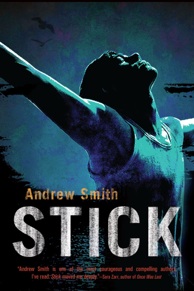 ve, but this room adds a whole new level to it, doesn’t it? Think about how the boys have to clean it – empty and scrub the pail – after they were beaten in that room and left there in solitude, sometimes for days at a time. I have to ask again – what’s up Mom & Dad!?
4. At one point in this segment, Stick makes the point: “I wasn’t sure how punching someone would make me feel like having balls made a difference.” Ironically, later on, he actually does get hit in the balls, hard, and finally stands up for himself by punching the guy in the nose. Other than this being great irony, what does it say about stick – both his early statement and the fact that he finally stood up for himself? Could it have anything to do with what Emily said about Stick making fun of himself?
5. Dad. We’re finally beginning to understand. So, it seems when he is drunk, his true nature and problem comes out – but only with Bosten. Why do you think Dad confuses Stick for Bosten – and, if he hadn’t passed out, do you think Stick saying who he was would have mattered? Now that Stick knows what’s been happening, and he and Bosten have talked about it, what next?
Don’t forget to check back next Saturday, when we will be discussing Part 2 (Pages 107-216).
July: Stick (Hosted by Roof Beam Reader)
7/7: First (Part 1): Pages 2-597/14: First (Part 2): Pages 60-103- 7/21: Next (Part 1): Pages 107-216
- 7/28: Next (Part 2): Pages 216-292
Also, have you entered to win a copy of next month’s Andrew Smith book, Ghost Medicine?
Head over to Not Now, I’m Reading for your chance! The giveaway ends July 14th (today)!
 Roof Beam Reader