Roof Beam Reader
Adam Burgess
Review: The Realm of Possibility by David Levithan
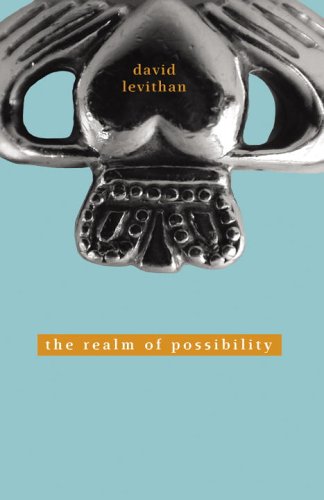
The Realm of Possibility by David Levithan
Final Verdict: 3.25 out of 4.0
YTD: 09
Plot/Story:
4 – Plot/Story is interesting/believable and impactful (socially, academically, etc.)
“There’s the girl who is in love with Holden Caufield. The boy who wants to be strong who falls for the girl who’s convinced she needs to be weak. The girl who writes love songs for a girl she can’t have. The two boys teetering on the brink of their first anniversary. And everyone in between.” This is The Realm of Possibility, as described by the Knopf paperback edition’s book blurb. “One school. Twenty voices. Endless possibilities.” At the core of this collection are the separate but equal themes of independence and necessity. As we grow up, as we create our own identities, we must learn the balancing act of individuality and belonging. We must learn how to be strong and capable, but we also must learn how to be pliable and vulnerable. The twenty interconnected stories in The Realm of Possibility explore all the different aspects of growing up and coming of age – from dealing with a loved one’s illness, to committing to a serious relationship; from learning what it really means to be strong, to allowing one’s walls to come down – taking a chance at loss, in order to gain. For this group of teenagers, life has just begun – and the possibilities are endless.
Characterization:
2 – Characters slightly developed.
The structure of this work automatically places characterization at a disadvantage. Because the book is made up of twenty short segments, written by twenty different narrators, there is not much room for growth or development of any single character. There are a few reoccurring characters (those who write one segment and who are then included as a main character in someone else’s segment), but, because the sections are written like diary entries, each portion still says more about its narrator than about anyone else, which means there are only 10 or so pages for each of the twenty important people. This is a difficult for me, personally, because I am a reader who truly enjoys rich, deep, whole characters. That being said, the characters and their stories work together very well and, despite being flashed at the reader in short bursts, they are certainly interesting and emanate all the emotions that Levithan intended them to: fear, courage, love, abandon, despair. While I cannot applaud the characterization in this book (simply because it was not a main element) – I can adamantly suggest that the lack of character development in this book was no disservice to it, because the rest of the elements – particularly the exploration of individuality and “possibilities”- are the core of this book and hold everything together quite nicely.
Prose/Style:
3 – Satisfactory Prose/Style, conducive to the Story.
The stories are written in free verse of various forms and the prose, in this way, adds a certain element of characterization which is generally lacking (as mentioned above), because each narrator has his or her own physical and emotional voice – distinguishable from the other stories in the timeline. One item I take issue with is the many instances of whole pages left nearly blank, with just a few words or sentences. This is something I have come to expect from young adult novels of a certain type (and from certain authors). At first, it was charming, but the more often I encounter it, the more it starts to feel like a clever ploy to make extremely short books lengthier by page number, if not by word count. This does not mean that the stories which are structured in this way are ineffective (far from it, in most instances), but it does sometimes leave me wanting more. In this book, where the stories are so interesting and the language so engaging, it was frustrating to oftentimes have so little to revel in. Other than that minor irk, Levithan captured me with his prose and language the way he always does: completely. His narrative voice(s) are so pure, so believable, and so welcoming – it is impossible not to sink into these stories and enjoy yourself, simply because the language is just so comfortable. Most of us have been in these situations, or ones similar to them – and whether the reader is still in high school, just out of it, or finding high school a distant memory- the language coupled with the messages and the familiar feelings drawn from each story, will ring bells for nearly everyone.
Additional Elements: Setting, Symbols/Motifs, Resolution, etc.
4 – Additional elements are present and enhance the Story.
The Realm of Possibility is a sort of short story collection whose overall narrative revolves around a group of students from the same high school. Some of the stories are directly interconnected, while others are only slightly related. It is similar in structure to Sherwood Anderson’s Winesburg, Ohio, in that all of the stories are connected because their primary characters exist in the same place and time, often with overlapping elements throughout the larger work. Setting up the narrative this way allows Levithan to explore twenty different personalities existing (and co-existing) at the same time, but with very different circumstances, situations, and messages. The two strongest segments, in my opinion, are “Escapade” and “Possibility” – which are, incidentally, the last two stories in the collection. These two drive home the message of friendship and future –the messages of hope and individuality that have been developing throughout the entire book. Ultimately, reading this book was a delight. It is a quick, simple read, but one which evokes real emotions and memories because the various situations described are so relatable and the people so believable. Although the characterization section of my review brings the overall rating down, the book feels much more, as a whole, like a “4” than a “3.”
Suggested Reading for:
Age Level: MG, YA+
Interest: High School, Coming-of-Age, Interpersonal Relationships, Family, Mental/Physical Health and Coping, Sexuality (Heterosexual & Homosexual).
Notable Quotes:
“There is certainty in a ring. The non-ending, the non-beginning. The ongoing. The way it holds on to you not because it’s been fastened or stretched or adhered. It holds on because it fits.”
“…the things that hold us are only as strong as the faith we have in them – you go on the bridge because you trust it will not fall.” pp
“My parents are okay with me being gay but they would kill me if they saw me with a cigarette.”
“Getting what you want is just as difficult as not getting what you want. Because then you have to figure out what to do with it instead of figuring out what to do without it.”
“You will always be my always.”
Review: The Woman in White by Wilkie Collins
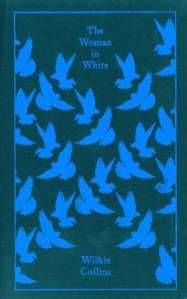
The Woman in White by Wilkie Collins
Final Verdict: 4.0 out of 4.0
YTD: 8
Plot/Story:
4 – Plot/Story is interesting/believable and impactful.
Wilkie Collins’s The Woman in White is widely accepted to be one of the first –and best- mystery and sensation novels. The main character, Walter Hartright, is also considered to be one of the earliest literary detective characters – one who later inspired the development of mystery/detective genres (Hartright’s investigative techniques, for example, are later employed by private detectives in mystery novels that followed this one). The story revolves around a few characters who are at first drawn together by chance, but then become involved in an elaborate plot of deception, orchestrated by the ingenuous Count Fosco and his cold-as-ice wife, who just happens to be the slighted aunt of our main character’s love interest, Lady Glyde. Lives are threatened, identities are stolen, and more than one man’s (and woman’s) place in the world is in jeopardy. How are Lady Glyde and Anne Catherick’s (The Woman in White) destinies intertwined – and why do they look so strikingly similar? When Lady Glyde and Marian are doomed by the devious count, will Walter – a simple art teacher with no resources and no friends- manage to piece together enough evidence to vindicate the unfortunate women – before it’s too late?
Characterization:
4 – Characters extraordinarily well-developed.
The range and depth of characters in The Woman in White is impressive, to say the least. If Collins has one advantage over Dickens, it is that his characters are a bit richer – a bit more interesting and realistic than Dickens’s characters, who often become grotesques. Count Fosco is perhaps one of the most brilliantly drawn characters in literature – ranking along-side Nabokov’s Humbert Humbert in the perverse, unpleasant yet satisfactory enjoyment he brings to the reader’s experience with the story. Collins has a way of creating characters that are downright evil, but with intermittent, surprising bits of good – or genuinely good, with moments of badness. He writes truly human characters, flawed but perfect in the same breath. Drawn thusly, the mystery aspect of the novel is further richened because one can never be entirely sure that we are seeing the true nature of any character at any given moment – after a few hundred pages of wondering just how dastardly a character can get, he suddenly surprises the reader with a moment of genuine sensitivity or compassion. Minor characters, too, such as Anne Catherick’s mother and Mr. Fairlie, Lady Glyde’s uncle, bring additional elements – like comic relief or historical significance, to Hartright’s narrative, increasing the complexity of the story while simultaneously further committing the reader to the main characters and their destinations. Ultimately, the dénouement –beautiful as it is – could not have been achieved without clever assembly of characterization throughout the entire story, which is finally realized in a final letter, written by Count Fosco himself.
Prose/Style:
4 – Extraordinary Prose/Style, enhancing the Story.
In my experience, 600-pages of Victorian literature can amount to one of two things: transcendent literary genius, or a mentally exhaustive torture device. In the case of Collins and The Woman in White, the prose was far from prosaic (Haha… get it?). Okay, jokes aside, this is one of those pieces of literature you could recommend to someone who doesn’t read literature. The style and language are just that good, and the story just that engaging. The pace is well-measured, so even though there is plenty of description and flushing out of details, the story rarely, if ever, stalls. Something in the way Collins has designed the tale (perhaps in large part due to the multiple narrators, who pick up the story as ‘main character’ while it advances) makes these 600-pages flash by as if there were half as many. The narrative voice(s) is engaging, the language is substantive without being overwrought or lofty – finishing this book is like having enjoyed a piece of gourmet cheesecake, garnished with just the right amounts of fresh fruit and chocolate sauce, and maybe even a dash of warm caramel (getting hungry yet?). Each bite is a delight to be savored and the story as a whole, when finished, is satisfying – so much so that the reader might be licking that dessert plate clean.
Additional Elements: Setting, Symbols/Motifs, Resolution, etc.
4 – Additional elements improve and advance the story.
First – one minor issue. The edition I read was the Penguin Classics Clothbound edition, pictured above (which, incidentally, I won in a giveaway from the awesome Allie at A Literary Odyssey). I love the edition and I love the footnotes (although I do much prefer footnotes to appear at the bottom of pages, rather than in the back – I hate having to flip back and forth). What I discovered from the footnotes, though, was that Collins, while a fantastic writer and an even better storyteller, was not too concerned with historical and/or legal accuracies. This is a common pitfall with serial novels that often needed new installments to be completed quickly, to meet magazine/newspaper deadlines. So, there were frequent mentions of things Collins got wrong, usually because certain things he described (laws, inventions, etc.) were not yet in place at the time the story takes place. Now, without the footnotes, I would not have known the difference – so it is a small complaint and not much to dwell on, considering none of the “mistakes” impacted my enjoyment of the story. That aside, the elements that were interesting and which added to the story include: the examination of the rights (or lack thereof) of women in the 19th century; perception of foreigners by English natives; isolation; identity theft and the legal process (thank goodness for the discovery of DNA!); fine arts and the craft of writing; hereditary rights to income and property; secret societies and politics; and, of course, love – revenge – and the nature of family. What makes a good story a great story is not just that it is enjoyable or entertaining, not just that it is written well, with interesting content, but that all of these elements come together seamlessly – that the reader can learn about a time, place, or culture while also being entertained. The Woman in White achieves all of this, and how.
Suggested Reading for:
Age Level: Adult
Interest: Epistolary novels, Victorian literature, Gothic novels, Sensation novels, Mystery/Amateur Detective novels, Law and justice.
Notable Quotes/Excerpts:
“Where is the woman who has ever really torn from her heart the image that has been once fixed in it by a true love? Books tell us that such unearthly creatures have existed – but what does our own experiences say in answer to books?”
“Our words are giants when they do us an injury, and dwarfs when they do us a service.”
“I sadly want a reform in the construction of children. Nature’s only idea seems to be to make them machines for the production of incessant noise.”
“Let the music speak to us of tonight, in a happier language than our own.”
“Any woman who is sure of her own wits, is a match, at any time, for a man who is not sure of his own temper.”
“The woman who first gives life, light, and form to our shadowy conceptions of beauty, fills a void in our spiritual nature that has remained unknown to us till she appeared. Sympathies that lie too deep for words, too deep almost for thoughts, are touched, at such times, by other charms than those which the senses feel and which the resources of expression can realise. The mystery which underlies the beauty of women is never raised above the reach of all expression until it has claimed kindred with the deeper mystery in our own souls.”
“The best men are not consistent in good– why should the worst men be consistent in evil.”
Review: Player Piano by Kurt Vonnegut
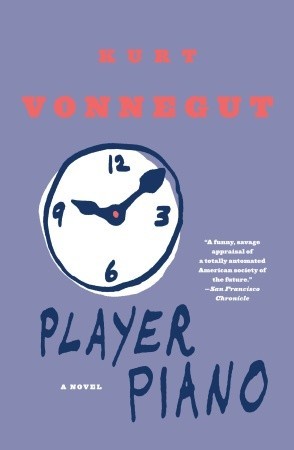
Player Piano by Kurt Vonnegut
Final Verdict: 3.75 out of 4.0
YTD: 7
Plot/Story:
4 – Plot/Story is interesting/believable and impactful (socially, academically, etc.)
Player Piano is Kurt Vonnegut’s first novel, and one of his best. It brings to mind all that is great about Vonnegut as storyteller and philosopher – reminding me of his masterpieces: Cat’s Cradle, Slaughterhouse-Five, and The Sirens of Titan. This particular novel is “Wall-E” meets The Moon is a Harsh Mistress meets Atlas Shrugged. Americans have striven for technological perfection. Decades and decades of mechanic improvements have resulted in the virtual elimination of manual labor of any kind. The majority of Americans are out of work because machines have taken their place – and the only actual people employed are engineers – Ph.D.’s – with advanced I.Q.’s, the geniuses who run the factories. All others, those who cannot get beyond the bachelor’s degree, are assigned to work either in the Army or with the Public Works departments (where sometimes twelve men will be assigned the job of repairing one minor pothole). Because of these advancements, there is no poverty and no hunger. The upper-echelon do have a certain prestige – they make more money, live on the “better” side of town, have nicer homes, etc; still, even the Average Joe has healthcare, regularly upgraded appliances, luxuries, and a retirement fund. But with this comfort and mindless care – this forced apathy- comes the disillusionment of the American Dream. Is having a good and simple life worth it, if you’ve done nothing to earn it? Is a happy life possible, without satisfaction – without passion – without creativity? What price can be placed on individuality, spirituality and the sense of self-worth – and can those ideals be traded in for unearned security?
Characterization:
3 – Characters well developed.
Vonnegut’s stories are almost always more about the overall idea than they are about the characters or their journeys. His books tend to be cynical, darkly comical visions of America – either as it is now or as he imagines it will become in the near future. Player Piano is no different in this regard; however, Paul Proteus, the novel’s main character, does go through a certain change – he comes to realize that his purpose in life is the same as any man’s purpose, which further leads him to discover that that purpose and the self-actualization that once had been afforded Americans who were born to dream, had been stolen by the mechanization of society and labor. There was nothing left to work for – nothing left to dream about, because everything was being handed out, regardless of merit and with very little effort on the part of the recipients. Paul gradually gives up his privileged life – prodigal son of the nation’s newest “founding father,” to become an outlaw and outcast, a rebel, and perhaps a new messiah for the reclamation age. Aside from Paul’s character, though, there is little growth or development in any of the characters – they are simply there, as Paul is there, to support Vonnegut’s overarching theme: the sacrifice of identity and self-worth for technological advancement and “quality” of life.
Prose/Style:
4 – Extraordinary Prose/Style, enhancing the Story.
Regardless of whether or not I love a particular Vonnegut work, one thing I am rarely disappointed by is the prose or style of the piece. Be it short story, essay, or novel, Vonnegut has a clever, witty, charming little voice. His prose is swift and biting – intelligent but not self-indulgent; sarcastic but not pompous. Vonnegut loves to take jabs at humanity in general – there’s a sense that he has given up all hope for any redemption whatsoever; the shit has hit the fan and so it goes. Player Piano meets these typical Vonnegutian (?) criteria. The story flows well – there’s a comic seriousness to the prose, as if the story, like life’s story, is one great, big tragedy – we can either laugh or cry (sometimes both). This, though, is one of Vonnegut’s better stories and, because the story is so good, the typically good prose elevates even further – making the entire experience, from meaning to impact, a positively enjoyable (if rather depressing) one.
Additional Elements: Setting, Symbols/Motifs, Resolution, etc.
4 – Additional elements improve and advance the story.
Vonnegut is a cynic and a realist. As one who narrowly survived the bombing of Dresden, he has plenty of real-life experience to bring to his writing, and one can hardly fault him for seeing the darker side of humanity. Still, he approaches that darker side with a seriously powerful sense of humor. Even though he clearly has little hope that humankind will redeem itself, he still manages to poke fun and to approach life with a quirky, disillusioned mirth – something that should be quite impossible. Player Piano is in some ways the light-hearted antithesis to Atlas Shrugged. It is the realistic interpretation of a mechanized, wholly capitalist, time-is-money-is-everything world, and what living in that world would do to the human spirit. The book explores the polar-swing from the traditional idea of the American Dream, where the Everyman can amount to anything, to an America where lethargy, stagnation, and status quo are king. Gone is the farmer, the waitress, the shopkeeper, the mechanic – nearly every imaginable job has been replaced by a more efficient, cost-effective, mechanized employee, and while the result is a world where everyone is secure – where everyone has a home, insurance, transportation, food, clothing, etc., no one has real liberty or purpose. Dreams and ambition are antiquated. The final frontier is bunkum.
Suggested Reading for:
Age Level: High School+
Interest: Dark Humor, Futurism, American Culture, Philosophy
Notable Quotes:
“I want to stay as close to the edge as I can without going over. Out on the edge you see all kinds of things you can’t see from the center.”
“In order to get what we’ve got, Anita, we have, in effect, traded these people out of what was the most important thing on earth to them — the feeling of being needed and useful, the foundation of self-respect.”
“Yesterday’s snow job becomes today’s sermon.”
Review: The Adventures of Sherlock Holmes by Arthur Conan Doyle

The Adventures of Sherlock Holmes by Sir Arthur Conan Doyle
Final Verdict: 3.50 out of 4.0
YTD: 06
Plot/Story:
3 – Plot/Story is interesting and believable.
The Adventures of Sherlock Holmes is the third installment in the series and, unlike the first two installments – which are novels- this one is a collection of ten short stories. The rating I apply here encompasses the collection as a unit, though some stories are naturally “better”/more effective or more entertaining than others. The collection starts with “A Scandal in Bohemia,” a story that – to lovers of the series (be it in book, film, or television form)- is of utmost importance and excitement, because it is the introduction of Ms. Irene Adler, the one woman who gets the best of Mr. Sherlock Holmes. I was delighted with this story, although it – like many others in the collection- was rather easy to figure out. Some other favorites in this set include “The Five Orange Pips,” which has the Ku Klux Klan as its villains; “The Adventure of the Speckled Band,” which is one of the few in this set that I actually misjudged a bit; and “The Adventure of the Copper Beeches,” which is just so creepy, one wonders if this is where a bit of Poe influenced Sir Doyle (even though Doyle openly derided Poe’s detective stories). All-in-all, I enjoyed the set of stories quite a bit – they provide for interesting and entertaining glimpses of Sherlock Holmes and Dr. Watson in various cases, without necessarily needing to develop a single story over an extended period of time, as the novels do. I believe the inclusion of the short stories in the timeline adds much to the Holmes Universe – I look forward to the next set (The Memoirs of Sherlock Holmes) and following that up with the next novel in the series (The Hound of the Baskervilles).
Characterization:
3 – Characters well developed.
While the Sherlock Homes stories are almost assuredly interesting and entertaining (and even confusing or mysterious for some), and while Doyle’s writing is surprisingly engaging, particularly for a detective/crime genre, one thing that is usually “good” without being “great” is Doyle’s characterization. Holmes and Watson are certainly identifiable, as are some of the regular minor characters, such as Inspector Lestrade. Still, after two novels and 10 short stories, now, one would hope to see not just identifiable characters, but ones which are growing, changing, evolving, or surprising us in some way. Although Holmes does get bested a few times in the short stories – and admits to it- this is the only minor growth in character throughout the collection. Many of the stories follow the same format, thus Holmes and Watson react and quip in the same ways. The antagonists and/or auxiliary characters in each story are interesting, too, but since the crimes are often easily solved, characterization suffers here as well. Still, I am interested by these characters and I still enjoy following their stories and interactions – they are likeable (and not), which makes me want to spend more time with them again in the future.
Prose/Style:
4 – Extraordinary Prose/Style, enhancing the Story.
The one element of the Sherlock Holmes series which has yet to fail me, after three consecutive parts, is the writing itself. Doyle is an incredibly talented writer – he crafts stories well and executes them even better. Even when the mystery is not so mysterious – and when I have figured it all out by the mid-way point of the story, I still want to keep reading it, and I still enjoy finishing it, because the prose is just a joy to follow. The dialogue is well-done, too. One of the most enjoyable parts of the series is witnessing the back-and-forth between Holmes and Watson (particularly when Holmes is chiding Watson for his “dramatic” way of retelling the cases in narrative form – Holmes believes the stories should reflect more on his methods, whereas Watson believes the stories should present the crimes/cases themselves, and the seemingly extraordinary way that Holmes manages to solve them). There is also clearly a growing relationship between the two men – Watson writes into his narrative how disappointed he is whenever Holmes seems to overlook potential happiness (typically the presence and disappearance of a beautiful woman), for example – this relationship is demonstrated more in the prose and dialogue than in the actual characterization itself (as they grow more comfortable with and accustomed to one another, their way of speaking to and about the other also changes), which is intriguing.
Additional Elements: Setting, Symbols/Motifs, Resolution, etc.
4 – Additional elements improve and advance the story.
I was initially impressed by Doyle when I read the first installment of the Sherlock Holmes series, A Study in Scarlet. This primary novel helped me to realize that Doyle knew much more about the world – history, politics, religion, etc. – than I ever realized. He does it again here with the short stories, particularly in terms of American politics/sociology, as well as science and British colonization. These stories are not just entertaining, but also instructive – and, to me, no story is better than one which is simultaneously enjoyable and educational. In addition to examining larger, global issues, Doyle also exposes his readers to philosophical arguments about the nature of crime and punishment – there are many instances in this set of stories where Holmes, after solving the crime, lets the criminals go free, even when the crime committed was murder. One might agree or not with Holmes’s reasoning for why he lets certain criminals go, and what he believes their ultimate punishment to be (or to be valued at), but that the question is raised in the first place is certainly daring and unique, particularly for a time and a culture where every crime has its punishment, and vigilante justice was not looked kindly upon. Further, Doyle explores the human elements of friendship, marriage, family, and relationships.
Suggested Reading for:
Age Level: High School+
Interest: Detective Stories, Mystery, Crime, History, British Fiction, “1,001 Books to Read Before You Die.”
Notable Quotes:
“It is an old maxim of mine that when you have excluded the impossible, whatever remains, however improbable, must be the truth.”
“The lowest and vilest alleys in London do not present a more dreadful record of sin than does the smiling and beautiful countryside.”
“You see, but you do not observe. The distinction is clear.”
“To Sherlock Holmes she is always the woman. I have seldom heard him mention her under any other name.”
“There is nothing so unnatural as the commonplace.”
“A man should keep his little brain attic stocked with all the furniture that he is likely to use, and the rest he can put away in the lumber-room of his library, where he can get it if he wants it.”
Review: The Handmaid’s Tale by Margaret Atwood
 The Handmaid’s Tale by Margaret Atwood
Final Verdict: 3.75 out of 4.0
YTD: 04
Plot/Story:
4 – Plot/Story is interesting/believable and impactful (socially, academically, etc.)
The Handmaid’s Tale is a rather terrifying vision of an America wherein the government has fallen to religious (Christian) extremists, and society is forced to regress to puritanical social and cultural constructs. First, women are forced out of their jobs. Then, their bank accounts are frozen and their funds accessible only by their husbands or male next of kin. Soon, women, non-believers, and sinners are being rounded up and sorted out – either to fulfill various “roles” in the new society or to be exterminated as examples of “justice” being served for violators of God’s laws. The Jews are shipped out of America or killed. Children birthed out-of-wedlock or born to parents who are in their second or third marriages (and, thus, unrecognized by the Church) are stolen from their parents and subjected to early indoctrination. Offred, the main character, is a Handmaid. She is hunted down, separated from her husband and daughter, and mercifully “allowed” the chance to serve God’s purpose, by becoming a live-in sexual servant to a Commander – one of the new society’s highest leaders. All women are subjects, after all, and their primary purpose is to serve their men by giving birth to children (and births have declined rapidly due to toxins in the air, water, etc.). Offred must accept, or die. But, beneath all tyrannical regimes there exists small rays of hope – freedom fighters and subversives, working slowly, quietly toward change. Will Offred live the remainder of her life – however long or short that may be- in full service of her Commander and the will of the new regime? Will she be tormented by echoes of the past – memories best forgotten and certainly left unsaid? Or will she find a way out, after all?
Characterization:
3 – Characters well developed.
The world Atwood has created in The Handmaid’s Tale is by far the most important character in it. The plot is executed in such a way as to lend a feeling of suspense and mystery to the novel, an accomplishment which makes the book simultaneously more than just “literature” and more than just “entertaining.” This is accomplished primarily because of the slow development of the story’s primary character, which is the world itself – the religious regime and the cloistered, domineering social structure. They are living, breathing elements of the book – just as much as Offred, Ofwarren, the Commander, or any other character within it. That being said, the story itself is so powerful and commanding, that it allows less room for growth and development of the traditional characters. While there are certain changes to watch for, primarily in Offred, the Commander, Nick, and Ofwarren (and, also in Offred’s relationships with each of these characters, which also change and develop slowly, in different ways, throughout the course of the novel), the back stories of many of the characters are left untold – hinted at, but never completely explained. This is one of those books where one might wish it had been another 50 or 100 pages long, simply to allow for more character development and interaction. What exactly happened with Serena Joy, for example? Or, how are Rita and Cora different – what does it mean that one is always smiling and tender, while the other is guarded and gruff? So much, including the ending, must be guessed, assumed, inferred – this does add to the mystery of the story and allows for personal interpretation but, personally, I would have loved just a bit more guidance and clarity. Small complaints, really, for what turns out to be an incredibly engaging read.
Prose/Style:
4 – Extraordinary Prose/Style, enhancing the Story.
Atwood creates a style of prose – a type of narration – which was completely new to me, and highly appropriate to the conditions in which the narrator lives. Most of the book is narrated in such a way as to depict not just internal monologue, but a person who spends time speaking to herself. This makes sense, considering the fact that most Handmaids had few, if any, people they could speak openly with – but how Atwood actually manages to physically narrate in such a way as to give the reader the impression of a narrator who is talking to herself, without expressly mentioning it, is beyond me. Still, she absolutely does it. The exceptions to this style are found in the form of brief moments of dialogue and in the epilogue. Speaking of the epilogue – this turns out to be a transcript of a speech given at a “Gileadean Symposium.” It is a section at the end that I almost skipped because it was labeled “Historical Notes” – just another example of Atwood’s cleverness. To get full appreciation for the story, be sure not to miss this last section of the book!
Additional Elements: Setting, Symbols/Motifs, Resolution, etc.
4 – Additional elements improve and advance the story.
There are so many reasons to love this book: the language and the prose; the setting – familiar but so changed; the mystery and suspense; the humor. The best of all these, though, the reason to truly love this book, is because of the story itself. It is terrifying in theory and would be equally terrifying in practice (allowing one’s self to admit that such practices did exist, largely, and still do exist, in certain communities, makes the sting even sharper). Also adding to the intrigue is the understanding that societal changes such as this one are not too difficult to imagine. How many times in the history of humankind have we witnessed the seemingly rapid rise of brutal dictatorships? How quickly are we “re-educated” – turning in neighbors, friends, co-workers for their transgressions, in hopes of keeping ourselves, our families safe? The situation described in The Handmaid’s Tale can be compared effortlessly to that of Nazi Germany – the treatment of the Jews, the gays, the “others.” It is larger than that, though – there is a deep, dark element of human nature being explored here; something that is more than just racism or sexism or any form of bigotry or dominance. It is the nature of fear and power. What really controls us? How can we be made to do things we would never, in our right minds, consider doing? Fear and power.
Suggested Reading for:
Age Level: High School+
Interest: Dystopian Society, Religion, Social Constructs, Power, Male/Female Dynamic, Fear.
Notable Quotes:
“Nolite te bastardes carborundorum – Don’t let the bastards grind you down.”
“Newspapers were censored and some were closed down, f or security reasons they said. The road-blocks began to appear, and Identipasses. Everyone approved of that, since it was obvious you couldn’t be too careful. “
“She is a flag on a hilltop, showing what can still be done: we too can be saved.”
“There is something reassuring about the toilets. Bodily functions at least remain democratic. Everybody shits, as Moira would say.”
“Better never means better for everyone, he says. It always means worse for some.”
 Roof Beam Reader