Roof Beam Reader
Adam Burgess
Experimental Review: Nova Express by William S. Burroughs
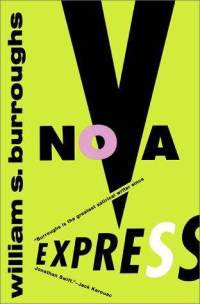 Nova Express by William S. Burroughs
YTD: 03
William S. Burroughs is an unusual author, and this book irritated me, in a way. I’ve decided to adjust my review a bit to fit my mood, reaction, and the author. I do this out of love and respect (and frustration). William S. Burroughs was a master of the cut-up technique – he was a postmodern writer, “Godfather” to the Beat generation, and he oftentimes had a habit of writing in a nonsensical, satirical way, particularly about things – political/social- that he felt were being addressed nonsensically by those in power. This includes, primarily, drugs, sex, and privacy. As Burroughs is a favorite of mine, and because this book and its predecessor (the third and first, respectively, in a trilogy, which includes a book called The Ticket that Exploded, which I’ll likely read later this year) were so ridiculously cut-up and disjointed, I’ve decided to pay homage in my review, thusly:
Plot/Story: 2 – Plot/Story could work with better development.
Third in a trilogy. Fourth in a quartet. Nova Express – agents of the body searching for, fighting against, elements exploding. Some sex – homosexual, heterosexual, asexual- mild. Tame. Boring, comparatively. Not the Wild Boys. Third book following Naked Lunch makes Burroughs prudish, bizarre, twisted, normal, odd. Remember disembowelment? Remember parasites – anuses, walking and talking? Anuses like mouths, with teeth to bite. Burroughs forgets – forgets the past, forgets the future, forgets, mid-sentence. Remembers. Where are the cats? The balance? Closed captioning provided by the Nova Agents – looking for you. Put you on drugs to make you weak. Make you stupid. Catch you on drugs – detox, death. Double paradox. Double jeopardy. No-win situation. Chemical and biological hazards, walking bombs, all of us. Overdose.
Characterization: 2 – Characters slightly developed.
Character development. Human faces, human emotions, inconsequential. Attachments where attachments due, feeling detached. Characters Good? Bad? These are descriptors – qualifying phrases applied to one and another, sometimes with cause and sometimes without. Fruit salad. Rabbits. “Agents.” Characterization lacking – list of goods, non-existence, list of bads, like The Goodbye Mister. People stand for things, things mean what? Control elements vs. language – power vs. power. Nature vs. machine.
Prose/Style: 3 – Satisfactory Prose/Style, conducive to the Story.
Jonathan Swift, but not really. Eat the young? Maybe. Probably – especially the boys, if they’re high. To get high. Brilliant in a way, subtle. Subtle but over the top – possibilities previously impossible, unexplored. “Good Grief, Charlie Brown.” Masterful like Stein – obnoxious like Stein. Henry Miller. Love child. Cut-up experimentation, finished. Culmination of phase, of trilogy, of mathematical series (four). Onward to reality (which is what, exactly?).
Additional Elements: 3 – Additional elements are present and cohesive to the Story.
Control elements: Government, Society, Culture. Language is virus. Language is power. To catch the virus – to get sick – to make noise. To be vocal, is power. Is wrong and right. Right is might. Speak out against Control Elements. Law powers create criminals to justify existence of Law powers. Good creates bad to create good. To be in control. Addiction, dependence. Junkies. Criminals are the powerful ones – only if infected. Infected with speech. What is human? Who defines humanity? Addicts, homosexuals, criminals – disappear for utopia? Not really. Make more for Utopia? Not really. Break down the walls – with voice – break down the walls to win.
Suggested Reading for:
Age Level: High School+
Interest: Drugs, Privacy (Invasion of), Sexuality, Cut-Up Prose, Postmodernism, Beats, Culture
Review: Gone With the Wind by Margaret Mitchell
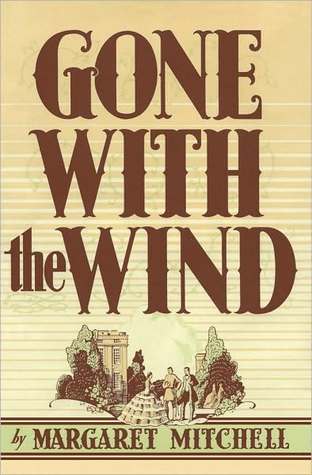 Gone With the Wind by Margaret Mitchell
Final Verdict: 4.0 out of 4.0
YTD: 1
Plot/Story:
4 – Plot/Story is interesting/believable and impactful (socially, academically, etc.)
“The greatest love story ever told.” “The epic novel of our time.” These are just two of the many descriptive phrases applied to Margaret Mitchell’s brilliant tome, Gone With the Wind. Is it an epic tale, indicative of the essence of the American south during the Civil War? Absolutely, it is. Is it one of the most tense, romantic, and familiar love stories of all-time? Yes, it definitely is. But, when it comes down to it, do these short phrases accurately describe what Gone With the Wind is all about? No, they do not. Gone With the Wind is about the end of an era – the collapse of a civilization. It is about selfishness and prosperity, morals and aristocracy, war and destruction, mercenaries and old maids. When we come right down to it, the book is about change and how people deal with change differently – some, those who understand how to take advantage of circumstances, will manage change with extraordinary success; others, those too old, naïve, or stubborn to adjust, are destroyed by change – deflated and disillusioned. In the tradition of Mark Twain’s Adventures of Huckleberry Finn and John Steinbeck’s Grapes of Wrath, Gone With the Wind is American reality in print – a detailed period piece which resounds beyond its time and echoes on through the ages.
Characterization:
4 – Characters extraordinarily developed.
I cannot think of another book that is written so perfectly and that I love so much, whose main characters are so utterly despicable and unlikeable. Scarlett O’Hara and Rhett Butler lack almost any kind of redeeming quality – they are easy to hate, yet, somehow, I love them. This is the mark of inspired writing and realistic characterization. Although I was often at odds with the actions of Scarlett and Rhett, I also sympathized with their plights and understood why they chose to act the way they did – why they made the choices they made. Some of the minor characters, too, were downright unbearable. From the faint-prone Aunt Pittypat to the combative India, from the faulty White Knight, Ashley, to the Yankee Army Wives, so many characters in the cast of Gone With the Wind are largely negative – foolish, weak, selfish, and proud, among other things. Still, as irritating as they might be, they are honest characters. They are believable and independent from one another, equally dislikeable, but each in his or her own way. Fortunately, there were some saving graces – characters easy to fall in love with, such as Scarlett’s angelic but deceptively strong sister-in-law, Melanie. Also, Scarlett’s loud but wise nurse, Mammy. Ellen O’Hara, too, the well-respected matriarch of Plantation Tara and, yes, even Scarlett’s verbose, drunken Irish father, are decent people – flawed, but champions nonetheless. Put together, this cast of characters, crafted and molded so superbly by Mitchell, are interesting to watch, easy to believe, and enjoyable to spend time with.
Prose/Style:
4 – Extraordinary Prose/Style, enhancing the Story.
At just over 1,000 pages, Gone With the Wind is quite the chunkster. Its subject matter, too, is hefty. Combined, the length and plot are seemingly daunting and the primary reason why it took me so many years to take this book down off the shelf, where it has been sitting for a half-decade. Surprisingly, I found myself breezing through a hundred pages a day and finishing the book in less than two weeks. One of the things I most hate in a book is lengthy chapters – chapters of 25 pages or more- and this book was filled with them; yet, for some reason, it hardly bothered me this time. So, why was I able to read the book so quickly? Interesting themes, partly. Entertaining characters, somewhat. But, largely, it was thanks to the prose. While, at times, I found the romantic (lower-case “r”) a bit over the top, it was not so dramatic as to distract from the more important elements of the story. That being the one minor complaint – all that is left to say about the style and prose of this work is that they are simply lovely. The language is fluid and charming, as befits a story about the American south. The dialogue is well-spaced and delivered appropriately, supporting the general narration and the many internal monologues of Scarlett. There were some grammatical errors, becoming more frequent later in the book, but this is a complaint against this particular edition (1973) and the publisher (Avon), not the author.
Additional Elements: Setting, Symbols/Motifs, Resolution, etc.
4 – Additional elements improve and advance the story.
Instead of trying to describe the many interesting and important elements of this book – the topics covered, the politics presented, the societal elements explored- it might be easier to talk about what was not in this book. This is a book about the American south – and there are many different types of southerner depicted here, with ample time provided to express their belief systems, social ideals, political aspirations, etc. The one thing missing which could have provided some more insight would have been a prominent Yankee/Northern character. Still, as I’ve mentioned a few times – this is a southern book, and it is appropriate that it be presented through southern eyes (mostly Georgian, although there are brief interludes from Louisiana, Virginia, and even Ireland). Perhaps the most interesting elements in the book is the battle between the decline of the “Old” south and the rise of the “New” (characterized by the “Oldies” as scallywags). The nature of love, too, and the blinders we place upon ourselves – the distracting fantasies, the aching for the past – are intimately, almost painstakingly evaluated. Ultimately, though, it is perhaps Scarlett’s oft repeated thought, “I’ll think of it all tomorrow. I can stand it then,” which sums up the various aspects of this book and its themes. So much has happened, so much has changed. It is only those who can continually refocus, who can stay strong and positive, and who can adjust to the changes, sacrificing, at times, prior ideals, who will survive the turmoil.
Suggested Reading for:
Age Level: High School +
Interest: American South, Civil War, Antebellum Era, American Reconstruction,
Notable Quotes:
“My dear, I don’t give a damn.”
“He never really existed at all, except in my imagination. I loved something I made up . . . . I made a pretty suit of clothes and fell in love with it.”
“Death and taxes and childbirth! There’s never any convenient time for any of them!”
“After all, tomorrow is another day.”
“If the people who started wars didn’t make them sacred, who would be foolish enough to fight? But, no matter what rallying cries the orators give to the idiots who fight, no matter what noble purposes they assign to wars, there is never but one reason for a war. And that is money.”
“As God is my witness, I’m never going to be hungry again.”
2011 Reading Survey
Hosted by: The Perpetual Page-Turner
1. Best Book You Read In 2011?
We the Animals by Justin Torres. Far and away the best read of 2011. I did also enjoy The Night Circus by Erin Morgenstern and Under the Poppy by Kathe Koja. Some great classics found their way in, too: The Garden of Eden by Ernest Hemingway and 1984 by George Orwell. All of these books got perfect ratings from me.
2. Most Disappointing Book/Book You Wish You Loved More Than You Did?
The Golden Mean by Annabel Lyon. I so, so wanted to love this book. When I first found out about it, I was stoked! A story about Alexander the Great’s boyhood, and his mentor Aristotle? AMAZING. Unfortunately, it just wasn’t very good.
3. Most surprising (in a good way!) book of 2011?
Ragtime by E.L. Doctorow. I’ve had the book on my shelf for years – sort of afraid to pick it up. I loved my one other experience with Doctorow (Homer & Langley) but, for some reason, I had a fear of hating this one, or being bored by it. Fortunately, it was brilliant and I loved it. Great way to end 2011! I’ll be reading Billy Bathgate sometime in 2012, since I’ve owned that one for quite some time too.
4. Book you recommended to people most in 2011?
We the Animals by Justin Torres.
5. Best series you discovered in 2011?
Well, I’m not sure I would say I “discovered” this series in 2011, since I’ve known about it since I was a boy – I used to watch the movies and t.v. show, I dressed up as the main character for Halloween, etc. But, the best series I dove-into reading-wise for the first time in 2011 was definitely the Sherlock Holmes series by Sir Arthur Conan Doyle. I read the first two novels (A Study in Scarlet and The Sign of Four) and cannot wait to read more in 2012!
6. Favorite new authors you discovered in 2011?
Andrew Smith (author of one of my favorite books of 2011, Stick).
7. Best book that was out of your comfort zone or was a new genre for you?
Hmm.. there’s not much that I would consider out of my comfort zone. I did, however, read some “Classic Erotica” this year. I discovered a book called Teleny, or The Reverse of the Medal which was technically written anonymously, but scholars have deduced that the likely author was Oscar Wilde. Now, being a vehement originalist (one who searches for unexpurgated and unabridged original texts) and a lover of Wilde, I had to get my hands on a copy. I did. I had to read it. I did. And, I loved it! I don’t read erotica, but I’ll never refuse to read Oscar Wilde.
8. Most thrilling, unputdownable book in 2011?
Either The Emerald Atlas by John Stephens or The Eyre Affair by Jasper Fforde
9. Book you most anticipated in 2011?
Probably The Son of Neptune by Rick Riordan. And The Marbled Swarm by Dennis Cooper. They didn’t disappoint!
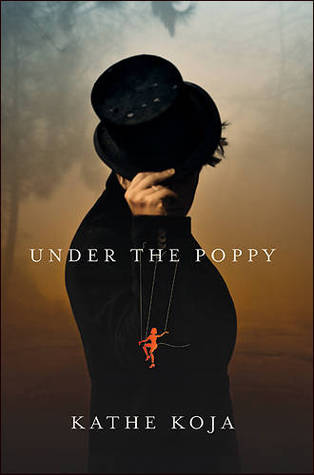
10. Favorite cover of a book you read in 2011?
11. Most memorable character in 2011?
Oh, boy. Let’s see. There are Tristan and Istvan from Under the Poppy. The narrator from The Marbled Swarm. Humbert Humbert from Lolita. So many good ‘uns!
12. Most beautifully written book read in 2011?
The Night Circus by Erin Morgenstern and Lolita by Vladimir Nabokov were probably the best written books I read in 2011. The Agony and the Ecstasy by Irving Stone as well.
13. Book that had the greatest impact on you in 2011?
We the Animals by Justin Torres (Am I sounding like a broken record yet??)
14. Book you can’t believe you waited UNTIL 2011 to finally read?
1984 by George Orwell – so freaking good!!
15. Favorite Passage/Quote From A Book You Read In 2011?
There is a drowsy state, between sleeping and waking, when you dream more in five minutes with your eyes half open, and yourself half conscious of everything that is passing around you, than you would in five nights with your eyes fast closed, and your senses wrapt in perfect unconsciousness. At such time, a mortal knows just enough of what his mind is doing, to form some glimmering conception of its mighty powers, its bounding from earth and spurning time and space, when freed from the restraint of its corporeal associate.” – Oliver Twist, Charles Dickens
16. Book That You Read In 2011 That Would Be Most Likely To Reread In 2012?
I will definitely be re-reading Stick by Andrew Smith.
17. Book That Had A Scene In It That Had You Reeling And Dying To Talk To Somebody About It? (a WTF moment, an epic revelation, a steamy kiss, etc. etc.) Be careful of spoilers!
The opening scene from Under the Poppy by Kathe Koja is INSANE. I loved it and it definitely set the tone for the rest of the novel, but it was a “SAY WHAT?!” moment, for sure.
Book Blogging/Reading Life in 2011
1. New favorite book blog you discovered in 2011?
Hmmm… that’s tough. I really think all my 2011 favorites are old favorites from 2010. The blogs I visit most often are:
A Literary Odyssey, A Room of One’s Own, Dead White Guys, and The Blue Bookcase.
2. Favorite review that you wrote in 2010?
I suppose I was pretty proud of my reviews for 1984 and Oliver Twist.
3. Best discussion you had on your blog?
Darkness and Light in Young Adult Books
4. Most thought-provoking review or discussion you read on somebody else’s blog?
I think the number of posts that came up about the “darker” elements of YA were interesting to read, as were the many posts on censorship and banned books. Nothing I can (or want to) point to specifically right now, though.
5. Best event that you participated in (author signings, festivals, virtual events, memes, etc.)?
Book Blogger Appreciation Week, ArmchairBEA, Indie Lit Awards, Literary Blog Hops, Dewey’s 24-Hour Read-a-thons, Random Acts of Kindness (R.A.K.) and Blog Bash.
6. Best moment of book blogging in 2011?
When Roof Beam Reader was nominated for -and made it to the final round of voting in- a BBAW award (Best Literary Fiction Blog). That was an incredible honor and a great moment for me and the blog.
7. Most Popular Post This Year On Your Blog (whether it be by comments or views)?
My most viewed post is my review of Oliver Twist by Charles Dickens (interesting, because it has hardly any comments). My most commented-on post is the 2012 TBR Pile Challenge Sign-Ups! A good sign for reading in 2012, I hope!
8. Post You Wished Got A Little More Love?
Hm.. maybe my review for Lullaby by Chuck Palahniuk.
9. Best bookish discover (book related sites, book stores, etc.)?
Out of Print Tees. Oh, yeah!
10. Did you complete any reading challenges or goals that you had set for yourself at the beginning of this year?
I completed my own 2011 TBR Pile Challenge (barely) but I failed miserably at all the other challenges I signed-up for. In 2012, I’ve limited myself to three challenges, and I really think I can manage them!
Looking Ahead…
1. One Book You Didn’t Get To In 2011 But Will Be Your Number 1 Priority in 2012?
Gone With the Wind – I’m reading it right now!
2. Book You Are Most Anticipating For 2012?
Passenger by Andrew Smith (the sequel to The Marbury Lens)
3. One Thing You Hope To Accomplish Or Do In Your Reading/Blogging In 2012?
I hope to stay active in the community in general – participating in various events and such. I would like to meet some more book bloggers (new ones, or ones I just haven’t developed a relationship with yet) and keep in contact with some of my favorite book-blogging pals. I’d love to attend some in-person events, too, such as BEA. We’ll see.
Review: Ragtime by E.L. Doctorow
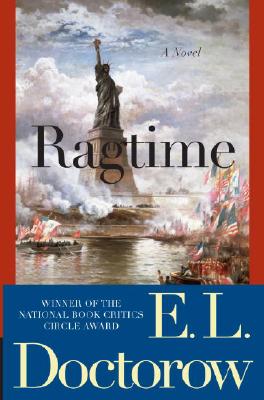
Final Verdict: 4.0 out of 4.0
YTD: 69
Plot/Story:
4 – Plot/Story is interesting/believable and impactful (socially, academically, etc.)
E.L. Doctorow’s Ragtime is one of those, “I can’t believe it took me so long to read this” kind of books. It has been sitting on my shelf for years, intriguing me but intimidating me at the same time. I have only ever read one Doctorow novel (Homer & Langley), which I loved, but for some reason, I didn’t believe Doctorow could do such a brilliant job twice. I was wrong. Ragtime is early-20th Century American in print. Henry Ford, Harry Houdini, and J.P. Morgan, racial tensions and union-building, women’s suffrage and world wars: Ragtime has it all, because America was dealing with it all.
Characterization:
4 – Characters extraordinarily developed.
The story is narrated by an unknown third party, who refers to certain characters as “Mother and Father,” but who is never a part of the story himself. It is possible that he is their “adopted” son, but this is conjecture since the issue of the narrator is never addressed. It may also simply be a third-person omniscient presence, indicative of “the Historian.” Aside from this family, the main characters include a diverse group of folks, including: Harry Houdini, J.P. Morgan, an African-American pianist and the woman (maid to the above-mentioned family) who had his child, as well as a young, beautiful Starlet, a Jewish man and his daughter, and a women’s rights activist. Each of the characters represents something important about America at the time – an ideal, a bigotry, a fear, a promise. From the entrepreneur to the artist, from the activist to the magician, these people are individuals who, whether closely or distantly connected, shape the nature of a nation.
Prose/Style:
4 – Extraordinary Prose/Style, enhancing the Story.
At nearly 400-pages, this book – a period piece- could easily have been a drag. Historical fiction has been hit-or-miss with me. Some, like Irving Stone, manage to dance the delicate tight-rope of fiction and non-fiction, so that the real events –the facts of historical situations- are presented to the reader in a creative, highly readable way. Other authors make the mistake of presenting their works like a textbook, even if their story is largely fictionalized, so there is little pleasure or enjoyment to be gained from the experience of reading the book itself. Doctorow is much the former. Although he is dealing with real events and experiences, and has obviously done the research required for accuracy, his craftsmanship in writing truly shines. He is a brilliant storyteller and creative writer, who combines the real and imagined in a seamless way. The book was a page-turner for two reasons: the premise and the prose. They both work wonderfully.
Additional Elements: Setting, Symbols/Motifs, Resolution, etc.
4 – Additional elements improve and advance the story.
There is so much to say in this regard, that it is hard to know where to start. For anyone who is curious about America in the early-1900s, I would suggest this book. It is relevant, factual, believable, and still entertaining. There are so many different elements being explored (Mother/Son relationships, Employer/Employee relationships, the Immigrant experience, the Female experience, the Inventors, the Millionaires, the poor, and the powerful) that it makes the reader question who is the main character of the book. This can be distracting, until one realizes that the main character is The American. This book is entirely about the experience of being American in America during this time, and the realization that “American” meant so many different things (hope, power, money, love, equality, individuality, freedom) to so many different people but, also, the same thing to everyone: respect.
Suggested Reading for:
Age Level: High School +
Interest: American History, Literature, Historical Fiction, Race Relations, American Dream
Notable Quotes:
“It was evident to him that the world composed and recomposed itself constantly in an endless process of dissatisfaction.”
“Friendship is what endures. Shared ideals, respect for the whole character of a human being.”
“It occurred to Father one day that Coalhouse Walker Jr. didn’t know he was a Negro. The more he thought about this the more true it seemed. Walker didn’t act or talk like a colored man. He seemed to be able to transform the customary deferences practiced by his race so that they reflected to his own dignity rather than the recipient’s.”
“And though the newspapers called the shooting the Crime of the Century, Goldman knew it was only 1906 and there were ninety-four years to go.”
Review: The Optimist’s Daughter by Eudora Welty

The Optimist’s Daughter by Eudora Welty
Final Verdict: 3.0 out of 4.0
YTD: 68
Plot/Story:
3 – Plot/Story is interesting & believable.
The Optimist’s Daughter is primarily a story about place, position, and values, although it does also touch on familial relationships and dealing with grief and the lost past. The main character, Laurel, is a calm, level-headed, independent woman – strong and filled with common sense and class. She comes home to tend to her father, who must undergo retinal surgery. The father’s young wife, Fay, is Laurel’s polar opposite – naïve, vain, vulgar, selfish and quite stupid. Laurel is Mississippian, while Fay and her family are proud Texans – and the portrayal of Mississippians as genteel and classy, while Texans are crass and dirty, is impossible to miss. The novel’s primary focus seems to be an examination of regional culture (with clear implications for and against those territories which are explored); however, Fay the Texan is so unabashedly stupid and Laurel the Mississippian so prominently “good,” that the didactic overshadows much of what could have been implicit and thereby more entertaining than sermonized.
Characterization:
3 – Characters well developed.
In general, the minor characters and those on the periphery (particularly those who are deceased prior to the start of the story, so are referred to in flashbacks/conversation, etc.) are the saving grace for this category. The main character – the Judge and “Optimist”- is portrayed simultaneously as hero and victim, as godlike and wholly human. In remembrance, he is eulogized as a giant of the community, but his own daughter remembers him much differently. Welty touches on an interesting and honest aspect of human nature, here, but it is the only truly complex (and still too plainly delivered, in my opinion) element of characterization. The other main characters, Fay and Laurel in particular, are starkly contrasted and without subtlety, making them rather uninteresting. Laurel’s “bridesmaids” – the southern women- are funny, so also make the story more palatable.
Prose/Style:
3 – Satisfactory Prose/Style, conducive to the Story.
Welty’s prose is clear and uncomplicated, which mirrors her story quite well. The dialogue is handled nicely, as are the flashbacks – some of the most touching moments of the book are the segments wherein Laurel reminisces about her mother and (briefly) her deceased husband. The story reads well because Welty tells it well – and this comes across in her writing. The novel was originally published as a short story – later expanded- and this comes across at times. As a short story, the dichotomous characters and opinionated (almost grotesque) regional descriptors may have worked much better, but as no complexity seemed to be added to the story when it lengthened, the book often comes across as a really long short story, which is in a way antithetical.
Additional Elements: Setting, Symbols/Motifs, Resolution, etc.
3 – Additional elements are present and cohesive to the Story.
There are clearly themes that Welty is exploring here: Southern regionalism, North (Chicago) and South (Mississippi/West Virginia), Duty to Parents, Stepmother (young bride) syndrome, Selfishness, Memory (undue homage), and even the idea of Optimism itself. Perhaps the most interesting (or confusing) element of the story – and the one to really consider, is this latter idea of optimism. What does it mean to be optimistic? Who in this story is The Optimist? We would assume (and are flat-out told, at one point) that the old Judge is the optimist and, when he passes, the duty of the optimist falls upon his daughter (hence the book’s title); however, very few instances of optimism are ever demonstrated by either of these two characters. So, we think about Laurel’s mother – who died years before the Judge. Perhaps, through Laurel’s memory, we will discover that Laurel’s mother was the true optimist of the family. Not quite. This leaves Fay – the one who tries to “scare the judge into living.” Was she really so naïve as to believe such a thing would work? Is Welty equating optimism, then, to naïvete – to a juvenile way of viewing the world? And here the real story begins…..
Suggested Reading for:
Age Level: High School, Adult
Interest: Death and Dying, Family, Grief, Widowhood, American South, 1960s America, Individuality, Memory, Nostalgia, Class, Caste/Societal Position, Regional Relations.
 Roof Beam Reader