Roof Beam Reader
Adam Burgess
Censoring Mark Twain: A Literary Embarrassment
Censoring Mark Twain: A Literary Embarrassment
NewSouth Books is publishing an edition of Mark Twain’s Huckleberry Finn that removes every occurrence of the “n-word” and replaces it with the word “slave.” I am outraged by this desecration of a classic American masterpiece – the editor specifies readers’ “discomfort” and possible book banning as reason enough to censor the book, but my question is: Where have all the teachers gone?
Mark Twain wanted us to be uncomfortable, that’s the whole point. He wrote the story to reflect the attitudes and situations of the people – to force Americans to look this problem in the face, reflect on it, and deal with it. My hope is that everyone who cares about honesty in American history and the liberty and protection of writers, will speak up and out against Blair Publishing and this asinine, spineless censorship.
The work is provided with an Introduction by Editor Alan Gribben, who attempts to explain his reasoning behind censoring all 217 occurrences of the word nigger, as well as other racial slurs against Native Americans. The intent, based on Mr. Gribben’s argument, is not to replace the original work, which scholars and the literati will no doubt continue to prefer, but to make the book more accessible to less-learned or more sensitive readers, by excluding one of the English language’s most hateful descriptors.
As my readers know by now, I am a staunch opponent of any type of censorship. I can certainly understand where Mr. Gribben is coming from – his hope, as a Twain scholar – is to make the book (truly, the defining piece of American literature) more commonly listed amongst school reading lists and more confidently taught in classroom settings. This is admirable, to be sure, but at what price? My questions are as follows: 1) Who gives anyone the right to alter the original intent of an author, particularly one as paramount to American literature as Mark Twain; 2) How is it not plain to see that, by removing the word and its overall sentiment, you dilute the meaning and intent of the work; and 3) When does shielding a sensitive public from the truth of a time, place, or particular sentiment, do the people any justice?
Let me take a walk through Mr. Gribben’s introduction (found here), point out areas of disagreement, and explain my own reasons for being so utterly outraged and fearful for the future of American literature, if its masters’ origins –the foundations for all American writers to follow- are in peril.
On page eleven, Gribben points out that “Twain scarcely had to concern himself about the feelings of African American or American Indian readers.” What Gribben does not mention, though, is the actual reason why Twain was only concerned with white readers, which is this: It was the white reader’s mentality and attitudes which Twain was calling into question. Twain was not concerned about offending anyone, because he was hoping to rattle the cages, to get people worked up, annoyed and, ultimately, reflective.
On page twelve, Mr. Gribben reminds us that Huck Finn was said to have been a boy of “’sound heart and a deformed conscience’ – in other words, someone reared amid such pervasive prejudice that he had a hard time seeing through its premises.” I agree with Mr. Gribben on this point, but I would ask – how, then, by denying the reader the opportunity to truly live in Huck’s world, to see first-hand the complete and utter disrespect and debasement with which Huck’s “role-models” treat the minority races, can the reader get this sense of Huck’s internal struggle? He goes on to say that the “implications of permanent inferiority . . . repulse modern day readers,” at which, I assume, Twain would stand up and cheer! Thank goodness these words and actions repulse modern readers – they should! And they should be there, always, as a reminder of a time when we, as a society, were not repulsed, so as not to ever forget and thereby repeat the damaging mistakes of our past.
When we get to page thirteen, Mr. Gribben mentions how he is “unable to utter the racist put-downs spoken by numerous characters” in the book, when giving lectures or public readings, then seems surprised that the audience, too, would feel discomfort. The audience, like the classroom, will take its cue from the speaker (as Mark Twain well understood). The solution, then, to this “nagging problem with the text” is not resolved, as Mr. Gribben asserts, by simply removing the words – it is only masked. The key is not to turn from these feelings, but to embrace and examine them – to explain the text, as it is, and as it was meant to be. Open up a dialogue, learn from one another. Will it get uncomfortable? Probably. Will some be hurt, others saddened, and still others hardly affected at all? Absolutely, yes. But by masking the true nature of the work, and the intent of the author, we do a great disservice to Twain’s bold and near-revolutionary stance on social conscience – and that is the lesson we should be teaching, the point we should be getting across. Mr. Gribben seems to forget that the language of this novel is not a “problem,” as he concludes, but is in fact the key element of the story, without which it would not stand as the beacon of American literature that it is today.
On page fourteen, Mr. Gribben reasserts a notion he had been signifying throughout the initial portion of the Introduction, which is that Huckleberry Finn has long been considered the “mandatory statement about American slavery.” I would argue, though, that the book is not about American slavery, it is about the American conscience, and Mark Twain, by making use of genuine dialect, slang, and inflammatory language, was needling at his readers’ consciences from start to finish.
We arrive at page fifteen, wherein Gribben empathizes with teachers who are weary of assigning the beloved classic “because of the hurtful ‘n word.” Gribben asserts that this is “proof that a single debasing word was overwhelming every other consideration.” If this is true, then the tragedy is not the presence of the hurtful word in this great American text, but in the lack of courage in our teachers. Where are our Aristotles? Our Platos? Who is teaching our teachers how to teach, and why have they become so afraid of facing American history realistically and explaining to our future generations where we came from, who we were, and what we have tried to become? There is no “here” without a “there” and it was the river-boat journey in-between which carried us ever-onward.
Gribben goes on to state that “the term ‘slave’ is recognized globally as an affront to humanity.” Yes, as it should be – but Huckleberry Finn can hardly be read “authentically,” as Gribben asserts, if this stated attitude, and Huck’s journey itself, is diluted by the censorship of its most offensive language; the counter-sentiment to Huck’s cry: “All right, then, I’ll go to hell!” when he chooses to stand by Jim despite the “civilized” beliefs of his society (that the Christian thing to do with a runaway slave is return him) must be there in full-force, or we reduce that most momentous of literary moments to something fleeting and inconsequential.
On page seventeen, Gribben makes a valid point about how teachers become misguided in their attempts at teaching this text. He says that, “some teachers go so far as to write the offensive word in large letters on the board and encourage their students to exchange opinions about it.” Of course, this approach could be disastrous, if the dialogue is not carefully and sensitively planned and guided, with previous historical insight into the presence of the word in the text, where it comes from, and what Twain was doing with it. I once had a Biology teacher who would throw out similarly provocative words, related to anatomy rather than literature, in an attempt to “break the ice” and get her students more comfortable with the “naughty words.” Did it work? Not really – but that was largely because the teacher did not treat the words as seriously as they should have been, as the teacher with the large letters on the board probably had not done. But to erase the word completely is equally harmful to our understanding of the work itself, and to the possibility for further progress and growth as a people who are capable of learning from and lamenting the past, without having to be mired in its shames without opportunity (the opportunity being social and personal maturity).
Later in the Introduction, Gribben somewhat paradoxically claims that if the “allusions to an inhumane institution” (slavery) make readers uncomfortable, it is a fortunate thing. He goes on to ask: “Would we rather have a novel written about the American South of the 1840s that entirely avoided the existence of slavery?” How does one distinguish, then, which aspects of the American South of the 1840s are worthy of inclusion, or deserving of exclusion? There are current attempts at re-writing that history, excluding the existence of slavery from classroom textbooks, for instance, which Gribben would seemingly oppose vehemently, based on his assertions above. But how does he disassociate that question from this one: Would we rather have a novel written about the American South of the 1840s that entirely shies away from the existence of derogatory slurs and very real social sentiments of that time, negating any of the progress we have made to-date? It seems Gribben makes this argument by focusing again only on slavery as the issue in Huckleberry Finn but it is not just slavery being berated by Twain – it is racism and the human conscience. Twain is begging his audiences to WAKE UP, not to roll over, cover their eyes and ears, and hope that all the bad words go away.
Similarly, Gribben points out the importance of the oft-debated and somewhat offensive “sometimes comically ungrammatical dialect.” On page twenty-seven, Gribben argues that “Jim speaks with an untutored dialect because it was against the law in most slave states to allow slaves to attend school or otherwise learn to read and write.” This is an interesting argument, and one with which I agree and have made in my own defense of authentic dialect in this novel. Yet, if the dialect is so offensive to many, how can Gribben be for leaving it in the text while being for excluding what was then a very real, common, and authentically used term? These are two sides of the same coin, both equally important, but to argue in favor of one and in opposition to the other is a blatant double-standard, and one which needs serious re-evaluation. I agree completely with Mr. Gribben’s point that the dialect must be left genuine, and my argument is the same for the use of natural, if highly offensive language. How do we justify honoring the contentious grammar, but then completely remove the controversial language? Why cannot we teach the importance of both, in parallel, in the same way? It seems by removing the heated language from the natural dialogue, we are deflating a balloon – the item retains its vivid color, and is certainly something to be held in one’s hand, but with very little purpose.
Gribben concludes by speaking to the impact Twain’s writing (Tom Sawyer and Huck Finn in particular) had on modern American literature. He mentions that, by affording us a naïve and rather unreliable (by virtue of being uneducated) narrator in Huck Finn, the reader is then made “to carry out most of the task of constructing its meaning.” He furthers this by noting that the book “prompts readers to check on whether or not they are succumbing to social pressures in order to avoid admitting that a pervasive practice might be tremendously wrong.” He relays this information in direct correlation to the reasoning behind many nations’ attempts at banning or censoring the book (fear of revolution) – though he does not see that he now is the one “succumbing to social pressures” (31) by censoring the greatest of all American novels because it is preferable to causing offense and it is easier than explaining true intent by forcing readers to search for deeper meaning. Gribben mentions that it is “conformist and cowardly of us to assume that prevailing laws and customs, no matter how solidly established, are too sacrosanct to be skeptically examined and tested.” Fortunately, the pendulum of explicitly racist dialect has swung far from its arc of the 1840s; unfortunately, however, what is now “sacrosanct” is the view that any racist language, regardless of purpose and intent should be barred on the grounds of preserving dignity and righting historical wrongs – this, sadly, misses the obvious: Twain, by being scrupulous and meticulous in his prose – language, dialect, and narrative voice – was the original champion for the idea of alike humanity and common decency. Censoring his work, diluting the errors and passions of the characters, and ignoring the truth and reality of the time only furthers the misunderstanding that the work in some way perpetuates racist feelings. Upon correct reading and careful guidance and instruction, one realizes that this book does just the opposite, and rather than taking the simple road out – away from the sensitive spots – we should, instead, fight for confident, competent, and courageous teachings of these socially and historically significant works.
*As a side-note: I am particularly bothered by a certain bit of logic that Mr. Gribben attempts to use, in support of his argument. At one point, he tells an account of how he, at a Mark Twain conference in Pennsylvania, had to cross a line of picketing parents to get into the venue. The parents were there, reportedly, because one teacher had asked an African American boy to read the part of Jim, the slave. This, not unexpectedly, caused an incident and flamed the protest; yet, one must ask – how exactly does this relate to the book itself? One teacher’s ineptness at presenting the material, or one group of parents’ potential over-reaction, has nothing to do with the power of the book. It is duplicitous to infer that these parents were there protesting the book, based on its language or anything else, when they were, in actuality, protesting the apparent discrimination in the classroom, which could have been, through proper use of Twain’s text, a learning experience for all. The use of this anecdote is a flawed logic and should be dismissed, as the two arguments (one against the events in the classroom; the other against the book) have nothing to do with each other.
“The difference between the almost right word and the right word is really a large matter – it’s the difference between the lightning bug and the lightning.” – Mark Twain
Review: Under the Poppy by Kathe Koja

Under the Poppy by Kathe Koja
Final Verdict: 3.75 out of 4.0
YTD: 1
Plot/Story:
4 – Plot/Story is interesting/believable and impactful
If you can imagine a marriage between the coy, tongue-in-cheek, clever mysteries of Agatha Christie and the melancholic, whimsical, romantic lyricism of Shakespeare, then perhaps you have an understanding of what Kathe Koja has created with Under the Poppy. The place is 1870s Brussels, amidst what one assumes is the beginnings of the Franco-Prussian War (at least, this reader assumes, as he is unfamiliar with any other war of this time and place). The book’s main players – Rupert Bok and Istvan – are life-long lovers, drawn together in boyhood, pulled apart by circumstances. The two, in their youth, somehow became entangled with the darkest, most powerful and secretive of high-society. That entanglement, coupled with the two’s dangerous romance (never spoken aloud, but so clear to all), results in a perpetual cat-and-mouse game between the story’s antagonists (de Metz and his servants – the General, in particular) and the puppeteer-players. The somewhat under-explained history between the two puppeteers (primarily Istvan) and their former masters is what drives the drama onward, resulting in feints and volleys, dashes and escapes, relationships severed and deepened, and, ultimately, wounds scarred, but healed.
Characterization:
3 – Characters well developed.
What certainly shines in terms of characterization in this novel is the genuine presentation of the main characters, who happen to be homosexual. In another story, as written by another author, it is likely that these two men (and some of the minor characters as well) would have quickly turned into grotesques – exaggerated stereotypes for the larger perception of “gay man.” Instead, Koja allows each to be an individual, and both are strong in their own ways, talented in their own ways, and equally devoted to the other, in his own way. Realizing that the portrayal of these two characters was going to allow for not a “gay historical romance” but just a historical romance, period, quickly afforded me enough peace of mind to truly immerse myself in the story. The one less-than-perfect aspect to be found in this book, at least for me, is the somewhat shallow characterization and character development. Now, to be clear, the characterization in the book is good – it just wants deeper and more thorough development. What is interesting and unusual is that each of the major players – Istvan, Rupert, Benjamin, Isobel, Lucy, Ag, and even Mr. Arrowsmith, are so incredibly recognizable and distinct, and yet still under-developed. The disappointment, in large part, is not due to the fact that these characters are poor, because they are, in fact, rather fantastic; however, with these characters, there seemed so much more room to grow. Knowing more of their histories, for instance, their previous interactions with one another – the “how” and “why” of their relationships – would bring so much to the story, enriching it with a deeper substance that just was not present, because these relationships and histories remained largely a mystery. Of course, the sense of mystery allowed for a dramatic effect, overall, which speaks largely to the book as a play – which, perhaps, is right on point, considering the subject matter and the intent to mirror the puppeteers with their puppet-masters with the string-pulling of the narrative itself. So, ultimately, one is left not so much with a disappointment in the characters (because who could be disappointed in these beautiful, sad, lonely and heroically tragic creatures?) but in a craving for more – and knowing that the more was there to be had, if only…
Prose/Style:
4 – Extraordinary Prose/Style, enhancing the Story.
This particular section has been a point of contention for me, but I am erring on the side of the artistic, and forcing my personal structural preferences out of the picture in hopes of relaxing and enjoying the aesthetic aspect of the novel, in lieu of proper form. Of course, one must do this on many occasions with creative works, particularly those with an artistic function and subject-matter (like the stage!). Still, I will be up front in saying: I like grammar. I enjoy quotation marks and separated dialogue and internal monologue. I prefer different speakers to be distinguished by paragraph (or at least line) breaks. And none of this happened in Under the Poppy. At first, this made it very difficult for me to sink into the story – until I realized that the point is to let go. Then, my goodness! The artistry of the prose, the fluidity of the language, the sensuality and connectivity of the descriptions – no reader could ask for more, particularly from such an intensely romantic novel, which takes itself seriously by virtue of beauty and honesty alone. There is something strangely cohesive, too, between the relationship enjoyed (ever-painfully) between Rupert and Istvan, and the prose of this work – it is almost as if Rupert and Istvan are whispering their story, and those whispers scrawl themselves across the pages, so that thoughts and feelings, actions and desires, all pour out in series after series of emotional memory. There are points in the story when it almost seems like the words – the passions- are moving right through you, and out the other side, so, suddenly, you are the story and you feel it in every inch of your being. This is almost impossible to describe, but when a grammatical linguist can become enthralled and moved by a type of free-verse prose, well, that is a laudable accomplishment, indeed.
Additional Elements:
4 – Additional elements improve and advance the story.
If ever the phrase “all the world’s a stage / and all the men and women merely players” were to fit a novel – this would be that novel. Koja leaves the reader stunned by the brutal honesty of the story – no punches are pulled, and yet the tale is told so beautifully, so passionately, and so artistically, it becomes hard, at times, to pull one’s self off of this stage and remember that we are only the audience to this bittersweet drama. Perhaps the most impressive aspect of this novel is its decorum. How is it conceivable that a story about a saucy and crafty puppeteer, coming to live with his male-lover in a brothel, will turn out to be nothing but heartrendingly sweet and heroic? In the style of Dumas, less swashbuckler, or Austen, more twisted, it is so; this incredible tale, which starts off with perhaps one of the most memorable scenes I have ever read, quickly defines itself as a serious, old-fashioned, romance-mystery, the likes of which the Bronte sisters may have admired. A story like this could have easily become trite or even bawdy, but Koja manages to keep it delicate, tender, and truthful. Overall, this reader was incredibly impressed with Koja’s performance – the story certainly lives up to the romance of the book’s cover art, which originally drew me to it. Bravo! Merde! And may the show go on!
Suggested Reading for:
Age Level: Adult
Interest: GLBT, History, European History, Belgium History, Puppetry, Theater, War, Secret Societies, Romance
2010: My Life in Book Titles


How do you feel: Dangerous Laughter

Describe where you currently live: The Beautiful Room is Empty

If you could go anywhere, where would you go: The House in Paris

Your favorite form of transportation: The Wings of Merlin

Your best friend is: A Single Man

You and your friends are: The Dream Police

What’s the weather like: A Season in Hell

Favorite time of day: The Meaning of Night

What is life to you: Vanity Fair

Your fear:The Pillowman

What is the best advice you have to give: Look at the Birdie

Thought for the Day: Existentialism and Human Emotions

How I would like to die: Safe

My soul’s present condition: Light Boxes

My Top 10 Books of 2010
Top 10 Tuesdays
Top Ten Tuesday is hosted by The Broke and the Bookish.
This week’s theme is “Top Ten Books I Read in 2010.” Now, I am automatically excluding Under the Poppy, because I am not sure I will finish it by the end of the year (blasted overtime at the real job!) BUT I am definitely enjoying it, so I didn’t want there to be any misconceptions there. I’m also going to do my best to pick THE Top 10, but I do want to include a mixture of genres – hopefully it will just turn out that way without my having to try. Anyway, on to the list!
1. Who’s Afraid of Virginia Woolf? by Edward Albee
This was one of the funniest and saddest books (plays) I have ever read. The characters were horrifying in their actions and heartbreaking in their loneliness. The over-the-top comedy, though, allowed me to really enjoy what was happening (the insanity!) while still being affected by the plot.
 2. The House of the Spirits by Isabel Allende
Probably one of the most “majestic” books I have ever read. Allende’s prose and style are unbeatable, and the powerfully moving glimpse of South American history we get is really a masterful achievement. This is a book where one learns so much (about history, politics, society, and the art of writing) while simultaneously being treated to one of the most beautiful stories ever written.
 3. Will Grayson, Will Grayson by John Green & David Levithan
When I heard that John Green and David Levithan were teaming up to write a novel about the life and times of a manic-depressive gay teenager, I was understandably stoked. The authors of Looking for Alaska and Boy Meets Boy working together? Brilliant! What they achieved, though, is more than even I, an admitted fan of both writers, could have imagined.
4. A Single Man by Christopher Isherwood
The novel takes place in the course of one day – so the characterization was probably as well developed as it could be; the emotion of the novel – the desperation and sadness were genuine and personal – I felt exposed and violated, frustrated and hopeful. I could see myself in George – the future me – and I was disappointed in myself at times, proud of myself at times, but – ultimately – I was left with the sense of knowing who I am (who George is) and of accepting things as they are. The only truly possible way of living a satisfied (not happy) life.
 5. The Boy With the Cuckoo-Clock Heart by Mathias Malzieu
The Boy with the Cuckoo-clock Heart is a terrifying marriage of Peter Pan and Pinocchio. We have, here the fantasy-boy, whose life and self-image are largely designed by a lonely, childless elder, similar to Pinocchio’s Geppetto, and we have the boy’s struggle with maturity and growth – the Peter Pan who never wants to grow up, or who just cannot figure out how to do it. The story is a dark and cynical fairy tale which, admittedly, will not be for everyone; in fact, I would be reluctant to recommend the book to anyone, as it is rather sad, confusing, and bizarre. That being said, the overall sentiment is the dangerous power of love – unwelcome, unrequited, unrealized, or unknown. It is one of the most fascinating and ever-present themes in literature and in life. Malzieu delivers his version of this never-ending story in an eccentric way, but it is outlandishly beautiful and poignant, despite the failures in characterization and the not-so-happy ending.
 6. Of Human Bondage by W. Somerset Maugham
As I mentioned above, regarding the Plot, Of Human Bondage was a great story in its own right, but it also posed two very interesting ideas: the first is counter-religion/pro-Humanist. As the book was written in the early 20th Century, I found it a welcome break from traditional literature of the period; granted, there were certainly reactionary writers, writing back to their staunchly religious and pious (prude) predecessors i.e. 18th Century novelists; but, still, the atheistic sentiment in literature was not (and is not) exactly prevalent. That is not to say, by any means, that the book comes across as “religion-bashing” or “anti-Christian” or even “pro-Atheism” in any way – it is not a call to arms, so much as a subdued retraction from the mainstream. Also, the story speaks highly of the virtue of hard work and resolve. There is much mention of the great societies, particularly of the rising American ideal, and the indication is that the “American dream” has seeped into even European culture (though Americans in the story are not always spoken of in the highest regard). While the “try, try, try again” theme is common in literature, Philip’s pathos is so honest and authentic that the reader cannot help but root for him in a way that almost anticipated failure, but which allows for delight, personally, in his successes. Readers are always supposed to want their protagonists to find their happy endings, but Maugham writes Philip so brilliantly that one can actually be pleasantly satisfied by the little happiness he discovers, and about how he realizes it.
7. The Satyricon by Petronius
What makes this novel so great is really a combination of elements: 1st) that it is an ancient text written in prose, rather than verse, and in a way which, ultimately would become the “standard” for novelization in Western literature; 2nd) the honest account of social interaction and sexuality in this time period, most of which has been lost to history; 3rd) the genius satire, executed in a way that is both funny and somehow serious. Petronius obviously has a bone to pick with the political powers that be, and with the moral justices – he seems disturbed by those who are “in charge” and by the way they enact their trials and verdicts.
 8. The Grapes of Wrath by John Steinbeck
Not since Melville’s The Confidence Man and Twain’s The Adventures of Huckleberry Finn have I felt an author has so completely and implicitly captured the American spirit. The only faults to find in this novel were that too much, though not much really, was left unresolved. Why isn’t this really a problem, though? Because Steinbeck knew the problem itself was unresolved – yes, characters in this novel wandered off and were never heard from again; so it was with the migrant laborers, split from their families to find work, with promises to strike it big and return with wealth and advantages. The language and dialogue were masterfully wrought, and the novel’s structure is something unique and wonderful. The interspersed chapters of detached observation give the readers a clearer understanding of what is really happening, and the realization that, left with only the Joad family’s journey, we too would continue to be hopeful when there was no reason left to be positive. It is no wonder that The Grapes of Wrath is considered by some, such as Dorothy Parker, to be “the greatest American novel.”
9. Lust for Life by Irving Stone
Upon reflection and review, I find Lust for Life to be an almost perfect novel. It is well-written. It is, as far as I can tell, honest to history and the historical figures it represents. Stone does a masterful and delicate job of re-telling the life story of one of history’s greatest and most well-known artists. Though I would have appreciated more time having been spent on van Gogh’s mental decline, I did find the decline easy to follow and to witness. Some other elements, like van Gogh’s infamous alcoholism and “smoker’s cough” were left out (there was plenty of drinking – but a “problem” was not implied) which, perhaps, Stone did not find necessary, but I believe it detracts from some of the underlying problems (does a sober man really cut off his ear?). Still, though, the language, the relevance, the relationships, the characterization and emotion are all brilliant. Stone even makes an effort to present his characters in the manner which van Gogh would paint his own models and landscapes, an ingenious and, I’m sure, incredibly difficult task to accomplish. This has been one of the best pieces of biographical fiction I’ve ever read, and even one of the best novels I’ve enjoyed in my rather large reading history.
 10. War and Peace by Leo Tolstoy
This work was truly remarkable – both stylistically and in pure entertainment and reading-pleasure regards, and in its educational value. What strikes true for the reader in this novel are two major purposes for the book: first, the desire to explain, in full-detail, the nature of the Russian people, from peasant to nobility, during the turbulent Napoleonic era; and second, the need for any historian – literary, cultural, military, or scientific- to depict every single aspect of humanity and its many types of people during an event in order to attempt to explain the event and/or its causes, while maintaining the understanding that this may still be an impossibility. The families in War and Peace each have their ups-and-downs, some gaining wealth from nowhere, and some losing all they have – and his descriptions of how each family (and each person within that family) deals with losses or triumphs are whole, distinct, and believable – nobody reacts the same way. Perhaps the most fascinating aspect of the book, though, is watching as the scenes of war intermingle with the scenes of peace – the reader begins to understand how one element creates a cause-and-effect relationship with the other and how, in the end, everyone was connected, even when apart.
Review: The Chocolate War by Robert Cormier
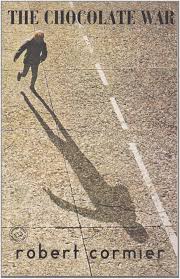 The Chocolate War by Robert Cormier
Final Verdict: 3.75 out of 4.0
Plot/Story:
4 – Plot/Story is interesting/believable and impactful
Robert Cormier’s The Chocolate War
Characterization:
4 – Characters extraordinarily well developed.
Having read Cormier’s I Am The Cheese
Prose/Style:
3 – Satisfactory Prose/Style, conducive to the Story.
What is great about Cormier’s prose is that it is written for the anticipated audience – in this case, high school boys. The language is simple, blunt, and rife with sexual innuendo and machismo. The dialogue is clear – it is not difficult to follow conversations, though a greater contrast between language of the teachers and other adults, versus the language of the teenagers could have enhanced the overall prose a bit. Still, different characters did have different mannerisms – Archie, Janza, and Jerry the most noticeably. The descriptions meshed well with the prose, the language and style were fluid and easy to read and follow – and the simple structure (short chapters, short sentences) was appropriate to the type of language employed for the type of audience likely to read the book. It was not stellar – but it works.
Additional Elements:
4 – Additional elements improve and advance the story.
As I mentioned above, what resonates most for me in this book is how brutally honest it is – how realistic these types of situations are, and how disturbing and horrifying it is to think about that, and to see it happening in print (because we know it happens in real life). The elements of bullying – psychological and physical- are completely unacceptable, yet wholly believable. There is a distinct reprimand, unwritten but present in the subtext, that the absence of strong, decent role models – parents or teachers- is largely responsible for the type of brutality occurring at this school. Where are the engaged parents? Where are the concerned teachers with spines to do something? Is this a problem restricted to private schools? To religious schools? Or is it a problem in all high schools, everywhere? This is clearly war – and in war, there are so many victims, so few perpetrators, and even more bystanders (which perpetuates the problem), but that this war is taking place in a school, where the hope would be that all are protected- that makes the battle and the final outcome all the more distressing and infuriating, and real.
Suggested Reading For:
Age Level: 14+, Young Adult, Teen, Adult
Interest: Coming-of-Age, High School, Youth Psychology, Violence
Notable Quotes:
“Archie disliked violence—most of his assignments were exercises in the psychological rather than the physical. That’s why he got away with so much. The Trinity brothers wanted peace at any price, quiet on the campus, no broken bones. Otherwise, the sky was the limit.”
“They tell you to do your thing but they don’t mean it. They don’t want you to do your thing, not unless it happens to be their thing, too. It’s a laugh, Goober, a fake. Don’t disturb the universe, Goober, no matter what the posters say.”
 Roof Beam Reader