Roof Beam Reader
Adam Burgess
Review: War and Peace by Leo Tolstoy
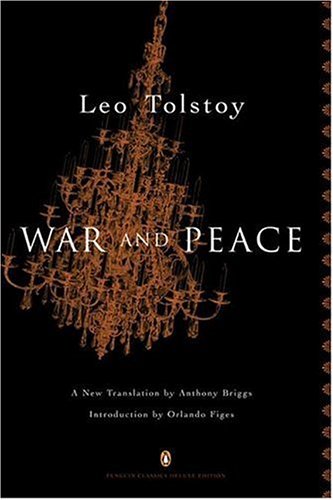 War and Peace by Leo Tolstoy
Final Verdict: 4.0 out of 4.0
Plot/Story:
4 – Plot/Story is interesting/believable and impactful
Leo Tolstoy’s War and Peace is early-19th Century Russian life, in print. It is a social, political, and military tale of epic proportion, spanning two decades and 1400 pages. So, where to begin with this review – probably one of the most difficult to write, simply due to the fact that the book is so massive and covers so many points, from mysticism and the Masons, to the friendship and ultimate showdown between Napoleon and Tsar Alexander, and everything in-between? Essentially, in terms of plot, the novel itself revolves around one group of characters, who weave in-and-out of social and political circles, and who engage in the war in various ways – the point being that all of these people, whether or not they are direct participants in the war, are somehow impacted and affected by it, but through no direct action or power of any one person. The story starts in 1805, with a social gathering of the crème-de-la-crème of Petersburg society. Here, we meet the many characters whose lives will go on display before us, including Pierre (the unlikely hero), the Drubetskys, the Bezukhovs, the Bolkonskys, the Kuragins, and more. The reader is afforded glimpses of each of the characters and some, like Helen or Count Rostov, remain static throughout, while others grow and change throughout the years – due to trials and tribulations each of them face, particularly Natasha and Pierre. Tolstoy’s prose is obviously masterful though, of course, this particular edition was an English translation, also done wonderfully. What Tolstoy does with the descriptions of war time and peace time, though, making them separate but equal – entities which should not coexist, but do- is brilliant. Readers are allowed to witness the actions of Emperors, generals, peasants, and aristocrats, whether they be Russian, French, German, Polish or otherwise. These families come together and are torn apart, as is the Russian military – held together by feelings of patriotism, but undermined by individual pride and egoism. How each battle impacts the neighboring locales is mirrored by how each familial separation impacts the characters; how each Russian triumph creates a sense of National warmth and re-commitment to the cause and the Emperor is mirrored by the many interrelationships – weddings, partnerships, friendships- for our main characters. Ultimately, what one gets with War and Peace is a holistic, all-encompassing look at Russian life during the French invasion – what people ate and drank, the games they played, the reasons each went to war or deserted, the religions in play, the groups in power, the doubts permeating the military ranks, and the flip-flopping confusion about the French (Russian high-society is torn between admiration – even adoration- of the French, speaking French and going to French opera and theater- and their loathing of Napoleon and his treachery). It is as if the reader is living his life with these people, a fly on the wall, witnessing the sights, sounds, and smells of all these interesting and uninteresting everyday Russian folk. The reader also learns, in part two of the epilogue, that Tolstoy had an even loftier purpose – one more daring and provocative than the historical account and anthropological study of the Russian people during the Napoleonic wars. His intent, really, was to dissect and discredit historians in general, for assuming that any one version of history could be correct, or that any one character or event in history could be of more or less importance than the total, collective, predetermined course of history itself.
Characterization:
4 – Characters extraordinarily developed.
While it does sometimes become difficult to keep track of the characters, whether because some have the same names, or their names change depending on who is being addressed, and by whom (and how), or because characters marry, or because the names are Russian, lengthy and difficult to pronounce; or, because the book is 1400 pages long, and characters who disappear for hundreds of pages, suddenly turn up again five or ten years down the road – still, the characters themselves, if you can keep pace with them, are all extraordinarily well developed. Tolstoy clearly knows each of his characters deeply – from the charming and beautiful Natasha, to the stunning but stupid Helen; or Pierre the bumbling hero and his unlikely inspiration, the idiot Krasnoye. Each of the characters, regardless of how much page time they receive, are clearly conceived in their entirety, three-hundred-and-sixty-degrees, by the author. This makes their growth throughout the years, their interactions with other characters, and their self-reflections, when they do occur, interesting and even, at times, revelatory. Two particular favorites of mine – and likely intentionally, on Tolstoy’s part – are Natasha and Pierre. They are unlikely protagonists at the start, but the reader is allowed glimpses and hints at their truer natures as the story progresses and, in the end, is rewarded by committing to these two, as they become the two to watch, as it were. Another interesting development is the character of young Nikolay, Countess Marya’s nephew. The reader watches him grow from boy into young adulthood (similarly to Pyotor Rostov), and while the real presence of this boy only comes about in the end, and in relation to Pierre, Tolstoy allows us to assume that he will lead the way into Russia’s new era, towards reconstruction after the burning of Moscow and the triumph over Napoleon – and, with sentiments of Plutarch- we almost wish there were another 1400-page volume in the works, to tell Nikolay’s tale. Almost.
Prose/Style:
4 – Extraordinary Prose/Style, enhancing the Story
It is necessary to applaud both Tolstoy’s original prose and mastery of language, which I am truly a fan of now, after having read his three most popular works (Death of Ivan Ilyich, Anna Karenina, and, now, War and Peace), as well as Anthony Briggs’s translation of the work into English. Though I was a bit surprised by the presence of more than a few grammatical/proofreading errors (an anomaly for Penguin editions), I was able to separate these from the prose itself, and from Tolstoy’s incredible storytelling ability. In another’s hands, this hefty work (you really could hurt someone with the bulk, if you dropped it at the wrong time!) could have been cumbersome, boring, and tedious – but I managed to read through the entire work in under 30 days and, had I not been an adult with a full-time job and other responsibilities, I likely would have plowed through it even faster. It was that enjoyable, that “easy” to read – not that it was without challenge. The work is certainly literary – the language and vocabulary are difficult, but the story is engaging and the prose is wrought beautifully. The only real challenge, for me, were the last 50 or so pages – part two of the epilogue- which veered dramatically and noticeably from the story and into the realm of theory and philosophy. While this reader understands Tolstoy’s intense passion for the subject, and his need to explain the deeper elements of the work, beyond sociological history and the story itself, even still, there was a point where one wondered – where did this come from, and when did the actual story end? For this reason, it almost became necessary to reduce the rating in this area but, fortunately, since Tolstoy remained a masterful linguist and proved himself to be even more brilliant a thinker than a storyteller, which was quite a feat, given his ability in the latter regard, it was possible to score the book perfectly here as well. I will warn those not interested in theory or philosophy, though, that, for you, it might be beneficial to stop reading after part one of the epilogue, as this is really where the “story” ends.
Additional Elements:
4 – Additional elements improve and advance the story.
Where can a reviewer begin, when discussing the many and varied elements of War and Peace. It would almost be best to leave this section blank, with a big, bold “4 out of 4” as one’s only commentary, because much will certainly be left out or overlooked. Still, it is important to try, because the work was truly remarkable – both stylistically and in pure entertainment and reading-pleasure regards, and in its educational value. What strikes true for the reader in this novel are two major purposes for the book: first, the desire to explain, in full-detail, the nature of the Russian people, from peasant to nobility, during the turbulent Napoleonic era; and second, the need for any historian – literary, cultural, military, or scientific- to depict every single aspect of humanity and its many types of people during an event in order to attempt to explain the event and/or its causes, while maintaining the understanding that this may still be an impossibility (see the first included quote, below). There is much to learn from this novel, and it is clear that Tolstoy tries to remain impartial, though, by his own reasoning, it is probably impossible for him to have been completely segregated, since his place in history is as a Russian, looking back on Russian society, during a Russian-French and Russian-European conflict. The most obvious source for debate and doubt would be Tolstoy’s depiction of Napoleon as not a military genius (as he has been described by so many historians), but as a rather lucky, arrogant dunderhead. This sentiment aside, though, the descriptions of the military tactics and engagements, the backroom dialogues, the socialite events and arranged marriages, the master-servant dynamic and farm life (similar to plantation life) – family structures and the power of money – are all well flushed, honest, and varied. Tolstoy depicts French victories and losses, as well as Russian victories and losses. He attempts to explain why the French soldiers lost control after gaining Moscow, and also spares no rod in terms of chastising those Russians who acted improperly, even stupidly or viciously. The families in War and Peace each have their ups-and-downs, some gaining wealth from nowhere, and some losing all they have – and his descriptions of how each family (and each person within that family) deals with losses or triumphs are whole, distinct, and believable, particularly in that nobody reacts the same way. Perhaps the most fascinating aspect of the book, though, is watching as the scenes of war intermingle with the scenes of peace – the reader begins to understand how one element creates a cause-and-effect relationship with the other and how, in the end, everyone was connected, even when apart.
Suggested Reading For:
Age Level: Adult
Interest: Russian Literature, Russian History, Napoleonic Wars, History, Classics
Notable Quotes:
“While ever authors continue to write histories of individuals – your Julius Caesars, Alexanders, Luthers and Voltaires – and not histories of everybody, absolutely everybody, involved in an event, there is no possibility of describing the movement of humanity without falling back on the concept of a force that impels men to direct their activity to a single end. And the only concept of this kind known to historians is the concept of power.”
“Gazing into Napoleon’s eyes, Prince Andrei mused on the unimportance of greatness, the unimportance of life which no one could understand, and the still greater unimportance of death, the meaning of which no one alive could understand or explain.”
“Every action of theirs, that seems to them an act of their own freewill, is in the historical sense not free at all but is bound up with the whole course of history and preordained from all eternity.”
My Top 10 Villains from Fiction
This week’s theme is “Top Ten Villains & Criminals”…. hmm. It’s easy to remember our favorite heroes from fiction, but what about those infamous, nasty bad guys? Well, let’s see what I can come up with. Let me know what you think!
1. Dolores Umbridge – The Harry Potter series by J.K. Rowling
-Okay, now, I said that “Javert” (#2) was going to be my first big, bad guy; but, yeah, I was wrong. The more I think back on all of my reading, the more I solidify my belief that Dolores Jane Umbridge, the “High Inquisitor” from Harry Potter, who has pupils carve scars into their hand during detention with evil, blood-drawing quills (things like: “I shall not tell lies”) is the most vile, awful villain of all time. She is even worse, in my opinion, than the series’ main “bad dude” Lord Voldemort. Why? Umbridge is supposed to represent “good!” She is an employee of the Ministry of Magic, the wizard agency established to protect magic and non-magic folk alike, and to protect the secrets of the wizarding world. She also becomes a teacher at Hogwarts School for Witchcraft and Wizardry, so should be trusted to protect and care for (and educate) the students – she does none of these. Her horrible little giggle, her racist/xenophobic ideals, and her general undermining of progress all get me riled up in a way that no character has ever done before.
2. Javert – Les Miserables by Victor Hugo
-This is a tricky one, because, while the reader knows that Jean Valjean, the protagonist of Les Miserables, is a good and decent man, he is, in the eyes of the law and through misrepresentations of the people around him, a criminal and an escaped convict. This is why Javert, the upstanding policeman (and, sadly, he really is – his deep need to always do what is right leads him to thinking/acting based on binaries – what is black and white – when often there are shades of grey that he is overlooking) hunts and hounds Jean Valjean throughout the story, which spans years in the characters’ lives. At times, the reader wants to reach in and smack Javert around, because he is just so prejudiced against the label of “criminal” that he cannot see beyond this to the man (or woman) who has been labeled – even if that person has gone to extraordinary measures to do good for people, to help others, to actively engage, honestly, in society, etc.
3. “Sameness” and society – The Giver by Lois Lowry
-Now, obviously, the bad guy here is an idea, but Lowry is such a masterful story-teller that this idea seems to come to life and become the antagonist character. The character-idea is so dangerous and destructive to the principles of freedom and individuality, that I cannot help but include it as one of the most powerful and scary fictional (thank goodness) villains.
4. “The Firemen” – Fahrenheit 451 by Ray Bradbury
-Mine is a website devoted to the love of books, the benefits of reading, and the danger of censorship, so how could I possible avoid including this awful bunch of book-burners from one of the greatest futuristic American novels of all time? The firemen of Fahrenheit 451 are charged with the job of destroying books and of preventing critical thought through reading. People get ideas from books and, similarly to the society presented in The Giver, Bradbury’s communities find ideas “scary” and dangerous – so they make every effort to eliminate them. Fortunately, the hero, Guy Montag (a former Fireman) changes allegiance and goes on a quest to defeat the Firemen and save the books!
5. February – Light Boxes by Shane Jones
-Is it the month? Is it a person? Is it a man or a woman? Does it have supernatural powers? Is it a god or a man trapped in the clouds? Is it all made up? Whoever February is, he is cruel and juvenile. He bans flight in all its forms, even those as simple as hot air balloons and paper airplanes. He smashes the little town with snow and sleet, cold and ice. He tries to break their spirits with month after endless month of February. Light Boxes is a darkly whimsical story, and the antagonist, February, is never truly explained – perhaps he’s just a lonely, sad, self-conscious little boy, scared of being discovered but, either way – he is so wicked that the town is forced to flee and begin anew again, somewhere else (after many sacrifice their lives trying to fight February). This is a short book, and the characters are not developed as much as they would be in a longer book but, still, there is a sense of something cold and bitter about February, and this is enough for me to list him! Er.. it..she..?
6. Nurse Ratched – One Flew Over the Cuckoo’s Nest by Ken Kesey
-I hate this woman. I know some might want to get into a debate about the nature of this character, and how she is really just a strong female character in an all-male world, which makes her appear harsh when she is really just trying to keep control, but I will not debate you on this because you are flat out wrong! Nurse Ratched is a mean, sadistic, heartless tyrant. She runs the psychiatric ward as a one-woman dictatorship, something like we might have seen in England of the 1600s, had Mary Queen of Scots come to power instead of Elizabeth I. She is controlling, patronizing, and passive-aggressive. She toys with “niceties” only to get what she wants from the patients, which is total control. The one patient who ends up making a stand, and who is likely the least “crazy” of the bunch, is fully lobotomized – on Ratched’s orders. He was a functioning, virile, stable (though “cowboy-esque” male who is stripped of his humanity – stripped of the ability to walk, talk, feed himself or even think for himself. She represents, I think, three things: 1) the burgeoning struggle between sex and power, coming to light in the 196s; 2) the nature of power and that “absolute power corrupts absolutely”; and 3) the incredibly ineffective and dangerous conditions of mental health facilities at the time (people were performing routine lobotomies as instant-fixes, and testing LSD on unwitting patients – shock therapy, sleep deprivation, etc.)
7. Mildred – Of Human Bondage by W. Somerset Maugham
-I don’t even know what to say about this character. We have all, I think, known someone like Mildred. Most of us have probably even had our very own Mildred to deal with and to overcome. She is a childish, selfish, self-absorbed person, wholly concerned with what will benefit her, even if it is completely disadvantageous or even hurtful to another person. The main character of this novel, poor Philip Carey, is inexplicably taken by dear Mildred – likely because Mildred is less than attractive and probably in frail health. This probably attracts Philip because he is deformed and can, in a way sense and relate to weakness or “otherness” in someone else. Still, Philip goes out of his way, nearly killing himself at times, to care and provide for Mildred. He devotes his time, energy, and money to providing for her – surprising her, caring for her, and, eventually, even caring for her child, another man’s daughter, as his own. Mildred is so realistic and believable -someone we all know- and this allows the hatred to really boil!
8. The Mother – A Child Called It by Dave Pelzer
-If you have read or know about this story, you probably do not even need me to explain this character, or why she is on my “top villain” list. She is easy to hate, because she is an awful, terrifying woman. Pelzer writes her so well (she is, I believe, based on his real-life mother, which makes it both easier to believe and harder to comprehend) that I almost wanted to hunt the lady down and ensure she was arrested, committed, or otherwise out of society and away from children. Why did she hate her child so much? Where did this favoritism and fawning of one child come in, while the other was left to suffer and nearly die? It is impossible for a reasonable and sane person to understand the nature of this woman, and I think that is why – when written so well – she becomes so interesting, if disturbing.
9. Peter Lomax – The Night Listener by Armistead Maupin
-This was a truly disturbing story but, as it turns out, one which happens regularly, particularly now, with the advent of internet and other impersonal communications technologies. Peter Lomax is a young, teenage boy who begins a relationship with the book’s main character, Gabriel Noone. Lomax is put into contact with Noone through their mutual publisher. It turns out that Lomax has written a powerful book about the physical and sexual abuse he endured as a child, committed by his parents and their friends. The book was sent to Noone to review – and this created a sense of brotherhood between the two, Noone as older mentor, Lomax as young prodigy/protected. As it turns out, little Peter Lomax might not be a 13-year old boy after all. Gabriel Noone seems to have been “played” for months (throughout the course of the novel) – it costs him his personal relationships, his professional standing in the literary world, and it even disrupts his work as a radio talk show host. Perhaps we are supposed to have sympathy for “Peter” at the end, but I had none. I find the people who live these lies and drag others into their webs vile and reprehensible – but Maupin wrote it brilliantly!
10. “The Clique” – Blindness by Jose Saramago
-If you have not already read this book, you should. The story is about a rapidly-spreading epidemic, seemingly contained in one city (New York? Boston?) – which causes the infected to become blind, and which seems to spread through contact or by being in close proximity to the infected. As the epidemic is beginning to spread, the government (muscled by the army) sets up a facility where the newly blind are housed, fed, able to shower and sleep, etc. Eventually, as more and more people are infected, the facility becomes over-crowded – “cliques” form between wards, and soldiers are sometimes forced to act harshly in order to keep peace (until they, too, become blind). Eventually, one “Clique” takes over the compound, and they terrorize the other groups – demanding money, personal items, and, ultimately, sex from the other groups’ women in exchange for food and water. These groups cower until, at last, rebellion and break-out become unavoidable. The descriptions of “The Clique” and their horrible actions, particularly towards the women, make for a horrifying reading experience, but it is so realistic and well-written – it is worth struggling through to get to the end.
Review: The Moon is a Harsh Mistress by Robert A. Heinlein
Final Verdict: 3.5 out of 4.0
3 – Plot/Story is interesting & believable.
Characterization:
4 – Characters extraordinarily developed.
Prose/Style:
4 – Extraordinary Prose/Style, enhancing the Story.
Additional Elements: Setting, Symbols/Motifs, Resolution, etc.
3 – Additional elements are present and cohesive to the Story.
Suggested Reading for:
Age Level: Adult
Review: Who’s Afraid of Virginia Woolf by Edward Albee
Who’s Afraid of Virginia Woolf? By Edward Albee
Final Verdict: 4.0 out of 4.0
Plot/Story:
4 – Plot/Story is interesting/believable and impactful
Edward Albee’s play, Who’s Afraid of Virginia Woolf?, is intoxicating – literally. With every turn of the page, the reader is taken deeper and deeper into the twisted mind of the play’s main characters, George and Martha. This married couple, daughter of the College President and Professor of History, horribly stagnant in his career, bring a fresh young couple (the new Biology professor and his wife) over for drinks after a late faculty party at Martha’s father’s house. If the scenes reflect the actualities of “behind the scenes” University leadership life, then perhaps college education should not be such an American ideal. The examination of mental instability (i.e. sociopathic tendencies, narcissism, and schizophrenia) are riveting and terrifying all at once, particularly as the story unfolds and more and more truth is sucked out from the multitude of fictions. The dangers of the enabler, to, and the perverse pleasure which can be gained from progressing another person’s instabilities and delusions is interesting and embarrassingly amusing. The description for the play states that one of the greatest points for this drama is its dramatic revelation at the end, and I must agree- though I saw it coming from early on, many readers probably will not and, regardless of knowing or not knowing, the revelation and its subsequent impact on the small party is stunning.
Characterization:
4 – Characters extraordinarily developed.
The two main characters, George and Martha, are brilliantly rendered. As their mania unfolds, the reader twisted personality traits – their motivations, desires, and failings – all come to light, in such a loudly subtle way, seen seldom in any piece of writing. Their son, too, and Martha’s father, though the reader never actually meets either of these characters, are so well described and recalled by George and Martha, it is almost as if they are active characters in the play – something Albee deserves immense credit for having achieved, as it adds an interesting sub-plot which advances the over-the-top major scenes quite nicely. Also, the younger couple, Nick and Honey, is developed just as much as they need to be in order to allow George and Martha’s story unfolds. They are there to serve a purpose, which is to allow George and Martha’s “games” to progress, their animosity to reach the boiling point, and the great truth (or lie) be revealed in the final pages. It also allows the reader to contrast a simple, well-planned, and expected “romance” (Hope and Nick) with a ravenous, destructive, sickening lasting-passion (Martha and George).
Prose/Style:
4 – Extraordinary Prose/Style, enhancing the Story.
In a play or drama, the biggest indicator of great “prose” is really great dialogue, scene direction, and description. This play in particular does not have much scene direction, though the points where Albee does make suggestions as far as stage placement, facial expression, etc. are so well-thought that the play almost requires nothing else (each director will be able to make this play his/her own, but with the direction Albee affords, it is almost certain that the most important moments will be executed in the right ways). The character reactions and descriptions, too, are simply stated, but make all the difference; such as when Nick, after finally picking up on the nature of Martha and George’s disturbing tete-a-tete is directed to be: “Stretching . . . luxuriating . . . playing the game) – perfection. What really progresses this play, though, is the interaction between the characters – the simple, flippant replies, the overly-dramatic reactions to the most mundane situations – Nick’s embarrassed replies; Honey’s confusion and naivety. Each of the characters is completely “on point,” though the only one who really seems to develop at all is Nick – and this is fitting, because George indicates that Nick will, indeed, be the one to move forward, while the rest of them remain stagnant in their lives, relationships and, most notably, careers. The most development, though, is not with characters – but with the story itself. Still, it is the characters and their dealings with one another which allows this development to occur and to work.
Additional Elements:
4 – Additional elements improve and advance the story.
One of the most interesting elements of this particular story is that it deals with characters that are completely mentally unstable and irrational – illogical in every way, but working in what one would assume to be one of the most sound, logical professions, higher education. Who could be more staid and calm than a History professor? Who could me more respectable and proper than a University President’s daughter? Edward Albee grabs us from the start by putting these seemingly simple character types into a relationship which is highly volatile and unpredictable, in a setting which should be nothing but calm and moderate. The inclusion of the two “new kids” on the collegiate block adds much in comparison – as if to say, with age and experience comes not wisdom, but insanity, so be warned! Of course, Albee is not making generalizations about all Academicians, or all History professors, or all Biology professors’ wives; but, still, he does seem to be saying: “Dear reader, take another look – things are rarely what we expect them to be.” The nature and art of psychological warfare is put under the microscope and outcome is extraordinary. Watching Martha and Gorge go back-and-forth with their “games” is at times invigorating, at times exhausting, but always interesting and unbelievable (except that it seems entirely natural). Sexuality, too, as well as alcoholism, politics, and science vs. society are all discussed as a part of the dialogue of this one evening, and these elements progress the story further into madness and resolution.
Suggested Reading for:
Age Level: Adult
Interest: Psychology, Madness, Marriage, Sexuality, Schizophrenia, Sociopaths, Delusions, Academia
Notable Quotes:
“Martha, will you show her where we keep the, uh, euphemism?”
“Martha, in my mind, you are buried in cement right up to the neck. No, up to the nose — it’s much quieter.”
“I looked at you tonight and you weren’t there! Finally snapped! And– and I’m gonna howl it out! And I’m not gonna give a damn what I do, and I’m gonna make the biggest goddamn explosion you’ve ever heard!”
Review: The Satyricon by Petronius
The Satyricon by Petronius
Final Verdict: 3.75 out of 4.0
Plot/Story:
4 – Plot/Story is interesting/believable and impactful.
Characterization:
3 – Characters well developed.
Prose/Style:
4 – Extraordinary Prose/Style, enhancing the Story.
Additional Elements:
4 – Additional elements improve and advance the story.
Suggested Reading for:
Age Level: Adult
 Roof Beam Reader