Roof Beam Reader
Adam Burgess
Review: Will Grayson, Will Grayson by John Green and David Levithan
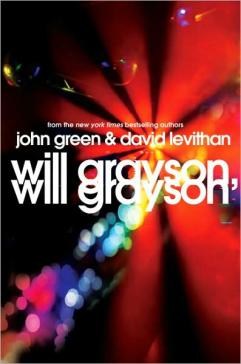
Final Verdict: 4.0 out of 4.0
4 – Plot/Story is interesting/believable and impactful
When I heard that John Green and David Levithan were teaming up to write a novel about the life and times of a manic-depressive gay teenager, I was understandably stoked. The authors of Looking for Alaska and Boy Meets Boy working together? Brilliant! What they achieved, though, is more than even I, an admitted fan of both writers, could have imagined. There are two Will Graysons – well, in fact, there are many Will Graysons, but there are two Will Graysons with whom this book concerns itself. The first is a straight, socially awkward and girl-shy sidekick to one Evanston, IL (i.e. Chicago) school’s biggest (literally) gay student; the other is a semi-psychotic, tortured, poor gay loner from Naperville, IL – a suburb just about an hour outside the city. Somehow, these two boys with the same name meet unexpectedly and hilariously in a Chicago porn shop called “Frenchy’s” – neither of them planned to be there, and both were too young to get in. Still, cosmic fate being what it is, these two Will Graysons were brought together and changed by one big, giant, glamorous and fabulous gay boy named, ironically, “Tiny.” Tiny falls in love with nearly every boy he meets – and his life’s ambition is to write a musical about … wait for it… his life! The musical evolves, though, through Tiny’s struggles with Will Grayson 1 (the best friend whose friendship suddenly starts to strain) and Will Grayson 2 (the love interest who is no good for Tiny, but who impacts Tiny more profoundly than anyone else ever has).
4 – Characters extraordinarily developed.
I absolutely fell in love with the characters in this book, as I did in both books by these authors, read previously. Each Will Grayson is distinct and identifiable, and not just because the prose is different, nor because each Will Grayson is written by one of the authors (thereby resulting in a separate voice). They are distinguishable because their stories and histories are different; their attitudes and outlooks are different; they grow in different ways, interact with others in different styles; they learn different lessons, and show their appreciation for Tiny and their friendships and new relationships (Will 1 with Jane and Will 2 with Gideon) in singular ways. Also, though they are both “loner” types, the Will Graysons interact with their few friends and with their parents in dissimilar ways as well. Tiny, too, is brilliant – loveable and annoying at the same time. He (and Will 2) instantly reminded me of people in my own past – people I can recall with both fond memories and some not so pleasant ones. The ability to recall one’s past through a story – that “reaching out and taking a hand” which Alan Bennett writes of in his play, The History Boys, makes the book and its characters so easy to relate to and to be drawn in by. Even the minor characters, such as Jane and Gideon, the musical’s cast members, the parents, and some of the teachers are all conducive to the plot in some way, without ever feeling unnecessary, over-the-top, or unrealistic. Will 2’s relationship with “Isaac” and its ultimate conclusion is also fascinating and terrifying.
Prose/Style:
4 – Extraordinary Prose/Style, enhancing the Story.
Another of the great positives for this book is that it is written by two authors (normally not something I enjoy) who each take on the job of writing one of the Will Grayson characters. David Levithan writes the gay, depressed Will (2) and John Green writes the coming-to-terms-with-growing-up straight Will (1), who ultimately learns not to succumb to his life rule #2 of “Shut Up.” That each character was written by a separate author allowed the two to really grow and develop singularly and independently, yet in relation to the story as a whole. Their meeting and link through Tiny is what holds their two worlds together, and which creates a cogent and highly readable storyline. I adored, as well, the inclusions of notes, poetry, and song – at times, I could truly imagine this book taking place on stage, characters as cast members, breaking into comic musical numbers about the dangers of being a gay tight end on the high school football team! What this means is the story, though written in prose, is highly visual and aural, so it literally comes to life in your imagination. I could picture these characters, I could hear their songs, I could imagine the sounds of their voices. The mastery of prose – though relatively simple (YA reading level), allows even a discriminate, adult reader to feel accomplished in reading the book.
4 – Additional elements improve and advance the story.
The final result of the musical, and the book, is that each of these three main characters – Tiny, Will Grayson, and Will Grayson, all come to terms with who they really are and, equally important, with what they mean to one another. You can love a friend as a friend. You can remain friends with an ex. You can appreciate another person without having to put your heart and soul into your relationship with that person – but the point is, ultimately, that you have to be honest. You have to open that metaphorical box and let Schrodinger’s cat loose – or you will never know if the friendships are alive or dead, they will just remain meaninglessly mundane and inconsequential, forever. There is also much to be said, in context, about gay rights and the “live and let live mentality.” The importance of forgiveness, too, rears its head – it is forgiveness which allows the gay Will Grayson (Will Grayson 2) to let go of some of his pain and anger, to allow himself real friendships with decent people, and to do something good for someone else. Love. Friendship. Acceptance. Forgiveness. This is Will Grayson, Will Grayson.
Age Level: Young Adult, Adult
Interest: GLBT, Gay Lit, Coming-of-Age, YA, Theater/Drama, Depression, Family, Friendship
Review: The Lost Hero by Rick Riordan
The Lost Hero by Rick Riordan
Final Verdict: 3.25 out of 4.0
Plot/Story:
3 – Plot/Story is interesting & believable.
Characterization:
3 – Characters well developed.
Prose/Style:
3 – Satisfactory Prose/Style, conducive to the Story.
Additional Elements:
4 – Additional elements improve and advance the story.
Suggested Reading for:
Age Level: Young Adult
Interest: Greek Mythology, Roman Mythology, Fantasy, Adventure
Review: Of Human Bondage by W. Somerset Maugham
 is a story about an orphaned, crippled boy’s journey into manhood. These journeys are rife with humor, sadness, wit, despair, and sometimes downright exasperation (stop going after that worthless hussy, already!). Philip’s physical deformity is a hardship which haunts him, both bodily and emotionally, throughout his life – even after corrective surgery which, at the time, did little for the problem. The perseverance, though, and the slow, subtle strengthening of character which ultimately leads to a satisfactory self-image and corporeal ability to make decisions based on desire and not from fear, are the driving forces of this novel. The, I suppose, didactic purpose of the novel is twofold: first, that individuals have the capacity to enact change through courageous resolve and believe in one’s self rather than any higher power (Philip throws off the theological and physical “crutches” to empower himself); and two: that it is perfectly natural for life’s path to detour, veer of course, and be completely road-blocked from time to time – the willingness and ability to adapt to and grow from change seems to be virtuous and worthwhile.
 Review: The Boy With the Cuckoo-Clock Heart by Mathias Malzieu
The Boy With the Cuckoo-Clock Heart by Mathias Malzieu
Final Verdict: 3.5 out of 4.0
YTD: 53
Plot/Story:
4 – Plot/Story is interesting/believable and impactful
Malzieu’s The Boy with the Cuckoo-Clock Heart is a fantastical tale of one boy’s struggle to love “normally” and not “crookedly.” The reader meets the boy, Jack, at birth, where a strange confluence of events results in his infant heart being fused with a cuckoo-clock, in what would be a 19th Century makeshift-pacemaker. We ride along with him to witness his first encounter with Miss Acacia and his discovery of the idea of love (or perhaps, more correctly and eerily, a ten-year old boy’s discovery of “lust”) and how that love grows, painfully and tragically, over time. The story is told in the style of, perhaps, the Brothers Grimm or Lewis Carroll, a phantasmagorical-type whimsy which shares an innate fatalism as the likes of Hans Christian Andersen. The tale certainly bears more relationship to the original story of The Little Mermaid than it does to the Disney version, which means there is no happy ending – so do not be expecting one. When I say the prose was believable, I am not being literal in any sense. The story on its surface is completely bizarre, imperfect and, at times, hard to follow. Still, it is magical in the old-school sense of literary-wizardry. There is something of Cormier’s I am the Cheese in the looped and revelatory ending, coupled with the almost scary fantasy of Spenser’s epic tale, The Fairie Queene (referring largely to the employment of allegory and symbolism, and not to imply that this book is written in verse). The reader is led to believe, right up to the end, that Jack may finally get the girl and learn to live with his new heart but, alas, only one of these realities may come to pass. There is something truly great and real about this, though, and though we learn some disturbing things about Dr. Madeline, the witch-doctor who places that cuckoo-clock in Jack’s chest, we also can understand and appreciate her sad motivation.
Characterization:
2 – Characters slightly developed.
The novel’s only downfall, for me, is the characterization and character development, or lack thereof. We do see Jack grow and learn from his mistakes, though he goes off repeatedly on the same doomed journey but, other than this, we do not learn much about any of the characters and what we do know remains static throughout. The story is strengthened in this regard due to the fact that it is, really, a fairy tale and not a traditional novel, so not as much time or attention needs to be paid to its characters, since the importance is meant to be placed on the story itself and its delivery (which is extraordinary). Fairy tales are often didactic or morality tales, and they are meant to be told in a beautiful way, but without much depth. This is certainly the case for The Boy With the Cuckoo-Clock Heart as, somehow, the reader is meant to believe that this boy could fall so head-over-heels in love and lust for a girl at the age of ten, and then to pursue her across the continent, repeatedly, even journeying after her again when he has just come out of a months-long coma. The character relationships are weak and are not really meant to be trusted, but this is because the real story is the action of Jack’s growing up – putting aside his old, wooden clock of fantasy and accepting his new, logical clock, which keeps him more firmly grounded in reality. Still, had the author managed to somehow maintain this creepy, fantastical tale and also incorporate deeper, more realistic or at least rounded characters, the beautiful fairy tale could, perhaps, have become a great novel.
Prose/Style:
4 – Extraordinary Prose/Style, enhancing the Story.
From the first sentence of the first page, Malzieu’s characteristically-French prose (translated into English quite masterfully) drew me in completely. It is clear that the author spent much time on the style and prose, so as to allow his story to unfold in the disturbingly magical way that it does – a feat that would not have been accomplished in most circumstances. Many reviews find the novel’s prose to be the only redeeming quality for the book, and I can understand this sentiment, as it far outshines the characterization and the plot itself, the former being weak and the latter being simply bizarre. Still, Malzieu certainly understands that his story is strange and extraordinary – it is the mark of a true artist that he managed to deliver the unusual story with a unique and effective prose and style, equal to the peculiarity of the fairy tale. There are some confusing historical references, such as the comments on the Tour de France which, as far as I know, was not happening in the late-1800s, but it is possible to accept these as confusion from a narrator who is reflecting on the story of his boyhood while writing as an older man or to accept them as flaws in the story and move on (as I did). Also, some of the sexual references can be odd, particularly when coming from a ten year old, but upon reflection and discussion with others about when (and how) boys begin to fantasize, I believe these burgeoning sexual feelings are acceptable, if not completely comfortable. There is something very similar in style to Shane Jones’s Light Boxes, which begins to make me wonder if we are on the cusp of a new literary movement. How exciting!
Additional Elements: Setting, Symbols/Motifs, Resolution, etc.
4 – Additional elements improve and advance the story.
The Boy with the Cuckoo-clock Heart is a terrifying marriage of Peter Pan and Pinocchio. We have, here, the fantasy-boy, whose life and self-image is largely designed by a lonely, childless elder, similar to Pinocchio’s Geppetto, and we have the boy’s struggle with maturity and growth – the Peter Pan who never wants to grow up, or who just cannot figure out how to do it. The story is a dark and cynical fairy tale which, admittedly, will not be for everyone; in fact, I would be reluctant to recommend the book to anyone, as it is rather sad, confusing, and bizarre. That being said, the overall sentiment is the dangerous power of love – unwelcome, unrequited, unrealized, or unknown. It is one of the most fascinating and ever-present themes in literature and in life. Malzieu delivers his version of this never-ending story in an eccentric way, but it is outlandishly beautiful and poignant, despite the failures in characterization and the not-so-happy ending.
Suggested Reading for:
Age Level: Adult, Literary
Interest: Postmodernism, French Literature, Coming-of-Age, Phantasmagoria, Fairy Tale
Review: The Hunger Games by Suzanne Collins
Final Verdict: 3.0 out of 4.0
Plot/Story:
3 – Plot/Story is interesting & believable.
The Hunger Games by Suzanne Collins is the first book in a series of three that takes place in an unspecified future, in what one would assume is a post-apocalyptic United States of America. “The Capitol,” which rules all of the thirteen outlying districts (a throwback to the original thirteen colonies, perhaps?), I envision as a New York City or even a Los Angeles (given the many references to over-the-top costume and makeup and the televising of live-action reality as entertainment (i.e. Hollywood). I enjoyed the story – the plot was eerily and frighteningly believable, but when I compare this first book in the series to other of a similar genre and focus, such as Orson Scott Card’s Ender’s Game or Takami’s Battle Royale, I feel underwhelmed and a little ill-at-ease. What I mean is that I felt like this book was simultaneously underdeveloped and too far advanced for an introduction to a series. There was too little time spent on getting to know the characters (who turn out to be heroes), so I could not cheer as heartily for them as I would have liked to – though, shamefully, I do admit that I was struck by Peeta’s romantic chivalry, possibly as it gives me embarrassing flashbacks of my own love-struck boyhood and how I would risk just about anything for the love of my teenage life (insert nostalgic sigh here). Still, even this sub-plot could have been much more intriguing and engaging if it had been further developed. I feel that The Hunger Games could have been the second or third book in the trilogy, after a book or two spent on character development, building up to the crux of the “Games” and perhaps focusing on the relationships between Peeta & Katniss and Gale & Katniss (since this, too, was so underdeveloped that I was hard-pressed not to believe Katniss would not just choose to ditch her old “flame” altogether for the charming Peeta). Still, the idea of the game itself, as well as the political and socioeconomic examinations, are all very interesting and when graced by the hand of an effortless prose, it was easy to sink into the story, despite the many overdone plot devices and a sometimes nauseating reliance on dues-ex-machina.
Characterization:
2 – Characters slightly developed.
The biggest complaint I have with this book is the lack of development in its characters and character relationships. So much could have been done with these very interesting and differing personalities – from Katniss and Peeta, to Cinna and Haymitch. The way these characters interact with one another was glazed over, but could have added extraordinary depth to the story – particularly since the plot is truly terrifying and thought-provoking. The one relationship which redeemed the book was, in my opinion, that between Katniss and Rue. More could have been done, again, to further develop and enhance the story, but when Rue meets her fate – I can honestly feel Katniss’s emotions in this scene, and I love the way in which she deals with it, tenderly and defiantly. There is no other moment in the book like this one but the sad thing is that there could have been many. I found quite a few of the characters to be interesting, but superficial. I hope that in later books these characters get more page-time – I would love to know more about their histories, motives, and passions. I feel that if the time had been spent on this development in book one, as I mentioned above, the story and series overall would have been elevated to another, higher level.
Prose/Style:
4 – Extraordinary Prose/Style, enhancing the Story.
The best praise I can give for this book (which is not to say that I did not enjoy the book – I am being critical because I feel the book could have been so much greater, honestly, had more time been spent in certain places) is its prose. The pace of the book overall was fantastic and the language was fluid and simple, without being dull. Now, setting aside the many obvious “automatic out” moments, which allowed Katniss and Peeta to suddenly escape danger through no real ingenuity of their own, I would find it difficult to find much, if any, fault with the style or structure of the book. I think the three portions were split in the appropriate places and though we are seeing the story through Katniss’s eyes, I do feel that each of the characters had a small something which distinguished them from the rest –particularly the more major players. This was not found so much in the dialogue as it was in description of body language and reactions, but sometimes that is enough to do the trick. There was also a great sense of wit and strength in Katniss, which, again, did not come through so much in the characterization as it did in these glimpses of moving scenes and self-reflective personality and emotion. Katniss’s inadvertent projection of her sister, Prim, onto Rue, for instance, was a touching part of the story and it was managed through the language rather than through the plot-action itself.
Additional Elements:
3 – Additional elements are present and cohesive to the Story.
As I mentioned in the plot section, one of the most interesting things for me about this book is how real the idea is – and this is both a statement as to the fragility of humanity, as well as a brutally honest account of the nature of politics and class warfare. These underlying elements, for me, are what prop this novel up and what could have, with lengthier and more in-depth development of the story and its characters, made this book nearly brilliant. It saddens me that I cannot rave about what greatness this book achieves, because I can see it working toward that peak but falling just short. Still, the story was engaging and these underlying themes helped to propel the action and were particularly effective when Katniss would give a wink and a nod to “The Capitol,” letting the world-at-large (and the reader) know that she understands this horrid game and, whether or not she can beat it, she is not fooled by it.
Suggested Reading for:
Age Level: Young Adult+
Interest: Dystopia, War-Games, Sci-Fi/Fantasy
Notable Quotes
“Only I keep wishing I could think of a way to…to show the Capitol they don’t own me. That I’m more than just a piece in their Games”
“Here’s some advice. Stay alive.”
“Already the boy with the bread is slipping away from me.”
 Roof Beam Reader