Roof Beam Reader
Adam Burgess
Review: Harry Potter and the Half-blood Prince by J.K. Rowling
 Harry Potter and the Half-blood Prince
Final Verdict: 4.0 out of 4.0
YTD: 46
Plot/Story:
4 – Plot/Story is interesting/believable and impactful
In Harry Potter and the Half-blood Prince, Rowling once again weaves multiple plot lines together to progress her larger story. Harry discovers a potions textbook which has been marked up by its previous owner, in ways that improve each potion, making Harry suddenly a stellar student in one of his least favorite subjects (much to Hermione’s chagrin). While at first charming, the book soon leads Harry and his friend to a dark place, after Harry makes use of several of the “darker” spells which have been written in the book. It becomes clear that, whoever the previous owner may have been, he (or she) was probably not a very nice person. The back-story behind the textbook and its owner comes to light late in the novel, with an alarming and plot-changing impact sure to stun and horrify anyone who has been reading the series in sequence. Also, throughout this book, Harry is traveling with Dumbledore through memories of Tom Riddle (Lord Voldemort) in hopes of discovering more about him, and any possible weaknesses. Dumbledore finally confides in Harry that, yes, it is very likely that, in the end, only Harry or Voldemort, but not both, will survive. The memories lead Harry and Dumbledore on a dangerous journey and, when they return to Hogwarts, it is to find the school in grave peril. Many beloved characters –and minor characters- are lost forever. The true terror and danger comes front and center, as the battle is brought out of the newspapers and into Hogwarts’ very grounds. Students are attacked, Professors are at war, and Ministry officials seem unable to contain the fear any longer. This is a chilling but beautifully rendered piece of the magical seven-year story – and, as we see in the end – it is the true “coming-of-age” point for Harry, Hermione, and Ron, all of whom must make the most difficult choice of their lives. Though dark and, at times, painful, the book also shows great positivity in terms of friendship and familial bonds, budding love, and loyalty.
Characterization:
4 – Characters extraordinarily developed.
All of the character and relationship development that J.K. Rowling has been molding throughout the first five books in the series has led to this moment in the story’s timeline. There are fewer new characters in this book than any of the five previous, which leaves ample time for focusing on what is happening with those we do know. For instance, romantic relationships begin to bud and, without spoiling anything for those who have not gotten this far in the series, there are some that are expected and hoped for, and some that were quite a surprise for me but, done well, still rather delightful. They also added another layer to the story – so that friendship and family ties were not the only bonds but, now a strong romantic-emotional attachment to one another also become impetus for fighting and persevering. There is one notable new character, Professor Horace Slughorn, who is well-developed and introduced in a rather fun and interesting way. He comes to Hogwarts to teach an open position which readers of the series may be surprised to learn is not predictable. Severus Snape, a regular of the previous books is also a prominent character here, who grows by leaps and bounds and not necessarily in a way readers might expect (or maybe they would). The relationship between Harry and Dumbledore, too, finally reaches that point where they have become almost peers; though Dumbledore is much older and more experienced than Harry, he begins to treat Harry as an equal, as one to be confided in, trusted, and partnered with. This is truly touching, especially as the story takes a turn in the end which results in the need for Harry to demonstrate true responsibility and take hold of his burgeoning manhood.
Prose/Style:
4 – Extraordinary Prose/Style, enhancing the Story.
Once again, Rowling’s talent for language and the written word astounds me. Though I have praised Rowling for her extraordinary prose throughout the series, I honestly must say that this is the first time where I truly felt enveloped by the story taking place, as if I was planted in a bubble in the middle of this exceptional world, and allowed to watch and hear what was happening all around me. I would sit down for what felt like a few moments, only to look down at the page number and realize I had just gulped down more than one hundred pages, without realizing it. This makes it sound as if the difficulty level is low but, actually, the plot is complicated, the vocabulary has expanded, and the chapters have lengthened; yet, despite all of these advances (or perhaps because of them) the story seems to move forward more fluidly, to read as if this were a spoken history – a play or an old drama (like Homer), meant to be experienced aurally and not just visually. It certainly plays out that way. There were, again, breaks in the prose, where other written items take the place of narration (like Hagrid’s tear-stained letter to the Gryffindor trio, explaining how a dear friend has passed away). While there were fewer than in previous novels (and I happen to be a sucker for these types of insertions), I did not really feel the loss until afterward, when reflecting on the prose and style. This is because the narration is done so masterfully, the dialogue so believably, that there is little to fault.
Additional Elements:
4 – Additional elements improve and advance the story.
While the primary setting for the novel is Hogwarts School of Witchcraft and Wizardry, as it is in the previous portions of this series, there are other familiar locations (the Burrow, Hogsmeade) which add interest and personality to the story. Also, the inclusion of memories to the plot allows for additions in setting, as well – such as Tom Riddle’s orphanage, the Gaunt family home, and an earlier Hogwarts. These inclusions enrich the story immensely, by allowing Harry (and the reader) a deeper understanding of this world and its characters. Another addition, haunting and masterfully created, is the cave which Tom Riddle visited as a boy, and which he turns into a darkly enchanted hideaway that Dumbledore and Harry must visit and escape from.
The most notable theme for me is this idea of growth into adulthood. There is a moment, after Dumbledore re-explains the prophecy of the Harry-Voldemort connection, in which Harry decides decisively that he will face death standing up. He notes to himself (brilliant internal monologue, by the way), that there is a difference between those gladiators who, walking into the arena to face certain death, do so of their own accord, head held high, versus those who are dragged into the amphitheater in chains and forced to fight. Harry understands that the fight, and death too, will likely happen either way, but it is the way in which one faces this moment that makes all the difference in the world. And, as Dumbledore points out, after all Harry has been through, the fact that he can face this moment, that he can still care enough about people and himself to put himself in front of Voldemort, before the world, says a great deal about Harry’s extraordinary capacity to love, and of the often misunderstood and underestimated power of love over hate.
Suggested Reading for:
Age Level: Adult, Teen
Interest: Education, Friendship, Magical Realism, Coming-of-Age, Family, Love, Fantasy, Good/Evil
Notable Quote:
“People find it easier to forgive others for being wrong than for being right.”
Review: Look Homeward, Angel by Thomas Wolfe
Look Homeward, Angel by Thomas Wolfe
Final Verdict: 2.25 out of 4.0
YTD: 44
Plot/Story:
2 – Plot/Story could work with better development.
Houston, we have a problem. Let me begin my discussion on this book’s plot and story by allowing the book to speak for itself, as it were. Here is an excerpt from page 487 (Scribner edition) which sums up my thoughts on the whole book:
“I think I am hell, and they say I stink because I have not had a bath. But I could not stink, even if I never had a bath. Only the others stink. My dirtiness is better than their cleanliness. The web of my flesh is finer; my blood is a subtle elixir; the hair of my head, the marrow of my spine, the cunning jointures of my bones, and all the combining jellies, fats, meats, oils, and sinews of my flesh, the spittle of my mouth, the sweat of my skin, is mixed with rarer elements, and is fairer and finer than their gross peasant beef.”
In short, the narrator (Eugene) thinks he is the shit. He believes he is a genius above geniuses – that he walks heads and shoulders, figuratively and literally, since he is rather tall, above anyone he meets – family, especially, but also friends, neighbors, whores, teachers, schoolmates, etc. He reminds me a great deal of Holden Caulfield, without the charming self-deprecation. And, whereas in The Catcher in the Rye we spend most of our time with the narrator, in Look Homeward, Angel, most of our time is spent with Eugene’s family – a large chunk of the story takes place before Eugene’s birth and, even afterward, most of what we are supposed to learn about Eugene comes from interactions with other people. Eugene himself barely makes much appearance until the end of the novel, when things suddenly get wildly metaphysical and conspicuous brush strokes of magical realism close out a novel which is otherwise constrained to the boundaries of Realism and even Naturalism. It was, plain and simple, the most bizarre coming-of-age story I have ever read, and probably the most difficult to read, for two reasons: 1) the character who we are supposed to come-of-age with is rarely a part of the story and 2) when he is a part of the story, he is incredibly obnoxious and self-righteous. He is supposed to be a wunderkind, a literary marvel, but there is no development to show the reader how this came to be, no indication of why we should believe or respect these assertions about Eugene. I am perfectly fine rooting for an awkward, lonely, genius-outsider; but only if I have been given reason to! If more of the story focused on Eugene, rather than his family and if more time was spent developing the relationship between reader and Eugene – the “why we should care about you, you little over-privileged and seemingly misunderstood snot who gets to go to Harvard for free boo-hoo” then maybe, just maybe, the story could have been great.
Characterization:
2 – Characters slightly developed.
Ironically, and as I have mentioned above, the most important character in the story, Eugene, is one of the least developed. Is this because we are supposed to relate to him through his family? Perhaps. Wolfe’s intent may have been to put his reader into Eugene’s shoes, by witnessing character interaction (mostly family) around us/him and allowing us to react as we will. If this is the intent then, for me, it failed. I wanted to understand Eugene. I wanted to connect with him, and grow with him – to learn about his childhood and how what happens to him in youth shapes the teenager who goes to State College, and the man who ultimately ends up studying at Harvard. But I couldn’t – Wolfe would not allow us to get close. There were rare moments of true emotion, like when Eugene’s young brother dies early in the story, or when that brother’s twin, Ben, dies later (I actually got teary-eyed here). The final few pages, too, were moving and beautiful, but they were so at odds with the rest of the book that I found it a struggle to appreciate any of it.
One character who did stand out, though, was Eliza, Eugene’s mother. She was a bully, a rascal, a money-grubbing monster. She is probably the least motherly mother-figure I have read in any book I can recall, to date. There is something fierce and inspirational about her, though. She is an absolute nut, for sure, but so is the entire Gant family – from head of house, down through the youngest child and back again. Without Eliza, though, this 500+ page novel would have been completely unbearable. She brought a sense of humor to the story; she was the recognizable “black sheep” family member– the eccentric who everyone likes to tease, to gang up on. She is the one who refuses to help anyone, who puts all the blame elsewhere and, yet, pulls through in the end. Thank goodness for what must have been an odd relationship between Wolfe and his mother (Freud, where are you?) because, had this been peachy-keen, the book would have gotten a resounding 1.0 out of 4.0 for me, I think.
Prose/Style:
3 – Satisfactory Prose/Style, conducive to the Story.
The one laudable aspect of this novel was its prose. Wolfe is an inexplicably beautiful writer. His style is fluid and old-fashioned (which is, yes, distracting at times). I recall writing down a few quotes/passages from this book over the past few weeks which, taken on their own, would likely make anyone want to rush out and get the book. Joke’s on them, of course, because, despite the awesome power that Wolfe has in elevating the English language to something almost god-like, it did not do enough for the story to make it edible. In fact, the beauty of the prose is in such contrast to the blunt, bare, and oftentimes crass nature of the plot, I teeter on wondering whether the prose does the story a disservice. I cannot help but think, though, that this is the one redeeming factor, over all. Certain scenes, moments, and descriptions were picturesquely beautiful – almost as if the text were a living, breathing thing, capable of steering our emotions, like a ship, through the choppy-waters of the story itself.
One further annoyance, however, was the repetitive use of certain words (like sardonic) throughout the book. It was almost as if, every few chapters, Wolfe went to a thesaurus to pick out a new word, then used it over and over again until he was sick of it, then back to the trusty thesaurus.
Additional Elements:
2 – Additional elements are present but do not develop the Story.
There are a variety of themes present in the novel, such as family, independence, mental health, alcoholism, and education. Many of these, like alcoholism, play a prominent role in the story and, while you are led to believe that there is a moral judgment being placed on something, or a didactic imperative about to be explored, the ball is ultimately dropped. Gant and Ben’s alcoholism, for instance, is repeatedly depicted and deplored; yet, much of the time, there is a jocularity to the finger-pointing sermonizing over sobriety and the dangers of abusing liquor. The family pretends to shun and despise Gant and Ben for their abuses, yet they tolerate it, they turn on one another for mentioning it, and one daughter, Helen, even sacrifices the chance for her own children and family by devoting all of her time and energy to caring for her alcoholic father. Even further, we are meant to believe, in the end, that Ben, the pitiable, worthless brother who never does anything with his life, and who pushes Eugene (nobly?) away from liquor and toward schooling, is somehow a guardian angel. He comes to Eugene as a vision, in the end, a specter of truth and earthly wisdom, when Eugene appears to be lost and wavers on the road toward or away from home. Education, too, is raised above all else, in one hand, and laughed at in the other. All the Gants praise Eugene for his intellectual talents and boast about him to family, friends, and neighbors but, really, their primary concern is wealth – what will Eugene, college graduate, be able to do now with his degree? How much will he make? When will we be able to stop supporting him and, instead have him begin sending money home to us? There is always a tongue-in-cheek double standard or hypocrisy to all that is “good.” Maybe this is the point, though: we all have our motives and, whatever truths we front to others, we always put self and the dollar first. If this is Wolfe’s purpose, then it is executed quite well.
Suggested Reading for:
Age Level: Adult, Literary
Interest: American Literature, Southern fiction, Family, Coming-of-Age
Review: Harry Potter and the Order of the Phoenix
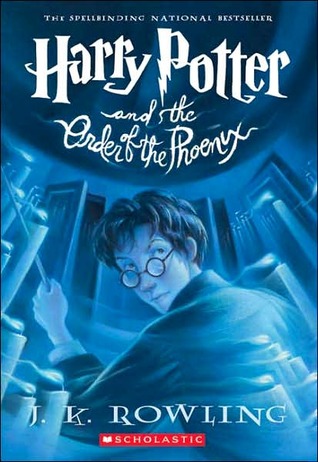 Harry Potter and the Order of the Phoenix
Final Verdict: 4.0 out of 4.0
YTD: 43
Plot/Story:
4 – Plot/Story is interesting/believable and impactful.
The fifth book in the Harry Potter series, The Order of the Phoenix, is the true beginning of what J.K. Rowling had been preparing Harry and his readers for since The Sorcerer’s Stone

Characterization:
4 – Characters extraordinarily developed.
I sometimes feel as if I am beating a dead horse when it comes to this character and J.K. Rowling’s talent. I sometimes hope to be surprised by one of the future installments of the series, in that maybe, just maybe, Rowling will slip up and do something disastrous or just downright boring with her characters. Alas, I am disappointed; she is a characterization genius! As I mention above, there are old characters and new in Book Five of the series and, again, Rowling spends ample time developing our familiar characters, giving the readers a better understanding of their personalities and backgrounds (such as the history of Neville’s parents, and a clear picture of his formidable grandmother) as well as introducing us to new characters, like the beastly Dolores Umbridge. I cannot, anywhere in my memory, recall hating a character as much as I hate Dolores Umbridge. I quite literally want to claw my way into the novel so I can wring her fat, toady little neck. That a writer can make me feel this much venomous dislike for one of her characters is a mark of true mastery of the craft and, incidentally, Rowling is equally good at presenting some truly loveable characters (Luna Lovegood, for instance, and Arthur Weasley – they are just people I want to know!). What Rowling does particularly well in this installment, though, is the back-history. We learn so much about each of the characters, whether it be via a trip through Professor Snape’s memory, or by hearing Sirius and Remus Lupin reminisce about their days at Hogwarts and of being in the original Order of the Phoenix. These histories truly enrich the story and allow us, as the readers, to connect even further and more deeply with these characters. We could easily champion them “in the now” but, after being treated to a more thorough example of their characters and motivations, we become willing to fight and die for these people, to stand side-by-side with them in their quest to defeat evil at all costs.
Prose/Style:
4 – Extraordinary Prose/Style, enhancing the Story.
Rowling again demonstrates a complete mastery of her prose and style in The Order of the Phoenix. Something of significance, though, is the marked difference in vocabulary and structure between this book and any of its predecessors (though, again, each book seems to take steps forward in this regard, as in the depth of the stories themselves). For the first time, in my opinion, the Harry Potter series makes a leap away from young adult fiction and into the genre of literary fiction. The language and difficulty level are intensified, the multi-layered plots and interweaving dynamics (character and plot) continue to grow, and the chapters and paragraphs lengthen. Also, Rowling continues to use many different style elements in her prose to engage the readers: newspaper articles, written letters and, now, “educational decrees.” Breaking up the general prose with these different types of style elements does wonders for the overall book – allowing the reader, again, to feel as if he or she is there, reading these items alongside the characters, reacting with them and then, gracefully, sinking back into the story.
Additional Elements:
4 – Additional elements improve and advance the story.
The majority of this fifth installment is again set at Hogwarts School of Witchcraft & Wizardry. There are many other smaller points of reference, though, including: The Dursleys home and the surrounding city of Little Whinging; the mountainous area of southern France; the wizarding town of Hogsmeade; the city of London and, in particular, the residence of the Black Family; and The Ministry of Magic itself. Having the majority of the novel take place in one area, with short journeys to other places does two things: 1st – it allows the reader a firm platform to center one’s self. Hogwarts School is the “home base” or “safe zone” which, though not always a pleasant place to be, is always familiar and recognizable. 2nd – it begins to develop the story into something more world-wide; as the evils and dangers grow, so do their reach. Suddenly, non-wizarding neighborhoods are at risk. The Ministry of Magic is not just a referenced place but, now, it is an actual, physical structure which we can envision. Combining the familiar with the new takes the storyline to an entirely new level. In addition to the enhanced setting in book five is a new and important theme: politics. In books one through four, there have been many recurring themes, such as education, friendship, family, love, good/evil, etc. With book five, though, comes an increased critique of the nature of power and politics on morality and decency (decision-making). We (Americans) are largely aware of this term “the politics of fear,” and J.K. Rowling holds nothing back in warning her readers about making decisions based from a place of fear or out of a defense of power and stature. Dumbledore and Harry Potter, though decent and honest to a fault, are attacked by the Ministry of Magic out of fear. The political powers, in hopes of securing their own strength and popularity in the public eye, make perpetual attempts at discrediting and even embarrassing the two “heroes” of the novel, simply because they dare to speak the truth – a truth which no one is ready to hear. This new theme leads up to an unresolved-resolution in which a showdown at the Ministry between Harry and Dumbledore (and Dumbledore’s Army) clash with Voldemort and his Death Eaters, and the Ministry, at last, is forced to bear witness and choose a side.
Suggested Reading for:
Age Level: Young Adult & Adult
Interest: Good/Evil, Friendship, Education, Fantasy
Notable Quotes:
“If she could have done one thing to make absolutely sure that every single person in this school will read your interview, it was banning it!”
“Thoughts could leave deeper scarring than almost anything else.”
“Young people are so infernally convinced that they are right about everything.”
Saturday, Uncensored! (#5)
 “If she could have done one thing to make absolutely sure that every single person in this school will read your interview, it was banning it!” – J.K. Rowling (Harry Potter and the Order of the Phoenix)
Hello! And Welcome to Week 5 of my Banned Book themed weekly post, Saturday, Uncensored! This meme is meant to bring continued and renewed attention to the dangers of censorship and banning books.
As always, I thank you all for your continued support and encouragement. I greatly appreciate your personal stories, too! If you are interested in the theme and/or getting involved, I would highly encourage you to visit deletecensorship.org. This fantastic website has great material on the cause, and I personally have purchased some of the anti-censorship related items, like book totes and a mouse pad. Of course, I’m a bit of a nerd like that.
Now, on to the good stuff! This week, in Saturdays, Uncensored: We take a look at two Young-Adult/Children’s novels which have been challenged, censored, or banned. I typically do not feature young adult or children’s fiction on my blog, but these were favorites of mine from childhood, so they deserve their spotlight moment too.
1. A Light in the Attic by Shel Silverstein
I cannot tell you how many times I ran to Shel Silverstein’s poetry collection, A Light in the Attic as a child – just for a bit of fun. The collection was an escape from a bad day, or cheered me when I was bored. The funny little poems, which relate so well to the way children actually think, could entertain repeatedly and endlessly. I never had my own copy as a kid, so whenever I was at the library with friends or my parents, I would seek these out. I am happy to say, though, that I did finally get my own copy a few years ago. I was also a huge fan of Silverstein’s Where the Sidewalk Ends and Prelutsky’s New Kid on the Block .
So, how does a delightful little book of poetry, a collection meant to engage and entertain kids, and to inspire them not just to read but to read poetry – to expose them early to things like rhyme scheme, meter, rhythm, alliteration, assonance, personification, metaphor and so much more – how does such a work get banned? Well, the major charges were and have been filed under the broad term of “inappropriate content.” More specifically, the book has been challenged for promoting disrespect to adults, for using horror as entertainment, and for, supposedly, encouraging violence (the old video game stigma). I think it’s so much easier for parents and adults to try and “shield” children as a way of protecting them, but this is a repeat offense that generation after generation of adults is responsible for, and it does not work. Instead of being lazy and denying kids exposure to these “bad things”, why not take the time, as a parent or educator, to treat sometimes sensitive subjects or topics with the time and respect they deserve; help educate children on how to interpret and respond to silliness and violence, peer pressure and bad tempers, rather than leaving them on their own to try and deal with it as the real-life problems (far less entertaining then their fanciful, fictional versions) present themselves. Do not scare – prepare!
2. A Wrinkle in Time by Madeleine L’Engle
Ah, of course, A Wrinkle in Time had to make it onto my blog, somehow, someway! It was the first sci-fi/fantasy book that I can remember reading, and it did things to my little brain that I just cannot put into words (though, I bet L’Engle could!). I re-read the book recently – a year or two ago- and find, now, that there are far better fantasy novels out there but this one still holds a special place with me, being “my first.” The story is interesting: genius children and their simpleton, but handsome, friend lose their father to some dark deviousness and set off to find him, with the help of three hilariously entertaining, bickering witches. One of the more interesting aspects of this novel, for me, was that the “bad guy” was just badness-in-essence. In most novels, fantasy or otherwise, the antagonist is a clearly defined man or monster, who/which needs to be defeated. But in this book, L’Engle has the cleverness (seemingly echoed/honored by Rowling in Harry Potter and the Prisoner of Azkaban) to suggest that the most evil and scary opponent is just evil in its purest form.
How, though, does a Newbery Award winning novel (1963) come to be banned and challenged on so many occasions (because there have been many and, in fact, the book continues to be challenged regularly)? Well, the most frequent charges are those based on the presence of magic and witchcraft. Obviously, magic and witchcraft must automatically equate to devil-worship, so these charges are quite understandable (cough). One of the more charming challenges, though, reportedly comes from a case brought to the Alabama State Board of Education, in which the challenger believes the book should be banned because, in the list of “those who defend the Earth against evil,” is Jesus Christ. What’s wrong with this, you ask? Particularly if “devil-worship” seems to be a moot point when Jesus Christ is called on as hero? Well, the problem is, Jesus Christ was listed along with other mortal men – philosophers, artists, scientists, etc. Apparently, it is not important to encourage your children to grow up to be great thinkers and moral leaders but, instead, to just … you know, ignore those book-thingies and let the weight of the world fall on someone else’s shoulders. (No offense to the Christian population, here, I know the majority are not so simple-minded. If you think this way, though, well, fair warning that your kids may just grow up to be a bit… stupid).
Thanks for stopping by for another Saturday, Uncensored! Have you read these books – thoughts on their being so often challenged? Comments otherwise? And – Don’t Forget! The “100+ Followers Super Giveaway” ends Tomorrow at 11:59pm CST – which means you’ve got one day left to enter to win 1 of 4 pretty groovy prize packs!
Top 15 Favorite Last Lines
It is “Hump Day” or, in boring terms, Wednesday; and since I do not have a regular Wednesday meme or posting theme, I thought I would do something totally random today.
Nerd that I am, I keep a journal of my favorite “last lines” from novels I’ve read. I posted my all-time favorite today on Facebook (from F. Scott Fitzgerald’s The Great Gatsby and got a nice response from Ash at Smash Attack Reads which inspired me to go the “Huh..this could be a blog post thingy, and then I’ll have a regular place to keep all the last lines I add to my favorites list forever and ever!” posting route.
These are in no particular order (though I did put asterisks ** next to my top favorites), and I know there are many, many other great and famous last lines out there – but I am only including the ones from books I have actually read.
Without further ado, my favorite last lines:
1. The Great Gatsby by F. Scott Fitzgerald **
“And so we beat on, boats against the current, borne back ceaselessly into the past.”
2. Winesburg, Ohio by Sherwood Anderson
“He stayed that way for a long time and when he roused himself and again looked out the car window the town of Winesburg had disappeared and his life there had become but a background on which to paint the dreams of his manhood.”
3. The Adventures of Augie March by Saul Bellow
“Columbus too thought he was a flop, probably, when they sent him back in chains. Which didn’t prove there was no America.”
4. Heart of Darkness by Joseph Conrad
“The offing was barred by a black bank of clouds, and the tranquil waterway leading to the uttermost ends of the earth flowed somber under an overcast sky – seemed to lead into the heart of an immense darkness.”
5. To the Lighthouse by Virginia Woolf
“Yes, she thought, laying down her brush in extreme fatigue, I have had my vision.”
6. A Tale of Two Cities by Charles Dickens **
“It is a far, far better thing that I do, than I have ever done; it is a far, far better rest that I go to, than I have ever known.”
7. The Adventures of Huckleberry Finn by Mark Twain **
“But I reckon I got to light out for the Territory ahead of the rest, because Aunt Sally she’s going to adopt me and sivilize me and I can’t stand it. I been there before.”
8. Cat’s Cradle by Kurt Vonnegut
“ If I were a younger man, I would write a history of human stupidity; and I would climb to the top of Mount McCabe and lie down on my back with my history for a pillow; and I would take from the ground some of the blue-white poison that makes statues of men; and I would make a statue of myself, lying on my back, grinning horribly, and thumbing my nose at You Know Who.”
9. The Catcher in the Rye by J.D. Salinger **
“Don’t ever tell anybody anything. If you do, you start missing everybody.”
10. Animal Farm by George Orwell **
“The creatures outside looked from pig to man, and from man to pig, and from pig to man again; but already it was impossible to say which was which.”
11. Sister Carrie by Theodore Dreiser
“In your rocking-chair, by your window dreaming, shall you long, alone. In your rocking-chair, by your window, shall you dream such happiness as you may never feel.”
12. Great Expectations by Charles Dickens
“I took her hand in mine, and we went out of the ruined place; and, as the morning mists had risen long ago when I first left the forge, so, the evening mists were rising now, and in all the broad expanse of tranquil light they showed to me, I saw no shadow of another parting from her.”
13. McTeague by Frank Norris
“McTeague remained stupidly looking around him, now at the distant horizon, now at the ground, now at the half-dead canary chittering feebly in its little gilt prison.”
14. Vanity Fair by William Makepeace Thackeray
“Come, children, let us shut up the box and the puppets, for our play is played out.”
15. The Perks of Being A Wallflower by Stephen Chbosky
“So, if this does end up being my last letter, please believe that things are good with me, and even when they’re not, they will be soon enough. And I will believe the same about you.”
What are your favorites? Leave me comments if you think I’m missing anything!
 Roof Beam Reader