Roof Beam Reader
Adam Burgess
Review: Vanity Fair by William Makepeace Thackeray
Vanity Fair by William Makepeace Thackeray
Final Verdict: 3.5 out of 4.0
Plot/Story:
4 – Plot/Story is interesting/believable and impactful.
Vanity Fair
Characterization:
3 – Characters well developed.
As mentioned above, one of the brightest spots for this novel is the attention paid to all of the characters’ strengths and weaknesses. Hardly any characters, save some minor ones, come across as flat or static – or even wholly motivated by one single impetus. The main characters, Rebecca (Becky, the wench!) and Amelia (oh, humble Emmy!) are clearly opposing forces, one portrayed as a vindictive, win-at-all-costs vixen; the other, a charming, generous, and kind-hearted (and heartbroken) virgin-mother figure. The surprises come in nearer to the end, though, when Thackeray begins to show the lovelier side (can it be?) of Becky, and the selfishness of our dear Emmy. This was clever and truly helped keep the story engaging, and allowed it to end in an interesting manner. Without their two stories and the sometime surprises afforded to the reader from both of the women, Vanity Fair really could have been quite a bore (which is, really, probably Thackeray’s point). Still, beyond these two – and perhaps the good Dobbin, not much is to be said about the remaining characters. While they too demonstrate their goodness (charity, beneficence, humility) and their poorer qualities (shallowness, dim-witted gullibility, greed) – none ever truly seem to grow or change as the story goes on. The only exception may be Amelia’s father-in-law who, in the end, may surprise the readers.
Prose/Style:
3 – Satisfactory Prose/Style, conducive to the Story.
Thackeray’s prose and style, fortunately, are fluid and engaging. The novel is a hefty one, my copy weighing in around 850 pages. Had the prose been too lofty or the style to vague or disconnected, I could have easily given up on the book before getting halfway. It is Thackeray’s wit and subtlety, his elegance of phrase and his talent for dialogue and (albeit slightly skewed/biased) narration which help guide the reader along and keep him or her engaged in the tryst through Vanity Fair (treated by the author as an actual place – which is, perhaps, the most obvious element of satire and irony though much more abounds throughout the pages). There was a nice balance of short and long chapters, so that it was not possible, really to anticipate how detailed a particular portion of the story would be until you were done with the relevant chapter. I also enjoyed the inclusion of certain interjections by the narrator about what was happening, either relating it to the farce of “Vanity Fair” in general, or to history as it was. At times, epistolary moments were brought in to add another layer of humanity and profundity to the moment – a son lost, a wife betrayed, a friend in need. What would have improved my particular addition of the novel, though, would have been footnotes at the bottom of the pages, rather than in the back. I do not enjoy breaking the flow of reading to flip to appendices and notes – particularly in a book of this length. That, however, is publishing/editorial choice, and not the fault of the author.
Additional Elements:
4 – Additional elements improve and enhance the story.
There are many themes which persist throughout the novel. The most obvious of these themes, of course, are vanity and social values/status. Almost every character in the novel, with the exception, again of Major Dobbin and perhaps Amelia’s young son (who shows a genuine consideration for certain people, as opposed to their stature), are concerned entirely with wealth, status, and getting their “due.” Even Emmy, who perhaps not vain in the monetary sense, was the cause of ruin to a man and his family because she refused to accept that a better, more suitable match should have been found (yes, we die-hard romantics might side with her at first – but keep reading!). Another theme is the idea of illusions and reality – how many of us can truly tell what the reality of a situation is, and how much of it is actually our own or others projections based on what we desire to see? It is also interesting to try to divine what Thackeray’s real point is. Certainly he is condemning vanity in general but, as he is equally harsh in his treatment of the rich and the poor, it seems he may be expounding a general condemnation for “civilized” society as absurd and backward (it is hard not to channel Kurt Vonnegut when reading Vanity Fair under these terms). Robert Louis Stevenson posed an interesting question after reading the book. He wondered whether, without the character of Rawdon Crawley (Rebecca’s husband) striking the Lord Steyne (Rebecca’s generous benefactor) upon walking in on the two at a rather compromising and suspicious time, would this novel seek to be a work of art and, instead, be just another book? At first, I was hard-pressed to believe that one action by one character in an 800 page novel would be the barometer for greatness but, upon days of reflection, I must agree that, had Crawley not taken action in that very moment he, like the rest of the players in Vanity Fair would have continued to exist only in a superficial light. That Thackeray gave Crawley a spine, if just for a moment, seems to hint that he does believe, underneath all the farce and the money and the struggle for power and inheritance, humanity might just rear its real and passionate head.
Suggested Reading for:
Age Level: Adult
Interest: Literature, English caste history, British fiction, Historical fiction
Review: Harry Potter & The Prisoner of Azkaban
 Harry Potter & The Prisoner of Azkaban
Final Verdict: 3.5 out of 4.0
Plot/Story:
3 – Plot/Story is interesting & believable.
The third novel in the infamous Harry Potter series by J.K. Rowling incorporates many of the same elements and characters as books one and two but amplified. In this installment, we are introduced to a few new characters (Remus Lupin, Sirius Black) that play important roles in both the upcoming novels and in Harry Potter’s past, which leads to the development of Harry as he has little to no contact with anyone who had known or were really friends with his parents up to this point. Also, Rowling allows us glimpses at the budding natures of other characters –good and bad- who will play important roles as the Harry Potter
Characterization:
4 – Characters extraordinarily developed.
As mentioned above, there is so much growth and development for both the major and minor characters in this novel. We begin to see who will be important, and who will likely be “supporting cast.” Readers also begin to understand the personalities of these characters and why they make the choices they do. The new characters are brought in with veiled mystery that is slowly unraveled throughout the books – with bits and pieces of back story placed here and there throughout the storyline. Hints are dropped as to characters’ identities and natures with a final resolution that is, if not surprising, certainly important and bound to thrill the reader and inspire one to go out and get the next book. Perhaps some of the best development, outside the continued growth of the three main characters who, unlike in many young adult fantasy novels, do not remain static through the years, but do show marked growth and change from year-to-year and from challenge to challenge (with references to the previous books and events, etc.), is the development of a new character, Remus Lupin, and a familiar character, Severus Snape. The reader is offered a glimpse at their shared path and begins to see just how and why Snape might have grown into such a, well, jerk. Rowling does not make things black and white, however, which is one of the greatest strengths for this series and its characters. Players in this drama are not merely “good” or “bad,” but are complex and deep, with varying past histories and experiences which, we see, begin to unfold and reveal so much more about who they are and where they are coming from (and, perhaps, where they will end up?). Even Snape, who is so easy to hate, is presented with a degree of empathy so as to remind the reader that – be we muggles, wizards, or squibs – we are all human, after all.
Prose/Style:
4 – Extraordinary Prose/Style, enhancing the Story.
Once again, Rowling’s prose draws the reader in. It becomes so easy sink into this extraordinary world, as if the story is wrapping itself around us and making us not merely observers, but characters in the story. We begin to feel the gamut of emotions which the main characters, particularly Harry, feel: love and hate, joy and sorrow, excitement and terror. That each character’s monologues and style of speech continues to be distinguishable from the other characters is also impressive, particularly when more and more characters that are having greater and deeper interactions with one another, are introduced and developed. I also particularly appreciated the continued development of internal dialogues and reflection, as well as the use of letter-writing as dialogue (I’m always a sucker for good epistolary moments).
Additional Elements:
3 – Additional elements are present and cohesive to the Story.
The setting of the novel, discussed in detail in my reviews for Sorcerer’s Stone and Chamber of Secrets is still incredibly beneficial to the plot. We are introduced to new places – Hogsmeade Village and The Shrieking Shack- which add further appreciation for this wizarding world and help us to continue to grow along with the characters, taking part in the new experiences they are having – whether it be discovering Honeydukes’ candy shop for the first time, and all the tasty treats it offers or visiting The Three Broomsticks pub and sipping our first Butterbeer (granted, vicariously through the characters). We also spend more time with Harry in Diagon Alley at the start of the novel, and we begin to appreciate the many different yet similar activities available to these special (and lucky!) people. Want to spend a day studying outside an ice cream shop – great! But Harry also gets the added treat of learning magical history through the many tales and stories of the wizened shop owner. The good/evil dynamic grows in a more concerted way in Prisoner of Azkaban
Suggested Reading for:
Age Level: Young Adult +
Interest: Friendship, Family, Education
Review: Harry Potter & The Chamber of Secrets
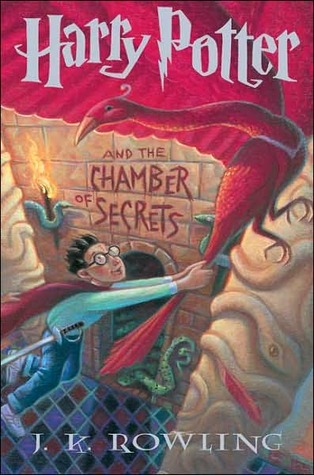 Harry Potter and the Chamber of Secrets
Final Verdict: 3.25 out of 4.0
Plot/Story (3 of 4):
“3 – Plot/Story is interesting & believable.”
In the second book of the series, Harry and his friends – Ron and Hermione- find themselves again involved in a battle with a mysterious opponent, whose identity and purpose are not revealed until near the end of the story. Lord Voldemort returns, not by physically possessing another wizard, but as an enchanted memory, weaving his evil plot through one of the Hogwarts first-year students. When Hermione and Ginny Weasley fall prey to the monster of The Chamber of Secrets
Characterization (4 of 4):
“4 – Characters extraordinarily developed.”
Once again, Rowling demonstrates her devotion to and mastery of characterization and character development. New characters, such as Gilderoy Lockhart, Dobby the house elf, and even Professor Binns are all perfectly introduced and executed throughout the book, regardless of their major or minor status in the storyline. Additionally, characters whom we are more familiar with from book one, like Harry, Draco, Ron, Hermione and Percy Weasley continue to grow and we begin to see more of their natures – even anticipating how they may act in certain situations, or where we might see them in future books.
Prose/Style (3 of 4):
“3 – Satisfactory Prose/Style, conducive to the Story.”
While The Chamber of Secrets maintains a similar reading level as its predecessor, The Sorcerer’s Stone
Additional Elements (3 of 4):
“3 – Additional elements are present and cohesive to the Story.”
Once again the setting of the story works to its favor. The novel begins in the “muggle” world, of which we are all familiar – a single family home in the suburbs of London, recognizable in general as “living space.” Then, we proceed through Diagon Alley, the wizarding area of downtown London, as well as the subway and its magical counterpart, Platform 9 & ¾. Balancing each of the magical places with a realistic twin helps to keep the reader firmly planted on the ground while simultaneously being swept into the mystical enchanting fantasy of Hogwarts. Rowling works her own magic, here again, almost making it seem as if, in our day-to-day lives, there would be nothing extraordinary at all about bumping into a crimson-cloaked wizard (though they do try to be covert). Certain symbols and motifs from book one, like friendship and the “formed family” are carried into and further developed in Chamber of Secrets. Other elements, such as the nature of humanity (subservience and slavery, hypocrisy, cozening, etc.) are introduced. The resolution, though, seems much more far-fetched than in Sorcerer’s Stone. While this is obviously a fantasy novel, the climax is a bit far-reaching and it becomes harder to believe, in this case, that no adult wizards – teachers or otherwise, would be present during the final “showdown.” While in book one it seemed almost natural for Harry, Ron, and Hermione to be solving the problem, here it seems a bit odd and even uncomfortable. Still, new information has begun to be hinted at in regards to certain characters, like Percy Weasley and the Harry-Voldemort connection, which is interesting at the start and even more fascinating to those, like me, who are going back for a re-read and being reminded of how early in the timeline these characters and relationships began to develop.
Suggested Reading for:
Age Level: All Ages
Interest: Fantasy, Education, Good/Evil, Friendship
Review: Harry Potter & The Sorcerer’s Stone by J.K. Rowling
 Harry Potter and the Sorcerer’s Stone
Final Verdict: 3.25 out of 4.0
Plot/Story (3 of 4):
“3 – Plot/Story is interesting & believable.”
Harry Potter and the Sorcerer’s Stone is the first in the Harry Potter
Characterization (3 of 4):
“3 – Characters well developed.”
As someone who has read each of the seven Harry Potter books (and auxiliary books in this Universe), I have the benefit of knowing that character development and characterization is something that the author continues to pay close attention to throughout the length of the series; however, I can say, also, that the attention paid here, in book number one, paves the way for the future books and allows the reader to engage with, identify, and relate to the major and minor characters from the start. This is incredibly advantageous to the series’ future success, and is a major factor in drawing readers in from the get-go. The major characters, such as Harry, Ron, and Hermione, are explained in detail, but not in such a way as to ever make the reader feel “forced” to like or dislike any of them; similarly, some of the minor characters like the Dursleys, Neville, the Weasley twins, and the teachers are so greatly developed that they are distinguishable from one another in action and language – the things they say and do are indicative of the personalities the author has been developing. Also, even the minor characters begin to demonstrate the type of personalities which become important to plots of future books.
Prose/Style (4 of 4):
“4 – Extraordinary Prose/Style, enhancing the Story.”
The prose and style of the first novel, while simple (largely, I understand, due to the publishers having asked Rowling to water down things a bit for her younger readers, who were likely to be the largest demographic) is never so easy as to be boring. There are not many “big” words or ideas, though much of the wizarding language is new; still, many of the names of characters are cleverly chosen based on their meaning, so as to represent the characters themselves. The spells, too, are well-researched and their Latin names reflect the purpose/power of the spell. All of this should form a strong impression in the intellectual and/or attentive readers mind, as to demonstrate that this author does indeed know what she is doing, and is executing her style quite brilliantly. The balance is swayed a bit in favor of the “simple” but, when comparing to other “children/young-adult” level fantasies, The Sorcerer’s Stone still stands out as more challenging and well-constructed, in my opinion.
Additional Elements (3 of 4):
“3 – Additional elements are present and cohesive to the Story.”
The setting is present-day England but the story takes place in a secluded castle, hidden from view (as are the wizarding villages) of the “muggle” or non-magic public. The setting is highly effective, as it is relevant and easy to relate to, but still magical and mysterious. Many symbols and motifs or allusions we begin to see here in book one are developed further in future books, and recur throughout the seven-book story, with varying levels of importance. It is difficult to see this, perhaps, unless one has read through the entire series first and then re-reads the books from the beginning but, as this is the case for my own review, I can answer thusly. For example, there is a comment made in this book about Professor Snape being able to “read minds,” which we find out four books later may not be far from the truth. The themes of love and friendship, too, as well as family (both by blood and by choice) are established here and will come up again and again throughout the Harry Potter storyline. This first book’s resolution, like resolution of all the parts through book six, is believable, credible (if fantastical) and also a bit playful, as it leaves the door open for what will happen in the next installment of the story.
Suggested Reading for:
Age Level: All Ages
Interest: Fantasy, Friendship, Family, Morality (Good/Evil), Education
Review: Existentialism and Human Emotion by Jean-Paul Sartre
I can’t write a long review on this one, because I just don’t feel up to it. I’m not a philosopher but, that being said, Sartre (and the translator) certainly made existentialism, to an extent, accessible to me as someone rather unfamiliar with the concepts. I appreciated a lot of what Sartre says about creating one’s self and always being one’s self “in production,” as it were. “The Hole,” however, was pretty absurd. That man lives to fill himself (and that man seeks out woman because she is, essentially, a hole to be filled) was just weird. I also didn’t like what he said about taste buds not really existing, because what one tastes and defines as “good” or “bad” isn’t really based on how it tastes, but on what one has pre-determined one wants (or what one believes is good for him). Too far a stretch, I think – though the point he makes about one finding it inconceivable that another would not like the taste (or smell, feel, etc.) of something one likes is well taken and appreciated. But, all-in-all, the philosophy is interesting and I would like to learn more. I have a copy of Sartre’s Nausea
Publisher: Citadel, 2000
ISBN: 0806509023
Challenges: N/A
YTD: 35
Source: Owned Copy
http://rcm.amazon.com/e/cm?t=httproofbeamr-20&o=1&p=8&l=bpl&asins=0806509023&fc1=000000&IS2=1<1=_blank&m=amazon&lc1=0000FF&bc1=000000&bg1=FFFFFF&f=ifr
 Roof Beam Reader