Roof Beam Reader
Adam Burgess
Join Me on Substack!
Dear Friends,
I’ve excited to share that I’ve moved to Substack!
Please find my primary page here: https://theadamburgess.substack.com/
I hope you’ll subscribe on Substack to keep up with the project and its conversations. I’m encouraged by some of Substack’s’ additional features, such as voice and video integrations, dedicated chats, and both internal and external reading and writing communities.
There will be additional content for paid subscribers (such as the community chats and future multimodal posts on various topics, and early access to or first notice about major events or plans, such as the Podcast or YouTube integrations), but the Contemplative Reading Project posts will remain free for subscribers.
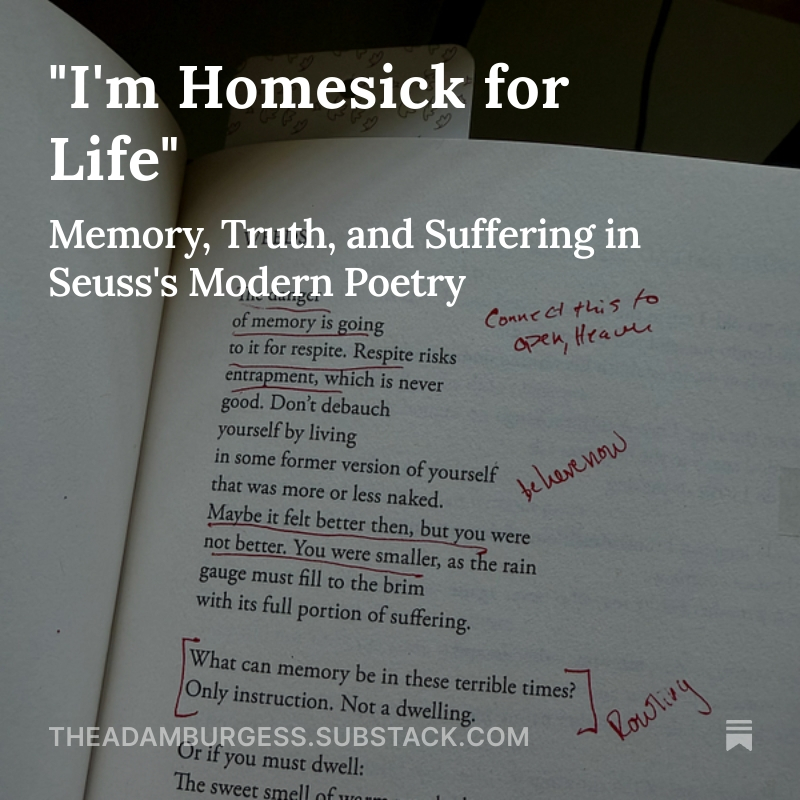
This week’s post, “I’m Homesick for Life: Memory, Truth, and Suffering in Seuss’s MODERN POETRY” can be found via the button below.
Substack Schedule
- Mondays: Contemplative Reading Project Reading Reflections
- Wednesdays: Writing Prompt Responses & Prompt for the New Week
- Fridays: Potpourri (blog on reading, writing, life, etc.)
I hope you’ll join me!
~Adam
| Bluesky | Instagram | Threads | Facebook | TikTok | Tumblr |
Collecting Butterflies

Dear Friend, All things must pass. So sings George Harrison, in one of my favorite songs (by one of my favorite singer-songwriters). Seeing as how …
Collecting Butterflies
Here We Go a-Wuthering
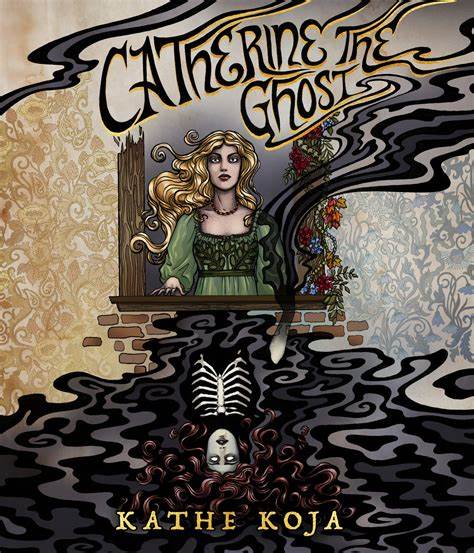
“. . . by the next day I did want him, not as a brother or sweetheart or husband or even as a pleasure, any more than I am always a pleasure to myself, but as Heathcliff, my own being, as I am his.” (Koja 52)
Robinson Crusoe has Foe.
Jane Eyre has Wide Sargasso Sea.
Great Expectations has Jack Maggs.
And now, at long last, Wuthering Heights has Catherine the Ghost.
There’s nothing I love more than a post-colonial reconsideration of a revered and enduring classic novel, especially when that reconsideration is a powerful examination poetically told. In Catherine the Ghost, Kathe Koja’s two Catherines are elevated from the observed to the observing. Though the human foils of the Grange and the Heights still consider them wild, Koja reminds us that a “wild woman” was just one with agency and self-respect.
I’ve had many conversations about whether Wuthering Heights is a “romance” or a “Romance,” or both or neither. When Koja writes, “does he feel, as she does, that strange intent presence? does he feel the cold, has he felt it all these years” (85), that question starts to seem silly. We all have our ghosts, you see, and as I finished reading this Ghost, sitting in front of the fire on a midwinter morning, I began to consider the spirit of all things—love and memory, regret and pain, and forgiveness, too—is where romance abides. It’s the revelation of finding another human being in me, and of knowing myself in them.
Wuthering Heights is a complicated, complex, and oft overwhelming story; it would take a great deal of daring and of skill to attempt to return to it, but it would, most importantly, require deep love for the original. Koja’s return is that place where love and attention meet talent and nerve. Whatever the souls of books are made of, these two are the same.
It was such a pleasure to come home to the Heights again.
 Roof Beam Reader