Roof Beam Reader
Adam Burgess
Sing, Unburied, Sing by Jesmyn Ward
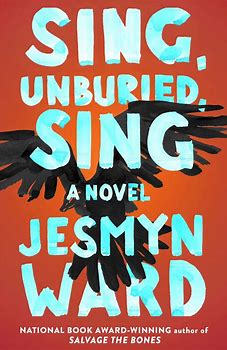
Jesmyn Ward’s Salvage the Bones has been on my radar since its publication over a decade ago, but somehow this one, Sing, Unburied, Sing, was the first of her novels that I bought, and thus it has been on my actual (physical) TBR pile for more than long enough to qualify for this year’s TBR Pile Challenge.
What I didn’t know about either of these novels is that they both won the National Book Award (2011 and 2017, respectively), and have cemented her place among the contemporary American literary masters. My reading of Sing, Unburied, Sing, for what its worth, confirms this. I’ve been skeptical of this trend toward magical realism in contemporary Black American fiction, especially when historical figures are involved. Ward’s approach, though, is delicate on the magical part, and it deals with everyday persons rather than reimagining the lives of remarkable people from our literal history.
Although I’ve found myself less and less interested in folk literature or magical realism that uses the supernatural as deux ex machina, I appreciate where Ward is coming from in crafting her tale the way she does. Much of the supernatural, which is a kind of side element anyway, is metaphor, and I find this much more interesting and effective, personally, when I’m not reading fantasy intentionally.
Ward’s characters, living on the Mississippi Gulf Coast, are realistic in formidable ways. Present here is tradition and intergenerational folk wisdom, but this is put into direct conflict with modern traditions and failings. The tension between embracing and curating generations of family and community knowledge with the onslaught of contemporary realities, including police violence, racist systems, and drug addiction, is a rubber band stretched to snapping.
This tension is expressed through the competing narratives of Jojo, an interracial teenager coming into his manhood, including the powers and challenges this brings, and his mother, Leonie, a woman who lost her brother tragically to racial violence, who married a white man despite that, and who has been unable to reconcile any of it. This lack is most evident in her inability to see and hear beyond the veil—beyond the senses’ true abilities—the way that her dying mother can, and the way that Jojo can, too.
A subplot whose climax is revealed only at the very end exists in the mystery of a relationship that formed between Jojo’s grandfather and a boy, Richie, both of whom were incarcerated together many years before Jojo’s story takes place. All of these characters and relationships are indicative of larger concerns while being at the same time very real and affecting to the people carrying the weight of America’s shames on their shoulders. It’s heartbreaking to see just how personal these grand errors can become, and how much damage they can do.
The question, in the end, seems to be whether we as persons and as a people can become something better than our histories. Ward’s answer is found in Kayla, Jojo’s younger sister who clings to him throughout, who rejects their mother, and whose final command, “Go home,” seems not so much an entreaty to another character in the end, but a command for us all.
“Home, they say. Home.”
A People’s History of the United States
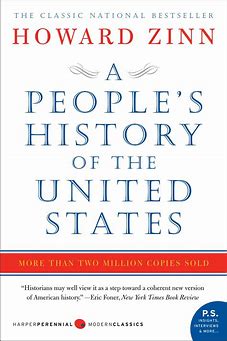
I have long wanted to read Howard Zinn’s A People’s History of the United States; in fact, I think I’ve owned my copy for at least a decade. Many things kept me from picking it up, from its length to the fact that it’s a general history book (I usually read only targeted histories, such as histories of a particular war or a specific topic, but less often something that covers a nation’s or people’s entire history). I also worried, based on the excerpts I’d already read plus reviews from friends, that the book would make me terribly sad and incredibly enraged. As it turns out, I wasn’t giving that premonition enough credit.
Howard Zinn’s A People’s History is, by the author’s own admission, a biased view, as all views are. It is, however, a more honest one, in my opinion, because it considers the lived experiences of the masses, not the few (something quite different from most histories) and because it recounts so much of what is traditionally left out of popular and educational history texts. Zinn presents us with major and minor historical events, movements, figures, and places as it would have been viewed by those most affected and with an attempt at creating immediate and longitudinal contexts. Even though I couldn’t read more than a chapter at a time without risking personal injury due to rising blood pressure and lockjaw, I felt like I was able to speed through the text, to comprehend and digest it well, and to gain an even deeper appreciation for my already skeptical view of the adage, “American exceptionalism.”
The history is bound to make an objective and conscientious reader feel monumentally disappointed in the American experiment, from its pre-colonial founding to the Clinton administration. When modern day conservatives rave about “woke” culture and anti-American sentiment (read: addressing cisgender white heterosexual privilege), it’s not hard to understand why a book like this one might frighten them (and why the less intellectually honest or less equipped might want to “ban” it). Ideas can be disruptive, and disruption can feel unsettling, even dangerous.
I too experienced this feeling while reading A People’s History. Many figures I have long admired are now under re-assessment, which is a painful but not unnecessary process. I think it would be easy to finish this one and walk away utterly disillusioned by the power and corruption, and great deception, of the American government and its economic system. And while there’s every reason to be angered by much, Zinn also highlights just how often the people have stepped in to say when enough was enough, to demand and create change, and to stand together and support one another in the most impossible of times and under the most extraordinary of pressures and disadvantages.
I won’t say A People’s History is uplifting or even very promising, because it’s not, but I think that if one is of a mind—or heart—to seek the good in a perpetually bad system and to believe that, ultimately, power really will rest in the people, then it’s enough that this book is edifying, challenging, and actionable. They call this “revisionist” history, but as I tell my students, revision is what we do when we have new information and when we have strengthened our ability to process that information. When we revise thoughtfully, we almost always produce something better.
If you’re an American and haven’t yet read Zinn’s A People’s History of the United States, I hope you will do so. I’m going to list some other recommendations below.
This one is Book 3 for my 2022 TBR Pile Challenge.
Recommendations for Similar Reading:
- Caste by Isabel Wilkerson
- Stamped from the Beginning by Ibram X. Kendi
- The 1619 Project edited by Nikole Hannah-Jones
- The Color of Law by Richard Rothstein
- A Queer People’s History of the United States by Michael Bronski
- An Indigenous Peoples’ History of the United States by Roxanne Dunbar-Ortiz
- An African- American and Latinx History of the United States by Paul Ortiz
- A Black Women’s History of the United States by Daina Berry and Kali Gross
- A Disability History of the United States by Kim Nielsen
- The New Jim Crow by Michelle Alexander
February Checkpoint #TBR2022RBR

Hello, TBR Pile Challengers!
Welcome to our second checkpoint for this year’s TBR Pile Challenge! It looks like some of you are off to a rip-roaring start! Way to go! As for me? I’m basically right on track, having completed two of my reads & reviews while being about halfway through list selection number three (A People’s History of the United States).
Progress: 2 of 12 Completed
So far, I’ve read and reviewed 2 of my 12 required books. I do plan to start Book 3 very soon, but more importantly, I need to get some reviews written and posted! I’ve got a couple of recent reads, like Lydia Millet’s A Children’s Bible and Rainbow Rowell’s Anyway the Wind Blows, sitting here on my desk staring at me with judgmental furor. (To be fair, I don’t review every book I read, anymore, so I may or may not even do these.) To be honest, I’ve pivoted to only reading books that I can rave about, as time is short and I don’t particularly believe in posting negative reviews (I just post the stars to Goodreads.)
I still plan to read all 14 of the books on my list this year, the main 12 plus my 2 alternates, so I’m glad to be at least “on track” with one a month. Summer usually leaves me extra time, so I can catch up on alternates then. That said, I have quite a few very long books on my list this year, one of which I’ve been working on for a few weeks already, so maybe I shouldn’t get too cocky.
Books read:
- Zen and the Art of Motorcycle Maintenance by Robert M. Pirsig
- When My Brother Was an Aztec by Natalie Diaz
How are you doing?
Below, you’re going to find the infamous Mr. Linky widget. If you read and review any challenge books this month, please link-up on the widget below. This Mr. Linky will be re-posted every month so that we can compile a large list of all that we’re reading and reviewing together this year. Each review that is linked-up on this widget throughout the year may also earn you entries into future related giveaways, so don’t forget to keep this updated!
MINI-CHALLENGE WINNER #1
Congratulations to Michelle of True Book Addict, who is the winner of our very first mini-challenge! Michelle will receive a book of her choice from The Book Depository ($15 USD or less).
We will have another mini-challenge in April but keep reading and posting your reviews. Remember that every completed review for your challenge list’s books that is linked up in our widget counts as an entry into the final prize at the end of the year!
LINK UP YOUR REVIEWS!
When My Brother Was an Aztec by Natalie Diaz
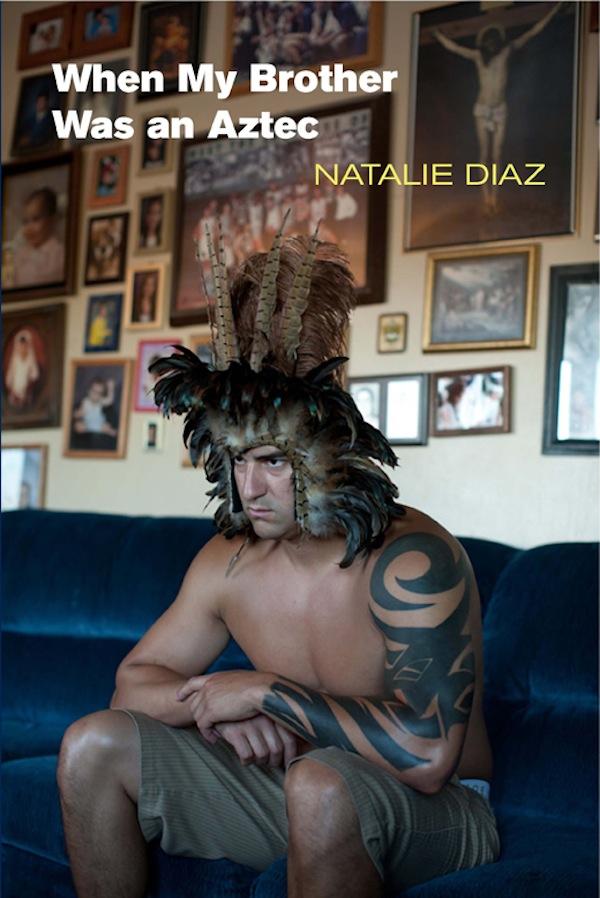
Natalie Diaz is a poet I’ve followed on social media for a long time. I appreciate her presence and the genuine, earthy things she shares online, as well as all her thoughts on poetry. We’re also from the same region of the United States, which is relatively sparsely populated and so often tight knit when it comes to things like artists and writers. When My Brother Was an Aztec, published by Copper Canyon Press in 2012, is her first collection, and what a stunner!
Copper Canyon is one of the poetry publishers I respect most. I can’t remember a single time I’ve purchased one of their titles and been disappointed; in fact, I’m usually blown away. And this experience was no different. What Diaz does in these poems is breathtaking, especially the honest, bare-knuckle way she tackles family issues like drug addiction. The way she melds the commonplace with the mythological is difficult to describe. In one poem, Diaz’s speaker describes her brother in a dementia-like state, paranoid and delusional, rifling through their parents’ house stealing all the lightbulbs and taking apart anything remotely electrical. In other, she shows us in heartbreaking detail how their mother and father have apparently resigned themselves to their fate. The speaker looks at her father like a willing Sisyphus, perpetually punishing himself through repeated interactions, failed ones, with his own son.
One of the things I loved most about this collection is when Natalie Diaz writes back to earlier and canonical poets, like Walt Whitman, as she does in “Reservation Grass.” This clear response to Leaves of Grass is both clever and haunting in form and purpose, mimicking as it does Whitman’s universalizing listing, yet illustrating the clear division in their lived experiences and promise. The speaker writes, “The shards of glass grow men bunched together—multitudes—men larger / than weeds and Whitmans, leaning against the sides of houses / . . . upon dirt not lawn” (30).
Her musings on family are just as searing and insightful as her poetic dueling with American master poets, and somehow just as universal despite their being first-person accounts. When she describes in “Why I Hate Raisins,” a memory with her mother, their hunger, and how she only came to understand selflessness versus selfishness as an adult, when it was too late, is piercing. That same sting of epiphany is present in so many of her poems, perhaps especially “No More Cake Here,” which appears to start off as a eulogy but eventually turns into a wish, and a loss.
I thoroughly enjoyed this one and am glad, through my #TBR2022RBR challenge, that I finally got to read it.
Postcard Poems by Jeanne Griggs
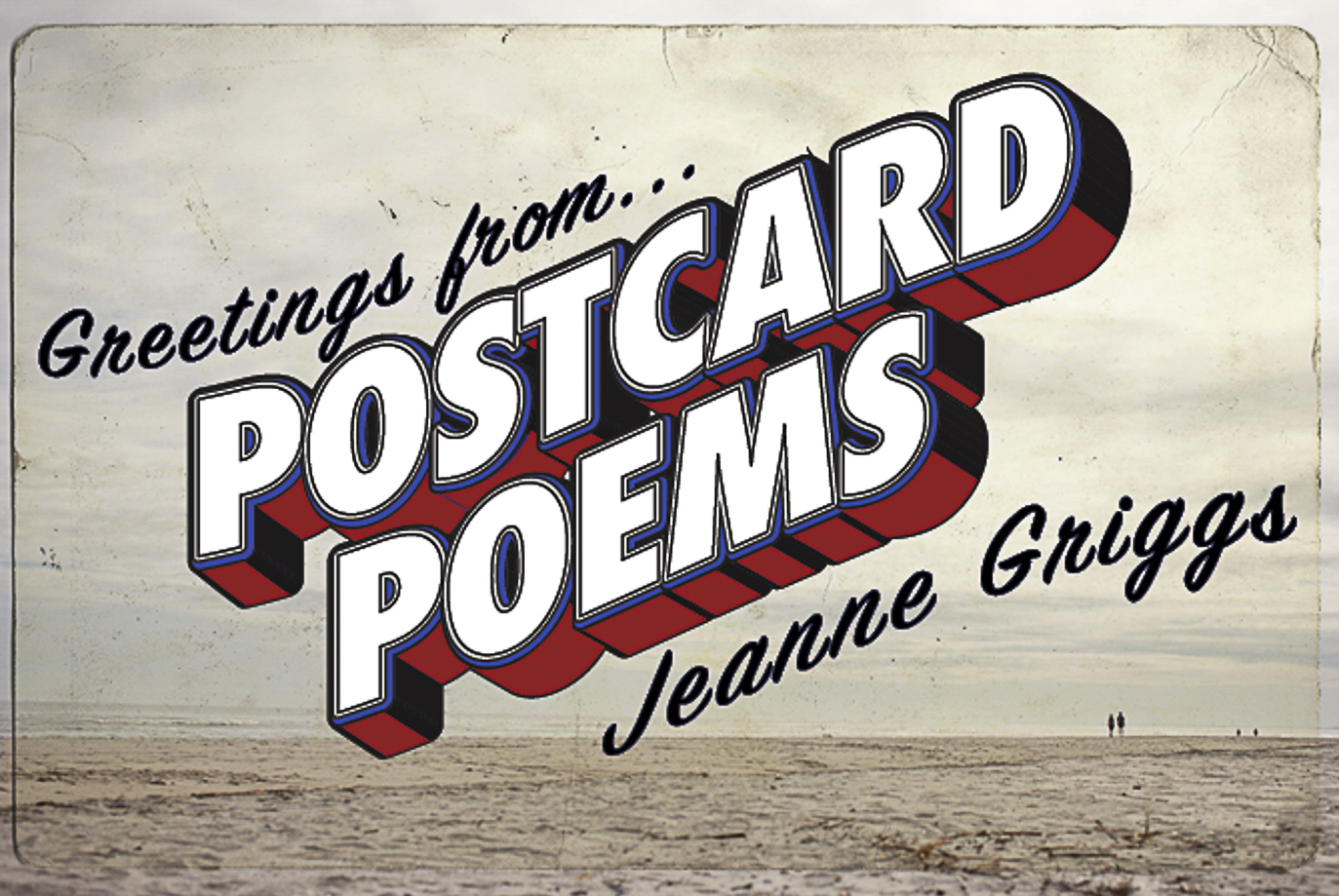
I was thrilled to receive a review copy of Postcard Poems by Jeanne Griggs. Poetry has been my genre of interest for the last few years, and my primary focus in terms of my own writing. The approach Griggs takes in her collection is both unique and accessible, and it gives readers a lot to love.
Initially upon receiving the book, I admit that my first reaction was, “Gah!” This is because the book is irregularly formatted, something I tend to avoid when purchasing because I’m so obsessive about the way books fit on my shelves. This means I’m probably missing out on a lot of excellent material, of course. Postcard Poems has reminded me to stop being so uptight about physical fit because I might be missing out on great content that fits absolutely. Here’s what I mean.
Griggs’ collection did two things for me immediately as a reader. First, it reminded me of how dearly I love epistles of any type. I love letter writing and postcards. It saddens me that no one does it anymore. I tried rather desperately throughout the pandemic to get people to “pen pal” with me, but with very little success. Postcard Poems reminded me why I love the practice so much and gave me the opportunity to feel like I was part of Griggs’ epistolary explorations. Each page is designed like a postcard addressed to various friends and family members. It was a delight to feel like I was getting to know not just the poems’ speaker, but also the recipients, especially those whose names appeared more frequently. I also know or have visited some of the locations involved, and this added to the nostalgia of the theme. But it’s not just the design approach that I enjoyed.
The poems themselves are also inviting. They are wholly accessible and contemporary but written by someone who is deeply observant. The poems create a sense of being-in-the-moment for her addressees. In this way they are both conversational and ekphrastic. The entire exercise seems like a reminder to put down your phone (and its camera) and to instead be in the moment; to see what is important about the place you’re in, or the people you’re with, or the things you’re feeling as you’re feeling them. And then tell someone, but only one someone. It’s this focus on both subject and audience that I found most exceptional in Griggs’ collection. It’s something to admire and emulate in real life, not just creative writing.
Three poems stood out to me for the way they express the heart of the collection and for their individual successes. These are “Note on a Postcard of Cypress Gardens,” “Note on a Postcard of the Kenyon Bookstore,” and “A Postcard of Magritte’s The Therapeutist.” All these poems succeed in achieving the purpose as I understood it (expressed above), but each does it in a way I found singularly successful.
In “Cypress Gardens,” the speaker laments the loss of wonder in childhood that gives way to the realities of danger as we age, the true circumstances of life we eventually can’t help but face, and the profound sadness we feel when we witness those we love transitioning in this way. In “Kenyon Bookstore,” the focus turns slightly from the observed to the observer. A similar disillusionment is felt, but it’s not the speaker watching her child’s perspective change; instead, the speaker, as grown adult and mother, must face another disturbing fact of life, that no one else cares as much as we thought, or hoped, they would. Lastly, in “The Therapeutist,” Griggs’ speaker takes this theme of loss and focuses it on memory and the body. It’s one of the most powerful confluences in the collection and comes across in the most striking imagery, as when the speaker writes, “I pull my blankets over the two / white ghosts in the birdcage / of my ribs and go forth / into the cold spring of another year” (40).
Many of the poems seem to strike melancholy notes, but there is in fact a deeply rooted hopefulness in each and throughout, which the final line above, concluding such a painful poem, demonstrates with remarkable clarity. Postcard Poems’ shining quality might indeed be just that; that it can carry such weight through a genre intended to be so light. The juxtaposition is a joy, even on the heaviest pages.
You can learn more about Postcard Poems and its author, Jeanne Griggs, here.
 Roof Beam Reader