Roof Beam Reader
Adam Burgess
The First 10 Days #100DaysJournal
ScribeDelivery
 Sometime in early February, I signed-up for a monthly subscription service called ScribeDelivery (only my second such service, but gosh, I might be getting addicted!) This particular subscription delivers journals and pens to my door once per month (and, I’m told, sometimes other items as well). As I was planning to begin my journaling project and to dive more fully back into writing, I thought this kind of monthly “treat” would be an awesome motivation and reward. My first package arrived yesterday, at last, and I’m pretty thrilled!
This one is, I believe, a bit larger than normal. The accompanying note explains that it’s a “first delivery” kind of package, so I think there are a few more items than usual. That said, it’s a great way to begin. As the image reflects, I received one regular size, Italian journal that has a bookmark and pocket; I set of “4 seasons” small journals, one with a cover design and color to match each season; two small “write it down” journals, and 4 pens (which are described as “Japanese pens” in the welcome letter, but some of them seem pretty typical to me. The fountain pen is a cool addition!)
Overall, it was a long-awaited and super fun package to open. I should mention that I already have a couple of concerns. The first is that the package took a long time to arrive and the reason for this wasn’t clearly articulated in the first order email. I tried messaging the company via Instagram, because that’s where I first connected with them and because the website didn’t have a clear contact area, but I got no response. I tried again with no luck a few days after, and then tried email and Facebook. It took about a week, I think, to get a response. The first reply came after my second question to them on Instagram, and it simply told me to check back on Facebook because someone would reply there. Uh, okay. So I messaged again on Facebook, and then got a canned response there and the same response to my email, on the same day. Awesome?
The second concern is that all of the items came in a simple bubble bag mailer. It’s possible the company is still new and working things out, but I was honestly expecting better packaging, not just a bunch of items slipped into a bag, free to slosh around (and, you know, there are pens — how easily could these poke through and fall out?) After checking the reviews, I noticed that comments about the packaging have been left in the past, with that very concern expressed (missing items), and that some have raised concern that their packages are pretty basic for the price. So, I’ll keep an eye on this, but I’m ready to give them another shot, partly because the first package was so cool and partly because I still love the idea of getting a monthly writer’s box!
100 Days Journal Update 1
About a week and a half ago, I mentioned that I was starting a new writing project that I’m calling “100 Days Journal.” It is just what it sounds like: 100 days of journaling. The hope is that it will accomplish a few things: 1) help me establish an effective routine; 2) help me practice and enhance my writing skills; 3) help me reveal to myself some of the things I should be writing about more in-depth.
Every 10 days, I plan to post a little update right here on the blog, for posterity and for whoever might be interested in what I’m doing or who might want to try it for themselves (I know a few people on Twitter already are doing it.) My first 10 days went “swimmingly,” as they say. It’s the first time in a long time that I managed to write for myself every single day. I honestly can’t remember the last time I did this. I’ve always been the kind to have a good stretch of about 3 or 4 days, and then oops! I think it helps that I had already been getting up earlier than necessary for a few weeks to do other “pre-day” tasks, like reading for myself and taking a walk before work.
Although I’ve been using prompt cards and the topics have been fairly different, I’ve found some similar themes in my first 10 days: motivation, family, fears, and challenges. A lot of my writing has been reflective in the sense that, I notice what has been holding me back in various ways. I commented in yesterday’s journal that I begin to worry if this will be a place where I’m constantly putting myself down. At the moment, that comment seems a bit melodramatic, considering the kinds of criticisms I was giving myself were both true and constructive, and that in the 25 pages I wrote over these last 10 days, there is a lot of hopeful, positive, rewarding reflection, too. But I suppose many of us do often see and cling to the negative more easily than the positive, which is what makes any change or growth harder, and scarier too.
The truth is, I’m proud of myself for coming this far, and I’m only 10% of the way into this journey. Imagine how I will feel in 10 days, when I’m 20% of the way in! And imagine what else I might reveal to myself about myself, or what inspirations I might find, craft, or takeaway from these daily exercises?
The Prompts/Topics:
- Getting Started / Open
- What conversation do you need to have today?
- What are three major emotions that you’re carrying right now?
- Describe your ideal weekend.
- What’s the one thing you’d never do and why?
- What 3 people in your life do you envy professionally? Why and do you notice any patterns?
- How do you define success, and how will you know when you have it?
- If someone has hurt you in the past, write a forgiving letter to them.
- What aspect of your life is holding you back right now?
- If all jobs paid the same, what would you choose to do?
So, the first 10 days went well, and the prompts led me to interesting places. I answered each of them, but not as directly as I might have imagined. Typically, the answer revealed itself in something else I already needed to write about and which was somewhat related. It’s been a rewarding and healthy process so far. I’m excited to keep going!
The Writing Life by Annie Dillard

As I sit here eating a toasted cinnamon raisin bagel with cream cheese, while staring out the window to gaze at this overcast day, the grey skies and near-rain, I feel a great sense of coziness. I begin to think about the authors I’ve “discovered” who, upon reading one of their works, I realize I’ve been missing out on something dear and true, and so rush out to buy everything else I can find and plan extensive projects to explore their works and lives in as much detail as possible. This happened to me with Kurt Vonnegut, and again with Joan Didion. It happened with Virginia Woolf, and again with John Steinbeck (all of that completely out-of-order.) And it’s happening again, now, with Annie Dillard.
Annie Dillard’s The Writing Life was not what I expected, but it was exactly what I needed. It was, much like this bagel and today’s atmosphere, cozy, quixotic, and just the tiniest bit mercurial, as if to say, “yes, take comfort in this thing that you’re doing, but remember these full clouds, and the wind, and the traffic that sometimes rushes by and threatens to swallow you up in it, or mow you down.”
I assumed The Writing Life would be something like Ursula k. Le Guin’s Steering the Craft, a book that covers various topics about writing well in narrative form and then supplements that narrative with some kind of exercise, or tips. Instead, rather than a “how to guide to writing,” Dillard simply writes about her life as a writer, and everything that means in the various moments when the two intersect inextricably, sometimes brilliantly but sometimes painfully. Within these explorations and reflections are remarkable gems of wisdom and instruction about writing and about life, too.
She begins her study with one of the most brilliant metaphors I’ve ever read, where she compares the writing process to the life of an inchworm who, upon making it to the tip of a blade of a grass and imagines itself at the end of the world, finds that world bending forward terrifyingly until it touches another blade of grass, and the inchworm begins all over again. (“O Me! O Life! of the questions of these recurring.”) I remember being stunned by this opening, laughing out loud. And as I return to my copy, I see the simple annotation, written in barely legible blue ink along the margin, that sums up my entire experience with the book: “Ha! Brilliant.”
This is a short little book divided into seven short little chapters. Yet, it packs a punch that has left its mark on me, for how long now? A month? Two? I’ve been unable to write anything about it, because I simply want to read it again and again. To combat what would be perhaps a futile practice in indulgence and avoidance, I instead went to Barnes & Noble yesterday to buy Teaching a Stone to Talk, which I will commence reading shortly. And I wrote these little thoughts down. But okay, I’ll probably read this one again soon anyway.
Notable Quotes:
“How we spend our days is, of course, how we spend our lives.”
“One of the things I know about writing is this: spend it all, shoot it, play it, lose it, all, right away, every time. Do not hoard what seems good for a later place in the book or for another book; give it, give it all, give it now.”
“There is no shortage of good days. It is good lives that are hard to come by. A life of good days lived in the senses is not enough. The life of sensation is the life of greed; it requires more and more. The life of the spirit requires less and less; time is ample and its passage sweet. Who would call a day spent reading a good day? But a life spent reading — that is a good life.”
“Anything you do not give freely and abundantly becomes lost to you.”
Folio Friday: Of Mice and Men
 This week, I’m excited to share with you all a new selection from the Winter catalog of The Folio Society. As many of you know, I’m a devoted fan of The Folio Society editions of classic literature, and the three I received so generously from the publisher last month have done nothing but encourage my adoration. Today’s featured edition is John Steinbeck’s classic, OF MICE AND MEN.
I’m always drawn in by the incredible cover art and interior illustrations that The Folio Society are known for, and one thing I truly appreciate about their editions is the thought and design they put into their sturdy slipcovers.
I think this edition’s smooth tan coloring and darker silhouettes, coupled with the western font, truly delivers on the sense of loneliness and resignation that permeates the novel, as well as its slow, almost still persistence. The slipcover, too, is simply beautiful in its paradoxically bright and colorful design.
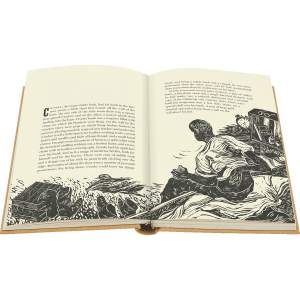 Of Mice and Men
- Illustrated by James Albon
Migrant laborers George and Lennie are dropped miles from their new workplace by a bus driver who deems them unworthy of an unscheduled stop. The symbolism is clear from the outset – itinerant farm workers have little social status in the land they sow and harvest for others’ financial gain. George is slight and savvy, Lennie a hulking simpleton, and the pair have formed an unlikely friendship. They wander state to state, working on ranches and sleeping rough between jobs, until Lennie’s childlike naivety inevitably lands him in trouble and they must once again move on.
 Steinbeck’s sparse narrative is suggestive of a stage play and his gift for relating complex human sentiments with the briefest authorial direction is unsurpassed. The characters are drawn with confident self-restraint that borders on detachment; Steinbeck sets the scene then pulls back to allow them space to tell their story. The effect is overpowering and ensures this thought-provoking novella will endlessly gnaw at your conscience.
If there was any hope of realizing the American dream, it is ruthlessly shattered by Steinbeck as the story progresses, leaving us wrangling with the reality of life at the fringes of society in a country battling financial meltdown. It is an extraordinary book that endures and rattles like the horses’ halter chains in the barn – a repeated refrain that is full of foreboding.
About the Author: John Steinbeck was born in Salinas, California, in 1902. In 1919 he enrolled at Stanford only to drop out six years later without obtaining a degree. Steinbeck then moved to New York City to find work as a freelance writer, though he quickly returned to California where he worked as a caretaker in Lake Tahoe. There he wrote his first novel, Cup of Gold (1929). His first major successes were with Tortilla Flat (1935) and Of Mice and Men (1937). His 1939 novel The Grapes of Wrath won Steinbeck a Pulitzer Prize in 1940, and at the height of its success sold ten thousand copies a week. Despite his pro-American writing during the Second World War, the FBI maintained a file on him as a suspected Communist due to the calls for economic reform found in his works. Steinbeck was awarded the Nobel Prize in Literature in 1962. He died in New York City in 1968.
About the Publisher: For 70 years, The Folio Society has been publishing beautiful illustrated editions of the world’s greatest books. It believes that the literary content of a book should be matched by its physical form. With specially researched images or newly commissioned illustrations, many of its editions are further enhanced with introductions written by leading figures in their fields: novelists, journalists, academics, scientists and artists. Exceptional in content and craftsmanship, and maintaining the very highest standards of fine book production, Folio Society editions last for generations.
Book copy and all images are courtesy of The Folio Society. Feel free to visit their NEWS AND BLOGS page for more information. In case you missed them, take a look at my Folio Friday features for Mary Beard’s S.P.Q.R. and other Folio Society books.
Folio Friday: Kavalier & Clay
 This week, I’m excited to share with you all a new selection from the Winter catalog of The Folio Society. As many of you know, I’m a devoted fan of The Folio Society editions of classic literature, and the three I received so generously from the publisher last month have done nothing but encourage my adoration. This week, I want to highlight Michael Chabon’s THE AMAZING ADVENTURES OF KAVALIER & CLAY.
I’m always drawn in by the incredible cover art and interior illustrations that The Folio Society are known for, and one thing I truly appreciate about their editions is the thought and design they put into their sturdy slipcovers.
This edition is bound in a soft blue and grey and its cover illustrations and text match the odd whimsy and subtle seriousness of the text’s primary themes.

The Amazing Adventures of Kavalier & Clay
- Illustrated by Chris Samnee
- Introduced by Michael Moorcock
- Colouring by Matthew Wilson
In his introduction for this special collector’s edition, author Michael Moorcock describes The Amazing Adventures of Kavalier & Clay as ‘a modern classic worthy of its Pulitzer Prize as only a handful can be’. Having worked in the very ink-stained offices Chabon describes, Moorcock praises this visionary novel’s authenticity, noting that it creates a world so compelling it leaves us wanting to ‘remain in its aura just a little while longer’. Since its publication in 2000, the fictional superhero has escaped the confines of the novel, appearing in his own series of comics published by Dark Horse.
 Michael Chabon’s pre-war New York is a place of optimism and art, of big band music and sharp suits – in his hands the city becomes a transformative place, taking lost souls and making them Americans taking broken children and making them superheroes. By intertwining the stories of two Jewish boys with that of their liberty-inspired comic hero, Chabon tells not only the story of a fledgling art form, but that of America itself, as seen through the eyes of its immigrants.
About the Author: Michael Chabon is the bestselling and Pulitzer Prize-winning author of The Mysteries of Pittsburgh (1988), A Model World (1991), Wonder Boys (1995), Werewolves in their Youth (1999), The Amazing Adventures of Kavalier & Clay (2000), Summerland (2002), The Final Solution (2004), The Yiddish Policemen’s Union (2007), Maps & Legends (2008), Gentlemen of the Road (2007), Telegraph Avenue (2012), Moonglow (2016), and the picture book The Astonishing Secret of Awesome Man (2011). He lives in Berkeley, California with his wife, the novelist Ayelet Waldman, and their children.
About the Publisher: For 70 years, The Folio Society has been publishing beautiful illustrated editions of the world’s greatest books. It believes that the literary content of a book should be matched by its physical form. With specially researched images or newly commissioned illustrations, many of its editions are further enhanced with introductions written by leading figures in their fields: novelists, journalists, academics, scientists and artists. Exceptional in content and craftsmanship, and maintaining the very highest standards of fine book production, Folio Society editions last for generations.
Book copy and all images are courtesy of The Folio Society. Feel free to visit their NEWS AND BLOGS page for more information. In case you missed them, take a look at my Folio Friday features for Mary Beard’s S.P.Q.R. and other Folio Society books.
Joy and Terror, and Donuts?

Last week, I quietly and independently published my first book-length work of literary criticism, FROM A WHISPER TO A RIOT: THE GAY WRITERS WHO CRAFTED AN AMERICAN LITERARY TRADITION.
This publication follows a string of creative nonfiction essays, which have been more my style lately, and a scholarly article I wrote and published in Watermark back in 2016.
So, it was with some trepidation that I returned to academic non-fiction, and especially something of this length, when my focus has been short, creative work for the last few years. But today, I awoke to the news that my book is the #1 Best Seller in LGBT Literary Criticism. I’m sorry, but what!?
Granted, LGBT Literary Criticism is a small field, but still, I’m feeling overjoyed about it. That said, with the joy comes a bit of terror. I realize, now, that my work is out in the world, to be read, loved, torn apart, or ignored. It doesn’t belong to only me, anymore, and that’s something that will take some getting used to.
I’m now courting larger publishers who might be interested in acquiring the book, particularly after what seems to me a pretty solid early interest (60+ copies sold in the first few days plus a #1 ranking on Amazon is an okay sign, right?). I suppose I’ll have to wait for reviews to start rolling in before I have anything concrete to put in query letters, but who knows?
Anyway, after finding out the good news this morning, my plan was to go out and celebrate with a donut from an incredible vegan bakery in town. These are far-and-away my favorite donuts, and I’m not even vegan! Unfortunately, the bakery is closed on Mondays. So, I need a new plan. Where are the Girl Scout cookies?
 Roof Beam Reader