Roof Beam Reader
Adam Burgess
Folio Friday: S.P.Q.R.
 This week, I’m excited to share with you all a new selection from the Winter catalog of The Folio Society. As many of you know, I’m a devoted fan of The Folio Society editions of classic literature, and the three I received so generously from the publisher last month have done nothing but encourage my adoration. This week, I want to highlight Mary Beard’s S.P.Q.R.
I’m drawn in by the incredible cover art and the interior illustrations that The Folio Society are known for, and one thing I truly appreciate about their editions is the thought and design they put into their sturdy slipcovers.
This edition, in particular, is bound in a beautifully marbled red with gold lettering, evocative of the powerful and often romanticized Roman empire. It seems to me the perfect fit for famed historian Mary Beard’s impressive and “definitive account of ancient Rome.”
S.P.Q.R. by Mary Beard
 In this bestselling account, Mary Beard considers how Rome grew from an insignificant village to a genuine superpower. Her sparkling narrative also reveals the Romans’ view of themselves and their achievements, and why they remain so important to us. Covering 1,000 years of Rome’s past, and casting fresh light on the basics of Roman culture, this breathtaking survey blends epic events with the colourful experiences of ordinary citizens to provide a definitive history of ancient Rome.
 The book contains more than 45 specially selected sumptuous full-colour images. The glorious reproductions collected here include beautiful Etruscan jewellery; details from Trajan’s column showing a fortified camp; a stone relief depicting Praetorian officers; statuary from Hadrian’s extraordinary villa at Tivoli; and votive objects from an archaic Roman temple site. Interspersed throughout the text are 60 black-and-white images: a coin showing the sweeping hair of Mithradates; the crumbling remains of Hadrian’s Wall; an image of the arch of Constantine; and the tombstone of a devoted couple (both former slaves) who met when the bride was aged just 7.
About the Author: Mary Beard is one of the most original and best-known classicists working today. She is Professor of Classics at Newnham College, Cambridge, and the Classics editor of the Times Literary Supplement. Her books include the Wolfson Prize-winning Pompeii: The Life of a Roman Town (2008), Women & Power: A Manifesto (2017) and Civilisations: How Do We Look?/The Eye of Faith (2018). Her popular TLS blog has been collected in the books It’s a Don’s Life (2009) and All in a Don’s Day (2012). Mary Beard is a Fellow of the British Academy and was awarded an OBE in 2013 and a damehood in 2018 for services to classical scholarship.
About the Publisher: For 70 years, The Folio Society has been publishing beautiful illustrated editions of the world’s greatest books. It believes that the literary content of a book should be matched by its physical form. With specially researched images or newly commissioned illustrations, many of its editions are further enhanced with introductions written by leading figures in their fields: novelists, journalists, academics, scientists and artists. Exceptional in content and craftsmanship, and maintaining the very highest standards of fine book production, Folio Society editions last for generations.
Book copy and all images are courtesy of The Folio Society. Feel free to visit their NEWS AND BLOGS page for more information. In case you missed them, take a look at my Folio Friday features for THE THOMAS HARDY COLLECTION and for Ursula K. Le Guin’s THE LEFT HAND OF DARKNESS.
Happy Book Birthday to Me!
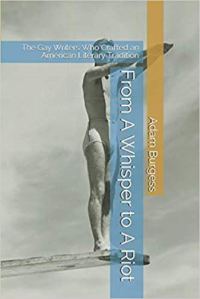 Today, I’m excited to share some awesome news. After two years of research and writing, and another two years of editing, revising, and revisiting, I have finally published my first book!
FROM A WHISPER TO A RIOT: THE GAY WRITERS WHO CRAFTED AN AMERICAN LITERARY TRADITION is an academic text that covers gay American literature from 1903-1968, a period often ignored or overlooked. It is the culmination of four years’ work, and I have decided to move ahead with publishing it independently. Why? Well, there are a few reasons.
First, academic publishing is brutal and, for my particular situation, not entirely necessary. I have been publishing other small pieces and feel satisfied with that avenue for creative work. This book, though, is the blood, sweat, and tears of years of graduate study and, ultimately, a dissertation and defense. I did send proposals and chapters to a few different academic publications, and while some of the responses I received were reasonable, even helpful, they helped me see that, what I really want to do is get this out into the public as I have envisioned it. I do not want to break the book into smaller articles. I do not want to market it for a particular course. I do not need wrestle with a University Press and its gate-keepers
This book is mine, and I want it to be available for others, as is. I believe I see something in it that some publishers are missing, which is that it is more than just a literary analysis and more than just a cultural history. It is both. These two pieces work together. The varied chapters work together. And I hope that any reader who decides to give a try will, in the end, see how all of it developed together, too.
So, I’m pleased to be in this position. The book is available in both print and e-book versions, via Amazon (and elsewhere, soon, I hope!). Even though it is an academic text, I think it’s pretty accessible. If you’re interested in American literature, history, and LGBT Studies, I think you’ll like this one. Or I hope so, anyway.
Onward!
- Amazon Print Edition: https://www.amazon.com/dp/1797500074
- Amazon Kindle Edition: https://www.amazon.com/dp/B07NWHFSBY
- Goodreads: https://www.goodreads.com/book/show/44066051-from-a-whisper-to-a-riot
The House of the Vampire by G.S. Viereck
 George Sylvester Viereck published The House of the Vampire in 1907. It is one of the first “psychic vampire” novels ever written, but what makes it even more interesting is the romance at its center is a homosexual one (in fact, a homosexual love triangle, of sorts.)
I first encountered Viereck while working on my dissertation (which, side note, has been edited and revised, and is soon to be published as a book on Amazon; I’ll be posting about this soon), and I was surprised by the themes of his work, the stark clarity with which he wrote them, and the deep awareness he brought to issues of gender and sexuality in a time that always seems so deeply ignorant and puritan to our contemporary one. (Spoiler Alert: My book upends a lot of these misconceptions about the early-twentieth century!)
Perhaps the most compelling element of this novel, gay “romance” of the early-1900s aside, is the psychic aspect. It is not a straightforward, “the vampire will drink your blood” kind of horror. Instead, the antagonist feeds off of the creativity of those around him, specifically focusing on a slow devouring of one talented individual at a time. The vampire takes an apprentice under his wing, showers him (or her) with affection, and all the while drinks the life-source of that individual’s creative talents, until the writer, artist, or poet has nothing left to give. It’s in many ways more horrific than the simple vampire villain.
Despite being relatively unknown, it is safe to say that House of the Vampire is, or deserves to be, a classic of the Victorian Gothic genre. The writing is suitably Romantic, the blurring of lines between reality and the supernatural is present and effective, and the exploration of humanity through art and relationships, love and fear, is both interesting and touching. Although relatively short and fast-paced, much more akin to Jekyll than Udolpho, the questions at its core are what make House of the Vampire worth reading, and reading in particular for the honesty with which Viereck treats the possibilities of human love and action.
Overall: 3.5/5.0 This book was selected as part of my 2019 TBR Pile Challenge.
February Checkpoint #TBR2019RBR
 Hello, TBR Pile Challengers!
Welcome to our second checkpoint for this year’s TBR Pile Challenge! It looks like some of you are off to a rip-roaring start! Way to go! As for me? Well, I am almost exactly where I was in January. So, I suddenly find myself falling behind, after having been on track! But what else is new?
Progress: 2 of 12 Completed / 1 of 12 Reviewed
So far, I’ve read 2 of my 12 required books. I do plan to start Book 3 very soon, but more importantly, I need to get some reviews written and posted! Last month, I mentioned that I’ve actually never read a book by Dean Koontz. Now I can say that I have. And it was… interesting?
I plan (really, I do!) to read all 14 of the books on my list this year, the main 12 plus my 2 alternates, so getting a jump-start on this list before spring semester began was important. I think I’ll read something non-fiction, next, since I’ve read two novels already. Perhaps Light the Dark, to help re-ignite my writing as well.
Books read:
- The House of the Vampire (1907) by George Sylvester Viereck (reviewed)
- The Funhouse by (1980) by Dean Koontz (review coming)
How are you doing?
Below, you’re going to find the infamous Mr. Linky widget. If you read and review any challenge books this month, please link-up on the widget below. This Mr. Linky will be re-posted every month so that we can compile a large list of all that we’re reading and reviewing together this year. Each review that is linked-up on this widget throughout the year may also earn you entries into future related giveaways, so don’t forget to keep this updated!
MINI-CHALLENGE WINNER #1
Congratulations to Bev of My Reader’s Block, who is the winner of our very first mini-challenge! Bev will receive a book of her choice from The Book Depository ($15 USD or less).
LINK UP YOUR REVIEWS!
P.S. Congratulations to Jean of Howling Frog Books, who is the overall “winner” of the 2018 TBR Pile Challenge! Jean will receive a $50 Amazon gift card OR $50 of books from The Book Depository. Thanks to all who participated!
Becoming by Michelle Obama

The first book I read in 2019 was Michelle Obama’s honest and compelling memoir, Becoming. To be honest, some part of me expected that the book would focus primarily on her time as First Lady; I was pleasantly surprised, however, to find that, instead, the memoir is a more balanced retelling of her entire life, from childhood to post-White House. As I was reading it, I couldn’t help but marvel at her style, eloquence, and personal experiences, while simultaneously thinking: just imagine the book she could write specifically about her time in the White House. So, while I originally approached this book desiring a little more of the politics than it delivers, I was nevertheless swept up by her story, happy to learn more about her life and roots, and ultimately more than satisfied with the comprehensive life story she provides.
For me personally, part of the fun was reading about Obama’s life in Chicago. Having grown up in the Chicago suburbs, it was a treat to read about her time on Euclid Avenue and in Hyde Park, as well as some of the other recognizable places she mentions. That said, the familiarity created for me as a reader who knows the area is not, I think, limited to readers from Chicago. This is because she writes in a way that is relatable to anyone growing up in any similar neighborhood, and there are so many like it across the United States. I think her relevance to larger audiences comes across many times in the memoir, as when she visits a girl’s school in England and finds that her experiences, and theirs, are surprisingly similar. She’s able to be a role model to a nation of young women growing up thousands of miles away, because the life Obama has lived, and her outlook on society and the future, makes so much universal sense.
I also enjoyed the traditional “three act” design of the book, which begins with “Becoming Me,” is anchored in “Becoming Us,” and ends with “Becoming More.” Anyone who is interested in learning more about Michelle Obama as a person, not just a politician’s wife, will likely find this structure appealing because it demonstrates clearly how Obama become who she is, not just in the context of her remarkable marriage, but through the many people, professions, educational opportunities, struggles and personal successes she has had. It should not be surprising that Michelle Obama has a unique perspective on life, nor that she must have led an interesting one herself, but what might impress readers most is how thoughtful she writes about it, how deeply she connects the past, present, and future events of her life, and how remarkably she can reflect on the positive and negative moments in her life in order to look, constantly, toward a better future.
It’s also a treat to read such an intimate portrait of such a public figure. She treats her family, friends, and spouse, as well as their political allies and rivals, with honesty and fairness. She describes moments of joy and betrayal and provides a behind-the-scenes description for many of the moments that so many Americans must wonder about all the time. One of the most impressive elements of her memoir is this level of candidness. She admits mistakes, she reveals real marital struggles and personal upheavals, and she explains how exhausting and disorienting it was to feel that her sense of self was vanishing as the rising trajectory of her husband’s career skyrocketed. One can only imagine the strength it must take for anyone in this position, and perhaps those who read Obama’s account of it will be more patient and considerate of political families across the spectrum.
Ultimately, Becoming is just about everything one would hope for in a memoir, pictures included! It is honest, fair, funny, interesting, and comprehensive. Obama invites readers into her remarkable life and doesn’t try to hide or misrepresent that life in any noticeable way. She also invites more questions and, for me at least, a hope for future works that explore some elements and eras of her life in even more detail.
Notable Quotations
“Now I think it’s one of the most useless questions an adult can ask a child—What do you want to be when you grow up? As if growing up is finite. As if at some point you become something and that’s the end.”
“If you don’t get out there and define yourself, you’ll be quickly . . . defined by others.”
“For me, becoming isn’t about arriving somewhere or achieving a certain aim. I see it instead as forward motion, a means of evolving, a way to reach continuously toward a better self. The journey doesn’t end.”
“Everyone on Earth, they’d tell us, was carrying around an unseen history, and that alone deserved some tolerance.”
“Your story is what you have, what you will always have. It is something to own.”
“It hurts to live after someone has died. It just does. It can hurt to walk down a hallway or open the fridge. It hurts to put on a pair of socks, to brush your teeth. Food tastes like nothing. Colors go flat. Music hurts, and so do memories. You look at something you’d otherwise find beautiful—a purple sky at sunset or a playground full of kids—and it only somehow deepens the loss. Grief is so lonely this way.”
 Roof Beam Reader