Roof Beam Reader
Adam Burgess
Christopher Wild by Kathe Koja
Anna Quindlen once wrote, “[books] are the destination, and the journey. They are home.” It is hard for me to find a better example of this adage than the works of Kathe Koja. The act of reading her stories is not just an experience, but an event. Every time I begin a new Koja novel, I wonder, “can I really go home again?” There is a fear in the first pages, a desperate hopefulness that Koja will not have abandoned me as a reader. But the answer to that question has repeatedly been, yes. In reading Kathe Koja, I come home.
Christopher Wild is a remarkable trilogy of novellas that reimagines the life of Christopher Marlowe as it was in the 1590s and as it could have been in more recent times. The first novella, written in the passionate, fluid, Elizabethan style that will be familiar to fans of Under the Poppy, pays great homage to the historical life of Marlowe and his contemporaries. Included in the tale are a number of familiar characters, including Shakespeare and the University Wits. Koja adeptly tackles the myth of the man and weaves into it the facts as we know them, recreating a believable identity for this spy, lover, and dramatist. In the second tale, Koja imagines Marlowe in a near-contemporary society. How would this man navigate city life, intrigue, sexuality, and his writing if he lived in a time and place more similar to our own? Some of the characters from the first novella reappear again with different names and roles, but they—most of them—fulfill their prophecies. The third novella imagines a near-future, one that seems dystopic in many ways but which, unfortunately, becomes more and more probable all the time. An intrusive government that can control anyone’s every move; a nation of closed borders and constant surveillance; a paranoia about free thought and free speech, both of which are stifled by a police state that employs its creative citizens or destroys them when they do not comply. Amidst this darkness is a poet who dares to defy the system and who will speak the truth, whatever the cost.
Holding all three novellas together is the idea of the writer-activist. What responsibilities does a writer have to truth? How does the poet hold an oppressive government to account? Can words wake us up from our lethargy and apathy? In each case, Christopher, or Chris, or X04, or Kit, or Merlin, personifies the answer to these questions. To be bold and brazen. To be honest and courageous. To be independent of mind and heart and spirit. These are the necessary qualities of the poet, the individual, the rebel, the titan. And what sustains him? Love. Sure, Koja eagerly and truthfully draws a man who is liberal in his lusts and passions, for drink and for men. In all three novellas, the Marlowe character gives and takes of the body with abandon and without apology. And yet, the sexuality is never tawdry, never gratuitous. It reflects the character of the man, the vibrancy and virility of his existence, and his constant state of awareness, the recognition that his time is short. In whose hands could these sensibilities, this anchored sensuality, be more powerfully and delicately crafted? I’m reminded only of Anthony Burgess and Henry Miller—satirical surrealists—who express the balance of mind and body not only in the stories they create, but also in the language they craft to tell them. Koja is undeniably in this company.
Many have noted that this work is an ode to Christopher Marlowe. Koja’s knowledge of Marlowe comes across loud and clear, and her passion for the man, his talent, and his lifestyle are treated with deserved reverence. What this unique work does for me, however, even as a fan of Marlowe, is much bigger than a love letter to one Elizabethan playwright: it is a love letter to writing and to writers. In reading the three novellas, one notices common themes arise over and over again. At the heart of these is the river of time that connects all of us and all of our stories, and how its mythos cannot be outrun or over-imagined. This becomes clear in the way Koja ends each of the three Marlowe tales. The second, which takes place in a near-present time, is the most hopeful. It seems to me a powerful message about the role of the writer as s/he exists in the present. The past cannot be changed and the future is unclear, but if anyone has the ability and audacity to dare plumb and dam and navigate those rivers, it is the writer. And if anything has the power to move hearts and minds, to stir men and women to action, it is the voice of the poet. Kathe Koja, in honoring a literary and cultural hero and phenomenon, reminds us that Marlowe is much more than a man; he is an idea. The charge of that idea, the electricity of it, is so palpable in the way Koja crafts and caresses Christopher Wild, that it brought this reader, and writer, out of a months-long slump. Koja has made a writer want to start writing again, and I can’t think of any idea more profound than that.
Notable Quotes
“The small feed as they can, the large as they will, whether the meal suits them or no. there is the world” (22).
“What does it matter, that first fulcrum point, if the mind resolves to move the world?” (24)
“Was there concomitant comfort in the promise of rewards, pearly gates and eternity of rest among the blessed, safe forever from the outer darkness of freedom and sin, or only the fear of that dark?” (155)
“But for himself the point was and is still the brute beauty of it—attended by power, yes, sheer playful aggression, and that live-wire rush when the writing comes right, nothing in the world to better it, as if the gears of the universe have for one perfect moment fallen into perfect place” (209).
The Ingram Interview by K.B. Dixon
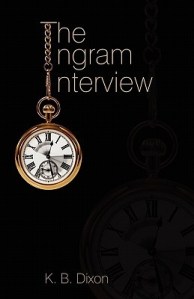
Meet Daniel Ingram, retired English professor: despondent, eccentric, and in the midst of writing his memoir, after being kicked out of his current home (a retirement facility) for depressing the other residents. The story itself is the process of Daniel writing his story, so the reader witnesses him interviewing himself (at least, this is what I eventually concluded – as the interviewer is never identified) as he moves out of the retirement center to live, briefly, with an ex-student and attempts to reconcile with his ex-wife so as to find a more permanent place to live. Daniel recently suffered a medical shock, which seems to have jolted his sense of self and needled at that pesky morality issue, wherein Daniel realizes that it may be “now or never”. Surprisingly, that is about the extent of his revelation and, while he mentions his family and other past failures, he has little regret in life and, instead, seems focused on just getting his story written and moving onward to a new retirement facility, to new people, to new experiences. He is a people-watcher, an outsider, and finds little importance in life, outside of what he is doing in each moment. Still, there are moments where he seems genuinely proud of and hopeful for certain people and things; it’s a strange, cold type of non-emotional emotion. Daniel clearly feels things, worries about things, and thinks about quite a lot, but he uses all of that to one end: writing.
There is only one main character in the book, and that is Daniel Ingram, interviewer and interviewee. The other characters are present only in relation to Daniel’s interactions with them and opinions of them. Still, though Daniel seems emotionally detached, we are able to learn quite a bit about him, about his fears and ideals, by the questions that are asked and how he responds to them. One of my favorite moments is when the Interviewer mentions the nice weather, and Daniel rants about the inanity of mediocrity, how, even when it comes to weather, there should be some kind of substance (so a beautiful, clear day – 72 and sunny- is worthless – give him 48 degrees any day!). There is something about life in that answer; Daniel wants to feel something, he wants to (or does) appreciate the less-than or more-than average. Another favorite moment is the end of the book, where Daniel’s fears and recovery are finally addressed head-on, and that beautifully moving admission is quickly followed by a comment on somebody’s shoes, and how those shoes speak to the man’s personality. It’s kind of brilliant.
The self-interview as style was unique and interesting. Many writers I know employ this device when creating stories, but few –if any- that I can think of have actually turned the process itself into the actual story. I honestly had an incredibly fun time reading this book (and read it in two sittings of 60-pages each) because of the style; it was interesting and new and reminded me of something I would do for myself, either in preparation for writing a short story or other creating writing piece, or simply as a self-evaluation for blogging purposes or job interviews, etc. It was also amusing to keep up with Daniel’s thought process, which was ever-changing. In the course of a chapter, the questions would range from topics like burglary in the retirement center to the artistic value of a certain movie, to the nature of Daniel’s relationship with his son. This style reminded me of how quickly our own thoughts race through our heads, how we can be sitting in a room, staring out the window, and in the hour that passes, a thousand thoughts about a thousand topics and memories will have passed, and these little thoughts are what we are made of and these moments of reflection are how we grow as individuals.
What I find so attractive about this book is that there is a very real human spirituality to it. The themes and style remind me of something Mitch Albom would write, if he were more focused on the human element, rather than the religious. Dixon is allowing the reader to take a look at a man, aging and coming to terms with that mortality, but not grasping at any straws, not looking for any type of relief, but just living to the best of his ability, through the last of his days. The narrator, Daniel Ingram, still has to struggle with accepting mortality and the fact that the “better days” are over, but he uses that struggle as another life event, another learning experience, another writing process. This type of spirituality, the intellectual pursuit of life through life, resonated with me in a way that similar topics, addressed through religious revelations and explanations never could.
Final Verdict: 3.5 out of 4.0
Notable Quotes:
“Dan Noakes. He has a weakness for taffy-colored shoes.”
“In thirty years I have never been able to look out on a meadow filled with grazing cattle and not first think – ah, a field of swaying bovines.”
“He has an excellent reputation, Dr. Nesbitt – you just have to ignore the fact that for some reason he thought it would be a good idea to do something interesting with his mustache.”
“Who is Everyman? Where did he go to school? What sort of jobs did he have before he ended up with this one? He used to be one way, now he’s another. Does he know why?”
2 Samuel 16-1 Kings 9 #2018BibleRBR
Reading the Bible as Literature
Week Fifteen: 2 Samuel 16 – 1 Kings 9
The end of Second Samuel and the beginning of the Books of Kings is essentially the concluding of the story of David and the introduction of his successor, Solomon. Historically, the section is interesting because it illustrates how David’s reign was important to establishing stability in the kingdom of Israel and yet how it was still precarious (even his own son rose against him in the end). Similarly, it highlights the difference between the two reigns, in that Solomon’s reign was more peaceful; more time could be spent on diplomacy, infrastructure, etc.
The Death of David: The last part of II Samuel describes how one of David’s sons, Absalom, rises against him in an effort to take the kingdom. This demonstrates that, despite David’s great skill as a military and political leader, as well as his many virtues as a man, the kingdom was nevertheless precarious and still in flux. It establishes a striking difference between the end of the “shaky” area of Israeli establishment and the rise of a secure and prosperous nation under Solomon. It should also be noted that earlier prophecies, such as Nathan’s vision that David’s own son would eventually have sex with his father’s wife (or wives, as it turns out) in public are proved true. I think it is important to connect David’s vices and virtues with the strengths and weaknesses of Israel at this time. From the time of Saul, the kingdom has continued to grow both in political power and in its embracing of monotheistic religion (Yahvism). Like David, though, mistakes are still being made. David is in many ways the personification of his rule, just as Saul (not a bad king, per se, but one with many fatal flaws) was the personification of his own. This trend continues with Solomon.
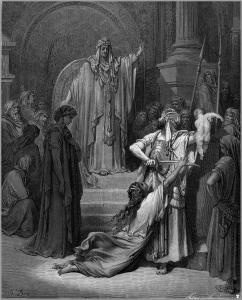
The Wisdom of Solomon: Solomon is anointed king while David still lives, which is the first step to securely and strongly establishing him as the undisputed ruler. He also acts quickly, upon ascension, to eliminate any possible objections: he kills his brother Adonijah and his father’s general, Joab, both of whom had been preparing to claim the throne for Adonijah (indeed, at the moment Solomon is anointed king, Adonijah is throwing a party in preparation for his own ascension!). He also banishes (then kills) Shimei, who is the last powerful representative from the kingdom of Saul. This quick action plus the support of David himself brought the kingdom rapidly into Solomon’s favor. Things only get better from there, however, as the new king soon proves his worth to god. When god comes to the king in a dream and asks what Solomon would have, his response is refreshingly noble: wisdom – a good head and heart for fair judgement over his people. The moral development of kings from Saul to David to Solomon continues to grow. Solomon’s wisdom is shown in his ability to build relationships between multiple border nations, to establish a temple for Israel’s religion and encourage their full conversion, thus further solidifying the tribes into a single nation of shared cultural customs, and of course, in the anecdote of the two women who appear before him with a baby, asking him to determine who is the baby’s true mother (1 Kings 3:16-28). Solomon’s reign, written about 400-years after it ends, is seen by those later priests as the climax of early Israeli history, and there is a clear sense of awe and euphoric nostalgia in the writing of it.
Solomon’s Politics: The wisdom of Solomon is meant to go undisputed. He asks god for this ability, and not only does he get it, but he is also rewarded (for his humility) with riches, power, health, etc. Certainly, Solomon is a brilliant leader and judge. He allies himself with the Egyptians and the Lebanese, in the first case through marriage and in the second through commerce. An unfortunate fact about Solomon’s reign is that he stretched the kingdom’s budget too far. When he could not pay for all the supplies he needed to build the temple and the king’s house, he resorted to using forced labor; or, in other words: slaves. (1 Kings 9:15; 1 Kings 9:20-21). This seems to be often overlooked in discussions of Solomon’s reign which, otherwise, is peaceful and admirable.
OTHER INTERESTING BITS
Suicide: In this part of the bible, we find one of the five (or six, if you count Samson) instances of suicide described in the bible. It’s interesting that in none of these cases is the suicide treated as sinful or evil; so, where does the idea of suicide-as-mortal-sin come from? Some argue that the commandment “thou shalt not kill” applies to killing one’s self. This might be true, but there doesn’t seem to be clear indication of such and the five (or six) biblical accounts of suicide do not really lend themselves to that interpretation, either.
David’s Continued Love: In II Samuel 21, David delivers Saul’s descendants to the Gibeonites to be killed, with the exception of Mephibosheth, Jonathan’s son, whom he continues to protect and to keep in his favor. This demonstrates again David’s continued love for Jonathan, as well as the respect he keeps for the covenant they shared. Even later, when it is argued that Mephibosheth was biding his time (while Absalom and David were arguing) to return to the throne, David’s return to power sees Mephibosheth back in favor again, without question.
Rizpah: One story that I think is often overlooked in II Samuel is that of Rizpah, whose seven brothers are killed and hung up in public. Like Sophocles’ Antigone, Rizpah cannot bear to see the bodies desecrated and be left to rot without ritual. The custom of burial rites for the dead in this region is so close between the Greek myth and this Christian tale, it is striking. It also says much about David that he is moved by Rizpah’s actions and eventually orders that the bodies be buried, along with the bodies of their ancestors (Saul and Jonathan) in a proper ceremony and in a proper setting.
David’s Census: David institutes a census, which is for some reason frowned upon by god (Why? There seems to be no prior outlaw to this). The punishment for this census is one of three things: 7 years of famine; 3 months fleeing enemies; or 3 days of pestilence. David (wisely?) chooses the pestilence, which results in the death of 70,000 people. It is likely that the actions here are reversed. There was, perhaps, a serious pestilence at the time, which happened to take place after an unpopular census was taken (census being typically administered for the purposes of either a: raising taxes or b: organizing a military draft). So, post hoc ergo propter hoc – a later writer, no fan of censuses, might happily argue that the one was caused by the other.
April Checkpoint! #TBR2018RBR
 Hello, TBR Pile Challengers!
Yahoo! We’re 25% of the way into the TBR Pile Challenge and it is now time for our second mini-challenge with giveaway! We have 100+ participants this year, with nearly 90 reviews posted already. This is fantastic! I hope you’re having a good time making progress through your own TBR piles.
Question of the Month
Have you discovered any new favorite authors as a result of the TBR Pile Challenge? Read an author you’ve never read before but definitely want to again? Share!
 My Progress: 4 of 12 Completed / 3 of 12 Reviewed
So far, I’ve read 4 of my 12 required books and have reviewed 3 of them. This is good progress, I think, but I’m feeling a bit disappointed that I haven’t made any progress since last month. Oh well! 4 of 12 = 33%, which means I am still technically ahead of schedule since we’re just now hitting the 25% marker. That said, I do want to read both of my alternate books, which means I’m really aiming for a “14 out of 12” completion. Summer is coming and the odds are I will completely most, if not all, of my challenge between mid-May and mid-August. I don’t want to get ahead of myself, but I have a feeling I’ll get to at least 6 of my challenge books during that time. Come on, summer!
- The Hound of the Baskervilles (Completed 1/3/18)
- Aristotle’s Poetics (Completed 1/10/18)
- Ready Player One by Ernest Cline (2011) (Completed 01/25/18)
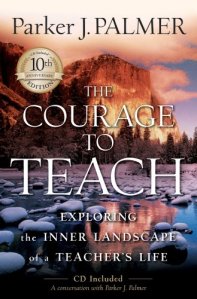
- The Courage to Teach by Parker J. Palmer (Completed 03/10/18 – Review pending)
How are you doing?
Below, you’re going to find the infamous Mr. Linky widget. If you read and review any challenge books this month, please link-up on the widget below. This Mr. Linky will be re-posted every month so that we can compile a large list of all that we’re reading and reviewing together this year. Each review that is linked-up on this widget throughout the year may also earn you entries into future related giveaways, so don’t forget to keep this updated!
MINI-CHALLENGE #2
As I mentioned in the Announcement post, there are four mini-challenges planned for this year. Our fourth checkpoint also brings with it the second mini-challenge!
Here’s the plan: Visit this link to see the list of linked-up participants. Travel around and leave a comment (or two, or five) with some encouragement for this challenge. Then, when you’re done, come on back to this post and comment with a link to the blog where you left your encouragement.
Everyone who spreads a little cheer and positivity on another challenger’s post(s) will be entered to win a book of choice, up to $15 USD, from The Book Depository! Comments need to be posted and linked-up here before our next checkpoint on May 15th, and the winner, drawn randomly from the collection of comments, will be announced in the May checkpoint post. Only those who registered for the 2018 TBR Pile Challenge by January 15th are eligible to participate in these challenges and/or to win any of the TBR Pile prizes.
LINK UP YOUR REVIEWS

1 Samuel 21-2 Samuel 15 #2018BibleRBR
Reading the Bible as Literature
Week Fourteen: 1 Samuel 21 – 2 Samuel 15
The second half of 1 Samuel and the first part of 2 Samuel recounts the decline of Saul’s reign and the establishment of David’s. Much of 1 Samuel is devoted to describing Saul chasing David and his few hundred followers throughout the kingdom, coming close to capturing him a few times but never quite succeeding. Each time, in fact, David is able to turn the tables and nearly kill Saul instead, much to that king’s chagrin. This section is most interesting in that it illustrates how two anointed kings, one of Israel and the other of Judah, take different approaches to dealing with a competing power who has been chosen by god (Saul disregarding god’s will, as usual, and David following it quite strictly). In addition, after the death of Saul and Jonathan, we are shown David’s goodness and his political savvy, as well as his fatal flaw.
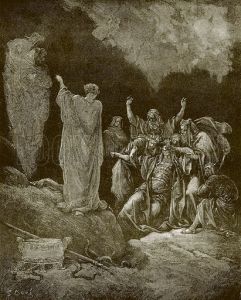
The Witch of En-Dor: Even though the story of the Witch of En-Dor is rather brief, I’ll be honest and admit that I always remember it because her homeland shares a name with Endor of Star Wars, Episode VI (“Return of the Jedi”). It is a fascinating and important moment in Saul’s history, though. As king, Saul outlawed all witches, seers, etc., because they were aligned with the old, polytheistic gods and not the Abrahamic monotheistic god coming to prominence. In his desperation, though, after suffering serious losses to the Philistines and threats from those loyal to David, he tells his generals to find a seer who can consult a “familiar” and tell him his future. The witch brings Samuel from the dead, and the news is about as bad as can be. Not only is Saul doomed, but his sons are going to die, too. I find it rather odd that, at this point in the bible, when historically Saul is moving away from the old gods and in factthe later writers had already moved on definitively to monotheism, they would insert such a pagan anecdote.
Saul or Ahab?: The last part of 1 Samuel makes for great reading, especially for those familiar with the story ofMoby-Dick. Just as Ahab is consumed with a desire to get revenge on the white whale that maimed and humiliated the captain, so is Saul consumed with a desire to destroy David, his biggest threat. There’s a common theme of self-conscious leadership in these two stories that is beyond compelling and, in both cases, the results are rather tragic. In Ahab’s case, the tragedy is that he gives up his own life seeking vengeance upon a creature that committed an unconscious crime—it acted as an animal should; and in Saul’s case, his lust for power and neurotic self-doubt caused him to turn on perhaps his most loyal attendant. In the pursuit of David, Saul twice exposes himself to danger and is offered freedom by David, who could have killed him both times but chooses not to. When Saul learns his lesson and has finally decided to leave David alone, he falls to the Philistines, as do his sons.
Absalom, Absalom!: For the most part, David is one of the godliest men of the Old Testament, especially for such a successful leader. He refuses to kill Saul, for example, even after being anointed by god, because Saul had also been anointed and to assassinate him would be to blaspheme against god’s wishes. Even the best of us are doomed to fall, though, and David’s weakness comes in the form of a beautiful woman named Bathsheba. One day, David catches Bathsheba bathing nude and decides he is going to have sex with her, even though she is married to Uriah, one of David’s loyal generals. Bathsheba becomes pregnant and David panics. First, he twice tries to get Uriah to go home and sleep with his wife so that they can pretend it is his child. But Uriah is a committed soldier and refuses to go home and seek pleasure while his comrades are at war. So, in desperation, David orders Joab to send Uriah to the front lines and fight to the death. In this way, David breaks four of the ten commandments: he covets his neighbor’s wife, he lusts, he commits adultery, and he commits murder. God is nothappy with this situation and promises to punish David’s line. Ultimately, a few things happen: first, David and Bathsheba’s son dies. Then, David’s own son, Amnon, rapes his half-sister Tamar; then, David’s other son, Absalom, kills the half-brother for that crime. Finally, after years in self-exile, Absalom returns to his father’s good graces, via Joab, only to begin plotting to usurp the kingdom of Israel from David. What a mess!
OTHER INTERESTING BITS
Dear Jonathan: When David hears that Saul and Jonathan have died, he cries, “how are the mighty fallen!” (2 Samuel 1:19). He also remembers Jonathan by exclaiming, “thy love to me was wonderful, passing the love of women” (2 Samuel 1:25-27). How romantic, and tragic. Later, when David learns that Jonathan’s crippled son still lives, he takes him in and offers him permanent protection, in honor of his father’s friendship.
Israel: After David comes to power over all Israel, he decides to make the city of Jerusalem capital for the kingdom. This is clever from both a military and a political perspective. David, of Judah (in the south), needed to ensure that he could not be accused of favoritism by the northern Israelites, nor could he look like he was abandoning the southerners; so he chose a city right on the border between the two, which had been controlled by the Canaanites. The city was also heavily fortified, especially the high-walled area known as Zion, so taking it ensured a more secure strategic position. From Jerusalem, David would rule a kingdom of about 30,000 square miles, or approximately the size of the state of Maine. This was a golden age for the Israelites but, in fact, the kingdom was rather small and feeble comparatively. The Egyptian and Hittite empires that preceded it, for example, were much larger, as would be the Assyrian, Babylonian, and Persian empires to come later. Ultimately, the rise of an Israeli Empire was only possible by accident, because it just so happened that no secure Asian power existed at this time.
Common Kings: The selection of the first two kings of Israel is interesting. Saul was chosen from the most minor of the tribes at the time, an oddity; and David was the youngest son in his family, another strange choice. What are we to make of the fact that these two, specifically anointed by god, come from such common backgrounds? It is also interesting to remember that the rise of David is foretold earlier in the Old Testament: “There shall come a Star out of Jacob, and a Scepter shall rise out of Israel, and shall smite the corners of Moab” (Numbers 24:17). David certainly does shine, and his reign is much longer than Saul’s. He is told by god, through Joab, that the sword would always be upon his family, and he does indeed crush the Moabites (despite the fact that his ancestor, Ruth, was one).
 Roof Beam Reader