Roof Beam Reader
Adam Burgess
Dear Martin by Nic Stone
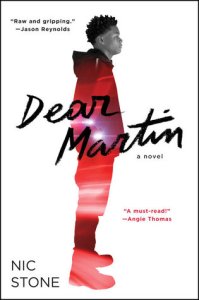 Dear Martin by Nic Stone is a timely and important fictional account of the kinds of news stories we hear all too often in the United States lately. Justyce McAllister is a brilliant young man who is mistaken for a criminal and who witnesses one of the worst injustices imaginable. The two incidents cause him to question himself, his place in the world, and his long-held beliefs about race, privilege, opportunity, and justice.
To cope with his thoughts and emotions after the fist incident, where Justyce is brutalized by a Latino police officer, he begins to write letters to Dr. Martin Luther King. The letters are both explorations of himself and questions about society. These letters are interwoven into the story of Justyce’s life, including his growing struggles at school, where he had been at the top of his class and quickly headed to the Ivy League, as well as his difficulties in love, confusions about place and race, and stresses between himself and his best friend, another black teenager who responds differently to the racial tensions surrounding them.
At the heart of this novel are the teachings of Dr. King and Malcolm X. The question of when it is necessary to act or to listen, to proceed with nonviolent resistance, or to radicalize for necessary change. To be peaceful or to rage. What do we do when our own mother tells us we cannot love the person we love simply because of the color of her skin? What do we do when our lifelong friends’ racism becomes more and more obvious, and troubling? How do we choose an identity when we are split between two worlds and do not really belong to, or are accepted by, either one? How do you deal with the pain of discovering the world is not what you thought it was and that your place in it is more precarious than you ever realized?
So much of what is happening in the world, and in our country specifically right now, is both reflected in and articulated by Nic Stone’s honest, biting, dangerous, beautiful coming-of-age story. Justyce McCallister is so many of us, and so many young people we know. And yet his is a story that continues, though we know it shouldn’t, and goes unspoken and unattended, despite the attentions we pretend to give it. Stone’s novel, like Angie Thomas’s The Hate U Give, is a modern-day must-read.
Final Verdict: 3.5 out of 4.0.
The Waste Lands by Stephen King
 I finished reading Stephen King’s The Wastelands (Book III in The Dark Towers series) on February 12, 2018. Here I am, on March 18, 2018, finally sitting down to write about it. I’m not sure what that means, except perhaps that I wasn’t feeling very compelled to get thoughts down right away. Usually, that means I was feeling rather “meh” about the title. When I absolutely love a book, I need to write about it right away. When I hate a book, I need to write about it right away. Lately, it seems I’ve read quite a few books that were middle of the road, and that’s unusual because I tend to pick well for myself. Of course, I might be blowing all of this out of proportion and simply ignoring the fact that I’m pretty damn busy teaching six classes this semester. Next week is spring break, so maybe I’ll finally get caught up on my own stuff.
Anyway, here’s what I can remember of The Wastelands. It is pretty weird. Even by the standards of Stephen King and this particularly weird fantasy series, The Waste Lands is weird. The last gunslinger, Roland, is back in action with his two new sidekicks from The Drawing of the Three (which I’m only now realizing I never reviewed?) They continue on the quest toward the Dark Tower, where Roland believes he will meet his fate. What this is exactly, remains unclear. The “villain” seems to have died back in the first book, The Gunslinger, but he remains a menacing figure throughout the series thus far. In addition, a new menace is revealed: a lingering technological sentience, a kind of senile artificial intelligence whose dementia, taking the form of an evil locomotive, is on a murder-suicide mission. The only thing standing in the way of this train and its quest to destroy the planet is The Gunslinger, his posse, and a book of riddles.
Sound weird, yet? Honestly, the premise is pretty ridiculous, and I say this as a devout King fan. He’s certainly imaginative. On the plus side, this book does manage a somewhat believable miracle which returns a favorite character from The Gunslinger to the plot line. I was not expecting this development, but it was wholly welcome because, honestly, he was the most interesting character in the series and I think the story needed him. To avoid spoilers, I’m walking a fine line in trying not to reveal anything about this character, but those who have read the first book in the series probably know to whom I am referring. That said, the characters “reanimation,” as it were, is pretty interestingly handled. It is certainly fantastical, but this is a fantasy series, after all.
Eddie Dean and Susannah continue to develop as well, and even Roland has moments of growth-through-weakness. The connection between our own earth—in time and space—and the planet Roland belongs to, gets a little bit clearer. Not only do we learn more about the doorways that bridge the space-time gaps, but we also learn who might have visited Roland’s world before, which explains the evil that has manifested itself there. In the wake of this early visitor is a “legion of fiendish foes both more and less than human.” The bad guys are acceptably creepy and disgusting, and specifically contrasted against the pure innocence of the one who returns from book one. The tension this creates could not have happened without that character re-entering the storyline, which is all the more reason to applaud King for doing it (despite some complaints that, well, the character was dead… and that’s cheating!)
Ultimately, even though this was the strangest of the three books so far, and felt sometimes very silly, it was still almost as gripping as most of what King does. It left me more eager to continue the series than did The Drawing of the Three, so hopefully that gradual trend continues. I began this series in 2013 – five years to read the first three books in an eight book series. That’s unusual for me.
Final Verdict: 3.0 out of 4.0
Joshua 5-Judges 2 #2018BibleRBR

Reading the Bible as Literature
Week Eleven: Joshua 5 – Judges 2
The book of Joshua unfolds as a sequence of battles, one after the other, which demonstrates Joshua’s prowess as a military leader and ultimately result in the total settlement of Israel. The most prominent anecdotes include the sacking of Jericho and of Ai, as well as the alliance with the Gibeons and, finally, Joshua’s death. Judges, which is much less unified in its telling, will make it clear, however, that the Israelites were not as clearly successful and progressively advancing as the book of Joshua would suggest. Rather than a regular string of successes, the battles for Canaan were much longer, messier, and humbling than earlier described. The reason for this is probably that Joshua’s legacy is at stake in the first book: a legend is being crafted and perpetuated, and so, with rare exceptions, his total domination and superior command must be depicted without question. It seems Judges, however, is compiled from a great deal of ancient historical documents, without much effort to tell any single storyline, and thus might suggest more factual accounts of this period than the lore of Joshua does.
Winning: Joshua 5-12 is essentially the recounting of a number of battles fought and won. Some of the most important and memorable battles come early, such as the sacking of Jericho. Over the course of 6 days, the Israelites circle the city of Jericho once and blow their trumpets. On the seventh day, they circle 7 times (the city must have been rather small) and blow their trumpets each time. After the last cycle, Joshua commands that the people shout with all their might along with the seventh trumpet-sounding. This “causes” the walls to fall down. Of course, what is more likely is that Joshua had some men chipping away at a part of the wall the entire time, while distracting the inhabitants of Jericho with the marching and trumpeting, even masking the sound. After Jericho comes the battle of Ai, which is significant because their first attack on it fails. This is blamed on Achan’s stealing gold, silver, and robes from Jericho, something explicitly forbidden. After stoning Achan and his family to death, they attack Ai once more (through some military trickery) and succeed, burning it to the ground and killing 12,000 people in the process. The next big event comes with the alliance to the Gibeons and Joshua’s slaughter of the 5 most powerful regional kings. During this period, Joshua causes the sun to stand still (10:12-14), an event for which there is still no explanation. The next couple of books recount more military successes.
Maps: After the many military successes, over the course of decades, Joshua reaches the ripe old age of 110. He knows he is going to die, so he spends his final days reminding the Israelites of their inheritances, which is to say the lands they shall settle based on tribe (with the Levites inheriting no land because they have been called to be priests). Essentially, we get a summary of Moses’s final words, right down to the reminders not to transgress against god or to revert to the old religions, nor to tolerate others’ gods/idols. Like Moses, he “gifts” the people their lands, tells them to be good, reminds them of their rich history from Abraham to Isaac and Jacob, down to Esau, Moses, and Aaron, and then dies. The second half of this book, then, is essentially a combination of area map with tribal history; in other words, a synthesis of the old and the new.
Judges: Although we are not far into the Book of Judges, we can already see a difference between it and the previous books, especially its closest relative, Joshua. In this case, Judges is essentially a history of Israel immediately following the conquest of Canaan by Joshua and the Israelites. Instead of being told as a linear story, however, it is a miscellaneous collection of historical documents, most that pre-date the writing of the book by many generations, and the documents are not always related. Therefore, what is compiles is not a unified tale; it also raises questions about Joshua’s unfaltering military leadership (Judges 1 recounts the struggles of many disorganized tribes, fighting solitary to survive; there is no single leader and few alliances). Some historical facts to keep in mind: the Israelites are rising to power in Canaan in-between the Bronze Age (c 2500+) and the Iron Age (c 1400 BC). Their rise takes place just between the decline of the Egyptian empire and the rise of the Assyrians, which is why they had some time to establish themselves in Canaan. It’s also important to note that the Israelites, historically Egyptian, rely on earlier bronze weaponry rather than the more advanced iron, which they would encounter in battles with some tribes, such as the Ai. This is a likely reason why they struggled to win against many the Canaanite tribes, those who may have been in contact with other advanced cultures.
OTHER INTERESTING BITS
The Judges: The so-called judges referred to in the title of this book were essentially minor rules of the various tribes. They were tasked with keeping the peace and pursuing justice. In the bible, of course, there is a direct connection between tribal and godly “judgment.” Each time the people defy god, they are delivered into the hands of their enemy. When they repent, god sends a “judge” (a new leader) to save them. Eventually, the period of judges develops into what will become a formal Kingdom of Israel.
Jericho: Much like many other sacked cities in the bible, Joshua commands that no one shall ever rebuilt Jericho lest they suffer the consequences (and in 1 Kings 16:34, a king who defies this edict does indeed suffer. As promised, both his eldest and his youngest son are killed). The problem is, Jericho is in an ideal area. Ultimately, the city of Jericho was re-built about 300-years after it fell to the Israelites and lasted into New Testament times. It was then destroyed again by the Persians and the Arabs in the 7th Century (AD). It was rebuilt again by Crusaders about 400 years later and remains there to this day, in Palestine.
The Bible and Science: The story of Joshua making the sun stand still had such an influence in early history that 2500 years later, opponents of Copernicus’s revelation that the earth revolved around the sun, rather than the reverse, used it to “refute” him. What really happened? Some have suggested that the sun simply wasn’t shining as brightly that day, which gave the Israelites an advantage (and was remembered, instead, as a day of perpetual sunshine). Others suggest a random refraction of sunlight, similar to what happens for half of the year in very northern parts of the globe, such as Alaska; but how/why that would have happened is unknown. Apparently, no one has solved this particular mystery just yet.
“Out, out, brief candle:” An English Professor and Stephen Hawking

The death of Stephen Hawking struck me with an unexpected intensity. I spent an hour online, just before bed, trying to determine whether or not this was one of those “celebrity death hoax” things. And then I spent the rest of the night staring at the ceiling of my bedroom, listening to my husband sleeping and wondering to myself, “what now?” A literature professor devastated by the loss of a theoretical physicist. Some things really are stranger than fiction.
Look up at the stars and not down at your feet. Try to make sense of what you see, and wonder about what makes the universe exist. Be curious.
I’ve wrestled with my emotions these last couple of days, trying to decide whether or not to write about this. I feel like an imposter. An interloper! I’m not a scientist. Still, I’ve always been fascinated with it. In high school, I took every class in the sciences that I could, from earth and planetary sciences to medical chemistry, from animal behavior to human physiology. I even started college as a biology/pre-medicine major and explored courses in geology, physics, and astronomy. But, I have never been “good” at science. I failed my first year of college chemistry because, when the professor started lecturing about “moles” and “imaginary numbers,” I got up and walked out of the room, never to return. (Okay, I retook the course a semester later and did alright). I love the word “quark,” but don’t ask me to explain what it is. I only remember that “mitosis” is a thing because it’s a word in one of my favorite songs, “Imitosis” by Andrew Bird.
I did end up becoming a doctor, after all, but with a penchant for philosophy rather than physics; and despite my personal difficulties with the subject matter, I have always considered myself a fan of Hawking’s. I’ve read some of his books, watched the recent biopic The Theory of Everything a few times, and always found him a welcome, quirky addition to any television show where he appeared as special guest. Yet, despite my being interested in his life and work, I didn’t expect to respond as intensely to his death as I have, with this deep sense of loss. It feels like a dear colleague, even a family member, has passed, and unexpectedly at that.
However difficult life may seem, there is always something you can do and succeed at.
Of course, Hawking was diagnosed with ALS in the 1960s and lived on, actively, for an incredible 55 years. He was also in his 70s when he passed away, so he lived a full life despite his disease. His death, then, should perhaps not have come as such a shock, and yet it feels shocking. Somehow, as nonsensical as this sounds, I expected him to live forever. He was Stephen Freaking Hawking, after all.
As I’ve thought about his passing over these last 48-hours, I realize that part of my shock and grief must come from a sense of severe disappointment that it has happened now. I feel we are living in a particularly dark, cynical, and mad age. Our society has fallen prey to forces that aim to discredit facts, create prejudice against science, and reject the virtue of honesty. Ignorance, bias, anti-intellectualism, and a gleeful embracing of actual “fake news,” has become a rallying cry and a way of life for much of our population.
And in the midst of these attacks on education, on invention, and on truth, we lose a man like Stephen Hawking, who devoted his life to seeking and spreading knowledge, and who did so in a way that embraced the reality that people approach science from different perspectives and backgrounds, and at varying levels of preparedness. He was a people’s scientist, a brilliant mind guided by a simply human heart, and a man whose voice and conscience we need more of now. The void he leaves behind seems impossible to fill and makes that darkness seem even more impenetrable and unavoidable.
I’m not afraid of death, but I’m in no hurry to die. I have so much I want to do first.
So, it is loss and sadness that I feel, yes. But more than that, it is despair. These unrelenting attacks on common sense become harder and harder to bear every day, especially to someone who devotes his life to the pursuit of truth and to equipping others with the tools they need to think for themselves, and to appreciate that ability. This is a great burden to lay upon the death of one man, I know. And in spite of my melancholy, I do want to remember Stephen Hawking for the good he has done for the world, and for me.
Hawking the Writer
I first encountered Hawking when I was a senior in high school. I had completed all four years of my diploma requirements by the time I was a junior, so I was able to take whatever extra electives I wanted in my final year. One of the classes was “Independent Reading” (shocker!) I’ve always been more of a fiction reader, but I took the opportunity in that class to read a lot of non-fiction, everything from a biography of Harry Caray (“Hooooly Cow!”) to Hoyle’s Rules of Games. Another book I remember was Stephen Hawking’s A Brief History of Time. I’m sure I only understood about 34% of that book, if I’m being generous. But it blew my mind anyway, and it led me to The Universe in a Nutshell, and A Briefer History of Time, and On the Shoulders of Giants.
Reading Hawking also led me to Carl Sagan (thanks to a friendly librarian who understood card catalogs better than I did). I read Sagan’s Cosmos, Contact, and The Demon-Haunted World. Sagan led me to other books, such as Homer Hickam’s Rocket Boys, which led to movies like October Sky, Space Camp, and the like. So, Stephen Hawking literally opened up an entire universe to me, a kind of intellectual quest that was and continues to be nearly spiritual in its own way, and a genre that, otherwise, I may never have explored. Most recently, the road from Hawking has led to my reading books like Neil deGrasse Tyson’s Astrophysics for People in a Hurry and Rachel Ignotofsky’s Women in Science. Had I not been a wandering, wondering, lost-but-eager 17-year-old kid who just happened to stumble across Hawking at that one opportune moment, I don’t even know what kind of reader, or person, I would be today.
Hawking the Human Being
Since first reading Hawking’s works, I’ve learned a lot about him as a person. According to his family, Hawking once said, “it would not be much of a universe if it wasn’t home to the people you love.” To me, this sentiment expresses the type of person Hawking was, at least as I’ve come to know him from afar. He had his human faults, like anyone else, and these have been expressed in biographies written about him, in the latest film about his life, and by Hawking himself, who despite his rare brilliance was also humble and self-aware. Still, to me, Hawking has always balanced an appreciation for the everyday human experience and human needs, with the genius required of him by his pursuits in theoretical physics. It seems to me a rare ability to be able to live with one foot in the “real” world and another planted firmly amongst the stars.
Some of the most impressive and personally meaningful things I’ve learned about Hawking include his support of women, both in the sciences and in general. He called himself a feminist and supported equal pay and opportunity for women, something the sciences and academia still struggle with despite our supposed “progressive” cultures. Hawking was also a champion for truth. He is famous for his statement that, “the greatest enemy of knowledge is not ignorance, it is the illusion of knowledge.” This message resonates strongly today, in an age that celebrates personal opinion above objective fact, an age that suggests we should all be free to abide by our own perceptions of truth rather than challenging us to aspire to creditable fact.
I’ve tried to recall all the times I saw him on some television show or another. I can distinctly remember him appearing in Star Trek: The Next Generation, The Simpsons, and The Big Bang Theory, although I know that’s not even close to a complete listing of his presence in pop culture. That desire and willingness to reach out to popular audiences always impressed me, and it is something I see in upcoming scientists. I know they, too, must have been inspired by his desire and ability to bridge that sometimes ominous gap. Hawking also had a great sense of humor. He joked constantly about himself and his “grand” pursuits and gave of his time rather freely for someone who must have been incredibly busy. And finally, his philanthropy efforts, both with his own foundation and with other charitable events and organizations, are just another reason to respect him as a human being, one who cared deeply for the human race and who seemed to genuinely worry about our future together.
Hawking the Marvel
Of course, what most impresses me about Stephen Hawking is simply how impressive he was. Intellectually and physically, he was a mystery and a marvel. The more I learn about Stephen Hawking, and the more I try to decipher his work (only the mass audience stuff, as I’m not nearly capable enough of reading his academic work), the more I realize how little I know about life, the universe, and everything. That kind of thinking used to leave me feeling depressed and desperately anxious. Will I have enough time to learn everything I want to learn? To do everything I want to do? To begin living the kind of life, and being the kind of person, I want? My stoic teachings have helped me learn to stop questioning and start doing, but Hawking’s life demonstrates this philosophy in action.
I look to Hawking and other personal heroes, now, and find some of that anxiety, thankfully, has dissipated. I’ve learned to understand these women and men as human beings, too, with their own struggles and challenges. Hawking certainly lived a life filled with challenges; yet he refused to let them stop him, as many of us would. He also found time to spread positivity and passion and encouragement to the millions of people around the world who needed to hear the purest of messages: you can do it.
Hawking once said, “my goal is simple. It is a complete understanding of the universe, why it is as it is and why it exists at all.” I think he must have come closer than anyone else in living memory to achieving this. His appreciation for the simple facts of life, his understanding of the bigger mysteries, and his joy in the mundane, must have made the experience of life the greatest event of all. I can only hope to achieve an ounce of that kind of perspective, that kind of drive, and that kind of focused passion. An ounce of the Hawking model would be a dream to me.
So, farewell, giant. May we build upon your shoulders.
And may we prove ourselves deserving of your legacy.
March Checkpoint! #TBR2018RBR
 Greetings, Challengers!
So, here we are in our third month of the TBR Pile Challenge – 25% of the way done! I am pleased to announce that we have 60+ book reviews linked up in our Mr. Linky widget (below). Nice work! Can we get another 30 this month?
As a reminder, the winner of the first Mini-Challenge was Fanda from Fanda Classiclit! Fanda won a book of her choice ($20USD) from The Book Depository. She chose a copy of Charles Dickens’s Hard Times, in honor of Dickens’s birthday. Enjoy, Fanda! Our second mini-challenge with prize will happen in April!
Question of the Month
This month’s question is simple: what’s the best book you’ve read so far this year? (It could be from this challenge, but it doesn’t need to be). If you feel so inclined, you might also share which has been your worst read of the year (any DNFs?)
My Progress: 4 of 12 Completed / 3 of 12 Reviewed
So far, I’ve read 4 of my 12 required books. At the moment, I’m confident that I will be able to read and review all 14 books on my TBR Pile Challenge list this year! I’m excited about that because I’m usually playing catch-up at the end of the year. What has been more challenging, though, is getting my reviews written in a reasonable timeframe. I have four books sitting in a pile to be reviewed, a couple of recent ones but a couple from weeks ago. This becomes a real challenge because the more time goes by, the less I can remember about what I meant to say about the book in the first place! Uh oh. I guess I have a new goal for myself… write my reviews within a few days of finishing the book(s)?
Books Read So Far:
- The Hound of the Baskervilles (Completed 1/3/18)
- Aristotle’s Poetics (Completed 1/10/18)
- Ready Player One by Ernest Cline (Completed 1/25/18)
- The Courage to Teach by Parker Palmer (Completed 3/10/18 – review coming)
How are you doing?

Below, you’re going to find the infamous Mr. Linky widget. If you read and review any challenge books this month, please link-up on the widget below. This Mr. Linky will be re-posted every month so that we can compile a large list of all that we’re reading and reviewing together this year.
Each review that is linked-up on this widget throughout the year may also earn you entries into future related giveaways, so don’t forget to keep this updated!
 Roof Beam Reader