Roof Beam Reader
Adam Burgess
Deuteronomy 17-Joshua 4 #2018BibleRBR
Reading the Bible as Literature
Week Ten: Deuteronomy 17–Joshua 4
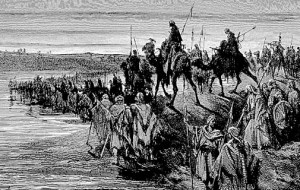
Deuteronomy closes with Moses reminding his people of all the good god has done for them and of all the laws that must be kept if the people are to honor god and stay in his favor. Failure to keep god’s laws could result in anything from plagues to banishment to total annihilation, so the last few chapters are, much like the last couple of books, reiterations of all the laws and customs, as well as who is responsible for what (such as the priests acting as leaders, doctors, judges, etc.). At the very end of the book, after Moses has shared his final wisdom with the Israelites and prophecies blessings and curses, god tells him to go up on Mount Nebo, where he can see all the land that will become Israel. Here, Moses dies alone with god, who buries him. God raises up Joshua to replace Moses as leader, and Joshua begins the work of preparing his people to cross the river Jordan and invade Jericho.
One God: As in the previous chapters of Deuteronomy, one of the most prominent messages is that the people of Israel must commit to serving and worshiping only one god. As such, anyone who worships other gods or idols, such as the sun and moon, must be put to death. The priests who are compiling this part of the bible are clearly struggling to deal with some continued interest in polytheism; including strict laws and severe punishments for such dual-beliefs, along with assimilating important traditions into this new faith, is a surer way to gain full compliance with the laws of Yahvism (monotheism – Abrahamic). On the bright side, it takes 3 witnesses to prove someone is guilty of worshiping other gods, so at least a single spiteful neighbor would be somewhat prevented from easily settling a grudge (or stealing his neighbor’s wife/land/cattle/daughter, etc.)
Good Laws, Bad Laws: Deuteronomy reinforces some of the laws pertaining to gender constructs, family obedience, clothing, and sexual encounters. For example, Deuteronomy 21:11-13 tells us that a woman taken captive can be taken as a wife after thirty days, but she cannot be enslaved or made a prostitute. That’s pretty cool. In addition, Deuteronomy 22:25-26 explains that rapists will be put to death. Hoorah! On the other hand, Deuteronomy 21:21 notes that “stubborn” or disobedient children should be stoned to death by the city, and that “cross-dressing” is an abomination (22:5). There are a whole bunch of other new laws outlined in this part of the book, as well as reminders about old standards. Some are logical and some are, well, weird.
Song of Moses: Deuteronomy 32:1-43 is written as a poem, often referred to as “Song of Moses.” Just before Moses is to die, god tells him that he should translate their history and laws into song, which he would then share with his people, who could then teach it to their children and grandchildren, etc. In many ways, this is perhaps the earliest iteration of a didactic “hymn,” a song that praises god while incorporating instructions from god. The Song of Moses relays the entire history of the Israelites, including their escape from Egypt and their 40-years’ wandering in the desert. There are reminders of faithfulness and faithlessness, as well as promises of blessings to the future faithful and curses to those who lapse.
OTHER INTERESTING BITS
Equal Punishment: Deuteronomy 19:21 gives us the famous passage about punishing people for transgressions. “eye for eye, tooth for tooth, hand for hand, foot for foot.” This chapter also outlines some caveats, however, including the difference in punishing someone who accidentally kills another versus the punishment for intentional murder. One interesting element is the punishment for bearing false witness. Essentially, whatever the person bearing false witness hoped to accomplish, so shall be his punishment (e.g. If someone falsely claimed that a neighbor stole his goat in hopes that he himself would get a free goat or the cost of it returned to him, that man would instead have to pay up the same to the person he falsely accused.)
12 Stones: Early in the book of Joshua, 12 priests are called to stand in the river Jordan and hold back the waters while the Israelites cross it (similar to the parting of the Red Sea). These priests then each take a stone and place them in a “circle of stones.” This is a tradition older and more diverse than is represented in the story, here. Like the stones of Stonehenge, the practice was used by many cultures and for thousands of years before Joshua’s time, usually as a way of depicting the calendar (one stone for each month). It is likely that the circle of 12 stones described here was already in place in this location (Jericho was an ancient city, probably established around 5,000BC, well before the Israelites got there) but reframed by the priests to suit this story. Yahvism would have otherwise rejected the practice as repugnant to their monotheism.
Hexateuch: Although many treat Joshua as the beginning of the second division of the Bible, which contains 21 books that make up “The Prophets,” others consider Joshua the sixth book in the “Hexateuch.” It is likely that the source material for Joshua is the same as the material for the first five books, known as the “Pentateuch,” and that it was written/compiled by the priests at the same time; thus, treating Joshua as the end of the first section rather than the beginning of the second section, makes a whole lot of sense.
On Tyranny by Timothy Snyder
 Timothy Snyder’s On Tyranny: Twenty Lessons from the Twentieth Century is an interesting and frightening review of some of the most troubling moments in world history. What makes it especially disturbing is that Snyder connects each of these moments with a current event or situation, articulating the similarities in clear detail and noting why we should all be concerned about what is happening in the United States, Europe, Russia, and China. Ultimately, each lesson is a rule for how to resist tyranny, and these rules come together to create a kind of resistance ethos. The historical moments connected to current events make the problems clear, and Snyder’s lessons remind us that, in the end, power rests with the people, even when all seems lost.
The twenty “rules” laid out in this book are as follows:
- Do not obey in advance.
- Defend institutions.
- Beware the one-party state.
- Take responsibility for the face of the world.
- Remember professional ethics.
- Be wary of paramilitaries.
- Be reflective if you must be armed.
- Stand out.
- Be kind to our language.
- Believe in truth.
- Investigate.
- Make eye contact and small talk.
- Practice corporeal politics.
- Establish a private life.
- Contribute to good causes.
- Learn from peers in other countries.
- Listen for dangerous words.
- Be calm when the unthinkable arrives.
- Be a patriot.
- Be as courageous as you can.
Even a cursory look at this list gives one an idea of how to go about the process of resisting authoritarianism, as well as subtle reminders of when and how fascism has manifested itself in the past. Of these rules and reminders, all of which are crucial, a few stood out to me.
First, “do not obey in advance.” Snyder recounts an experiment that was conducted to determine how willing individuals would be in causing pain to others if an authority figured (like a doctor) deemed it safe and necessary. The results were not encouraging, to say the least. Snyder reminds us to trust our own instincts and morals, and to put them into deep consideration against the instructions of any authority figure. Just because someone says “temporary pain is necessary for” whatever, doesn’t make it true. Should we ever inflict pain or hardship on anyone else? Really?
Another remarkable moment for me, in reading this short guide, is the call-to-action for defending democratic institutions. “We need paper ballots,” Snyder writes, and he is right. After what Russia did in the most recent election cycles, including in France and the United States, we must rise up at the local and state levels and demand that our representatives ensure the integrity of our electoral process. That probably means eliminating electronic polling machines, at this point, and returning to the paper process. It might take longer, but isn’t the effort and patience worth it, if it means rebuilding confidence in our process?
Snyder also asks us to “be kind to our language,” by which he means, don’t succumb to hyperbole and double-speak. Read books. Learn history (real history), and avoid the twenty-four-hour news cycle that treats everything like “breaking news” and conditions us to be always on the lookout for the next tragedy or event. This particular presidential administration seems masterful in its use of “breaking news” as devices of distraction. I hope that what we are seeing out of the Parkland students’ reactions is the beginning of a new mode of thinking, one which encourages long-term engagement and attentiveness.
“Believe in truth” is a particularly powerful idea right now. A long-feared problem has manifested itself in these last few years, one which has been predicted for a half-century by luminaries such as Isaac Asimov and George Orwell: the destruction of truth and fact; the creation of an environment wherein everything is true and false at the same time, and where opinions are treated as equally valid to fact. This has caused quite the nightmare for those of us who do deal in truth, but I think is even more damaging to those who haven’t yet recognized what is happening. We have to vocally and vehemently re-assert our right to truth and speak up in support of it whenever possible. Truth does exist. Not all opinions are valid. At some point, this is more important than hurting someone’s feelings.
Finally, taking personal action in the form of making friends, creating a private life where you surround yourself with like-minded people, and looking people in the eye, your neighbors and colleagues, is another important reminder. When tyranny rises, as it did in Nazi Germany and as it did during the “Red Scare” in the United States, it becomes only too easy for people to turn on their friends, co-workers, and neighbors. But we can make it harder by getting to know the people around us and building trust with them. There’s no easier prey for the state than a person with no friends or support. This also means, get active in one’s community and support the causes that one believes in. Chances are, when you are there for others, others may be more likely to show up for you, if and when you really need them.
These are just a few reactions to the twenty very important lessons Snyder details in his short but powerful book. I think fans of history and politics will enjoy this one for its blend of past and present, and the clear parallels Snyder draws between “then” and “now.” But I also think it’s a must-read for anyone who cares about the survival of democracy and the rule of law over the rise of tyranny and authoritarianism that encroaches more and more each day.
Numbers 35-Deuteronomy 16 #2018BibleRBR

Reading the Bible as Literature
Week Nine: Numbers 35-Deuteronomy 16
We have reached the fifth and final book of the Pentateuch – and the last of the books of Moses. Numbers closes with the Israelites reaching the promised land and the borders of the new nation being described. There is also a description of how the land will be divided (by lots) and in the differences between city-dwellers and suburbanites. Laws of marriage (intermarriage), inheritance, and the jubilee are reiterated. Deuteronomy picks up where numbers leaves off. I honestly have little to write, this week, because most of what happens in this section is a recounting of all that has happened so far, from the perspective of Moses. He is essentially on his deathbed, reminding the people about where they’ve been, what they have gone through, and what has been promised to them, so long as they remain faithful and obedient to their god and his commandments.
One God: Up until this point, the Israelite god is described as the true or supreme god, but there are quite a few concessions to the beliefs of others. The lingering cultural beliefs in multiple gods, and respect for the many nearby nations who do still hold those beliefs, had been begrudgingly tolerated while the Israelites were encouraged to focus on their own god, learn the new ways of this religion, and establish new laws and customs that would define them in contrast to the nations surrounding them. At this point, however, Moses firmly establishes that there is one god, and that all other beliefs in other gods are wrong, even an abomination worthy of death. The people are charged with teaching their children this most important law and are warned that the worship of other gods or idols, even be it a family member, will be punished severely. If anyone tries to turn your faith, god says, they shall be put to death.
Poor Moses: Listen, Moses (and his brother, Aaron, before he died) has a lot to deal with. He has spent decades leading these poor, tired, sometimes cowed and sometimes rebellious people through the deserts. From land to land, to place to place, Moses must keep control, keep god’s temper in check, and punish his people severely when they go too far. And now, as the people finally reach Canaan and begin preparing to settle themselves in a homeland, Moses finds himself a breath away from death. God certainly has a twisted sense of humor! Instead of spending his last days in a restful retirement, though, Moses “lectures” to his people, restating the important historical events of their time and reminding them about the key laws that he brought down from Sinai. A leader and a servant to the very end.
Deuteronomy: This is the first book in the Old Testament that comes not from the J, E, or P sources, but from a fourth source altogether. Legend has it that the book was found in a Temple sometime around 621 BC (2 Kings 22:8). The book was bound and presented to the young king, Josiah, who was so impressed by it that he treated it as prime law. This reinvigorated Yahvism, which was on the cusp of extinction; instead, this minority sect ascended to become the official religion of the land, named so by King Josiah himself. From thence, Yahvism would become Judaism, and would then disseminate further into Christianity and Islam. Quite the lucky find!
OTHER INTERESTING BITS
Lebanon: Since this book and the end of Numbers spends time outlining the borders of what would become the physical land of Israel, it is interesting to consider what this land actually was. It seems Lebanon was the area of Canaan contained within two mountain regions. It remains, to this day, one of two nations (the other being Israel) that is not primarily Muslim. In the description is also the city of Azzah, which scholars believe is now Gaza. It turns out that this area was probably Greek by ethnicity, and its ancestors likely came from either Crete or Cyprus (which became Caphtor). The evidence for this includes a description of its people as uncircumcised as well as “People of the Sea,” which is how the Greeks were described.
God the Father: This part of the text (Deuteronomy 8) suggests explicitly for the first time that followers should think of god as a “father,” and to be reminded that he both fed and watered the people, as well as punished them when they acted wrongly. This is also a lesson for the future, or a promise that those who remain righteous will be rewarded but those who do not will be destroyed.
More Laws: Not really. A number of laws and customs are reiterated, but they have been shared many times and in many places up to this point. Rules for which foods can and cannot be eaten are restated, laws about the 7-year release of debts are given again. Reminders about the body (e.g. do not tattoo yourself or cut your hair), about tithing and sacrifice, and about offerings are given again. The most prominent new message, though, seems to be the one about monotheism and god’s wrath. It is stated many times in this part of Deuteronomy that followers of other religions should be destroyed without pity. This is an important departure from the way rival religions had been treated in the previous books.
The Classics Spin #17! #ccspin
 Even though I am one of the founders and moderators of The Classics Club, it has been quite some time since I’ve participated in a Classics Club Spin, one of the fun events we do a few times per year. I thought I would jump back in, this time, since I’m ahead of schedule on my own TBR Pile Challenge but way behind schedule in my Classics Club challenge list?
What is the Classics Spin? Essentially, clubbers choose twenty books from their classics club reading list and post them by the due date.Then, on “spin day,” a number between 1-20 is revealed, and that is the book you have to read before the deadline (usually the end of the following month). You can choose your books randomly, divide them by categories, or whatever. Part of the challenge, though, is to choose at least a few that you know you’re dreading, just in case this is the opportunity to nudge you toward it.
So, I went mostly with a “random” sort this time, but I did choose at least one book from each of the “centuries” represented on my main club list. Here are the twenty I’ve pulled to play with:
- The Blazing World by Margaret Cavendish
- At Swim, Two Boys by Jamie O’Neill
- The Joy Luck Club by Amy Tan
- The 120 Days of Sodom by Marquis de Sade
- Kim by Rudyard Kipling
- A Vindication of the Rights of Woman by Mary Wollstonecraft (re-read)
- Eugénie Grandet – Honoré de Balzac
- The Secret Garden by Frances Hodgson Burnett
- The Good Earth by Pearl S. Buck
- The Blind Assassin by Margaret Atwood
- Paradise Lost by John Milton
- Dead Souls by Nikolay Gogol
- The Count of Monte Cristo by Alexandre Dumas
- The Bluest Eye by Toni Morrison
- Madame Bovary by Gustave Flaubert
- So Big by Edna Ferber
- Wise Blood by Flannery O’Connor
- One Hundred Years of Solitude by Gabriel Garcia Marquez
- Metamorphoses by Ovid
- The Mysteries of Udolpho by Ann Radcliffe
I guess I’m hoping for Number 3, Number 5, or Number 8 and probably most worried about Number 20, Number 19, and Number 13 – mostly because of how long they all are; but whatever happens, I’m ready to read! Let’s spin!
#2018BibleRBR Daily Reading Plan: March

Here is my daily reading schedule for March. As mentioned in the original post, this month the reading plan is Deuteronomy 5 through 1 Samuel 17. As always, feel free to read ahead, fall behind, or jump around.
I’ll be back again every Sunday with my thoughts on that week’s reading. On March 31, I’ll post a wrap-up for the month plus the reading plan for March.
The Reading Plan for March:
- March 1: Deuteronomy 5-7
- March 2: Deuteronomy 8-10
- March 3: Deuteronomy 11-13
- March 4: Deuteronomy 14-16
- March 5: Deuteronomy 17-20
- March 6: Deuteronomy 21-23
- March 7: Deuteronomy 24-27
- March 8: Deuteronomy 28-29
- March 9: Deuteronomy 30-31
- March 10: Deuteronomy 32-34
- March 11: Joshua 1-4
- March 12: Joshua 5-8
- March 13: Joshua 9-11
- March 14: Joshua 12-15
- March 15: Joshua 16-18
- March 16: Joshua 19-21
- March 17: Joshua 22-24
- March 18: Judges 1-2
- March 19: Judges 3-5
- March 20: Judges 6-7
- March 21: Judges 8-9
- March 22: Judges 10-12
- March 23: Judges 13-15
- March 24: Judges 16-18
- March 25: Judges 19-21
- March 26: Ruth 1-4
- March 27: 1 Samuel 1-3
- March 28: 1 Samuel 4-8
- March 29: 1 Samuel 9-12
- March 30: 1 Samuel 13-14
- March 31: 1 Samuel 15-17
I look forward to sharing my thoughts on the stories and literary elements of the Bible, as I see them, and I am especially eager to hear what you all find in your own explorations. As a reminder, this is a secular reading of the bible as literature, so any/all respectful thoughts and opinions are welcome. In my opinion, the more perspectives we have, the better!
To share on Twitter/Facebook/Instagram, etc, please use: #2018BibleRBR
 Roof Beam Reader