Roof Beam Reader
Adam Burgess
Genesis 43-Exodus 12 #2018BibleRBR
Reading the Bible as Literature
Week Three: Genesis 43-Exodus 12

This week’s reading brought us to the end of Genesis, the first book of Moses, and into the second book, Exodus. In the conclusion of Genesis, we see the decline of the tribe of Joseph (or the death of Joseph the person, depending on how you’re reading the book). We learn some important information about the relationship between the Hebrews (Canaanites) and the Egyptians, most importantly the extreme prejudice that the Egyptians have against Israelites (43:32 tells us that Egyptians will not eat with Hebrews, “for that is an abomination” and that the Egyptians look down on farmers/ranchers, which is the primary occupation for the Hebrews). That said, alongside this prejudice, we see that this particular Egyptian pharaoh is willing to bend traditional prejudices because he relies so much on Joseph and appreciates what Joseph (or the tribe of Joseph) has done for his land and people, including keeping them fed during the 7-year drought, and keeping the pharaoh rich.
Egypt and Israel: Historically, the end of Genesis and this beginning part of Exodus are interesting in that they illustrate some of the history between the Egyptians and the Israelites. A caution, though: unlike many of the major historical events described in Genesis, which can be corroborated with historical documents from other cultures, most of what happens in Exodus is documented only in the Bible. Still, we learn that, around the time that the tribe of Joseph falls, there is also a transition in Egyptian leadership. A new dynasty seems to rise with Ramses II (there is about 400 years between the end of Genesis, when Joseph dies, and the beginning of Exodus, when Moses is born) and the Egyptians, battling numerous insurrections and attacks from surrounding areas while simultaneously expanding their empire, are charged with being less and less “tolerant” of the presence of Hebrews in their lands. The close relationship between the tribe of Joseph and the earlier Egyptian king(s) has been long forgotten. As such, the bible suggests the Hebrews were enslaved in order to prevent them from rising up against Egyptian leadership. Again, it is only in the bible that the record of this slavery exists (and it should be noted: it was not the Hebrew slaves who built the pyramids. I have heard this suggestion many times and often took it for granted, but the pyramids were actually built about 1,000 years before Joseph entered Egypt).
Repeating Patterns: When Jacob and Joseph reunite, Jacob asks Joseph to bring his own sons so that he (Jacob) might bless them. Joseph brings Manasseh and Ephraim before their grandfather and places Manasseh on the right (to be blessed first, as the elder brother) and Ephraim on the left (to be blessed second, as the younger brother). But Jacob crosses his arms and reverses the order. We’ve seen this before! In the culture of ancient Israel, the firstborn is supposed to be the most important, but just as we saw Isaac blessed above Ishmael, and Jacob before Esau, and even Joseph favored above his many older brothers, here we see Jacob actively raise Ephraim above his elder and declare that his will be the blessed life. Why? Some say this is an example that these traditions are man’s, whereas god is not constrained by or concerned with them. I would also suggest that, again, these narratives are being written after history has happened, so the priests had the benefit of knowing which tribes did actually succeed. If historically the tribe of Ephraim was stronger, more successful, or longer-lasting than that of Manasseh, then it makes sense to write Jacob’s blessing this way.
Reverse Engineering Tribal History: As with many other points in the books of the bible, when names of individuals are listed and their histories/personalities/prophecies are given, we find that what is actually happening is a historical record of the people that has been reconstructed after the fact and written to coincide with the biblical narrative. For example, Genesis 49 gives us Israel (Jacob) speaking to his children on his deathbed. He lists them in order of age (tribal significance) and prophecies their rise or fall, depending on their documented actions to that point. Indeed, what is fascinating about this is that the priests responsible for compiling the bible stories and histories into narrative form took the history of these tribes, with Jacob as the primary patriarch (after Abraham) and reverse-engineered those histories as told through the mouth of Jacob, in prophecy. It is, then, a magical element of biblical storytelling, on the surface, but more importantly, a historical record of the Israelites in Canaan and Egypt at the time.
OTHER INTERESTING BITS:
Exodus 7: I have read the Book of Exodus so many times, and have seen countless film and television adaptations of the Moses story. In my recollection, it is always Moses who is acting the part of “hand of god” (god’s empowered agent). In actuality, though, Moses is extremely humble and shy, and only whispers to Aaron what to do. It is Aaron, then, who performs every action. I don’t know how I forgot this! I blame it on Hollywood.
Exodus 8: The 10 plagues brought by god were once claimed to have been the result of a near collision between Venus and Earth. No one could find an explanation for how all those crazy things (darkness, lice, storms of hail and fire, etc.) could happen, so why not an astronomical event? Turns out that was total hogwash – but nice try! (Astronomers were not amused).
Moses: Does the story of a unique boy, given up as a baby only to eventually rise to great prominence sound familiar? That’s probably because ancient folklore is riddled with these stories, from the story of Cyrus in Persian legend to the Roman legend of Romulus, and of course the Greek tales of Perseus, Paris, and Oedipus! So, one theory is that the story of Moses was adapted by Babylonian priests from the legend of Sargon of Agade, when the priests were writing the Hexateuch.
Passover: Speaking of borrowing/adapting stories from various cultures. Passover was the most important agricultural festival after the time of Moses, and was likely a pagan holiday at first (just like Christmas and Easter). Priests writing the book of Exodus likely assigned this most important festival to coincide with one of the most important themes in early Israeli legend: the exodus.
I’ll be back next Sunday, January 28th, for my last post of this month! On January 31st, the reading list for February will be posted (with perhaps anything else I want to add that I didn’t get a chance to in these end-of-week reviews).
Interested in other posts in this Reading the Bible as Literature journey? Click here and follow #2018BibleRBR on Twitter, Facebook, Tumblr, and Instagram.
January Checkpoint #TBR2018RBR
 Hello, TBR Pile Challengers!
Yahoo! It’s time for our very first Checkpoint (with mini-challenge #1 — see below). We have 100+ participants this year, which is pretty awesome considering the challenge was on hiatus for two years. I’m inspired by all of your interest and commitment – reading is awesome, isn’t it?
Question of the Month
Which book on your 2018 list has been on your shelf the longest? (Best guess is fine!) The one I’ve owned the longest is The Hound of the Baskervilles by Arthur Conan Doyle, and I’m excited to say that it was the first book I read and reviewed for this year’s challenge!
My Progress: 2 of 12 Completed / 1 of 12 Reviewed
So far, I’ve read 2 of my 12 required books. I’m feeling pretty great about that because the new semester starts tomorrow and I never have a whole lot of time for pleasure reading while school is in session. I plan (really, I do!) to read all 14 of the books on my list this year, the main 12 plus my 2 alternates, so getting a jump-start on this list before spring semester began was important. Books read:
- The Hound of the Baskervilles (Completed 1/3/18)
- Aristotle’s Poetics (Completed 1/10/18 – review to be posted soon)
How are you doing?

Below, you’re going to find the infamous Mr. Linky widget. If you read and review any challenge books this month, please link-up on the widget below. This Mr. Linky will be re-posted every month so that we can compile a large list of all that we’re reading and reviewing together this year. Each review that is linked-up on this widget throughout the year may also earn you entries into future related giveaways, so don’t forget to keep this updated!
MINI-CHALLENGE #1
As I mentioned in the Announcement post, there are four mini-challenges planned for this year. Our first checkpoint also brings with it the first mini-challenge!
Here’s the plan: Visit this link to see the list of linked-up participants. Travel around and leave a comment (or two, or five) with some encouragement for this new year and new challenge. Then, when you’re done, come on back to this post and comment with a link to the blog where you left your encouragement.
Everyone who spreads a little cheer and positivity on another challenger’s post(s) will be entered to win a book of choice, up to $15 USD, from The Book Depository! Comments need to be posted and linked-up here by the end of January and the winner, drawn randomly from the collection of comments, will be announced in the February checkpoint post. Only those who registered for the 2018 TBR Pile Challenge by January 15th are eligible to participate in these challenges and/or to win any of the TBR Pile prizes.
LINK UP YOUR REVIEWS

Genesis 25-42 #2018BibleRBR
Reading the Bible as Literature
Week Two: Genesis 25-42

This second week of reading Genesis continued to provide rich history and rich stories of characters that turn out to be more than they appear. Last week, I mentioned my annoyance with the Bible writers’ propensity for listing lineages in quick succession. This practice has always bothered me because it seemed indulgent and unnecessary – we never even hear many of these names again, anywhere in the bible (okay, maybe one time, a name gets dropped in Jeremiah or something, but seriously). For that reason, I have always read for the fun and fascinating parables and stories, like those of Jacob and Esau, Jacob’s Ladder, Jacob wrestling the Angel, Joseph and his coat of many colors, and Joseph’s interpretation of dreams. All of these occur in this portion of Genesis, but a closer, researched-based reading this time has also revealed much more.
Repeating Storylines: Have you noticed that there is a lot of repetition in the bible stories? In last week’s reading, for example, we learned about the family lines of Cain and Abel. If we look closely, their ancestors are very similarly named. In addition, this week’s reading demonstrated a repetition of the “overpopulated land” story. In this case, Esau and his family leave because the land won’t support both his and his brother Jacob’s families; we saw this exact issue with Abraham and Lot. These are just two examples of something that happens quite frequently, even in retelling from perspectives (i.e. the biblical narrator telling of events, for example, and then one of the biblical characters re-telling the entire thing, nearly word-for-word, to another character). So, why does this happen? History explains that there were actually three early versions of Genesis, one each (E and J) as written by the two Israeli tribes (northern and southern), and another (P), written later by priests. In an effort two coordinate the E and J texts, the writers (editors) of the P text often duplicated material in an effort to explain (in reverse chronology) some important historical features that were “priestly concerns,” such as record-keeping, major historical events, geography, etc. They also edited the two earlier text with additional legend to explain some of that history. (The earlier texts were once thought to have been written by Moses, hence why the KJV still lists the first 5 books—known as the Pentateuch—as “Books of Moses,” but now there seems to be consensus that these were written much later, and by many people, during the time of the Jewish exile.)
People As Places/Tribes: Another fascinating feature, related to the above editing traditions, is the fact that names, especially of important and first-born individuals, or familial relations (e.g. sons and brothers), often represent much more than just a single character in the story. This begins right away, in sections of last week’s reading. For example, the word Elohim, translated, means “gods,” not “God,” and a translation from the Hebrew word for “Adam,” means “mankind,” rather than “man.” So, what we now think of as “God created Man,” because of the tendency to translate this way, might actually work better as, “the gods created mankind” (or, when god brings the animals to Adam to be named, might more accurately be: “the gods brought all the animals to humankind.”) So, how did one man and one woman populate the earth? Well, if we are really talking about “womankind” and “mankind,” then it makes much more sense, and is more historically and biologically accurate.
The names Cain and Abel probably represent the relationship between the tribes of Elam and Sumeria. The names of Noah’s sons probably represent the geographical tribes of Arabia, Persia, Assyria, etc., and their languages (semitic or not). In this week’s reading, we see similar historical naming as representative of tribal affairs in the story of Jacob and Esau. The story of Jacob (Israel) and Esau (Edom) is one in which the younger brother (Jacob/Israel) usurps the role and benefits of the elder brother (Esau/Edom), despite tradition and with god’s blessing. Similarly, the Edomites, historically, rose to power and became a strong civilization first, but the Israelites, a younger tribe, would eventually rise and displace the Edomites. In this way, and in many other examples too numerous to outline, the Priest’s edition of Genesis seems to personify, in biblical characters, entire histories of civilizations, including their rise and fall, as well as natural disasters (such as the flood, which likely did happen but may have been borrowed/adapted from other cultures: see the Epics of Gilgamesh and Atrahasis).
OTHER INTERESTING BITS:
Chapter 27: Jacob tricking his father to bless him, rather than Esau, demonstrates both Isaac’s devious personality (allowing him room to “grow up” and accept god, which he later does) and represents the cultural histories of two tribes, the Israelites and Edomites.
Chapter 28: Jacob is “blinded” ironically in the situation with Laban, just as Jacob took advantage of his blinded father. This is perhaps when Jacob begins to become a better person, worthy of the blessing/covenant bestowed upon him.
Chapter 32: Jacob wrestles with a man, whom is taken to be an angel or some version of god. This seems to represent Jacob’s life-long struggle with god, after which he becomes “Israel” and also a better man, accepting god and the struggle, rather than fighting it any longer.
Chapter 37: Why is Joseph so favored, in such a large family? He is Jacob’s 11th son, and yet Jacob treats him with great favor, even giving him a “coat of many colors.” It’s important to remember that Jacob was Rachel’s first-born (Gen 30:22), and Rachel was Jacob’s favored wife (the one for whom he gave up 20 years of his life in service to Laban).
Join in the reading & discussion weekly & monthly with #2018BibleRBR.
The Time Quintet by Madeleine L’Engle
A Wrinkle in Time (1962)
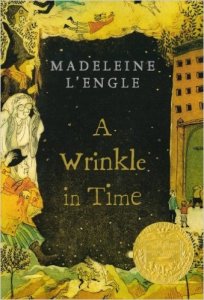 “It was a dark and stormy night.” The first book in the Time Quintet is the most well-known and recognizable. The book is classified as “science fantasy,” which is to say, science-fiction but also with elements of fantasy (the three traveler-guides who are often perceived as types of witches, for example, though I would argue this is a misreading). Of the five books in the series, this one is often rated as “third best,” for whatever that is worth, but I think it is my favorite. Partly, I must admit, this is nostalgia. I grew up with this story, it was my sister’s favorite, and I read it before reading any of the others (this was a re-read). That being said, if I am being honest, it is probably not the best of the five. What it lacks in, say, plot, it makes up for in other places, though, such as characterization. L’Engle understands how to draw a character in clear and in subtle ways. We know who the protagonist Meg is; her actions are not always noble, but they are always consistent to her character and ultimately work toward the good. We know who young Charles Wallace, the special genius, is, and how a boy wonder, untested, might find his first challenge is a struggle with his own ego; and we know who Calvin is, and why he belongs with the others despite not being one of their siblings. Without this first installment, I would find it difficult to understand or care about any of the characters in the later books, including An Acceptable Time, which deals with a new protagonist and, for the first time, the first-hand experiences of the Murry parents. I also much prefer the three mysterious guides, Mrs. Whatsit, Mrs. Who, and Mrs. Which, far more than the guides in any of the later books (although Gaudior the Unicorn from A Swiftly Tilting Planet might come close). Ultimately, what I love about this book is its unabashed embracing of science, including the wonder and, yes, the magic of reality, great and small. It also introduces a common theme to be explored in later books: the nature of good and evil, moral and immoral, selflessness and selfishness. If I have one complaint, it is the ending – where did they go? And why don’t we see them again? (Who? Read the book.) My Verdict: 3.5 out of 4.0.
A Wind in the Door (1973)
 “If someone knows who he is, really knows, then he doesn’t need to hate.” This second in the series picks up not long after the first. It takes the elements of morality (one might even say the human soul) and science, and merges them together in seemingly impossible ways. What if we could connect every single element of all that we know, from the grand scale of the full universe to the smallest, most miniscule and unobservable atom within us, and discover that they function in a delicate relationship? In this second book, L’Engle’s exploration of religious faith (particularly Christian) and its co-existence with scientific fact begins to come more clearly into focus. Suddenly, the books begin to speak as spiritual tracts and as scientific treatises. Who does that? Well, not many, and perhaps this is what has so fascinated readers of this series for so very long, the idea that one need not prefer or subordinate a belief system to a scientific understanding of the universe, or vice versa. Of the five books in the series, I think this one is the most interesting and in some ways the most playful, as it has a Magic School Bus for grown-ups kind of attitude about it; however, the story gets repetitive at points, and the dénouement, though rather beautiful, is a bit rushed and anti-climactic. Characterization also gives way to plot and purpose, in this case, which is why I think it is important to start with A Wrinkle in Time, otherwise we might care about what is happening to Charles Wallace, but we might not understand Meg’s and Calvin’s actions quite as well. (The introduction of the anti-hero principal, though, was both funny and powerfully moving). My Verdict: 3.25 out of 4.0.
A Swiftly Tilting Planet (1978)
 “People are afraid of knowledge that is not yet theirs.” Of the five books in this series, A Swiftly Tilting Planet is my least favorite. It jumps ahead in time by 7 or 8 years, and gives us Charles Wallace, at 15, as protagonist. The premise is absolutely fascinating: the world is on the brink of destruction, and only by visiting important moments of the past and making the one single change, at the precise right moment, will that destruction be avoided. Charles Wallace, via, somehow, Calvin O’Keefe’s mother, becomes a time traveler, with the help of an ancient Celtic rune and a magic, time-traveling unicorn named Gaudior. The one thing I found most irksome about this installment was its repetition. An evil force from A Wind in the Door is re-introduced, and the pattern Meg and Calvin followed on the tiniest scale as set in the last installment, is now followed by Charles Wallace, but in a much grander way, through time and space rather than at the cellular level, within a human body. Gaudior is funny at times, and while not emotive, he eventually becomes a kind of friend and protector for Charles Wallace. The historical episodes introduced, and the patterns of mythologies traced from the ancient Celts to the Native Americans, down to South America, and finally to present-day New England, is definitely thrilling. The fact that much of the mystery unfolds through discoveries made in textual evidence, like books and journals, also tugs at the heart-strings of any reader/writer. But the flow is choppy and Charles Wallace is, in my opinion, not well-served by the manner in which he travels. He is much too much an interesting character to have been relegated to a type of “body snatcher” whose experience is actually related through Meg’s psychic connection with him. That said, L’Engle continues her pursuit of bridging the world’s mythologies with scientific and technological advancements in an effort to highlight the ethics and morality, and necessary limitations, of intellectual pursuits, as well as human hubris. My Verdict: 3.0 out of 4.0.
Many Waters (1986)
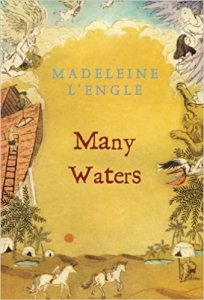 “In the coolness just before morning she liked to go sit on one of the great exposed rocks and rest, and listen to the slow song of the setting stars.” Sandy and Dennys Murry, the brilliant but practical siblings in a genius but often impractical family, finally get their adventure in this fourth installment, and it is one of the best. Although the fourth book in the series, this one is actually set between A Wind in the Door and A Swiftly Tilting Planet. The children are all still living at home, but when everyone else is away for the day, the twins–messing irresponsibly with their mother’s experiment–accidentally transport themselves to another time, which they mistake as a distant and different planet. The people are shorter, the language is different, the sun is hotter, the land dryer, and the technology non-existent. When Sandy and Dennys are discovered by the natives of this brave new world, which turns out to be their own ancient world, they are mistaken for giants or angels. Readers soon discover this is because both giants and angels exist in this time, and in this place, which is the land of Canaan just before the flood. In this antediluvian setting, Sandy and Dennys must figure out both what their purpose is in being there—was it God’s plan?—and also how to get home before the Nephilim, the fallen angels, decide they are too dangerous to their plans for world domination. With a little help from Noah’s family and the Seraphim, the teenagers manage to mend Noah’s relationship with his father and essentially save the entire human race. L’Engle makes a clear turn toward not just mythologies/faith systems in general, but the Christian religion (readers familiar with the Book of Genesis will recognize a lot of familiar names and places). Again, science and faith work together to tell a cohesive tale, rather than competing with each other in a dichotomy. Of the five books in this series, Many Waters is the most distinct, though it does reference events in prior books, and it is the most patient and complete of the stories; it never feels rushed, nor does it end too soon. My Verdict: 3.75 out of 4.0.
An Acceptable Time (1989)
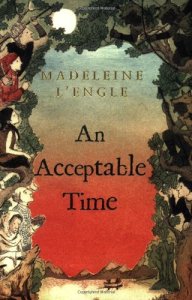 “I’m grateful every day that I can read and write. I don’t underestimate knowledge. But we get into trouble when we confuse it with truth.” In this final installment of the Time Quintet, L’Engle takes us a generation into the future, installing as her protagonist, Meg and Calvin’s daughter, Polly. Once again, L’Engle demonstrates her mastery of character: she understands who these people are, how they think, and what are their motivations. This is fortunate because some of the characters re-appearing from the previous novels are treated more fully, here, and we realize they are not necessarily what we expected. Are the brilliant Drs. Murry really so narrow-minded? Does the fact that they are grandparents, now, make them more cautious over Polly than they were over their own children, or were they simply not accepting the reality of their children’s adventures in the first place? After getting this far into the series, it was a surprise to be surprised by some of these characters’ actions, but in understanding their motivations, things turn out to be rather consistent after all. In addition to the Drs. Murry, we are introduced to Zachary, a semi-romantic interest for Polly, whose personality and described physiognomy are alarming from the first. He, too, remains rather consistent throughout, even to the point of disgusting the reader. In contrast are the Bishop and the native people, whom Polly and the Bishop (and Zachary) meet when a centuries’-old time circle overlaps their own, so that they can cross the time-space barrier. In this way, L’Engle again manages to place at the center of her story a discussion of religion (monotheism and polytheism, mythologies, druids, modern Christianity) with scientific possibilities. Most importantly, L’Engle explores the concepts of charity and forgiveness. What does it take to forgive someone who has committed the ultimate betrayal? The nature of evil, too, is treated with more finesse and complexity. Is it fair to call what is seemingly necessary, evil? While most of the original young cast of characters is absent from this tale, Polly is a wonderful addition: curious, gracious, flawed. Her journey to understand the universe, to understand faith, and to understand people & human nature, makes for an interesting and complex finale to a series that asks these questions consistently throughout. My Verdict: 3.5 out of 4.0.
Ultimately, I have to say that I am thrilled to have finally read this entire series. I most appreciate that L’Engle finds equal space for religious and scientific exploration, without making these antithetical the way so many do, as if we must choose one way or the other. Even though I do not follow her faith, I think this is a unique success for her series. Also, for the longest time, I had no idea that A Wrinkle in Time had even one sequel, let alone four! I do eventually want to read the related novels that deal with some of the same cast (and I assume similar themes). Someday. For now, L’Engle’s Time Quintet has definitely made its way onto my “favorite series'” list. It hovers somewhere under Harry Potter, The Lord of the Rings, and His Dark Materials, but above Chronicles of Narnia and maybe even the Percy Jackson books. Gasp!
Genesis 1-24 #2018BibleRBR
Reading the Bible as Literature
Week One: Genesis 1-24

Genesis is one of the most interesting and rewarding books of the bible. There is a whole lot going on, and a lot that precedes/prefigures events that come later, both in the Old Testament and in the New Testament. Sure, there are some dull moments, where we get into things like the “Son of _ ; Son of _ ; who lived until 800 and _” nonsense, but mostly, the stories are fascinating, the people are familiar, and God is beginning to demonstrate the kind of deity he is. Adam and Eve. Cain and Abel. Noah. Abraham and Sarah. Isaac and Ishmael. Babel. Sodom & Gomorrah. I mean, this is just a wild beginning to any book!
Speaking of which: what is up with this God? I remember when I last read the bible through, about 3 years ago, I kept thinking, “man, this guy is a real jerk!” He seems to overreact to every little human flaw (or attempt at greatness), and to “test” (sic: “tempt”) his most devout followers in the most absolutely ridiculous way. Upon this reading, though, I’m wondering about the “lessons” behind God’s actions, rather than focusing on the actions themselves. Let’s take two, for example:
First, after Eve and Adam eat the fruit of the Tree of Knowledge of Good & Evil, they are expelled from the Garden of Eden. In my recollection, and in many modern-day references, it is only this post hoc ergo propter hoc (cause and effect) that is the focus. They disobeyed God, so he gets rid of them. But I think this misses an important piece: God says in Genesis 3:22 that they are being expelled before they can eat from the Tree of Life. In other words, it is not just that they disobeyed God and are now tarnished with the knowledge of good and evil (which essentially makes their innocence null & void and will cause them to know sin), but that if they stay, they may also become immortal. If they are “all knowing” and immortal, then they are much too close to being god-like; or, in God’s words, they would become “like one of us.”
Second, after the flood and re-populating of the Earth, Noah’s descendants begin to spread and to form different tribes, occupying different lands (nations). Eventually, many generations later, the tribes come together to build a ziggurat, a massive tower that would reach toward the heavens. This is the Tower of Babel, and it was meant to be mankind’s shining achievement, proof that men could work together toward a common goal, and succeed. But for some reason this angers and disturbs God. Why? Why wouldn’t he want his children to come together and learn and grow, and communicate? Well, as with the Tree of Knowledge, Genesis 11:6 tells us God saw their work and thinks, “nothing will be restrained from them,” if they are all of one language and one purpose.
In other words: these two glimpses at God’s methods seem to me to reveal a deity who is concerned, like much of ancient mythology (Greek & Roman, anyway) is concerned, with man’s hubris. Go too far, strive for too much, believe one’s self too important, and you are surely to fall and fail, hard. Is it possible, then, that the underlying message, here, is one of a compassionate God who must do some extremely shady things in order to guide mankind toward humility?
Other Interesting Bits:
- Genesis 3:15: seems to be the first prophecy of the coming of Christ.
- Genesis 5:22-24: notes, “Enoch walked with God; and he was not; for God took him.” Why is his death different from all the others? Is it because he is a seventh son?
- Genesis 14:21-24: Abraham refuses the spoils of war because he doesn’t want to be indebted to a potentially corrupt king. (This I’m noting only because it reminds me of a stoic philosophy, which is another journey I’m on).
- Genesis 15: God’s covenant with Abraham relays the act of cutting animals in half and lining them in an aisle for the men to walk down, to “cut the deal.” This practice of cutting animals in half and walking together between them, symbolizing an important agreement between two parties, is literally where that phrase, “let’s cut a deal” comes from.
- Genesis 16: The story of Sarah and Hagar = the inspiration for Margaret Atwood’s The Handmaid’s Tale.
- Genesis 19:1-29: The story of Sodom & Gomorrah. As it turns out, this does not seem to be a direct condemnation of homosexuality; indeed, there is no shock or disgust expressed at the idea that the men want to have sex with the new arrivals (identified as men, although I’m interested in reading earlier untranslated texts to see what the actual pronouns are; angels are traditionally non-gendered, so more investigation is needed). Instead, what upsets God about their actions seems to be a confluence of attitudes: lust, violence, rage, covetousness and, perhaps most importantly, refusal to respect that Lot has placed the visitors under the protection of his household, which is an ancient and sacred custom in multiple cultures and mythologies.
Join in the reading & discussion weekly & monthly with #2018BibleRBR.
 Roof Beam Reader