Roof Beam Reader
Adam Burgess
The Folio Society’s New Northanger Abbey!
As you all know, August was the month of all things Austen! While running the event and moving across country, I somehow managed a re-read of Northanger Abbey, which was even better and funnier than I remembered. I hope you all enjoyed the annual Austen reading event, whether you were a participant or an observer. But, it’s now confession time.
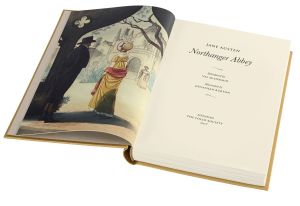
The Folio Society, a wonderful publisher of exquisite editions, and made up of some really awesome people, gave me a head’s up on a new Austen edition that would be coming soon. (Of course, they also stopped by and offered up a giveaway again this year, which was amazing!) While reading my old, dusty copy of Northanger Abbey, I got a sneak-peek at The Folio Society’s brand new, stunningly beautiful edition! Now that the book has become available, I finally get to share!
 Jane Austen’s Northanger Abbey
Introduced by Val McDermid and Illustrated by Jonathan Burton
‘Jane Austen is the pinnacle to which all other authors aspire’- J. K. Rowling
Crumbling castles, ghostly skeletons and innocent maidens in the gravest of danger: the tropes of Gothic romance fill the mind of Catherine Morland. Venturing from her country parsonage home to delight in her first season in Bath, the Austen’s naive heroine must navigate the more prosaic hazards of female friendship and undesirable suitors to secure the affection of eligible Henry Tilney. But when she is invited to Northanger Abbey, the Tilneys’ ancient stately home, Catherine’s love of sensational stories fires her imagination, and threatens to destroy her future happiness. The last of Austen’s novels to be published, appearing posthumously in 1818, Northanger Abbey was the first to be completed, written when Austen was in her early twenties. Simply told in lively and elegant prose, this is her most playful work. But the tongue-in-cheek tone that characterizes the story belies the skill of a truly great writer flexing her creative muscles. Just as Austen’s talent for satire exposes the failings of the overwrought gothic novels of the age, her subtle, beautifully observed portrait of Bath society reveals the real value of fiction: its power to convey ‘the most thorough knowledge of human nature’.
 As Val McDermid writes in her introduction – a heartfelt account of how Northanger Abbey has reinvented itself for her with each rereading – Austen unfailingly provides us with the opportunity to investigate our own lives and find surprising truths there.’ Award-winning illustrator Jonathan Burton has created six colour illustrations, depicting both the ballrooms of Bath and the imposing Abbey. Witty, fresh and perceptive, the images perfectly reflect Austen’s wonderfully sardonic novel.
The penultimate edition in Folio’s Jane Austen series, this volume is bound in gold cloth, and the slipcase reproduces the work’s spirited first line. If you haven’t gotten your hands on a Folio Society edition, yet, this is a great place to start. I now have quite a few classics from TFS, and they are quickly becoming my favorite collection.
Product information
Bound in metallic cloth. Set in Baskerville with Trajan display. 232 pages.
Frontispiece and 5 colour illustrations. Blocked slipcase. 9½ ̋ x 6¼ ̋.
For seventy years, The Folio Society has been publishing beautiful illustrated editions of the world’s greatest books. It believes that the literary content of a book should be matched by its physical form. With specially researched images or newly commissioned illustrations, many of its editions are further enhanced with introductions written by leading figures in their fields: novelists, journalists, academics, scientists and artists. Exceptional in content and craftsmanship, and maintaining the very highest standards of fine book production, Folio Society editions last for generations.
September’s Classic: Death Comes for the Archbishop #CBAM2017

August is dust and September is here! Autumn is on the way! And this month, we’ll be reading Death Comes for the Archbishop by Willa Cather! I’m a huge fan of Cather, but I haven’t read this one, yet, so I’m really excited.
Don’t forget: We have a Goodreads group! And we’re using #CBAM2017 to chat on Twitter, Facebook, and Instagram.
 About the Book:
There is something epic—and almost mythic—about this sparsely beautiful novel by Willa Cather, although the story it tells is that of a single human life, lived simply in the silence of the desert. In 1851 Father Jean Marie Latour comes as the Apostolic Vicar to New Mexico. What he finds is a vast territory of red hills and tortuous arroyos, American by law but Mexican and Indian in custom and belief.
In the almost forty years that follow, Latour spreads his faith in the only way he knows—gently, although he must contend with an unforgiving landscape, derelict and sometimes openly rebellious priests, and his own loneliness. One of these events Cather gives us an indelible vision of life unfolding in a place where time itself seems suspended.
Schedule:
- September 1st: Begin reading.
- September 15th: Mid-point Check-In
- September 30th: Final Thoughts
Feel free to read at your own pace, post at your own pace (or not at all), and drop by to comment/chat about the book at any point. The schedule above is just the one I plan to use in order to keep myself organized and to provide some standard points and places for anyone who is reading along to get together and chat.
The Mystery of Emma #AustenInAugustRBR
Please welcome Chris from WildmooBooks!
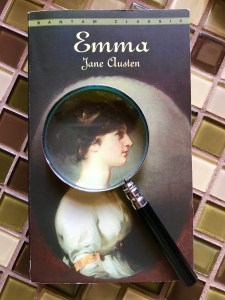 I’ve been reading Emma as a mystery novel. I’m trying not to be open minded about what a mystery novel “should be.” (I hope you never “should on yourself” when it comes to reading, Dear Reader.)
For a few years now, I’ve committed to reading one Jane Austen novel a year. Thus far I’ve read Pride & Prejudice, Persuasion, and Sense & Sensibility.
Last year a member in my mystery book club mentioned that Emma could be read as a mystery novel. I was intrigued.
I was also a bit worried. I’ve heard that people either love or loathe Emma. And that some consider Emma to be not only Austen’s best novel but a perfect novel. The P word made me even more apprehensive because if I didn’t like perfection in Jane Austen, what kind of reader would that make me?
All fears aside, Emma had been firmly lodged in my mind as the Austen novel I would read this summer.
Halfway into this first reading, I must admit that considering Emma as mystery novel seems a bit of a stretch. I can see how it could be dissected as a mystery story, perhaps of the detective ilk with the reader in the role of detective. I see clues being dropped about what’s “really” going on, yet perhaps I’m also being misled as a reader. Maybe I’m being just like Emma and seeing only want I want to see.
And what about the hero and villain who usually form the backbone of a mystery novel? The hero typically tries to put the world back into order after a crime and the villain wants to deceive people to get away with that crime. Is there a crime in Emma?
 I suppose we could look at Emma as an antihero, the sort of do-gooder who wants to help people but ends up causing harm. And then there are all the other characters to consider, people who are making assumptions, making up motives, and misreading the intentions of others in their social circle. There are prejudices, half-truths, secrets. This is all certainly the stuff of mystery novels.
Hmm, so much to ponder! I shall read on and see what conclusions I come to at the end.
Have you read Emma? If not, please enter the international giveaway I’m offering. If you have read it, what do you think of Emma as a mystery novel?
p.s. It was P.D. James who first talked about Emma as a mystery novel and she certainly knew what she was talking about when it comes to the genre. I’m holding off reading her argument until I finish the novel.

Giveaway:
Chris has generously offered to giveaway one copy of Jane Austen’s Emma, to be shipped from The Book Depository (please make sure they ship to your location).
To be entered: You must have signed-up for the event (on the master post) by August 7th. Please also leave a comment on this post, addressing Chris’s question above and/or your thoughts on Jane Austen as a possible mystery writer. Have you felt any of her other works had hints of mystery in them?
Giveaway opens August 29th and will close at 10pm CST on September 5th.
Bridget Jones’s Diary Was My Lean In #AustenInAugustRBR
Please welcome Jill from All the Books I Haven’t Read!
Bridget Jones’s Diary was my Lean In
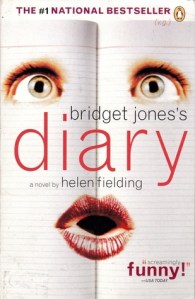 I started my professional career in the year 2000. It doesn’t seem that long ago, but when I think back, things were so different. I didn’t even have a cell phone, and the internet was still kind of new. Amazon existed, but Amazon Prime did not. And as a woman in the workplace, there were no widely read books like Lean In to help us navigate the issues women face.
What should I do when the president of the organization hits on me (in the same breath he told a bartender I was under 21, ugh), when should I tell my colleagues I was pregnant, should I ask for a raise or find a new job? I had no guide other than hurried talks at lunch with my girl friends who may or may not have been out to take my job. As is my way, I turned to books.
When I first found Bridget Jones’s Diary, a British novel loosely based on Jane Austen’s Pride and Prejudice, I felt like I finally had the guide I needed. Bridget had the same worries and issues I had. Her boss was too busy commenting on the size of her skirt to take her seriously, and her friends all gave her terrible advice. Bridget had to find her own way to a better job and a satisfying love life in her own way. Much to the delight of myself, and millions of other readers, she did it in a hysterical way with diary entries.
I eventually found my way too. I’m closing in on forty now, and I eventually found a job that suited me. I owe it all in large part to Bridget Jones, my year 2000 role model. As Bridget herself said, “It is proved by surveys that happiness does not come from love, wealth, or power but the pursuit of attainable goals.”
That Librarian Lady Shares It All! #AustenInAugustRBR
 Please welcome, Laura from That Librarian Lady!
Laura is a high school librarian and book nerd who blogs about her reading life at That Librarian Lady.
I’ve always loved reading, but I got out of it a bit when I started college. My last year of college, I picked up Pride and Prejudice for the first time and fell in love. I promptly read all of her other novels before moving on to similar classics. Suddenly, I had rediscovered the joy of reading again. I have no doubt that Jane Austen’s books relit that fire. I probably wouldn’t be a librarian had I never picked up Pride and Prejudice.
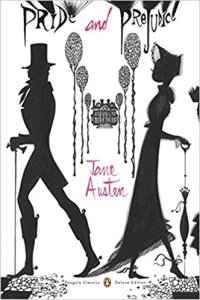
Since then, I’ve started collecting different editions of her novels, particularly editions with gorgeous covers. I really love the illustrations on the Penguin Deluxe Editions so I’ve decided to give away a set of those for Austen in August.
The set includes Pride and Prejudice, Sense and Sensibility, Emma, and Persuasion. Good luck!
 To Be entered to Win:
1. You must have signed-up by August 7th (on the master post) to be a participant in the Austen in August event.
2. Leave a comment (which includes a way to contact you, such as an e-mail address).
3. In that comment, share one favorite scene, moment, quote, or memory from a Jane Austen book!
Note: Images for book covers were found on the web. Items may be slightly different than they appear. Neither the event host nor the giveaway host are responsible for items that do not arrive, whether due to incorrect address information, mail theft, product being lost/stolen, etc. Giveaway opens on August 20th and ends at 10pm PST on August 27th.
 Roof Beam Reader