Roof Beam Reader
Adam Burgess
It’s an #AustenInAugustRBR Bookstagram Challenge!
Jane Austen in August 2017
Day 2 of our Celebration of Jane #AusteninAugustRBR
And we’ve only just begun…

Today is an intro to a new feature for 2017 ~
Austen in August on Instagram
[+ twitter – pinterest – fb – etc]
Adam has invited me to share the daily Jane Austen prompts I have created to inspire those participants who do enjoy or who might enjoy the creativity of book photography. You may be joining us as an instagrammer, or may already be a #janeausten #bookstagrammer joining us. Each of you are most welcome to participate at your level of interest. Cheerleaders are definitely valued!
The #Bookstagram Reading Challenge follows as listed. Participants post a photo for the listed prompt, tag it @faith.hope.cherrytea as host, and hashtag it #JAusteninAugust – #AusteninAugustRBR so everyone can find and follow the new photos of JA related prompts.
Choose the prompts that inspire you. Take your photos anytime, then post your bookstagrams corresponding to the day of the prompts you’ve chosen. [Or use a scheduling service such as Later.com to post for you] I’ve found it a creative focus that increases enjoyment of my books on a new level. This month, it’s our Jane Austen collections.
This also works for those who prefer to post photos to twitter, pinterest or fb. Be sure to identify them with the same #hashtags as above. Share your love and spread the word for Jane Austen in August.
Are you ready? Let’s Party! . . .
Jane Austen in August 2017
1 – Ready Set Go – 1st #JA book you’re reading
2 – Resources – TBR stack for #JAusteninAugust
3- Travelin’ Band – fav JA roadtrippin’ reads
4- Silver Screen – any 5* JA movie recs?
5- 2nd Time Around – 2nd hand JA book find
6- Faith & Family – your fav JA quote
7- #BookmarkMonday – show your JA bookmarks
8- Tops – your top pick[s] of JA books
9- Party Time! – Anne Elliot’s 230th Birthday!
10- JA Geometry – worst JA love triangle[s]
11- Shopaholic – Best ever bookstore JA find
12- What’s New?- new JA library find
13- Let’s Get Poetical – JA book spine poetry
14- On Deck – JA you’re reading right now
15- Day Out – show us your JA outdoors
16- Wordless Wednesday – JA book illustrations
17- Get Serious – nonfiction Jane
18- Showtime – show off your JA bookshelves
19- Most Wanted – your ‘must have’ JA novel
20- For Openers – fav JA chapter opening line[s]
21- Surround Sound – JA audio book lovers
22- Comfort Zone – your fav JA reading spot
23- Waiting on Wednesday – JA you’re anticipating
24- Unfinished Business – JA/variations you dnf
25- Up to Now – #JAusteninAugust read so far…
26- Villainous – least liked JA character[s]
27- Favouritism – most liked JA character[s]
28- Memorabilia – JA items / memorabilia
29- News – what’s new in the world of JA ?
30- Last Word – have your say #JAusteninAugust
31- That’s a Wrap – your #JAinA completions
#JAusteninAugust @faith.hope.cherrytea # AusteninAugustRBR
I’m thrilled to be participating with each of you in the #AusteninAugustRBR event and so pleased to offer this new month-long addition. My “Thanks to Adam” for generously including me in the lineup of activities.
Cheers to each of you for beginning this Jane Austen reading journey through August!
We’ll be watching for your #AusteninAugustRBR posts wherever you’re active on social media.
Find Sharon @_eHope on twitter, goodreads, FaithHopeCherrytea on pinterest with a dedicated Jane Austen board, on facebook, Faith Hope & Cherrytea on WordPress and Blogger.
Austen In August Year 5! #AustenInAugustRBR
 Welcome to the Master Post for our 5th Annual Austen In August event! This is a one-month event focused on all things Jane Austen, including her primary texts, any re-imaginings of her works, biographies, critical texts, etc. In mid-June, I announced sign-ups for the event, and was excited to discover that so many people are ready to come back to Jane! I know many of you, like me, have been anxious to get started, so thank you all for your interest, for signing-up, and for spreading the word.
I have a lot of things planned for this month-including giveaways, guest posts, and, of course, my own reading and reviewing of Jane Austen works. I will be reading Northanger Abbey, which I’m also hosting as this month’s selection for the Classic Book-a-Month Club.
First, let’s talk logistics: Whenever you review a book or write a post related to the event, please link it in the comments section of this master post and include some kind of title or description. This will ensure that others will know what your post is about before they click on it. Please make sure to only link-up your posts in the comments on this main post!
 Whenever you link a post, you will become eligible to win the giveaways that I will be hosting here throughout the month. The only way to be entered for these prizes is to make sure your posts are linked-up here (this includes reviews of the books you’ve read, commentary on Austen topics, giveaways, or any other posts directly related to this event).
There are also going to be giveaways hosted by participants of the event (thank you for your generosity!). Specific details for each of these giveaways may be different, so be sure to read the rules on those giveaway posts carefully and enter if you are interested! For any of the giveaways, here or at other participants’ blogs, you will need to be pre-registered (by August 3rd) for this event in order to win.
Be sure to use #AustenInAugustRBR to chat about this event on Twitter, Facebook, Instagram, etc.
Are you participating? What are you planning to read? Let us know in the comments!
August Classic: Northanger Abbey #CBAM2017

As July comes to an end, it’s time to look toward August and our next read! This month, we’ll be reading Northanger Abbey by Jane Austen! I’ve chosen this one to coincide with my annual Austen in August event, which also begins on August 1st.
Don’t forget: We have a Goodreads group! And we’re using #CBAM2017 to chat on Twitter, Facebook, and Instagram.
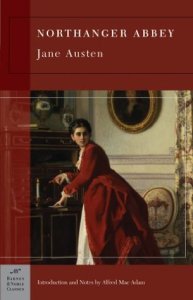 About the Book*:
Northanger Abbey is often referred to as Jane Austen’s Gothic parody. Decrepit castles, locked rooms, mysterious chests, cryptic notes, and tyrannical fathers give the story an uncanny air, but one with a decidedly satirical twist.
The story’s heroine is Catherine Morland, an innocent seventeen-year-old woman from a country parsonage. While spending a few weeks in Bath with a family friend, Catherine meets and falls in love with Henry Tilney, who invites her to visit his family estate, Northanger Abbey.
Once there, Catherine, a great reader of Gothic thrillers, lets the shadowy atmosphere of the old mansion fill her mind with terrible suspicions. What is the mystery surrounding the death of Henry’s mother? Is the family concealing a terrible secret within the elegant rooms of the Abbey? Can she trust Henry, or is he part of an evil conspiracy? Catherine finds dreadful portents in the most prosaic events, until Henry persuades her to see the peril in confusing life with art.
Schedule:
- August 1st: Begin reading.
- August 15th: Mid-point Check-In
- August 30th: Final Thoughts
Feel free to read at your own pace, post at your own pace (or not at all), and drop by to comment/chat about the book at any point. The schedule above is just the one I plan to use in order to keep myself organized and to provide some standard points and places for anyone who is reading along to get together and chat.
*Further description and analysis can be found at SparkNotes.
In the Path of Falling Objects by Andrew Smith
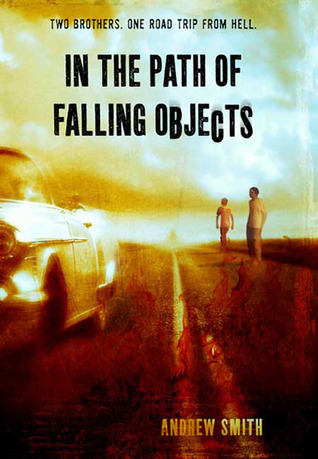
Plot/Story:
Sixteen-year-old Jonah and his fourteen-year-old brother Simon are abandoned by their mother, left in their house without food, running water, or electricity. Their eldest brother is serving in Vietnam, with plans to return home soon, but they haven’t heard from him in months. The brothers soon realize that they have little chance of surviving on their own; so, with ten dollars and some spare clothes, they leave their New Mexico home and head west towards Yuma, Arizona, where their father is incarcerated and soon to be released. Not too far into their journey, the horse they have been riding on dies, so they are forced to make the rest of the journey on foot. At least, that’s what they should have done. Instead, brash Simon, never one to heed his older brother’s warnings, hails down a passing car which is being driven by an unlikely and unsavory pair, a sociopathic man and a pregnant teenage girl. At first glance, the man and the beautiful young girl seem like a couple of unlikely heroes. The boys soon realize, though, that their would-be hero is not what he appears. He has buckets of cash littering the trunk of his car. There’s a stolen Don Quixote statue in the backseat. Oh, and he also has a gun. But he’s not the only one packing heat. The question is: who will use his gun first, and why?
Characterization:
There are some ups and downs with characterization and character development. Some of the characters are well-developed and complex, particularly Mitch, the sociopath, and Matt, the eldest brother. The small glimpses into Mitch’s darker persona are spaced well and provide tantalizing precursors to the larger melt-down, which readers will anticipate but not be disappointed by when it finally arrives. Witnessing the boys’ elder brother’s descent into madness, caused by the horrors he is exposed to in Vietnam, is also intriguing; it adds complexity and character to the story’s sub-plot. I found Jonah, Simon, and Lilly less interesting, though they were the characters that received the most page time. Jonah’s deep, almost paralyzing infatuation with the girl comes about so quickly and without much explanation, making it difficult to believe (aside from a “teenage hormone” perspective). Simon’s anger toward his older brother is also near-immediately apparent, but it is there with little explanation or cause (Jonah seems like a decent guy and hasn’t done anything, that we know of, to make Simon mad at him). There’s the underlying “sibling rivalry” theme which works, of course, but the level of animosity the brothers have toward each other, particularly Simon toward Jonah, doesn’t really fit a “that’s what brothers do” kind of equation. We learn, later in the story, that there has always been conflict but developing that sooner, rather than forcing it to be assumed, could have helped the overall narrative. Still, the brothers’ relationship is engaging, tense and passionate, and ultimately resolved.
Prose/Style:
The book is formatted as a third-person omniscient narration, but not really. It’s essentially from Jonah’s perspective, written after he has gained facts about events which he could not have witnessed in person, as well as narrating those events which he did witness first-hand. So, the feel of the narration is third-person omniscient because there is little question that everything written down has actually happened but, in actuality, the narration is limited. Because the portions of the novel pertaining to Matt, who is not physically present in the story, are written in epistolary form, Smith is able to get away with this somewhat; however, for the portions witnessed by Simon, Mitch or other characters, one does need to suspend analysis a bit and just let the story flow in order to enjoy it. Chapters are often headed with a character’s name, such as “Simon,” which helps the reader follow-along with who is saying what, when (although, ultimately, the entire story is Jonah’s map/journal). Aside from the somewhat strange structure, I definitely enjoyed the language and the prose – both of which were appropriate to the age level and well-suited to the setting of the story and its tone. The pace is deliciously suspenseful, building slowly but with an almost liquid fluidity, like a syrupy trail winding its way through the desert: sticky, sweet, rich, and satisfying.
Additional Elements: Setting, Symbols/Motifs, Resolution, etc.
One of the strangest things about the book is that it is difficult to completely like or completely hate any one of its characters (and this, incidentally, is one of the best things writers can do for their stories, in my opinion). There are complexities of personality – inner demons and better angels- associated with each of the characters, and it is up to the reader to practice compassion and understanding when dealing with them, particularly with the protagonist(s). Jonah, the narrator and main character, is not a typical hero. Mitch, the antagonist, is vile but also quite sad. Lilly is tragically desperate, seeking shelter wherever she can find it, with little concern for what it costs her. Simon is angry, tired of being treated like a child but not wholly prepared for the adult world he’s been thrust into, head-first. The book is about family and survival, it is about making difficult choices, sometimes between the lesser of two evils, and oftentimes it is about finding out how to recover after having made the wrong choices.
Excerpt:
I pictured the first time we saw the girl, breezing past us in that Lincoln, blond hair whirling around her, her glasses tipped down, her smile, the stroke of her fingers. The teasing.
Simon tumbled the meteorite around in the sweat of his hand. I wondered what it would be like to look down at the earth, to fall, to burn brilliantly in the air like the image of the girl who passed by, kicking back dust like cosmic ash, and could she see that, now; was she up there above us?
I wondered.
We closed our eyes.
The Vast Fields of Ordinary by Nick Burd
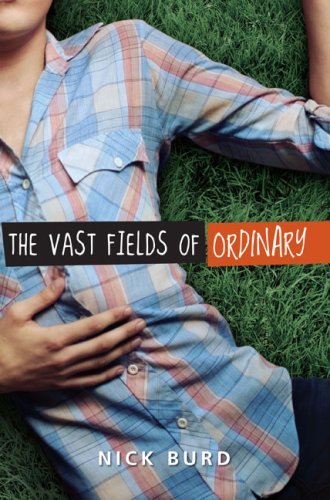
Plot/Story:
Dade Hamilton is an eighteen-year-old high school graduate. He is spending his summer working at Food World, avoiding his parents, making new friends, and keeping a secret he plans to take with him to college: he is gay. Dade becomes estranged from his “boyfriend,” Pablo, who is anything but a boyfriend, at least to Dade. Pablo is in the closet, too; but he also has a girlfriend, and he spends his time playing between the girl and Dade, never giving all of himself to either one, and never really knowing just what he wants. The confusion of which leads to terrible consequences. Although Dade’s last summer at home was supposed to be fun, it turns out to be a time of turmoil: his parents become estranged, his friends turn on him, and his job sucks. Until Alex Kincaid, the boy who dreams are made of, enters the picture. Suddenly, Dade’s summer turns around. He finds the courage to be who he is and, with the help of a friend, visiting from California, Dade heads to college a new man: positive, strong, and ready for life’s challenges.
Characterization:
Characterization and character development are strong points in Burd’s writing, at least in this particular story. His characters do not always do what I would hope or expect of them, but their unpredictability is believable and adds to their unique individualities. The Pablo character is particularly believable; his inner-conflict is painful, as is the outcome of his struggle. Dade’s parents are bizarre, but in the “we all know a family like that” kind of way. Their desire to come to terms with Dade’s sexuality is also realistic, in that it does not go perfectly well, but it is also not an “end of the world” scenario for their family, as is often the case in YA books that explore this theme. Perhaps the three most interesting characters, though, are the main trio: Dade, Alex, and Dade’s friend Lucy. While I was disappointed with Dade’s final decision (probably because I liked Alex’s character so much and could not see myself coming to the conclusion Dade does), I can still understand why Dade felt the need to make the decision he made and, in a way, it is laudable.
Prose/Style:
Aside from the proofreading errors (missing words, misspelled words, minor grammar oversights, etc) which are not necessarily the fault of the author, the overall prose and style of the story is right on par with the age and maturity level of the story, and with the intended audience. The language is smooth and engaging, supplementing the emotions of the story well and progressing the scenes without conflicting with or overpowering the story itself. The narrative voice is sound and appealing; it is easy to sink into the story and find yourself looking up only after pages and pages have passed by, without your knowing it.
Additional Elements: Setting, Symbols/Motifs, Resolution, etc.
This is a book quite simply about life and all its twists and turns. The story tackles family dynamics, infidelity, divorce, friendship (strains and strengths), coming-out and coming-of-age, first loves, sex, drugs, exploration, and substance abuse. The most important overarching theme, though, is finding one’s way, as a youth, through the mess and into one’s own. Dade is a relatively weak young man at the start of the story, a push-over. He submits to Pablo’s whims because the brief moments with Pablo make Dade feel wanted. He never questions his parents’ antics, though they are obviously unhappy and unhealthy. He lets his “friends” abuse him, making fun of him on a regular basis and exploding rumors about him, without confutation. Through meeting Lucy, a strong, self-aware lesbian girl, and Alex, Dade’s new love interest (one who allows Dade to explore real emotions, whereas Pablo only permitted the physical, when he felt like it), Dade comes into his own. He tells his parents the truth about himself and he stands up to them and to his friends. Dade leaves for college a changed person, confident and self-assured. He even makes the difficult choice of leaving behind what is most important to him, in order to put himself first, to take care of himself for the very first time. The Vast Fields of Ordinary is an endearing, realistic, and reassuring story about growing up without giving up; it is a story about learning how to respect others, without sacrificing one’s self.
Notable Quotes:
“It’s hard to show people everything, you know? You never know what they’ll do with it once they have it.”
Final Verdict: 3.25 out of 4.0
 Roof Beam Reader