Roof Beam Reader
Adam Burgess
Learning to Love Jane Austen
Please welcome Heather from The Bastard Title!
I didn’t want to take the Jane Austen class.
It was my sophomore year of college, and it was time to sign up for Jan term—a special, between-semesters intensive class that gave students a chance to do internships, or trips abroad, or study something outside of their majors. But that year I didn’t have an internship, and I sure as heck didn’t have a chance to do study abroad. I don’t even remember now what other classes were offered. All I know is, I didn’t want to take the Jane Austen class.
I mean, four weeks of tea parties and love letters? Yawn.
A few years earlier, I’d discovered that one of my best high-school friends was a huge Jane Austen fan. And I’d been surprised, because it didn’t seem to fit her at all. She liked anime and fantasy novels and all the weird stuff I liked. When she tried to get me to read Pride and Prejudice, I laughed. Wasn’t that all just romantic comedy girl stuff?
This is perfectly illustrative of one of the more damaging aspects of patriarchy and the male-dominated literary canon. I was a self-described feminist from the moment I learned the word, and a practicing feminist long before that. I wrote essays bemoaning gender inequality in first grade. Most of my favorite authors were and had always been women, and I attended a women’s college—for many reasons, but chief among them so that I could always feel free to stretch my intellectual muscle, without consciously or unconsciously molding myself to male pressures. And yet I thought Jane Austen was less worthy of study than male writers, because she was just writing about “girl stuff.” Tea parties. Romance. Clothes.
I’ll step off the soapbox now, but I think you know where I’m going with this. I was a complete idiot.
But I have to forgive myself. I was nineteen.
With all of that baggage, I don’t actually know how I ended up in the Austen class. But thankfully, someone convinced me to take it.
So for four weeks, I was immersed in Austen. We read five novels—skipping Northanger Abbey—and watched a number of film adaptations. And yes, we had tea parties. We decorated hats. We learned parlor games. We cajoled the professor into replaying the Colin-Firth-in-the-bathtub scene five times. But in between all that, I actually learned some stuff.
I think that what convinced me that Jane Austen was relevant to the 21st century was the adaptations. Particularly, the 1999 version of Mansfield Park, and Clueless. The 1999 Mansfield Park is smart and postmodern, it breaks the fourth wall, and it contextualizes a lot of uncomfortable realities relating to the slave trade that Austen never wrote about explicitly but which were a part of her world and thus a part of her worldview. And Clueless was…Clueless! It was one of my favorite movies, but I had no idea of its source. I loved that I was watching it for college credit, and even got really into analyzing it’s costuming as related to Regency fashion (there are more parallels than you might think).
It was these adaptations that taught me that Jane Austen is both of her time and timeless; that her work is ripe for re-imagining and remixing. That you can read beneath the surface of her comedies of manners to find deeper meaning but you can also enjoy them as escapism and fantasy, and yes, girl stuff. And that neither approach is the “right” one.
A part of me wishes that I’d borrowed my friend’s Pride & Prejudice in high school, but a larger part of me wishes that I had been taught it, alongside all the Shakespeare and Hemingway and Faulkner and Ellison. Perhaps I wouldn’t have internalized the idea that you have to be a male writer to have relevance. Perhaps I wouldn’t have minimized and denigrated so many of the things I secretly enjoyed. I know that I would have had a lot more fun.
Jane Austen in Pop Culture
Everyone, please welcome C.J. from ebookclassics!
Jane Austen in Pop Culture You Probably Missed
Nothing pleases me more than when I discover another place in pop culture where Jane Austen’s legacy has infiltrated, as I love seeing where literature intersects with movies, TV, music and other media. If you’re a Janeite and also enjoy how much pop culture adores Jane Austen, here are a few you things may have missed.
People Magazine
Revered as a celebrity for decades, even People magazine has never been able to ignore the magnetic pull of Jane Austen’s world. Back in 1995, Jane Austen made their list of 25 Most Intriguing People and as recently as this 2013, People saluted the 200th anniversary of Pride and Prejudice with much celebrity gushing over the author.
Marvel Comics
Between 2009 and 2011, Marvel released a comic series for Pride and Prejudice, Sense and Sensibility, and Emma. Written by Nancy Butler these beautiful comics are illustrated by either Janet Lee or penciled by Hugo Petrus or Sonny Liew. I want them all!
Pop Music
I couldn’t track down any modern-day music inspired by Jane Austen (if you know of any songs, please share them in the comments). But I did find this lovely song aptly titled “Jane Austen” by musician, Holly Christina, to share with you.
Saints Row
The open world concept video game is a humourous story about the Third Street Saints gang and life in the violent town of Stillwater, Michigan where the gang frequently confronts the law and rival gangs. In Saints Row IV, How the Saints Save Christmas and Saints Row: Gat out of Hell, Jane Austen is a character in the game. In particular, in Saints Row IV, she is the unseen and unnamed narrator of the story who isn’t revealed until the very end. I find this really fascinating.
Family Guy
In Season 13 of Family Guy, Stewie, Brian and Chris travel back in time to visit Jane Austen’s house and release “time-travel farts”. Fictional Jane Austen appears and is so delighted by this passing of gas, she is inspired to write Pride and Prejudice! Not sure how that works.
Funny Facts
A few funny stories I encountered in my research is that while working on the screenplay for Sense and Sensibility, Emma Thompson slept with Jane Austen’s letters next to her bed to remind her how funny the author had been. I also read that director Joe Wright convinced actress Judi Dench to play Lady Catherine du Bourgh in his version of Pride and Prejudice by writing a letter and saying “I love it when you play a bitch.” Indeed!
It’s that most wonderful time year. I hope everyone enjoys August in August!
What Matters in Jane Austen?


- Participants must post a comment telling me about their favorite Jane Austen book (or books) in the comments below, and include a good email address.
- Comments must be posted by 11:59 p.m. (US CST) on August 8 to be eligible;
- The winner will be announced on August 9 and must contact me with a good mailing address by August 12, or I’ll choose another winner;
- The winner must live in a country to which The Book Depository will ship. If you’re not sure, visit BookDepository.com and click “Free Delivery Worldwide” to see if your home country is listed.
Thoughts: Go Set a Watchman by Harper Lee
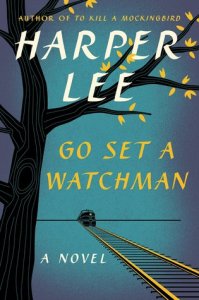
Go Set a Watchman by Harper Lee
Final Verdict: 3.75 out of 4.0
For a long time, Scout (Jean Louise) Finch of To Kill a Mockingbird reminded me of Huckleberry Finn. Just a kid from the American south, smart but crass, and willing to live by her own convictions. Interestingly, Go Set a Watchman has solidified this similarity for me. While reading, I repeatedly wondered: could Harper Lee be the love child of Mark Twain and Jane Austen? I know that sounds hilarious, especially considering how much Twain despised Austen’s work, but still. We have here a merging of regional American literature with a novel of assumed propriety and morality (Jean Louise, like many of Austen’s characters, often pokes fun at presumptions of ‘decorum’ or ‘class’). And Scout, like Huckleberry Finn, is often at a loss for what to do – questioning what is right and wrong, and wondering what is wrong with her when she feels that everyone else around her is mistaken about things like race. And, like Huck Finn, she’s willing to write-off her whole town for lost, striking out for New York City just as Huck lit out West.
I’ve heard and seen some say, “this book should never have been published.” Certainly, Go Set a Watchman is not without flaws, and those who loved To Kill a Mockingbird (and who adored Atticus Finch) are sure to be bothered by much of what happens here. But, ultimately, that doesn’t matter. This book shouldn’t be measured by how we felt about another book or about the same characters told from a different perspective (that of a child) at a different time (20 years earlier). While I can understand why the book is upsetting and how it basically pales in comparison to the original, I can’t agree that it shouldn’t have been published, and I don’t know what the point of that argument is, anyway. It has been published: Let’s deal with it.
So, where to start with this one? I would like to begin by saying that Go Set a Watchman is neither a prequel nor a sequel to To Kill a Mockingbird, despite what some blurbs and reviews would have us believe. It is the exact some book told from a different perspective and a different time. Even a number of the passages overlap, word for word. This is important. What is most important to note, I think, when deciding whether or not to read this, or what to think about it, is this: To Kill a Mockingbird was told though the eyes of a young Scout Finch, a tomboy who adored her father Atticus, and who could see only the best in him. On the other hand, Go Set a Watchman is the story of an adult awakening to her own individuality, claiming her own identity.
As the old adage goes, “we can’t go home again.” This is the lesson Jean Louise learns, with help from her eccentric Uncle Jack, who tells her that “it is always easy to look back and see what we were, yesterday, ten years ago. It is hard to see what we are. If you can master that trick, you’ll get along” (269). We readers, too, need to recognize that the Finch family, and Maycomb County, have changed in the twenty years of narrative time (or fifty of actual time) since we last saw them. The Civil Rights movement in America changed people, changed entire ways of life. Most of us would probably argue that this was good and necessary, but that still doesn’t mean the change was or has been easy, especially for those whose worlds were altered the most.
The first sections of the book tell of Jean’s visit home. There is some romance between herself and a man she’ll never marry. We meet Jean’s Aunt, again, and are treated to a host of delightful flashbacks from Scout’s childhood. This part of the book is like going home again, and it’s wonderful! But from the mid-point onward, we have a different story. Jean Louise is repeatedly struck by how different everyone seems, even her beloved Calpurnia. Her best friend is gone. Her brother is dead. There’s no one there to help her navigate the changing terrain.
Uncle Jack and Jean Louise spend the last section of the book discussing how Atticus had been Scout’s idol, her own self, really, for most of her life. Until now, the idea that she and her father would disagree on anything was completely foreign to her, unthinkable. But now Scout must “shake off a twenty-year-old habit and shake it off fast” (271). She has to be her own person, which means recognizing her own failures (that she is colorblind – not in the sense we might mean it now, but in the sense that she genuinely doesn’t see how people act, and are treated, differently, like it or not) as well as the failures of those most important to her, little Maycomb, Henry Clinton, and especially her father. There’s a painful break from childhood, and it’s going to be hard for those of us who were there with her, but that doesn’t mean the book is bad. It’s just hard. It’s a challenge.
I definitely think reading Go Set a Watchman is an exercise in suspending our egos. Which is ironic because Jean Louise has a similar task. For many of us, To Kill a Mockingbird was a special experience, and it holds a special place in the canon of American Literature. Atticus Finch is everything a good American should be: a stand-up guy who defends the less fortunate, who teaches his children to be who they are while also respecting others, who puts his own life and career on the line in his effort to ensure justice and a common good. What’s not to love about that? But, realistically, that was the young narrator’s perspective. That was the story told through memories of an adult looking back on her childhood from a nostalgic distance.
Go Set a Watchman is a worthwhile read for many reasons, one of which is for its intimate look at the many types of racism. It seems that every character in this book exposes their prejudices at some point, but each is also prejudiced, bigoted, in a particular way. Some of the characters simply hate black people. Others believe there’s some kind of natural, biological difference which elevates whites over blacks (and popular “science” of the time that explores this theme is referred to in the book). And still others seem reactionary: times are changing, and they respond with fear and resistance – there’s little real malice in this, just a personal anxiety of sorts.
The book is also interesting in how it addresses the Supreme Court’s integration decision, especially illustrations of how different people react to it; most of the southern characters disagreed with the decision, but some, like Scout, still found it necessary. There’s an intriguing look at the ideological differences between “States’ Rights” conservatives and “Federalist” liberals. Considering recent events, such as the newly-raised debates surrounding the Confederate Flag and “Southern Pride,” the release of this book is bizarrely serendipitous as it tackles the very same arguments going on right now. In reflection, it’s also incredibly scary (and disappointing) that these same conversations are still happening, half a century later.
One difficulty I have with this book, aside from my personal reactions to being disillusioned with the reality of Atticus (who, by the way, may be racist, but who is also still committed to justice and nonviolence) is the narrative construction. While Harper Lee’s prose style is still incredibly attractive, much of the book reads as compilations of scenes with fascinating and revelatory flashbacks, but which struggle to work together cohesively. It becomes very clear where, why, and how this book became To Kill a Mockingbird, but it also left me wondering what might have happened had that original classic developed into something twice the size, an epic spanning the length of time that is ultimately covered by the two works, and corrected accordingly. An interesting thought.
I can say that I think this is a fascinating, intellectually and emotionally challenging companion to To Kill a Mockingbird. Instead of looking to Atticus as the hero of this novel, we’re going to turn to Jean Louise and, despite her own racism, try to applaud her courage in standing up to her family, empathize with her growing pains, and hope the best for her. Will she stay in Maycomb, where she might be able to do the most good (as Uncle Jack so presciently notes: “the time your friends need you is when they’re wrong . . . they don’t need you when they’re right”). Or will she go back to New York, where she can see people of other races as simply people?
Ultimately, I don’t think Go Set a Watchman works well without To Kill a Mockingbird, which is problematic; still, for those who know the originally or who will eventually read it, this one adds so much depth and reality to the story of Maycomb and the Finches. Lee wades into difficult, muddy, maddening terrain; she does it well, and with her own characteristic flavor.
Thoughts: A Little Life by Hanya Yanagihara
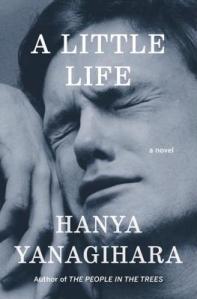
A Little Life by Hanya Yanagihara
This is the first formal review I’ve written for Roof Beam Reader in five months, when I reviewed Emily St. John Mandel’s Station Eleven in February. As with that book, I find, this time, that I’m unable to move onto other reading until my thoughts and reactions about this one are evacuated. It’s just one of those books. This post is bound to be lengthy, so I apologize in advance for that. But, as I set out to write my thoughts on this peculiar and devastating book, I find that I must clarify my position on two points that have significantly influenced my reaction to the novel.
Two Major Issues:
First: the book has been heralded as the long-awaited “great gay novel.” This description is not only maddeningly inaccurate, it is dangerously wrong. Despite appearances, this is not a novel about gay life, about homosexuality or coming out; it is not about sexuality or sexual identity at all. This is a book about friendship and love battling to save the life of someone who is haunted by memories of pedophilia and rape, sexual and physical abuse, psychosis, emotional trauma and sadism, and who cannot escape except through self-criticism and self-harm.
While any of these terrible things could be relevant to gay life, they are also relevant to straight life. The problem is: calling this book the “great gay novel” and then expecting readers to equate homosexuality, gay identity, with child sexual abuse and pedophilia as some kind of post hoc ergo propter hoc relationship is what gay rights activists have been fighting against for so very long. Jude St. Francis does not end up in a gay relationship because he was abused, as a child and an adult, by men. Jude St. Francis is not even gay: he is sexless; no, he is de-sexed.
The comparison that these reviewers make are perhaps unconscious, but they are all the more dangerous for that (worse: a part of me wonders if this push is due to cultural realities: it’s “time” for the great gay novel, so this must be it). I prefer the description given on the book’s own inside-flap: “An epic about love and friendship in the twenty-first century that goes into some of the darkest places fiction has ever traveled and yet somehow improbably breaks through into the light.” Yes, that’s it, for the most part. Let’s hope later editions remain true to this description and not the disturbingly misleading ones that outside forces have attempted to place on it.
That being said, in an academic sense, calling this book a “great queer novel” makes a lot of sense. The difficulty is helping people understand the difference between a “gay” novel and a “queer” one. The book is wildly anti-heteronormative. There are some straight people in the book, major and minor, but the majority of the main characters are somehow “othered,” as are their histories and relationships. For example, one character is adopted as an adult, another is parentless; one character is bisexual, another is gay but struggles with it; one character is disabled, another seems able to change his body almost at will.
Gender and sexuality in this book are uncomplicatedly fluid: transgender issues come up, for instance, as does lesbianism and the cis-gendered. In this way, yes, call it a great queer novel. Call it a study of male friendship that refuses to be categorized. But do not call it the great gay novel, as the relationship at the heart of the story has nothing to do with sexuality: the main character is basically asexual and his eventual lover is basically heterosexual even though he ends up with another biological male. Most importantly, their love, their partnership, has far less to do with sexual identity than it does with non-sexual romantic friendship.
This is all my reaction to others’ descriptions of the book, however. There’s nothing the author or publisher have said (that I know of) which reflects such a flawed perspective on the story, and the story itself doesn’t presume to present itself that way, either.
Second: My personal experience reading this book might be far different from most, and that is because I intimately understand and relate to it. Because of the nature of this book, of Jude St. Francis’s life, and Willem’s, I can’t say any more than this. Suffice it to say, it is a deep struggle for me to separate myself from this story in order to review it objectively as a work of art. But I’m going to do my best.
Thoughts on the Book:
Essentially, this is a book about friendship. The characters are the heart and soul of this novel, especially the main character, Jude, who, despite his tragic past, is the core of the four friends’ lives. They (Jude, Willem, JB, and Malcolm) met as college freshman, although Jude was only 16 at the time. Each of the characters is special in some way: Willem the actor; JB the artist; Malcolm the architect; Jude the lawyer. They all struggle, at first, but each will eventually reach wild levels of success. One can imagine that they were able to achieve their successes only because of their friendship, although this is never specifically granted by the novel itself.
Outside their friendship are other characters, major and minor, some of whom arrive and remain (Jude’s adoptive parents, for instance, and his doctor) and others that serve a purpose and then disappear. There are not many women in the story, which has been a point of contention for some, but Yanagihara has already explained her reasoning for this (it’s a story about male friendship and the many varied ways that friendship can manifest itself) and I take no issue with the lack.
An interesting and admirable element, in my opinion, is the narrative voice which is at times third-person with varied relativity to one or another of the characters depending on whose story is being told at the time, and sometimes, much less frequently, in the first-person, as when a character is relaying things directly (usually in a kind of monologue, which I imagined as dictation or epistolary in nature, but could just as well be a character speaking aloud to himself). This narrative approach allows for two things: first, the mysterious, slow, painful revelation of Jude’s backstory; we the reader know as much about Jude as the other characters do, and only bits and pieces (first, hints; then, allusions; next, minor descriptions; finally, all of it) come through, in guesses made by other characters or in sections when the narrator is closely aligned with Jude himself. This can be vexingly frustrating, but it is also brilliant in its devotion to an honest portrayal of the main character. Second, it allows the reader to get closer to Jude in the same way that the characters do, to understand how this dynamic works, fails, strains, etc.
Less interesting, less creative, is the prose style. It’s surprisingly matter of fact. I haven’t read Yanagihara before, so I’m not sure what her writing style is in general, but I will say that I think it works well, here. Even though the prose and language aren’t particularly appealing, the pages still turn. There’s a balance, here, equal to the balance between the plot and narration. The raw, almost clinical style of writing is like the raw, almost clinical way that Jude lives his life. In moments of tension, the prose style will change subtly. In moments of affection, breakthrough, break down: the same. The reader gets to know Jude, as much as is possible, and begins to realize that Jude must make great effort, 24 hours a day, 7 days a week, to be the person he is: he is always, always inside his own head. Every thought has some level of darkness and pain attached to it; every action is planned, agonized over, debated.
This has been one of the most intellectually and emotionally challenging reads for me. The complexity of the novel’s themes is matched by the intricacy of the narrative, the cerebral construction of story edifice and story time that allows the present and the past to unravel, slowly but significantly, so that, at a certain point about 400-pages into the book, I suddenly felt like I was just a part of this group. For me, it was like the flip of a switch.
At the half-way mark, I hated this book. I wanted to give it up. It is painful, horrifying, depressing, and almost gratuitous. It is without hope, without joy. It is, as many have said, a type of exaggerated fantastic allegory, where the evils laid upon man are as persistent, unrelenting, scarring as can possibly be, and the goodness of friendship and true love are as pure, unwavering, angelic as can possibly be. It is a fairy tale where the only happy ending for Prince Charming is the ending every fairy tale necessarily leaves out.
There’s very little that is pleasant about this book: it is not a beautiful story and it will not be a beautiful read. I can’t recommend this book. But I can’t deny its power, either.
Suggested Reading for:
- Age Level: Adult
- Interest: Friendship, Sturm und Drang, Child Abuse, Self-Harm, LGBTQI+, Disabilities, Nontraditional Families.
Notable Quotes/Passages:
- “The only trick of friendship, I think, is to find people who are better than you are—not smarter, not cooler, but kinder, and more generous, and more forgiving—and then to appreciate them for what they can teach you, and to try to listen to them when they tell you something about yourself, no matter how bad—or good—it might be, and to trust them, which is the hardest thing of all. But the best, as well.” (210)
- “It is always easier to believe what you already think than to try to change your mind.” (369)
- “He had forgotten that to solve someone is to want to repair them: to diagnose a problem and then not try to fix that problem seemed not only neglectful but immoral.” (517)
- “You don’t visit the lost, you visit the people who search for the lost.” (656)
 Roof Beam Reader