Roof Beam Reader
Adam Burgess
Tiny Thoughts on a Bunch of Books
 The last book review I posted was for Emily St. John Mandel’s Station Eleven, way back in February. Since then, I’ve read “a few” books, but haven’t had time to get my thoughts down about any of them.
This post is going to serve as a very brief, rather frantic “catch-up.” I want to at least write down reactions to the other books I’ve read so far. No, these aren’t formal reviews – but something is better than nothing!
So, in order of completion from most distant to most recent:
Half Bad by Sally Green: This is the first book in a planned YA fantasy trilogy by new author Sally Green. I think the premise is interesting and the execution rather good. There is quite a bit in this book which is derivative, owing a lot to other popular YA fantasy series’ on the market; however, that being said, I really enjoyed the story and a lot of what is unique about it. Green builds quite a bit of believable tension into the story, issues between the main character/protagonist and his best friend, his girlfriend, his father, his family etc. I think this is a series worth reading and fans of YA fantasy are likely to enjoy it.
 Warlock by Jim Starlin: Adam Warlock is one of my favorite comic book characters and I’m glad to have finally read the complete story in graphic novel form. Some of the more interesting stories (like the Infinity plots) are not present because they are exterior to the original Warlock storyline, but this graphic collection was still fun, dark, and interesting.
Half Wild by Sally Green: This is the second book in Green’s fantasy trilogy and an interesting and improved follow-up to the first in the series. Main characters from the first book reappear and some new ones are introduced. A lot of the tension between the main character and minor ones continues to deepen, and Green takes some very welcome and exciting risks. I’m looking forward to the next book in the series (which, from what I’ve read, will be the conclusion to the trilogy – but you never know with fantasy series’!)
The Alex Crow by Andrew Smith: I’m a huge fan of Andrew Smith, and The Alex Crow did not disappoint. This is Smith’s most complex and adult novel to date. It’s not hard to understand the comparisons to Kurt Vonnegut. There have been some criticisms about unnecessary storylines or sub-plots, but I think those critiques are missing the point. The story’s sub-plots work together toward a final conclusion, without one or the other of these storylines, the overall message would not be as profound as it is. Unfortunately, that message seems to be lost on some readers. Still, this book, after Grasshopper Jungle, is resulting in a great deal of critical attention and acclaim for Smith, praise which I think is completely valid.
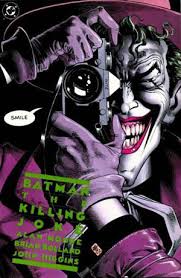 Batman: The Killing Joke by Alan Moore: I read this because of Twitter hoopla surrounding gender representations in comic books and the new covers for some classic comics. I’ve never been a big fan of Batman comics (I’ve enjoyed the movies more – and I’m really a Marvel fan, so I haven’t given as much attention to DC stories) but this was a really interesting take on the Joker’s possible backstory. I know there’s a debate as to whether or not the backstory is necessary or helpful – some fans like that the Joker is just innately evil, while others appreciated the fact that perhaps some event triggered that descent into madness. I can understand both points of view – for what it is, I enjoyed this story.
Ms. Marvel, Vol. 1 by Willow G. Wilson: I think this is an incredibly powerful and long-overdue take on female power in comics. The new Ms. Marvel is young and fierce, filled with good intentions but also prone to mistakes. Volume 1 introduces us to her character, her friends, and her family, all of which adds great complexity and detail to her personality and the possibilities/pitfalls that might be ahead of her. Super cool.
 A Game of Thrones by George R.R. Martin: I’m so glad I finally read this book, and I’m eager to get on with the series. While I don’t think that Martin is quite the writer or world-builder as, say, Tolkien, his take on fantasy is still refreshing and unique. As Martin has explained, his goal was to place fantasy elements in a realistic medieval environment, and in that I think he is succeeding. The story is dark, dangerous, and rarely redeeming or uplifting, but the times (from a historical perspective) were equally difficult. As a fan of the television show (until this season, where I’m finding much to complain about) I think it’s incredible how closely the show was adapted from the book – but those who have only watched the show are missing some important things, even simple things like the characters’ ages make a big difference in understanding and appreciating what’s happening.
Saga, Vol. 1 by Brian K. Vaughan: I finally took the plunge and started this series. Everybody talks about it, and now I know why. I don’t think I’ve enjoyed a comic so much since Blankets (which, admittedly, is completely different and not actually a comic – it’s a long graphic novel). Anyway, Saga is narrated from the future by the protagonist who is, in the first comics, just a newborn baby. We learn about her parents and their worlds & the war they’re engaged in. The comic is rated “M” for good reason – I wasn’t expecting some of the graphic sexual situations and violence, but the great thing is that it’s not at all gratuitous, it’s just a part of the world. I’ve got Volume 2 sitting on my shelf waiting to be read, and I haven’t been so anxious to get to a read, especially a comic, in a very long time! Loving it!
Also read but not reviewed:
 The Blood of Olympus by Rick Riordan (4 out of 5, Read May 2014)
Bertram Cope’s Year by Henry Blake Fuller (5 out of 5, Read June 2014)
Where Things Come Back by John Corey Whaley (3 out of 5, Read June 2014)
Gathering Blue by Lois Lowry (4 out of 5, Read June 2014)
The Dog Star by Donald Windham (3 out of 5, Read June 2014)
Messenger by Lois Lowry (4 out of 5, Read June 2014)
The Madness of Lady Bright by Lanford Wilson (4 out of 5, Read July 2014)
Son by Lois Lowry (3 out of 5, Read July 2014)
 The Boys in the Band by Mart Crowley (3 out of 5, Read July 2014)
Totempole by Sanford Friedman (5 out of 5, Read July 2014)
The Front Runner by Patricia Nell Warren (4 out of 5, Read July 2014)
The Normal Heart by Larry Kramer (5 out of 5, Read July 2014)
Lemon Sky by Lanford Wilson (4 out of 5, Read July 2014)
Invisible Life by E. Lynn Harris (2 out of 5, Read July 2014)
Letters to Montgomery Clift by Noel Alumit (5 out of 5, Read July 2014)
Sons of the Prophet by Stephen Karam (3 out of 5, Read August 2014)
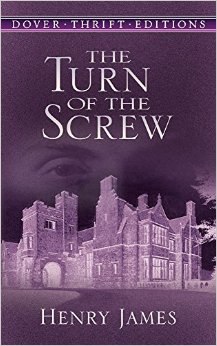 The Turn of the Screw by Henry James (4 out of 5, Read December 2014)
Let Us Now Praise Famous Men by James Agee (3 out of 5, Read December 2014)
Halfway Home by Paul Monette (4 out of 5, Read December 2014)
Revival by Stephen King (4 out of 5, Read December 2014)
Red Caps: New Fairy Tales for Out of the Ordinary Readers by Steve Berman (3 out of 5, Read January 2015)
Thoughts: The Moviegoer (1961) by Walker Percy

The Moviegoer (1961) by Walker Percy
Final Verdict: 3.5 out of 4.0
Nowadays when a person lives somewhere, in a neighborhood, the place is not certified for him. More than likely he will live there sadly and the emptiness which is inside him will expand until it evacuates the entire neighborhood. But if he sees a movie which shows his very neighborhood, it becomes possible for him to live, for a time at least, as a person who is Somewhere and not Anywhere.
Walker Percy’s The Moviegoer is loved by many with the same passion and intensity as books like The Catcher in the Rye are loved by others. And many readers find this one just as difficult to enjoy as The Catcher in the Rye, too. It is unlikely that one will get through a graduate program in American Literature without hearing this book mentioned at least a few (dozen) times. Yet, here I am, after four years of undergraduate study in English/American literature and another 5 years of graduate study in English/American literature, and I have just now read it.
The book won the National Book Award and was named one of Time magazine’s 100 Best English-language novels. At the same time, it’s a darkly didactic, existential novel. Walker Percy was an enormous fan of Søren Kierkegaard, and that influence is recognizable in this work (although much more so in Percy’s later writing). Still, the heaviness is balanced, here, with a poetic narrative structure that gives some lightness to the rather despondent tone.
The Moviegoer is set in New Orleans not long after the Korean War. It tells the story of Binx Bolling, a stock-broker just about to turn 30 years old. Bolling is basically isolated from the world, though he holds a job and interacts with family and friends. Still, there is a willing distance brought on by family problems and his traumatic experiences in the war, but also by the general decline of southern tradition which is the underlying theme for the entire work.
To cope with his depression and anxiety, Bolling has taken to constant daydreaming. He enjoys routine and repetition, these are safe, and he finds meaning and comfort in movies and books rather than the real world, which is why he cannot manage to maintain any healthy or lasting relationships (even his most loving, meaningful relationship is rather disturbing).
At Mardi Gras, Bolling decides to break his routine and set out on a journey in search of his true self. This quest takes him on a rather directionless and ultimately pointless meandering around New Orleans’ French Quarter, down around the Gulf Coast, up to Chicago and back again. Although he interacts with people he meets along the way and has some insightful and poignant moments, these experiences essentially amount to little of substance. Bolling is making an effort, mostly unconscious, to maintain a vague existence. He wants to be open to life’s possibilities, or so he says, but he is basically unhappy, unsettled, and unfulfilled.
Still, though Binx is an oddball–mentally unstable, emotionally stunted, and intellectually uninspiring–he yet has a bizarre and unsettling charm, an eccentric and darkly humorous personality that is simultaneously off-putting and somehow familiar. His flaws, that he is homophobic, sexist, and racist, are not glossed; and yet, the honest depiction of this disturbed southern “gentleman” almost, almost, adds to the charm of his character.
In another place, at another time, it would be quite easy to fall head-over-heels in love with Binx and his story, for his disillusion and his complete willingness to admit that there’s just not a lot in the real world that is worth living for. We could fall for him as simply as teenage boys have, for decades, fallen for Holden Caufield’s antagonistic, self-indulgent cynicism. But, for me, I think that time has mostly passed – and for that, I am grateful.
What is the nature of the search? Really it is very simple; at least for a fellow like me. So simple that it is easily overlooked. The search is what anyone would undertake if he were not sunk in the everydayness of his own life.
Suggested Reading For:
Age Level: 21+
Interest: Southern Literature, New Orleans, American Existentialism, PTSD, Depression.
Thoughts: Station Eleven by Emily St. John Mandel
Station Eleven by Emily St. John Mandel
Final Verdict: 3.75 out of 4.0
Station Eleven begins, ironically and appropriately, in a theater with a staging of William Shakespeare’s King Lear. Three of the novel’s recurring characters are first encountered in this opening scene, a moment in time that will be revisited throughout the novel. As the pages unfold, and the Traveling Symphony makes its way through a dangerous Midwestern landscape, ancient literature—from the Bible to Shakespeare—will become central in rebuilding culture and society in a drastically altered world .
Arthur Leander, Jeevan Chaudhary, and Kirsten Raymonde: three strange and special lives destined to intersect as one world ends and another begins. Over the course of decades, in the old, pre-plague world and the new world of survivors, the lives of these few characters, as well as the dark prophet child who grows up to be more sociopath than saint, begin to reflect the power, the beauty, the fear, the ability, the evils, and the resilience of the human spirit.
Although this story cannot exist without its characters, I found many of them rather superficial throughout most of the book. This may be because the reader’s attention is drawn between the development of the characters and the effects of the apocalyptic tragedy; it may also be a result of the number of characters; it could be because of the multiple perspectives or the dance with time and numerous settings. Suffice to say, it’s a complex world and this often results in a certain distance between reader and characters. That being said, as the story unfolds and the many characters’ backgrounds begin to come together and to interact more closely, and more clearly, the dual worlds (before and after) and major conflicts (good and evil) begin to envelop the characters, resulting in a page-turning climax that makes any earlier lack seem basically innocuous.
One of the best things Station Eleven has going for it is its style and language. This is a distinctly literary work, more reminiscent of Orwell’s 1984 and Atwood’s The Handmaid’s Tale than the majority of contemporary dystopian fiction. The prose style and complexity are, quite frankly, a welcome breath of fresh air in a rather over-saturated and underwhelming genre.
So, do you want to be scared out of your mind in a paradoxically beautiful way? Okay, then: read Station Eleven. The balance of realistic and futuristic themes, art and politics, society and wilderness, all work together in bizarre and unexpected ways. St. John Mandel’s talents are expressed in the crafting of each of these individual elements, but most of all in her construction of a symphony that effectively highlights each of her strengths without allowing one or the other to overshadow or outperform the rest. Those expecting a traditional post-apocalyptic novel may be disappointed, but those open to experiencing the dystopian genre in a somewhat softer, more realistic, and character-centered (rather than event-centered) way will be pleasantly surprised.
The fluidity of time, the focus on how individuals cope with the change and how larger society functions, how history begins to be rewritten following a worldwide calamity, are elements which coalesce to form a fresh, unique, and disturbingly thought-provoking new work in an age-old and often derivative genre.
Suggested Reading For:
Age Level: YA+ (skewed toward adult)
Interest: Dystopia, Apocalyptic, Post-Apocalyptic, Literary.
Notable Quotes:
“Dear friends, I find myself immeasurably weary and I have gone to rest in the forest.”
“First we only want to be seen, but once we’re seen, that’s not enough anymore. After that, we want to be remembered.”
“No one ever thinks they’re awful, even people who really actually are. It’s some sort of survival mechanism.”
“She had never entirely let go of the notion that if she reached far enough with her thoughts she might find someone waiting, that if two people were to cast their thoughts outward at the same moment they might somehow meet in the middle.”
“If your soul left this earth I would follow and find you.”
Thoughts: Trifles (1916) by Susan Glaspell
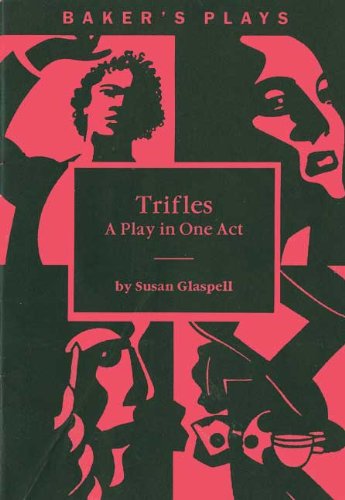 Susan Glaspell’s Trifles (1916) is a one-act play that would ultimately inspire another of her works, a short story called “A Jury of Her Peers.” The story is loosely based on an actual event, the murder of John Hossack, which Glaspell reported on while working as a journalist in Des Moines, Iowa. Hossack’s wife was accused of killing her husband, but the wife denied it. Although she was convicted, that conviction was eventually appealed and overturned.
Glaspell is an essential early feminist writer, one who was directly influenced by the likes of Kate Chopin and Fanny Fern; alas, she is often overlooked in feminist literary studies. For those unfamiliar with Glaspell, this short one-act play (my copy was only 26 pages) is a great place to start. The play is funny but poignant. It is a brief, direct example of Glaspell’s primary concerns – the inequalities between women and men, and the culture’s preoccupation with gender roles (stereotypes). It is ultimately a harsh exposé on the patriarchy’s oppressive control over women’s lives.
As its title suggests, the “trifles” of this play are “women concerns,” which men look at as relatively nothing in comparison to “real” (that is male) problems. Glaspell’s approach, however, which sets-up two distinct narrative points of view, one female and one male, creates an interesting and often comic tension between the main characters – the men and their wives. The house which serves as the play’s setting functions as both a crime scene but also as a home, and the characters, depending on their sex and their “purpose” or “role,” will view the house as one or the other of these things (the men treat it as merely a crime scene, the women cannot detach the house from its function as the home of their friend and neighbor who has been accused of murder).
 What is most interesting about this play is how much of a wallop it really packs. It is deceptively simple, not just because it is short, but the language, scenery, dialogue, stage direction – everything about the play is designed to be easy. Everything, that is, except for its subject matter. A reader (or audience member) could easily lose herself in the comedy of the situation, in the banter between husbands and wives, or in the knowing looks passed between the ladies, but the reality of the play, the feminist charges being raised and the dark, despondent yet somehow liberating mood created by the plight of the play’s absent Mrs. Wright (pun intended?) creates a rich paradox impossible to ignore.
The final moral crisis, which the women must face together and alone, reveals much about the meaning of justice and the role of women in seeking or fulfilling that justice. Although it is the men who “own” the law (quite literally, as the two male characters represent the police force and the county law offices), it is the women who will determine Mrs. Wright’s fate.
Notable Quotes:
“I didn’t know as what his wife wanted made much difference to John.”
“Women are used to worrying over trifles.”
“She used to wear pretty clothes and be lively, when she was Minnie Foster, one of the town girls singing in the choir. But that–oh, that was thirty years ago.”
“I know how things can be–for women. I tell you, it’s queer . . . we live close together and we live far apart. We all go through the same things–it’s all just a different kind of the same thing.”
Special Interview with Author E.J. Runyon!
 Hello, Readers!
Today I have a special treat for everyone. In 2013, I received for review a book called Claiming One. It is a short story collection by then newly-published author, E.J. Runyon. I enjoyed that collection so much, in fact it was one of my favorite reads of the year.
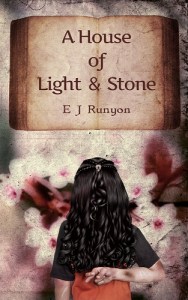
Well, I’m thrilled to say that E.J. Runyon is back, this time with her first novel! The early reviews for A House of Light and Stone are outstanding. I was so excited about the prospect of a new book from E.J. Runyon that I reached out to the publisher to see if there was any way that I could be involved. To my delight, they (and E.J. herself) responded in the positive – so I am able to bring you today this special Q & A with Ms. Runyon!
I hope you enjoy the interview, and I hope you’ll enjoy the works of this talented author as much as I have!
===============================
Thanks for having me here, Adam. It’s lovely to have the support of someone I like following.
E.J., tell us about your new novel?
This one is a Literary Fiction effort; I hope it continues to go over well. It’s set in 1967, East L. A. and follows Duffy and her family. True lives, the hard truths, shown in a mixture of small, daily cheer and that one step forward, one step back dynamic. It’s about the strangeness of being genuine to ourselves. Both Duffy and her mother fall in love with females. For Duffy it’s a calm, new part of her growing-up. For her mother, Rennie, love takes a different shape. And though all this year, they both progress into a new understanding of self and place in the world they’re confronted with.
How does it feel to have a debut novel under your belt?
Oh, I think I’m dealing well with it. (chuckle) I spent a long time with the idea that the slow and patient application of ‘you’ve got to make this better’ may have given me something I can honesty say shines. A few places touched me deeply, and I wrote it. It’s gotten reviews that echo that, too. And that helps the strangeness of being a published author of something larger than short stories. You know I try for depth and poetry in what I write. So for my ‘first’ I think I earned the way I feel reading reviews. Strange, but still—joy.
Anything you’re very proud about with this work?
One reader’s said that they ‘… feel this book is a great example of literary fiction, using the term in the most flattering possible way’ That makes me proud, very proud. And one reviewer wrote up a very nice online review that just detailed exactly what I had tried for the book to be to readers. So seeing it all laid out in a considered and eloquent review was so proud-making, I was smiling for most of that week, walking around with that, “They like it!”, grin on your face.
Why’d you decide not to go genre, like so many writers these days?
I think there’s the need for this type of Literary Fiction works as well as genre works in today’s markets. I feel it’s a valid goal now, for authors to write as we see the world, and not only for what some powers that be tell us the market will sell. You can see that in the rise of the Indy publishing marvel. More writers are willing to write exactly what they feel is worthy of their talents. And for me that’s Literary Fiction.
What’s up next?
I want to continue being an author who ‘goes there’ in my work. An interview recently in The Rumpus, with Wendy C Ortiz, put it as, “discussing subjects we have long discarded as unspeakable.” That what’s next: more of the unspeakable that lies in the hearts and souls of all my other characters.
===============================
More About the Book:
Giving a voice to the silent. A House of Light and Stone is the first full-length novel from writer E. J. Runyon, which follows the daily struggles of an abused young girl as she takes her first tentative steps into growing up. Secrets and lies abound in the backstreets of late-sixties Los Angeles, and coming of age here is no mean feat. For Duffy, whose talent and creativity far exceed her years, growing up is about making immutable choices and learning one simple lesson: that understanding oneself is absolutely everything. In charting Duffy’s quest, Runyon illuminates the dark corners, shedding credible light on a subject that could easily slip into the realms of melodrama. The result is something believable and profound; a true testament to the strength of the human spirit.
No light read. Powerful, dark and uplifting… Three words that capture the essence of Runyon’s deeply moving
More About the Author:
 E.J. Runyon lives in the US Southwest. Since 2002 she’s found herself moving on to smaller and smaller desert towns, while working to become the author and writing coach she planned to be. First, she quit working in software and sold her home to finance her degree in Creative Writing and her Grad-work in Online Teaching and Learning. She’s never looked back since. Now, her life revolves around her own writing and Bridge to Story – an online creativity coaching business that she runs– and you know, being a better person day to day. E.J.’s passion is focused on writing fine prose and on getting folks writing, her aim is coaching them in writing well. She participates yearly in National Novel Writing Month – an event she’s been involved in since 2001. Her first collection of short stories, Claiming One was published by Inspired Quill in 2012, which was followed in 2013 by Tell Me How to Write a Story, a guide for writers new and old alike.
Website: www.bridgetostory.com
Blog: http://www.ej-runyon.com/
Twitter: @EJRunyon
===============================
 Roof Beam Reader