Roof Beam Reader
Adam Burgess
Giveaway: Jane Austen Etsy Swag! (#AustenInAugustRBR)
Hello, Austen in August Pals!
This is just a quick note to let you know that an Austen In August “Etsy Giveaway” is being hosted for us by Shannon of River City Reading.
Head on over there to see what awesome things she has up for grabs – and good luck!
Giveaway is open only to registered participants of our Austen in August event.
Jane Austen: Fact and Fiction (#AustenInAugustRBR)

Hello, Austenites!
Today’s guest post comes from Sally Smith O’Rourke, author of The Man Who Loved Jane Austen and Yours Affectionately, Jane Austen.
Please give her a warm welcome, and be sure to read through to the end for a lovely surprise!
Jane Austen: Fact and Fiction
 By Sally Smith O’Rourke
Many years ago (I won’t divulge just how many) I decided to re-read Jane Austen’s six published novels, consecutively, something I’d never done before and discovered that all her heroines are intelligent, strong and independent minded women. She also created heroes who loved the women for their intelligence and strength, not in spite of them. I realized, too, perhaps later than some, that Jane Austen was a feminist. Unlike Mary Wollstonecraft’s condemnation of society’s treatment of women, Jane Austen wrapped her feminism in a cloak of propriety. The women lived productive lives in the society into which they had been born but on their own terms.
Rather than becoming infatuated with any single character in Austen’s books I found that I wanted to know more about her. What made a woman born in the 18th century have such a modern take on society? After devouring three biographies and many other books about and related to Jane Austen I realized that education was the key, as Wollstonecraft declared. At a time when most families considered females a basic commodity, chattel, something to be bartered or sold outright in exchange for land, money, position or all of the above; the Austens were different.

Not only educationally but how Cassandra and George Austen reared all their children was also a crucial aspect of Jane’s success. While Jane learned the domestic arts (she was known to have done beautiful handwork) she was also educated along-side her brothers up until university. The Reverend George Austen did so in a time when most females were lucky to be taught to read and write and those who did learn were generally in the upper classes. All the children had access to the Reverend’s sizable library which ultimately led to Jane’s heightened interest in history and politics. In fact, Jane was crushed when the entire library was sold off before the move to Bath when her father retired.
But book learning was a relatively small part of the education I address here. It seems evident to me that the Reverend and Mrs. Austen created an environment of open-mindedness and respect for everyone, male or female. While they stopped short of complete equality, the girls were very evidently allowed to express their own opinions, as Jane’s History of England shows, no subject was off-limits.
And while George Austen did not live to see his daughter’s success, he tried to get First Impressions (Pride and Prejudice) published in 1797. He obviously thought the book strong enough to present to a publisher although it was rejected.
I believe this open-minded and accepting atmosphere in which the Austen children were reared made it possible for Jane to accomplish all she did. The other women in the family, her mother, sister and family friend (later sister-in-law) Martha took care of the domestic chores of the household so Jane would have the time and privacy to write to her heart’s content.
 It was in that same open-mindedness and taking the lead from their father that her brothers were active participants in Jane’s success. Edward made sure she had the time, place and where-with-all to write as paper and ink were quite costly. He also made available Chawton Cottage on his Hampshire estate where the ladies lived and Jane wrote, revised and completed all her books. Henry arranged the publication and handled the contracts for all of her novels. Frank, ever the champion of his favorite sister as well as James and Charles encouraged her. Her brothers accepted her as an intelligent, strong and independent individual so put no pressure on her to marry. Her brothers were excessively proud of her.
Jane had wanted a bit of anonymity but all of her brothers seemed to enjoy telling people who their sister was a great talent. There is a story in the family that Edward and Henry met a man who was celebrated for his literary attainments and commented that Pride and Prejudice was the cleverest book he had ever read and would very much like to meet the author for the book was far too clever to have actually been written by a woman (Sense & Sensibility was published with the author listed simply as ‘A Lady’ and P&P was by the author of S&S). Since Edward and Henry were telling the story we can assume that they set the man to rights and no doubt with much pride.
I made every effort to create a character who captures the true spirit of the beloved author. To me she is very real and I am happy to say that many readers have said that in reading Yours Affectionately, Jane Austen they feel as though they are sitting and having tea with her so perhaps I succeeded.
About the Author:
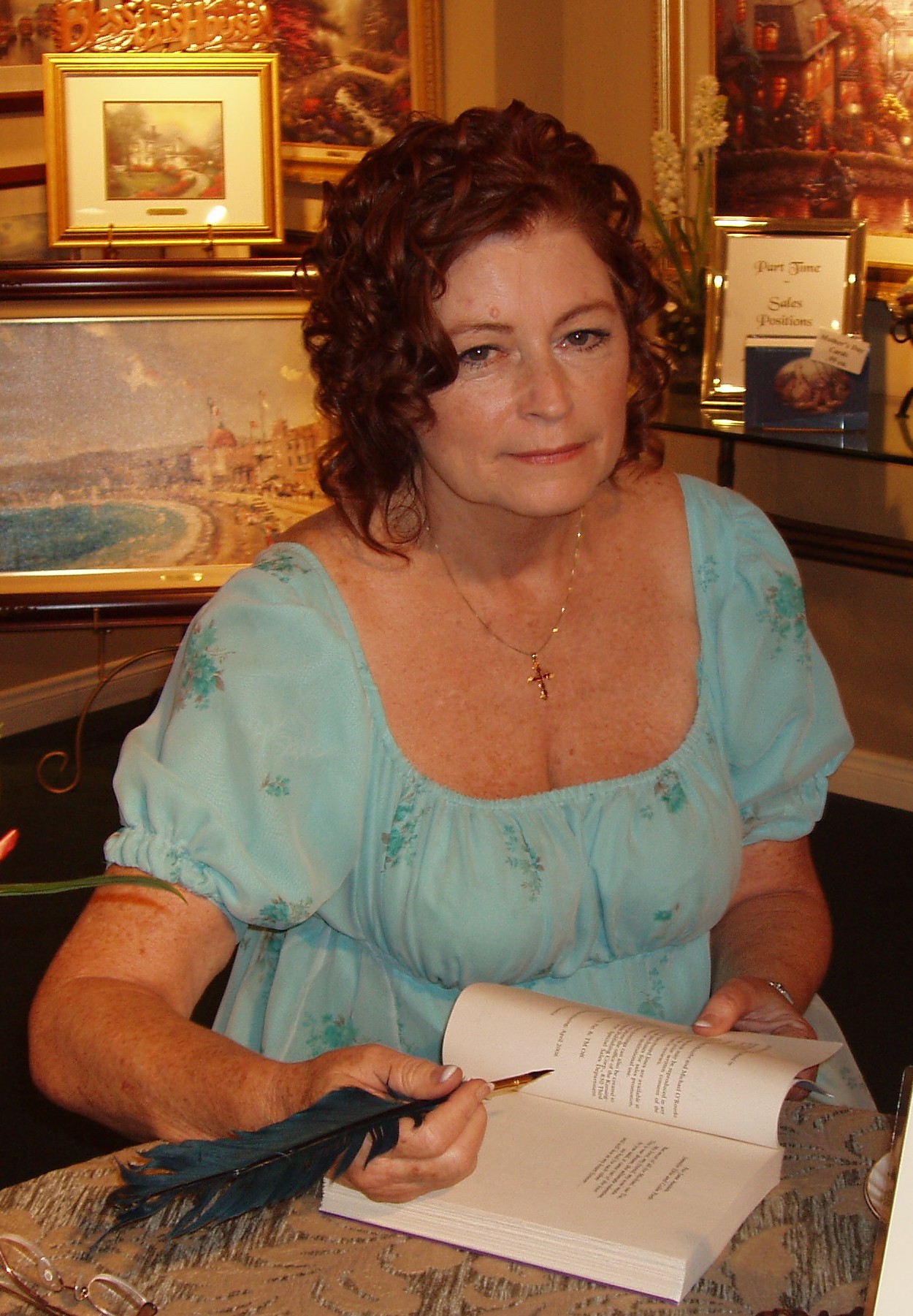 “Where shall I begin? Which of all my important nothings shall I tell you first?” (J.A. June 15, 1808)
That I reside in a small Victorian village in southern California; a mere two miles from my place of employment, a local hospital where I spend most daylight hours as a scrub nurse in the operating room.
That I am a native Californian, having been born in Glendale, and that I have spent most of my life here with a relatively short span of years in Reno, Nevada where I attended school. Returning after graduation I have remain in sunny SoCal.
That I was widowed some time ago. That I have the very domestic hobbies of sewing, cooking, baking, candy making and cake decorating. Oh, I write, too. Spending time with my nieces and nephews (great nieces and nephews as well), step-children and my grandchildren keeps a smile on my face.
That Mike, my late husband and teacher, taught me that writing has to be treated like a job so every day no matter how tired I am I edit, research and/or write one or more projects.
That Yours Affectionately, Jane Austen is my first solo effort (my other three having been collaborations with Mike) and I am happy to say is being received with some acclaim and enjoyment by readers.
That my next project might be a story of reincarnation in Pasadena, CA or a haunted house in San Francisco then again it may be a fairy story in Pebble Beach, CA and of course the possibility of a follow up to Yours Affectionately, Jane Austen is ever present.
That many stories are running around in my head and often colliding but I untangle them, pick up the debris and continue on.
And so you have a few of my nothings.
Giveaway:
 There will be three winners!
1 copy of Yours Affectionately, Jane Austen (USA = Print or E-Book; International = E-Book Only).
1 copy of The Man Who Loved Jane Austen (USA = Print or E-Book; International = E-Book Only).
1 audiobook copy of Yours Affectionately, Jane Austen (mp3 file).
To be entered for a chance to win, you must be a registered participant of Austen In August. Simply engage with this post and author in the comment section and be sure to include which book you are interested, and in which format! Giveaway will close on 8/17. Also be sure to leave an email address {adam (at) gmail (dot) com} where you can be reached. Good luck!
Fitzwilliam Darcy, Such As I Was! (#AustenInAugustRBR)
Hello, Austenites!
Please welcome Carol Cromlin, author of Fitzwilliam Darcy, Such as I Was!
Staying True to the Original Work
![Calling_Card[1]-A](https://roofbeamreader.com/wp-content/uploads/2013/08/calling_card1-a.jpg)
Jane Austen fan fiction falls into two categories. Some prequels and sequels follow the premise of the original work, while others veer off into uncharted waters (think vampires, modern day adaptations, &c.).
For the prequel or sequel author who chooses to stay true to the original story, it is at once a help and a hindrance that many elements of your story are predetermined. Clearly, you have a head start because the main characters and their personality traits are known; their relationships with each other defined and the world in which they exist established. The challenge is in setting a course for your story that does not contradict any of the established “facts.”
.
 When I was writing my Pride & Prejudice prequel, Fitzwilliam Darcy such I was, a significant challenge arose as I tried to imagine how Mr. Darcy and Mr. Bingley came to be such good friends. This back story was of no importance in the original work, so Jane Austen never explained it. What she did tell us is that Mr. Bingley was 22 – or two and twenty, for he “had not been of age two years when he [let] Netherfield House.” We also know Mr. Darcy was eight and twenty when Elizabeth’s censure began to make him see the deficiencies of his character. This was a significant difference in age. Distance was an issue as well. One gentleman was from Derbyshire; the other from “the north of England.”
What circumstance could possibly account for so strong a friendship developing between two men who, on its face, shared no similarities and seemingly would have had no occasion of ever crossing each other’s path? I finally settled on what seemed to me a logical and plausible explanation, based on Austen’s facts.
Another challenge lies in staying on course when your story begins to take on a life of its own. For me, the timing of the death of Mr. Darcy senior proved a complicated issue. In Pride and Prejudice, Darcy, in his letter to Elizabeth, says his father had died, “about five years ago.” Thank goodness for me he added the qualifier, “about” because meshing the loss of his father with other events that would certainly have been occurring in the life of a Georgian gentleman, aged three and twenty, was a very sticky wicket. In order to present the story line I envisioned, I needed to stretch the “about” as far as reason would allow; I placed the loss of his father 4½ years prior to the writing of his letter to Elizabeth.
Staying true to the original work requires an author to constantly validate his or her story line but this test makes you a better writer and in the end you prevail because you are determined to pay homage to an Author you greatly admire.
About the Author:
 Carol Cromlin has a great appreciation for history, tradition and all things British, and is someone who has always needed to know how and why; researching and writing this book drew naturally on those traits. Cromlin graduated from Hofstra University and has a graduate degree from Fordham University. She lives in the United States with her husband, son and dogs. You can visit Carol’s website to learn more about her and her books.
.
About the Book:
Fitzwilliam Darcy is arguably the best known, most charismatic hero Jane Austen ever created but he is also the most unfathomable. Who exactly was Mr. Darcy? What principles guided him? What desires drove him? How did he come to be the character Austen, so vividly, portrayed?
Carol Cromlin offers a window into the private life of this young, landed, Georgian gentleman. Her story presents events during the first eight and twenty years of Fitzwilliam Darcy’s life that shaped his personality and established his character, making him the man who so decidedly won Elizabeth Bennet’s heart, despite her absolute determination against him.
GIVEAWAY: Congrats to our winners, Kai and Jean!
![Give_Away[1]-A](https://roofbeamreader.com/wp-content/uploads/2013/07/give_away1-a.jpg)
Carol has generously offered to give away two signed paperback copies of her book, each with a pair of custom book marks (US, Canada, UK)! The giveaway is open only to participants of this event. To enter, just engage with us in the comment section below (be sure to leave an email where you can be reached, if you want to be entered into the drawing). A winner will be chosen on August 15th! Good luck!
.
Jane Austen & the Tyranny of Illness (#AustenInAugustRBR)
.
Self-sacrifice & the Tyranny of Illness inEmma

by Monica Fairview
Of course, everyone who knows anything about Emma knows Mr. Woodhouse to be the ultimate hypochondriac. Yet it takes only a superficial comparison between Mr. Woodhouse and Mary Musgrove in Persuasion to see why Mr. Woodhouse is so well-liked in spite of his obsessive phobias about health. Unlike Mary, who uses her illness to her own selfish advantage, Mr. Woodhouse’s concern for everyone’s health is far-reaching. It extends even as far as worrying about the horses that bring Isabella and John Knightley to Hartfield.
As readers we can accept Mr. Woodhouse as we could never accept Mary. He is a gentle figure of fun, but Jane Austen never subjects him to the lashing whip of her judgement. Everyone in Highbury knows of his anxieties — “his neighbours knew that he loved to be inquired after,” — and they are happy to oblige, since Mr. Woodhouse’s anxiety for others translates into concrete terms – into, for example, supplying the Bates’ with cuts of meat from the Hartfield pigs, since he regards those pigs as more healthy than others.
Yet there is no question that Mr. Woodhouse’s “peculiarities and fidgetiness” would be enough to drive anyone to distraction. Certainly they require a great deal of sacrifice on the part of Emma, who has formed a “fixed determination never to quit her father.” On the extreme end, she cannot marry, though admittedly, when she considers Frank Churchill’s “proposal”, she doesn’t think turning Frank down for the sake of her father is too much of an obstacle. “I do not find myself making any use of the word sacrifice,” says Emma. However, when it comes to marrying Mr. Knightley, the idea of leaving her father even for a man she loves makes her so guilty she feels almost like a criminal. “Poor Mr. Woodhouse little suspected what was plotting against him in the breast of that man [Knightley] whom he was so cordially welcoming, and so anxiously hoping might not have taken cold from his ride.” Under such circumstances, the fact that Knightley himself is actually willing to perform the sacrifice of leaving Donwell Abbey to live with Emma at Hartfield does not strike us as in any way unusual, yet for a gentleman of his position it is a major undertaking.
 Beyond this, there are the restraints that Emma has to endure on a daily basis. Her father’s anxieties have restricted her life so severely that she has never been to visit her sister in London, a short journey away. The picnic on Box Hill is the longest way she had ever travelled. When Emma and Harriet have an unpleasant encounter with the gypsies, Mr. Woodhouse’s alarm is such that the whole of Highbury hears of it. “Poor Mr. Woodhouse trembled as he sat, and, as Emma had foreseen, would scarcely be satisfied without their promising never to go beyond the shrubbery again.”
Yet Mr. Woodhouse is not the only person in the novel whose “illness” (or in his case, obsessive fear of illness) affects those around them and limits their movements. For years, Frank Churchill has been held in check by his aunt’s ill health, even though many in Highbury believe Mrs. Churchill’s illness to be imaginary. Mr. Knightley, for example, suggests to Emma that Mrs. Churchill’s health is simply an excuse for Frank – who is now too proud to deal with his poor relations – to stay away from Highbury. Even Frank himself is not entirely clear whether her illness is real or a means of controlling him. “That she was really ill was very certain; he had declared himself convinced of it… Though much might be fancy… he could not be prevailed upon, by all his father’s doubts, to say that her complaints were merely imaginary.”
Still, as in Emma’s case, Frank cannot marry the woman he is engaged to because he’s afraid to upset his aunt and make her illness worse. The deceit he practices as he tries to cover up causes a great deal of confusion and turmoil, particularly for Jane Fairfax. When they plan to have the first ball Highbury has seen for year, they are forced to abandon their plans after Frank receives a letter from his uncle calling him back to his aunt’s bedside: “Mrs. Churchill was unwell – far too unwell to do without him; she had been in a suffering state… but now she was too ill to trifle.” In general, the inhabitants of Highbury consider his aunt a selfish, tyrannical woman. It is only after she dies that they come to realize that she was genuinely ill. In any case, her death liberates Frank and enables him to finally announce his engagement to Jane.
Another person who is subjected to this tyranny of illness is Miss Bates. Miss Bates represents what Emma’s situation would have been, if she didn’t have financial resources. A poor spinster forced to look after her mostly deaf and poor-sighted mother, Miss Bates is an object of pity (and even ridicule) while Emma is not. Yet Miss Bates is cheerfully self-sacrificing. Not only is she unstintingly kind to her mother, but she releases Jane Fairfax from any obligation to be physically present in Highbury, unlike Mr. Woodhouse, who is too fearful to let Emma out of his sight.
Ironically, Miss Bates doesn’t just have to look after her mother. She takes care of Jane as well. When we first hear of Jane Fairfax we hear that she is coming to Highbury instead of going to Ireland with her friends. Emma, who is sceptical of anything to do with Jane, is surprised that Jane is willing to sacrifice herself: “Miss Fairfax prefers devoting the time to you and Mrs. Bates?” Considering that Emma has given up all possibility of seeing the world to stay with her father, she expects the same of Jane, only to learn that the situations are, in fact, reversed. Jane is coming to Highbury, it seems, because “she is far from well,” and “nobody could nurse her as we should do.”
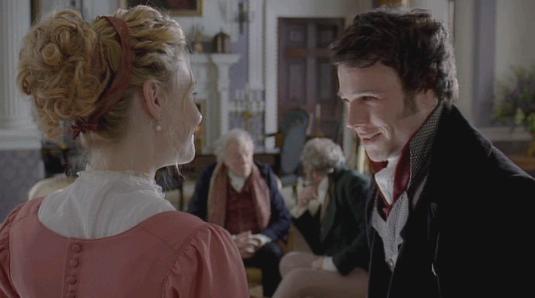 Miss Bates’ solicitous attitude to her mother now extends to Jane as well: “My dear Jane, where are you? Here is your tippet. Mrs. Weston begs you to put on your tippet. She says she’s afraid there will be draughts in the passage.” Throughout, Jane’s bad health is a matter of concern for everyone, but in her case, too, we discover that there is a strong emotional component to her health, since her health grows worse the more Frank flirts with Emma. Later, Frank, who has been conditioned by his aunt to respond to illness, seems more affected by Jane’s physical suffering than her psychological one. He tells Emma: “Do not pity me until I reached Highbury and saw how ill I had made her [Jane Fairfax]. Do not pity me till I saw her wan, sick looks.”
It is tempting to read into Emma, particularly the mother-daughter-younger niece pair (Miss and Mrs. Bates and Jane) in the novel, some of Jane Austen’s own uncertainties. We know that Jane Austen’s mother was something of a hypochondriac herself, and suffered from a variety of illness that were sometime called into question, especially considering her longevity. Moreover, Austen’s sister Cassandra did not marry and remained at home with her mother. Are Miss Bates and her mother somehow reminiscent of Cassandra and her mother? Was Jane Fairfax a kind of alter-ego to Jane herself (particularly since JA herself suffered from similar headaches). Were Jane Fairfax’s anxieties about being forced to work for a living a reflection of JA’s own? If so, then Jane Austen gave her a happy ending at least, or as happy as it could be with an unreliable husband like Frank Churchill. Was Emma what Jane Austen herself would have loved to be – free of the obligation to marry, independently wealthy, yet dutiful towards her parent?
We can only speculate.
This topic fascinated Monica Fairview enough to write a short story sequel to Emma which explores Mr. Woodhouse’s reaction the day Mr. Knightley moves into Hartfield. The story can be found in the collection Jane Austen Made Me Do it. Fairview is also the author of two full length Pride and Prejudice sequels: The Other Mr. Darcy (Caroline Bingley’s story) and The Darcy Cousins (Georgiana’s coming of age story).
Visit Monica’s website for more information about her and her books!
Thoughts: To Kill a Mockingbird by Harper Lee
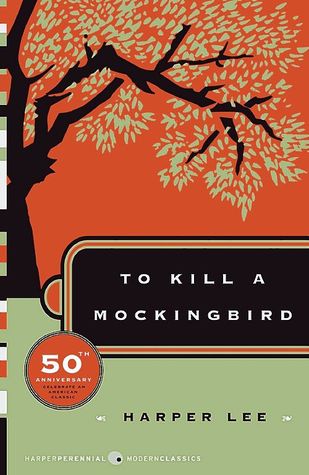 To Kill a Mockingbird by Harper Lee
Final Verdict: 4.0 out of 4.0
YTD: 46
Harper Lee’s noted –and only- work, To Kill a Mockingbird, has become a classic piece of literature and a staple of American culture and southern history. The narrator and protagonist, Scout Finch, along with her brother, Jem, and their friend, Dill, begin the story as lighthearted, inquisitive and playful children who are fascinated by a mysterious neighbor named Arthur “Boo” Radley. As the story progresses, they have a series of encounters with Boo, but they do not know it (until all comes to a head in the tragic and life-altering conclusion). Jem and Scout’s father, Atticus, is the town (and county’s) best lawyer, and also a representative to the state legislature. He is tasked with defending a black man against the charge of rape, and the task will change his children forever.
Although the book directly wrestles with issues of racism, violence, bigotry, caste, and education, its primary concern is coming of age and loss of innocence. Scout’s innocence, in particular, but also Jem and Dill’s, is threatened by successive incidents that reveal to these generally kind, somewhat simple kids the presence and nature of human evils. This is especially made clear with the conviction of Tom Robinson, a black man who, from the start, was bound to be found guilty, despite Atticus Finch’s brilliant defense and the clear evidence support Robinson’s innocence. This conviction shatters Jem’s world and forces him into manhood, meanwhile causing Dill, a gentle and artistic soul, to face the harsh realities of a world he tries so hard to avoid.
The trial is only the first of two major incidents which will change the kids’ worlds. The second happens at the end of the book, when the man whom accused Robinson of rape (and whom Atticus clearly implicates instead), attempts to make good on his promise to ruin Atticus Finch. Although neither he nor anyone in his family was punished for their perjury and false accusations, and although Robinson was ultimately convicted and suffered the harshest fate, Bob Ewell still feels it necessary to seek his own justice for the “damage of character” done to him at the trial. This particularly subplot is particularly telling of how class, within white society, is just as important and just as divided as the world of blacks and whites.
Ultimately, To Kill a Mockingbird is an exploration of human nature and each individual’s capacity for both good and evil. It is a commentary on the importance of moral education – much more so than academic education, and a discussion on social class and the true meaning of justice (and who is entitled to it). Harper Lee utilizes interesting Gothic techniques, reminiscent of the great southern Gothics such as Flannery O’Connor, to build tension and anticipation, and to foreshadow the story’s more important events.
Allowing the story to be told from Scout’s point of view, in retrospect, adds both honesty and evidence to the story, but also some room for doubt. She narrates the entire story in the first person, as through her childhood self’s eyes, but then adds analysis and supplementary thoughts to the narration, as an experienced adult revisiting these events after many years. The inclusion of these comments makes the narrator more trustworthy, as it reveals to us that she is aware (and admitting) that she is somewhat distanced from the time and place of the story and, therefore, could possibly be over or under-exaggerating certain things. The tone of her narration, like the tone of the story, begins in childhood innocence but becomes increasingly foreboding and self-conscious as the tale unwinds.
To be sure, To Kill a Mockingbird holds a beloved place in the hearts of many readers and also a coveted spot in the canon as a “classic” of American literature. When I first read this book, many years ago, I was not as much of a fan as I thought I would be, but this re-read has proved me wrong. The book is well-written and masterfully constructed (where and how Lee begins the story, for instance, really struck me as perfection, this time around). The characters, good, bad, and indifferent, are believable, interesting, and important to the plot and scenery. This is a book I will be revisiting again and again.
I read this book as part of a read-along, with additional thoughts posted Here.
Suggested Reading for:
Age Level: 16+
Interest: Social Justice, Racism, American South, Courtroom Drama, Coming of Age, Southern Gothic.
Notable Quotes:
“Thus we came to know Dill as a pocket Merlin, whose head teemed with eccentric plans, strange longings, and quaint fancies” (9).
“There were other ways of making people into ghosts” (12).
“It’s best to begin reading with a fresh mind” (19).
“When a child asks you something, answer him, for goodness’ sake. But don’t make a production of it. Children are children, but they can spot an evasion quicker than adults” (99).
“Shoot all the bluejays you want, if you can hit ‘em, but remember it’s a sin to kill a mockingbird” (103).
“Before I can live with other folks I’ve got to live with myself. The one thing that just doesn’t abide by majority rule is a person’s conscience” (120).
“I wanted you to see what real courage is, instead of getting the idea that courage is a man with a gun in his hand. It’s when you know you’re licked before you begin but you begin anyway and you see it through no matter what” 128).
“Dill was off again. Beautiful things floated around in his dreamy head. He could read two books to my one, but he preferred the magic of his own inventions” (163).
“I think there’s just one kind of folks. Folks” (259).
“Atticus had used every tool available to free men to save Tom Robinson, but in the secret court of men’s hearts Atticus had no case” (276).
“I came to the conclusion that people were just peculiar. I withdrew from them, and never thought about them until I was forced to” (279).
“As I made my way home, I thought Jem and I would get grown but there wasn’t much else left for us to learn, except possibly algebra” (321).
 Roof Beam Reader