Roof Beam Reader
Adam Burgess
TBR PILE CHECKPOINT #3: MARCH PROGRESS!

Congratulations to our February Winner: Alyssa from The Reader’s Refuge!
Aloha, TBR Pile Challengers!
It is March 15th and we are now at Checkpoint #3 for the 2013 TBR Pile Challenge! I’ve been happy to see all of your updates on Twitter and on your blogs, announcing your progress through the challenge. Congratulations on your successes so far!
I have currently read 6 of my required 12 books. I can’t believe I’m already half-way done! I plan to read two more (A Streetcar Named Desire and Gods and Monsters) by mid-May, which will leave me with just 4 more books to finish this challenge. I am going to try to knock them all out by August and finish up early, before the start of the next school year!
Book #1: O Pioneers! by Willa Cather
Book #2: The Alchemyst by Michael Scott
Book #3: Orlando by Virginia Woolf
Book #4: The Gunslinger by Stephen King
Book #5: The End of the Affair by Graham Greene
Book #6: Sodom on the Thames: Sex, Love, and Scandal in Wilde Times by Morris Kaplan (Review to come soon)
My favorites so far have been Orlando and O Pioneers! but, I have to say, I have enjoyed all of my choices – I’m happy with my selections thus far! Why did they stay on my shelves, unread, for so long!?
Now that we’re 1/4 of the way into the new year and this challenge, what are your thoughts? How are you doing? Which books have knocked your socks off, and which had you running for your alternates pile?!
Below, you’re going to find the infamous Mr. Linky widget. IF you have completed any reviews for books on your challenge list, please feel free to link them up here so that we can easily find your posts, encourage one another, see what progress is being made on all these piles, etc. Also, feel free to link-up to your own checkpoint post, should you decide to write one (not required – but feel free!)
Also – this month’s check-point comes with a giveaway! YAY! Any books that you have read and reviewed for this challenge, since February 20th, and which you link-up to the Mr. Linky below, will count as entries toward the giveaway.
The Prize: One book of your choice ($20 USD or Less) to be shipped from The Book Depository!
Good Luck and Happy Reading!
LINK UP YOUR REVIEWS Feb 21 – March 20
(Please wait until April 15th to link-up posts written after March 20th)
Thoughts: A Room of One’s Own by Virginia Woolf
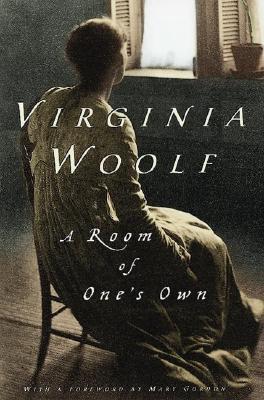 A Room of One’s Own by Virginia Wolf
Final Verdict: Perfection
YTD: 22
I finished reading Virginia Woolf’s A Room of One’s Own two days ago, and I have been thinking about it ever since. I imagine that I will be thinking about it for quite some time. It, like the last two Woolf books I read, was not what I expected it to be. Yes, I knew the book developed from lectures she gave on “Women and Fiction” to students at Newnham and Girton in 1928. Yes, I knew that Shakespeare’s infamous sister originated from these lectures, and I knew that Woolf’s renowned declaration that a woman must have “money and a room of her own if she is to write fiction” (4) was the primary theme for the lectures and papers which eventually became this book. So, why was I caught off-guard by this book? What did she give me that I wasn’t expecting? Was there something missing – something I expected to see but didn’t?
I was caught off-guard, first, by the lecture style. I have been reading quite a bit of nonfiction, lately. Essays and lectures about writing, theory, and criticism, as well as histories of sexuality and gender, in literature and other mediums. Most of these, aside, perhaps, from E.M. Forster’s Aspects of the Novel, are relatively straightforward nonfiction. But Woolf tells a story with her lectures – in fact, she creates a fictive world and fictive experiences to relay the message she intends to deliver to these young women. Typically, I look for a writer’s genius in their fiction, because, first of all, I’m a reader of fiction and because, secondly, I believe it is more difficult to get one’s point across in a creative way than it is to deliver it face-forward in an essay or lecture, where one can simply state what they mean, give examples, and move on. Fiction is harder – it is more subtle, delicate, and complex. You have to develop it in order to deliver it effectively. Nonfiction, while still taking great effort to make it “worthwhile,” and readable does not necessarily require story, too. But Woolf gives us the story anyway, and she gives us history, and she gives us visions of the future. It is, to put it plainly, simply stunning.
A Room of One’s Own is about the inequalities of sex, certainly. When she talks of needing £500 and a private room, with a lock, she is being quite literal. But she’s also going beyond that – she’s not just talking about women and she’s not just talking about the creative process. She’s talking about brilliance and genius and what it really takes to get there. This is a book as much about class and economics as it is about sexual politics. The great writers throughout most of history have been men because men have been privileged with wealth of their own, property of their own, space of their own. They had access to education and travel, to training and experience. Jane Austen, her ultimate exception to this rule, was brilliant despite this lack and, even so, her works, brilliant as they are, have their limitations, because Austen’s own experiences were limited. Woolf is a feminist, whether or not she would admit it, and that comes across at times in these lectures, but what is really interesting is that she is not speaking to women in general –she’s not really concerned with that population; she is speaking to women of genius.
Where does all this leave me? It is nearly 100 years later and the one theme at the heart of Woolf’s theory still seems to hold true: one needs time, space, and money in order to reach greatness. One must be granted the ability to spend time with one’s self, to give him or herself completely to their craft, to not be distracted by anything else, if he or she is to succeed. Of course, this makes sense and it is something I have thought about for more than a decade. If only I had time, I would say to myself, I could get this book written, that project completed. Or, if only I had the money, I would think, I could travel to Europe, investigate what I need to, experience what I must, and learn what I should, in order to write what I feel. So, knowing this, and reading it in blunt delivery from one of the greatest literary minds to grace history, what do I do with myself? Time? Money? I work 45-50 hours per week. I’m pursuing my Ph.D. full-time, which adds 6 hours of class time each week plus who knows how many hours of research, homework, and assigned reading, not to mention the additional 6 hours spent commuting to and from campus. Sleep factors in there, sometimes.
Woolf, you see, has made me seriously doubt the way I’m going about my life. She says one needs free time and privacy from distraction – but aside from winning the lottery, how does one support a (brilliant) writing life? She says one needs an education – but how far is it necessary to go, and how do you focus on your own work when completing the “required” education? These are the questions she raises and leaves unanswered for me. I don’t consider myself to be a genius, so it’s probably true that Woolf doesn’t intend her lectures for me; still, I do consider myself to be a writer and one who is very concerned with the requirements of time, space, and security. So, it’s a hard book for me. It’s a hard book, I think, for any writer who finds himself in a hard place. But it’s a life-changing book and it has left me with more thoughts than I know what to do with, more doubts than I can afford to deal with, and more desire than I can bear to let go of.
Notable Quotes:
“It is a curious fact that novelists have a way of making us believe that luncheon parties are invariably memorable for something very witty that was said, or for something very wise that was done. But they seldom spare a word for what was eaten” (10).
“And thus by degrees was lit, halfway down the spine, which is the seat of the soul, not that hard little electric light which we call brilliance, as it pops in and out upon our lips, but the more profound, subtle and subterranean glow, which is the rich yellow flame of rational intercourse” (11).
“One does not like to be told that one is naturally the inferior of a little man” (32).
“Some of the most inspired words, some of the most profound thoughts in literature fall from her lips; in real life she could hardly read, could scarcely spell, and was the property of her husband” (44).
“Indeed, I would venture to guess that Anon, who wrote so many poems without signing them, was often a woman” (49).
“When people compare Shakespeare and Jane Austen, they may mean that the minds of both had consumed all impediments” (68).
“Lock up your libraries if you like; but there is no gate, no lock, no bolt that you can set upon the freedom of my mind” (76).
“It is fatal for any one who writes to think of their sex. It is fatal to be a man or woman pure and simple; one must be woman-manly or man-womanly” (104).
“So long as you write what you wish to write, that is all that matters” (106).
A Room of One’s Own is Book 2 completed for the Modern March event.
Thoughts: Miss Lonelyhearts by Nathanael West
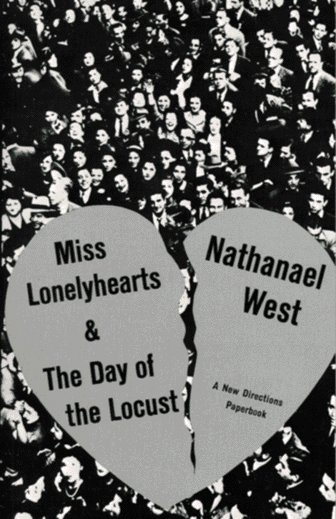 Miss Lonelyhearts by Nathanael West
Final Verdict: 3.5 out of 4.0
YTD: 21
Plot/Story:
4 – Plot/Story is interesting/believable and impactful (socially, academically, etc.)
Miss Lonelyhearts is the journalistic pseudonym for a male newspaper man who aspires to have his own gossip column. The reader is never told his true name, but it is his journey we follow. Miss Lonelyhearts has a deep and profound faith in Christ and Christianity. He becomes depressed by the letters he receives on a daily basis, from sad, sick, abused, and lonely men and women who are seeking his advice. He believes that Christ is the answer but is continuously mocked by his editor, Shrike, who derides his religion and who believes that art is the true answer. Miss Lonelyhearts has a stone where his soul should be – coldness where he should have passion. He relieves the ache of this by attempting to make love to women, his own girlfriend as well as others (even having affairs with his boss’s wife & some of his faithful readers). These affairs, coupled with his inability to connect with other people, will lead to his disillusionment and demise.
Characterization:
3 – Characters well-developed.
In addition to Miss Lonelyhearts, who is the novella’s main character and Christ-figure, there are a few others who complete the cast. First is Shrike, Miss Lonelyhearts’s editor – Shrike is a womanizer, a hedonist who lives for pleasure, though he cannot get any from his wife, and, essentially, the novella’s anti-Christ (though he survives and thrives, interestingly enough). Shrike is married to a virginal woman named Marry, which is kind of hilarious, if a bit heavy-handed. Betty is Miss Lonelyhearts’s fiancée and she represents the good, the naïve – the sheep, if you will. She praises the country and hates the city, believing it to be the cause of Miss Lonelyhearts’s anxiety and unhappiness (or illness, as she calls it). In addition to these are Mrs. Doyle, the story’s Mary Magdalene, and her husband Mr. Doyle, a cripple who Miss Lonelyhearts attempts, and fails, to heal. The rest of the cast are made up of minor characters, such an elderly homosexual man (whose presence exposes a bit of the early psychoanalytical obsession with homosexual “perversion”), the letter-writers who turn to Miss Lonelyhearts for help, and some co-workers at the newspaper. West knows what he is doing with his characters and, aside from the letter-writers who all tend to write the same way, despite having different backgrounds and problems, most of the characters serve a distinct purpose and come across with believable, individual personalities.
Prose/Style:
3 – Satisfactory Prose/Style, conducive to the Story.
West’s prose is raw, graphic, and emotionally American. His narration is swift and to the point, with moments of high and romantic description employed at appropriate intervals. The dialogue is believable even when certain of the situations are not, but the scenes where Miss Lonelyhearts is alone in his room and coming to terms with his fanaticism (he admits to needing to hold himself in check or risk losing himself completely to an obsessive, extreme zealotry) are the most poignant of all. The incorporation of letters from the newspaper audience allows for a broader view of the American disillusionment, without necessitating the inclusion of too many characters which, in a novella of approximately 65 pages, is both necessary and effective.
Additional Elements: Setting, Symbols/Motifs, Resolution, etc.
4 – Additional elements improve and advance the story.
Nathanael West’s works are deeply concerned with Depression-era America. He, like John Steinbeck, wrote stories about the American Dream and how truly unachievable that dream was. Unlike Steinbeck, however, West’s characters are not compassionate – there is no one to root for and, in fact, many are masterful grotesques. He follows in the footsteps of Sherwood Anderson, creating characters who are less individuals than they are the embodiment of a seedy, disappointing element of humanity. West was a Hollywood screenwriter and novelist and, coincidentally, died the same weekend as his good friend F. Scott Fitzgerald, another Hollywood novelist who explored the darker, disappointing side of the American dream. Miss Lonelyhearts, though short, packs a punch. West ironically employs the literary Christ figure, as he does in Day of the Locust and, in both books, it is a failed Christ and a failure of Christian faith in general being presented. SPOILERS FOLLOW: Miss Lonelyhearts himself goes through Christ’s journey (three days of “death”, a “Last Supper”, and a “Resurrection”) only to be killed (crucified) by one who lacks faith in him. Unlike Christ, who sacrificed himself for others, Miss Lonelyhearts is killed for betraying another man. Other themes include castration (one which would become increasingly important with the Beat generation), the Great Depression, and the frustrated American Dream.
Suggested Reading for:
Age Level: High School+
Interest: Great Depression, Loss of American Dream, Castration, Christian Allegory, Social Anxiety, Hollywood novel.
Notable Quotes:
“At college, and perhaps for a year afterwards, they had believed in literature, had believed in Beauty and in personal expression as an absolute end. When they lost this belief, they lost everything.”
“He read it for the same reason an animal tears at a wounded foot: to hurt the pain.”
“He felt as though his heart were a bomb, a complicated bomb that would result in a simple explosion, wrecking the world without rocking it.”
“Art Is a Way Out. Do not let life overwhelm you. When the old paths are choked with the debris of failure, look for newer and fresher paths. Art is just such a path. Art is distilled from suffering.”
Miss Lonelyhearts is Book 1 completed for the Modern March event.
Miss Lonelyhearts is Book 11 completed for the Classics Club Challenge.
Miss Lonelyhearts is Book 134 completed for the 1,001 Books TBR Before You Die Challenge.
Me and Jane Austen
 This month’s meme from The Classics Club is all about Jane Austen. Do we love her? Hate her? What’s our favorite work, if any?
I thought I’d start by sharing some delightful thoughts on Austen, from one of my favorite writers, Mark Twain.
In 1895, Twain was sailing across the Indian Ocean. He wrote in his journal that he found Austen “thoroughly artificial” and praised the ship’s library for its lack of Austen novels. He claimed that this “one omission alone would make a fairly good library out of a library that hadn’t a book in it” -Twain, Following the Equator (1897).
His dislike for Austen did not change much over time. He wrote the following in a letter much later:
“Whenever I take up Pride and Prejudice or Sense and Sensibility, I feel like a barkeeper entering the Kingdom of Heaven. I mean, I feel as he would probably feel, would almost certainly feel. I am quite sure I know what his sensations would be — and his private comments. He would be certain to curl his lip, as those ultra-good Presbyterians went filing self-complacently along. …She makes me detest all her people, without reserve. Is that her intention? It is not believable. Then is it her purpose to make the reader detest her people up to the middle of the book and like them in the rest of the chapters? That could be. That would be high art. It would be worth while, too. Some day I will examine the other end of her books and see.” – from “Jane Austen” in Who Is Mark Twain by Mark Twain (2009).
Was Mark Twain right? Was he being fair when he said that Austen’s books so angered him that “every time [he] read Pride and Prejudice [he wanted] to dig her up and beat her over the skull with her own shin bone?”
Well, it’s certainly fair for anyone to have his or her own opinion. And the great Charles Dickens happened to agree with him, although Dickens’s criticism was more misogynistic in nature (he didn’t think women had the capacity to be genuinely or adeptly humorous).
So, who am I to disagree with these giants of American and British literature? Well, I’m a reader with my own equally valid opinions. And I say Jane Austen is a master novelist, perhaps one of the best who ever lived. She’s certainly up there with Zola, Lawrence, Hardy, and Dreiser, in my opinion.
Are her books similar in theme? Sure. But they’re also vastly different. Mansfield Park cannot be confused with Sense and Sensibility. Marriage, family, and the middle class – they have a place in every Austen novel, because this is what Austen knew about. But it’s also this world and these people whom Austen dissects and often chastises, in many different ways. Marriage for love or for convenience? Property and station or happiness and companionship? These are questions one can expect to find in Austen.
But did you also know that you’ll hear about human trafficking and the slave trade? What about sexual impropriety in the military, alcoholism, parasitism, and hypochondria? Yep, they’re all in there! These issues and so many more are explored through masterfully constructed works, delivered in sometimes biting parody and satire.
Yes, it is safe to say that I love Austen. It took a while, though, and I can understand why, in our contemporary world, we might find her to be a bit dull on the surface. But when you take your time with her, when you look for the subtleties, such as her brilliant control of narrative time and her employment of multiple narrative types to craft a deeper, more complex prose, you might begin to see what all the fuss is about.
 My first attempt at reading Austen was early in college. I started (and failed to finish) Pride and Prejudice. I reacted in the typically dismissive male-centric way: “This is girly.” Later, in graduate school, I was fortunate enough to study Northanger Abbey and my appreciation for and interest in Austen was piqued. Could I have been wrong??
Shortly after finishing that semester, I revisited Pride and Prejudice on my own. And I finished it. And I thought, “Adam, you dolt!” I had been so utterly, completely, painfully naive and wrong. I re-read P&P again just a few months ago, and my appreciation for it grew. I also hosted Austen in August last year (and plan to do so again this summer), managing to read Sense and Sensibility, Lady Susan, The Watsons, and Sanditon. Just recently, I was able to finish Mansfield Park. A lot of these works might seem similar in many ways – style, themes, focus. But in reality, they’re quite different and, somehow, never disappointing.
Do I have my favorites? Sure. Could I rank them in some kind of personal “best” to “worst” order? Yes, although that “worst” categorization would be basically meaningless, as there’s no such thing as a “bad” Austen novel. Ultimately, they all have value, they are all entertaining, and they are all complex, but in different ways. Some readers are going to respond better to the funnier, lighter novels, while others will respond to the craftsmanship and depth of the more serious works.
As for me, my favorite is and will probably always be Northanger Abbey. It was Austen’s first book, though the last to be published. It is raw, it is hilarious, and it has its flaws. But it made me double-check myself and my opinions. It made me fall in love with Austen. So, there it will sit, on its lofty pedestal, forever and ever.
Thoughts: As You Like It by William Shakespeare
 As You Like It by William Shakespeare
Final Verdict: 3.75 out of 4.0
YTD: 14
I have been away from Shakespeare for far too long. I have taken two courses in Shakespeare, one in college and one in graduate school. In both cases, we spent the majority of the time studying his histories and tragedies (Titus Andronicus, Hamlet, Henry V, etc.), as well as the history of the period, his contemporaries (Marlowe, Jonson, Lily, Nashe, etc.) and some of the sonnets. In only one class did we read a comedy, A Midsummer Night’s Dream, and I firmly believe we only read this one because a) the instructor felt it necessary to include at least one example of Shakespeare’s comedic work and b) the instructor was also interested in mythology. So, I went into this play not having read any Shakespeare in more than 4 years and having very little experience with his comedies, though I’ve read quite a bit of his oeuvre.
While it is impossible to know just how much of As You Like It is still in its original form (this play, like all his others, was changed multiple times to suit stage needs and audience feedback, prior to having been printed for the first time), it is clear that it was likely written around 1599 (near the end of Queen Elizabeth I’s reign) and that it fits into the genre of the pastoral, which is inspired by ancient Greek literature. As in other pastoral stories, this one includes high-ranking members of society who must flee from court and hide in the countryside, for fear of imprisonment or execution. They abandon their princely lives to become shepherds, farmers, shopkeepers, etc.
As the play begins, we learn that Sir Rowland de Bois has died and his power and property have passed on to his eldest son Oliver. Oliver is charged with taking care of his brother, Orlando, but the brothers are not friends and Oliver instead completely neglects Orlando, leaving him without education, without property, and without any training which might allow Orlando to advance in the world and make a life for himself. There is a wrestling match at court, which Oliver attempts to “fix” so that the master wrestler, Charles, will kill Orlando during the match – but Orlando wins and during the match catches the eye of the beautiful Rosalind (who is the daughter of Duke Senior, who has been usurped by his brother, Frederick). After the match, Orlando learns that he must flee for his safety, so he heads for the Forest of Ardenne, where Duke Senior happens to be hiding, and is soon followed there (unknowingly) by Rosalind and her bosom friend Celia, both of whom are disguised (Rosalind as a boy, Celia as a darker-skinned peasant).
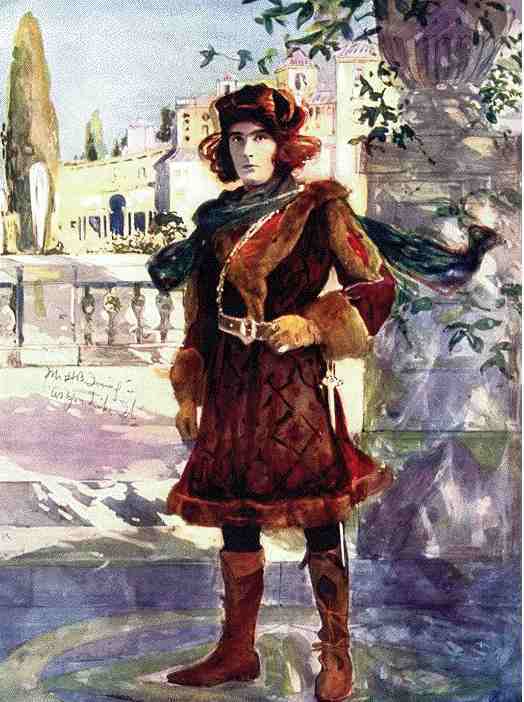 Ultimately, Duke Frederick orders Oliver to find Orlando and bring back Celia (Duke Frederick’s daughter), and threatens him with destruction and poverty if he fails. In the Forest of Ardenne, Orlando meets Rosalind as Ganymede (that name should ring some bells!), who says he will pretend to be Rosalind so that Orlando can practice courting her. This is some of the most elaborate gender-bending in literary history and is somewhat shocking to find in a 17th Century play. Rosalind will eventually become the mastermind of a community wedding, where four couples get married, after agreeing to her terms (given as Ganymede) the day before. There was a woman in love with Rosalind (as Ganymede) who agrees to marry another man, if Ganymede can convince her not to want to marry him (which he does by revealing himself to be a woman) and an agreement from her father, Duke Senior, that he will allow his daughter, Rosalind, to marry Orlando, if only they could find Rosalind (which, again, comes true after Ganymede takes off his disguise).
It gets even more complicated when we recall that, at the time, women’s roles would have been played by boys. So, here we have a boy playing Rosalind, who then – in the play- pretends to be a boy (so a boy playing a girl playing a boy), who then reveals himself to be a girl (all the while still a boy in real life). Talk about a sense of humor!
The primary theme of As You Like It seems to be the complexity of life and the tongue-in-cheek spoofing of conventional romances, where men are love slaves to their ladies and where love itself acts like a disease, disabling its sufferer. This play is littered with arguments, possibilities, choices, and dichotomies, all of which are presented as realities of life, without much (if any) preaching on Shakespeare’s part. There are plenty of binaries, but few didactic absolutes – it is as if Shakespeare is saying, “these are the many ways man and woman can live, the many choices they could make, and who are we to say which is right or wrong?”
My thoughts are all over the place on this one, because there is so much going on (within the play) and so much being said (by Shakespeare, through the play). That being said, the plot and story are surprisingly easy to follow, despite the play’s complexity. It is also highly entertaining and enjoyable because of the novelty of the story, for its time, and also because of its farcical nature and its ability to laugh at the ridiculousness of love, all the while being a love story. Enjoyable, interesting, thought-provoking, and funny. Classic Shakespeare.
Suggested Reading for:
Age Level: High School +
Interest: Gender Roles, Primogeniture, Patriarchy, History, Comedy/Drama, Identity, Homoeroticism, , Cross-dressing.
Symbols/Motifs: Ganymede, Poetry (Orlando), Cuckoldry; Exile, Artifice, Homoeroticism.
Dichotomies: City (Court) vs Country; Nature vs Fate; Realism vs. Romance; Old vs. Young; Noble Birth vs. Social Advancement; Reason vs. Foolishness.
Notable Quotes*:
“The more pity that fools may not speak wisely what wise men do foolishly.” (11)
“And this our life, exempt from public haunt, finds tongues in trees, books in the running brooks, sermons in stones, and good in everything.” (25)
“I shall ne’er be ware of mine own wit till I break my shins against it.” (33)
“All the world’s a stage, and all the men and women merely players; they have their exits and their entrances, and one man in his time plays many parts.” (44)
“The fool doth think he is wise, but the wise man knows himself to be a fool.” (89)
*Page numbers correspond to the 2000 Pelican Shakespeare edition, ed. by Frances E. Dolan.
 Roof Beam Reader