Roof Beam Reader
Adam Burgess
Thoughts: Orlando by Virginia Woolf


Orlando: A Biography by Virginia Woolf
Final Verdict: 4.0 out of 4.0
YTD: 5
Orlando is Virginia Woolf’s sixth major work and was written in a year, between To the Lighthouse and The Waves. It is an epic novel and historical biography which follows the journey of one character, Orlando, over the course of about 350 years (1588-1928). It is a biography not of any one character, but of the nature and history of gender, identity, and sexuality through time. At the start of the novel, readers will encounter Orlando as a young boy of noble birth. His family entertains Queen Elizabeth I, who is the first to notice Orlando’s beauty and potential. As he ages (slowly), Orlando will spend much of his time with “low” people – those well-outside the realm of nobility, though he himself is a member of the court. He explores and enjoys sexual relations with women of varying types, though each of his three serious ventures into love soon goes sour. Orlando will twice mistake the loves of his life for the wrong gender, which is particularly complex after Orlando himself has become a woman, remembering himself as a man, loving a man who is actually a woman. Ultimately, after trips abroad and back home again, Orlando’s story is one of exploration and being open to the many possibilities of life. He is a writer, first, who spends hundreds of years working on one short poem called “The Oak Tree,” a strong symbol of nature’s presence and dominance throughout the passage of time. Orlando witnesses the world-changing, from the sexual freedom and marriageless years of the Elizabethan period, to the stringent, stuffy, prudish world of the Victorian age. At a certain point, he (now she) wakes up to “the present” and is terrified, realizing that she suddenly exists in the now, and it is a now that she no longer recognizes, where women are property, where love is regulated, and where art and literature exist only in the past.
There are two main characters in the novel; the first is Orlando, who changes from male to female throughout the long passage of time. The second is actually the narrator – a third-person, mostly omniscient but nevertheless unreliable “biographer,” whose tone and style change throughout the book, as Orlando and his life are changing. One could argue, though, that the true characters are actually gender (identity), sexuality, and time: these are the ideas explored most intricately and most often throughout the course of the book and they are certainly front-facing; the narrator/biographer views time and Orlando in opposition to how opinions and practices of sex and gender are viewed differently at various points in history. Other characters (of the usual sense) include Sasha, Orlando’s true first love, a Russian princess; Shel, Orlando’s husband who is actually a woman (or who, at least, has the qualities of one); the Archduchess Henrietta who is actually Archduke Harry (perhaps the only truly homosexual character, as the others whose genders bend throughout could truly be said to be of the opposite gender, psychologically and even physically, after their changes, while Harry is simply a man who cross-dresses as a woman and who loves Orlando as a man); and certain historical figures, like Nick Greene (poet/critic), Queen Elizabeth I, and Alexander Pope.
Orlando, though massive in scale, brilliant in conception, and beautiful in prose, was actually considered by Woolf to be a “writer’s holiday,” so to speak. She refused to allow gender nor time to constrain her writing, which is evidenced by the fact that Orlando, who begins the story as a man and ends it as a woman, 4 centuries later, only ages 36 years in the process. Woolf’s secondary aim, aside from bending time and gender, is satirizing Victorian biographies and novels which traditionally emphasize truthfulness and fact (though they are obviously fiction). What is most fascinating for me is the fact that the book was, for Woolf, a game of sorts – a lighter satire and departure from her more rigid works; yet, this one is incredibly important and speaks seriously, though fantastically, to issues of self-discovery, truth, art, and gender. The exploration of the many time periods, from Elizabethan to the early 20th Century, particularly in terms of the literary arts in any given movement, will be fascinating for serious readers, but the beautiful and sensuous prose (less explorative than other works, making it more accessible) as well as the unusual topic and uninhibited re-imagining of reality and time make this a unique, awe-inspiring read for anyone willing to suspend disbelief and go along for the ride.
Suggested Reading for:
Age Level: Adult
Interest: Gender, Sexuality, Time, Art, Literary History, Nature, Truth, Poetry.
Notable Quotes:
“Nothing thicker than a knife’s blade separates happiness from melancholy” (45).
“Once the disease of reading has laid hold upon the system it weakens it so that it falls an easy prey to that other scourge which dwells in the ink pot and festers in the quill” (75).
“Bad, good, or indifferent, I’ll write, from this day forward, to please myself” (103).
“No passion is stronger in the breast of man than the desire to make others believe as he believes. Nothing so cuts at the root of his happiness and fills him with rage as the sense that another rates low what he prizes high” (149).
“Nothing can be more arrogant, though nothing is commoner than to assume that of Gods there is only one, and of religions none but the speaker’s” (173).
“Illusions are the most valuable and necessary of all things, and she who can create one is among the world’s greatest benefactors” (199).
“We write, not with the fingers, but with the whole person” (243).
“For it has come about, by the wise economy of nature, that our modern spirit can almost dispense with language; the commonest expressions do, since no expressions do; hence the most ordinary conversation is often the most poetic, and the most poetic is precisely that which cannot be written down” (253).
“Our most violent passions . . . are the reflections we see in the dark hollow at the back of the head when the visible world is obscured for the time” (323).
Orlando is Book 1 for my B2tC Challenge; Book 9 for my Classics Club List; & Book 3 for my 2013 TBR Pile.
Thoughts: The Alchemyst by Michael Scott
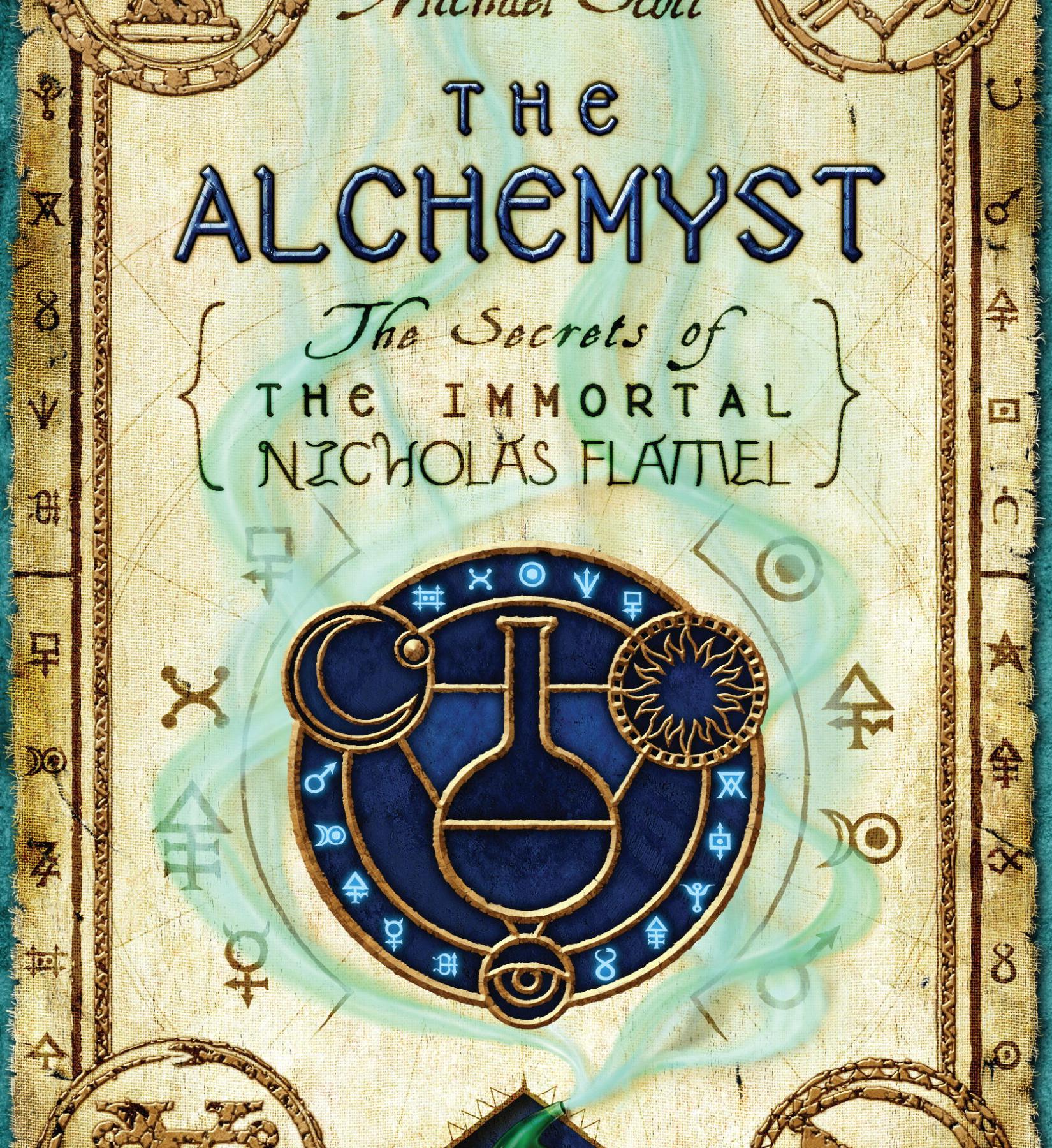

The Alchemyst by Michael Scott
Final Verdict: 2.75 out of 4.0
YTD: 4
The Alchemyst by Michael Scott is book one in “The Secrets of The Immortal Nicholas Flamel,” a YA fantasy series often likened to Harry Potter. Sophie and Josh Newman, teenagers and twins, have spent most of their lives moving from place to place. Their parents are architects who are always on the move, searching for that next big find. Because of this, the twins have become used to instability and are rather adept at adapting. This is fortunate because, one day, the strange bookshop owner who Josh works for, Nick Fleming, is attacked by a powerful and legendary magician, Dr. John Dee, and his golem minions. Immediately, Josh and Sophie are swept off by Fleming, torn from their family and told that they might just be the two people who will become responsible for saving the world, as the prophecies say. The twins are thrust into an underworld filled with ancient legends, dark and powerful gods, bitter rivalries, and the many varied forms of magic, alchemy, sorcery, and science – and, soon, their own powers are to be awakened.
While many people have told me that this is their second favorite fantasy series, after Harry Potter, I am not quite as convinced or enthralled. I do plan to read the next book in the series, and hopefully finish the entire thing at some point. However, one of the weakest elements for The Alchemyst was, in my opinion, its characters – and characters/characterization is always an important story element for me. The main characters, Sophie and Josh, are thrown into the major plot so quickly; there is little time to learn anything about them. Then, as things continue to happen, we do see certain elements of their personalities (mostly told, not shown), such as Josh’s potential jealousies, Sophie’s insecurities, and the fact that they have learned to love & protect each other as a result of not just being siblings, but also having absent parents who move around so much. Still, there was so little depth to them, and even less to the secondary characters. Nicholas Flamel’s love-story with Penelope is interesting, but not entirely relevant. I wish the pace of the story would have slowed down so that the characters could have had more time to interact and so that the narrative itself could have told us more about them, their histories, and their motivations. Maybe this will happen in later books – but as a stand-alone examination of this first book, I must say I was disappointed.
That being said, the book is largely an action-fantasy or fantasy-adventure story, and the prose and structure are certainly fitting. The language and vocabulary are appropriate for the reading level, and the pages definitely turn (which is both a pro and a con, in this case). In addition to a strong style, there are many historical and mythological elements of the book which are interesting and educational, something I enjoy quite a bit in fantasy stories of this level (the reason why I love the Rick Riordan books so much – they are fun and they teach us things). I particularly enjoy the exploration of “auras” as a type of power and individuality. Still, I felt that much of the time, Scott was throwing his mythological characters into the story for the sake of having them and to show off just how much he had researched about these ancient tales. The gods (Elders) pop-up all over the place, as do the immortals, mythological beasts, etc. There is a whole lot happening all of the time, which is fine for keeping one occupied, but upon reflection, I realize it left me with a sense of time spent pleasantly, simply, but unsatisfactorily. This first book, I felt, was interesting and fun. It has some great historical/mythological foundations to pull from, and the Author’s Note at the end of the book, which tells of Scott’s research into Flamel, is fantastic. But, ultimately, it was a bit of a shallow reading experience. If you are looking for a fun fantasy tale that won’t necessarily leave you thinking about it afterwards, this might be a good book for you.
Suggested Reading for:
Age Level: MG/YA
Interest: Fantasy, Mythology, Alchemy, Siblings, Twins, Family, Absent Parents
Notable Quotes:
“[Humans] barely look, they rarely listen, they never smell, and they think they can only experience feelings through their skin. But they talk, oh, do they talk. That makes up for the lack of use of their other senses.” (149-50)
“Once begun, change cannot be reversed.” (225)
Thoughts: Siddhartha by Herman Hesse

Siddhartha by Herman Hesse
Final Verdict: 3.75 out of 4.0
YTD: 3
Siddhartha is the story of, well, Siddhartha. It begins when he is a young boy in India, well-liked and well-respected by his peers and elders. He is on the path to holiness, surpassing even his masters in his knowledge and spiritual awareness (much like Christ). Siddhartha “is the story of a soul’s long quest in search of the ultimate answer to the enigma of man’s role on this earth.” As Siddhartha ages, he tries different means of achieving the ultimate enlightenment, first believing he must separate himself from the world in order to find the true “Self” within – then thinking the “Self” must be destroyed or ignored before one can find peace. He meets the Buddha and, while even his closest friends become followers, Siddhartha decides that he cannot find truth and Nirvana by following anyone else’s teachings, even if those teachings seem true. The story comes full circle, and it is only when Siddhartha is an old man, having faced and succumbed to temptations of wealth, sex, and power, that he finds himself in the quiet solitude of nature and learns that, to be one’s self, one must be willing to teach himself, to learn by himself, and to chisel out a path, slowly and painfully, just for himself.
Siddhartha is the main character throughout, and he is well-developed, particularly in terms of change in the “self” over time. The story of his sacrifice is believable, as is the story of his fall to vice and lust. Perhaps the most well-flushed episode is late in the book, when Siddhartha grows old and finds the land, and the sense of self, which will allow him to reach that place of inner-peace and calm that he had been searching for, for so long. Vesudeva, the ferryman who becomes Siddhartha’s closest friend and silent mentor, is equally interesting, which is appropriate as he and Siddhartha’s paths to enlightenment will ultimately coincide. The minor characters, such as the Buddha, Siddhartha’s son (Siddhartha Jr.), and Govinda, Siddhartha’s loyal but ever-searching friend, are relatively flat but serve their purpose, which is to advance Siddhartha’s journey toward awakening.
In addition to an interesting and thought-provoking story with believable and purpose-driven characters, Hesse employs an almost mystical prose which, though modern, is reminiscent of epic poetry or biblical storytelling. His narrative descriptions and use of dialogue are well meted and poised. The language is sensual, which parallels the deep, searching premise of the story itself.
This was an interesting reading experience. The book is one which should be approached with an open mind and in a calm setting. It is not very long (my edition was 122 pages) and, while it may not be feasible for everyone to read it in a single sitting, I do recommend it – although, not if that will cause the reader to rush. This reading experience should be savored. There were moments where I felt, genuinely, that Siddhartha was a complete idiot and that Hesse’s message was becoming completely antithetical to the original premise and to my own perceptions of the soul and the meaning of life. But then there were moments (including the Siddhartha’s final enlightenment) where I thought, “Hesse: You’ve pierced me.” This is a novel, but also a philosophy. It reminds me of Tolstoy’s Death of Ivan Ilych – a story that can be enjoyed for its literary brilliance, but also for its philosophical message, one which will resound for days, months, and years after.
Suggested Reading for:
Age Level: Adult
Interest: Philosophy, Enlightenment, Soul-searching, Wisdom, Meaning of Life, Education
Notable Quotes:
“I have spent a long time and have not yet finished, in order to learn this . . . that one can learn nothing” (15).
“Through thought alone feelings become knowledge and are not lost, but become real and begin to mature” (30).
“This riddle, that I live, that I am one and am separated and different from everybody else . . . and about nothing in the world do I know less than about myself” (31).
“Writing is good, thinking is better. Cleverness is good, patience is better” (53).
“I am not going anywhere. I am only on the way” (75).
Siddhartha is Book 8 for my Classics Club Challenge.
Review: O Pioneers! by Willa Cather

 O Pioneers! by Willa Cather
Final Verdict: 3.75 out of 4.0
YTD: 2
What can I say about Willa Cather? Not enough, certainly. She is known as one of the greatest, if not the greatest, chronicler of American Pioneer life, and for good reason. O Pioneers! is the first in a trilogy known as the “Prairie Trilogy”; it is followed by Song of the Lark and My Antonia. I have been, until now, more familiar with Cather’s later works, such as A Lost Lady, and there is a striking difference between her earlier works of Realism and the later move to Modernism. In A Lost Lady, one can witness that shift in action, but O Pioneers! is all Realism (with a bit of sensational romance thrown in vis-a-vis the likes of Frank Norris, Theodore Dreiser, and Thomas Hardy).
Alexandra Bergson is the eldest child and only daughter of Mr. and Mrs. Bergson, who have emigrated from Sweden to make a home and farm on the Nebraska prairie. Things do not go as planned. The land is difficult to farm, the climate is difficult to live in, and the people – a hodgepodge of French, Swedish, and other nationalities are not always on the best of terms. But when the farm becomes Alexandra’s, she soon proves her prowess at managing a household (or three) and cultivating the land, so much so that she becomes one of the most prosperous landowners in the region. This success does not come without sacrifice. She spends her young adulthood and middle years alone and lonely, sacrificing love and courtship to take care of her younger siblings and to honor the dying wishes of her father. Much of the story seems to be a lament – a commentary on the difficult way of life these early pioneers endured.
In addition to Alexandra, the minor characters (and all of them, except Alexandra, are minor), are equally well-drawn and independent. The youngest brother, Emil, is the secondary character and it is his story that the reader believes will be carried on, after Alexandra’s closes – he is to be the “new” that comes from a successful pioneering life. Emil has left the farm to get a college education, his brothers despise him for it because they can no longer understand him, and they fear and hate their sister for allowing Emil the opportunity and for forcing, as they see it, their family to change. In this rural community, being different is not encouraged. The most important character of all, though, is probably the land itself – and everything Cather wants to express through it and about it.
Alexandra and Emil, as well as Emil’s love interest (a married woman) and the loose-living French community are in stark contrast to the rest of the town. The main point of the story seems to live here, somewhere. It is extraordinary that this book, written exactly 100 years ago (1913), still speaks to us today. Anyone who has felt trapped by modern day’s excesses – too much noise, too many things, too many distractions, too many responsibilities, too much commentary… all of this was at issue, for Cather and the problem, having only amplified over time, is certainly valid and meaningful today.
Told in a beautiful, almost lyric prose that is accessible at all levels, but somehow transcendent, O Pioneers! is a story about chance and about planning; it is a story of leaders and followers, givers and takers; it is about family, community, hard work, education, and pursuing one’s dreams. Ultimately, it is a story of fate and impulse – a commentary on control and our inability, perhaps, to command even our own destinies, let alone those of others.
Suggested Reading for:
Age Level: High School+
Interest: Pioneer America, Frontier Days, Rural/Farming Communities, Family, Destiny/Fate, American Realism, American Regionalism, Education
Notable Quotes:
“The little town behind them had vanished as if it had never been, had fallen behind the swell of the prairie, and the stern frozen country received them into its bosom” (11).
“A pioneer should have imagination, should be able to enjoy the idea of things more than the things themselves” (37).
“It’s by understanding me . . . that you’ve helped me. I expect that is the only way one person ever really can help another” (39).
“There are only two or three human stories, and they go on repeating themselves as fiercely as if they had never happened before; like the larks in this country, that have been singing the same five notes over for thousands of years” (89).
“I’ve found it sometimes pays to mend other people’s fences” (105).
“It’s queer what things one remembers and what things one forgets” (178).
“Above Marie and Emil, two white butterflies from Frank’s alfalfa field were fluttering in and out among the interlacing shadows; diving and soaring, now close together, now far apart; and in the long grass by the fence the last wild roses of the year opened their pink hearts to die” (201).
“We come and go, but the land is always here. And the people who love it and understand it are the people who own it – for a little while” (229).
O Pioneers! is Book 1 for my 2013 TBR Pile Challenge & Book 7 for my Classics Club Challenge.
Review: Islands in the Stream by Ernest Hemingway

Islands in the Stream by Ernest Hemingway
Final Verdict: 3.75 out of 4.0
YTD: 1
Ernest Hemingway’s Islands in the Stream was published posthumously and was expurgated by Hemingway’s wife. A note in the preface states that she removed certain portions of the book which she felt certain that Hemingway would have eliminated himself (which begs the question: Why did he include them in the first place?). Personally, I cannot stand when books are expurgated, particularly by friends/loved ones or editors who think they “know better” than the author. That aside, the story is interesting and is much more like his later works, such as Garden of Eden than his earlier works. This does make me believe that there were probably portions of the book that were rather sensitive and could have been very enlightening, particularly to those familiar with Hemingway and his tragic end. The story is separated into three parts, including “Bimini”, “Cuba,” and “At Sea.” Each segment explores a different time period in the main characters life, and also explores different aspects of his life and emotions. There is one connecting thread throughout the three segments, which is family. My personal favorite section was “Bimini,” where the main character is visited by his sons and lives with a close male friend. Their relationship is incredibly interesting, especially considering the homosensual nature of it in contrast to the homophobic comments made by some of the characters (and by Hemingway himself, in real life). The idea of “manly love” is certainly a main focus in part one, but suffers a bit in the second two segments, which are more concerned with grief/recover and war.
Thomas Hudson, the main character, and his good friend, Roger, are the best developed characters in the book, particularly in part one. Thomas Hudson continues to develop throughout and his character is interesting to witness, as he struggles to grieve the loss of his loved ones. Hudson’s sons, too, are delightful – not since Garden of Eden have I seen such lovingly, sincerely drawn characters from Hemingway. In part two, “Cuba,” Hudson’s true love becomes a part of the story and she, too, is interesting and very similar to the woman in Garden of Eden, which leads me to believe that these two posthumous works might be his most autobiographical of them all. The minor characters, such as the bartenders, Hudson’s houseboys, and his comrades-in-arms in part three, are all well-crafted, sound, and believable.
One difference between Islands in the Stream and Hemingway’s other works is in the prose. It is still raw, but not quite so sparse or bare as usual. His descriptions are more flushed out, almost tortured at times. There is a moment in the book where Hudson is fishing with his sons, and it is described in such detail (even better, in my opinion, than in Old Man and the Sea) and with such deep emotion that I actually found myself becoming thrilled and engaged – by fishing. Something I truly dislike. That is the kind of magic Hemingway works with his words, his language, and his style. It is brilliant, as usual, but, again, I found myself much more drawn to the first section than any others – it is an exposed nerve.
Personally, I try my very best to separate writers from their works; however, I do believe that, no matter how hard we try, we writers reveal bits of ourselves in our works. Hemingway is known for his “masculine” prose – his ability to tell a story without much emotion, without much sap, without any flowery nonsense. This leaves him, throughout most of his chronology, rather walled-off from his works. In Islands in the Stream, however, as with Garden of Eden, I truly believe we see Hemingway exposed – there is a very sensitive, deeply troubled side to this man and that these books were published only posthumously speaks volumes to his relationship to them. Islands in the Stream is a delicate exploration of love, loss, family and friendship. It is a deeply moving tale of a man, an artist, fighting to wake up and live every day, despite his haunting sadness.
Suggested Reading for:
Age Level: Adult
Interest: Family, Loss, Artists/Artistry, Friendship, Sorrow, War
Notable Quotes:
“Out of all the things you could not have there were some that you could have and one of those was to know when you were happy and to enjoy all of it while it was there and it was good” (99).
“I kept waiting for truth and right to win and then somebody new would knock truth and right right on its ass” (147).
“Hell was not necessarily as it was described by Dante or any other of the great hell-describers, but could be a comfortable, pleasant, and well-loved ship taking you toward a country that you had always sailed for with anticipation” (195).
“He thought that on the ship he could come to some terms with his sorrow, not knowing, yet, that there are no terms to be made with sorrow. It can be cured by death and it can be blunted or anesthetized by various things. Time is supposed to cure it, too. But if it is cured by anything less than death, the chances are that it was not true sorrow” (195).
“I drink against poverty, dirt, four-hundred-year-old dust, the nose-snot of children, cracked palm fronds, roofs made from hammered tins, the shuffle of untreated syphilis, sewage in the old beds of brooks, lice on the bare necks of infested poultry, scale on the backs of old men’s necks, the smell of old women, and the full blast radio” (241).
“There’s some wonderful crazies out there. You’ll like them” (269).
 Roof Beam Reader