Roof Beam Reader
Adam Burgess
Review: That Old Cape Magic by Richard Russo
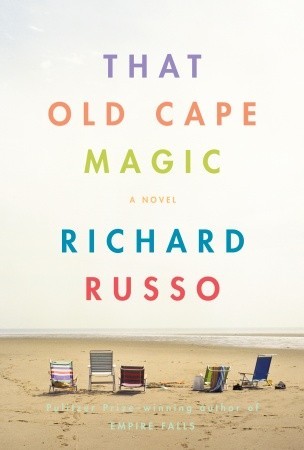
That Old Cape Magic by Richard Russo
Final Verdict: 3.75 out of 4.0
YTD: 52
Plot/Story:
3 – Plot/Story is interesting and believable.
That Old Cape Magic might be one of my favorite reads of the year. The main character, Jack Griffin, is the son of two Literature Professors – brilliant people, Yale educated, who never quite made it as far as they believe they should have. Jack is a disappointment to his parents because he gives up on “important” writing and moves to Hollywood in order to write screenplays. Of course, they are also quite envious of him for getting out of “the mid-fucking-west,” as they call it. Still, his parents are of the class of “academics” who find any popular writing – anything that anybody would willingly publish or find enjoyable to read- not at all valuable (don’t we all know those types of academics who think, “if the commoners are reading it, it must not be very good!”?). Griffin struggles against their influence all his life, only to realize very late that he has become exactly like them (even –gasp- a literature professor!). Over the course of decades, as he slowly morphs into the very thing he was rebelling against, he loses his parents, his wife, and any sense of self he once had. He, like his parents, seeks out Cape Cod in order to reclaim himself and remind him of what is truly important to him, and to set his parents to rest, at long last. Ultimately, Jack’s journey is to find happiness by accepting where he comes from, by letting go of pains from the past, and by acknowledging all the good things that he has – a lesson most of us could be reminded of from time to time.
Characterization:
4 – Characters very well-developed.
The characters in this book range from self-absorbed (most of them), to self-deprecating; from hilariously buffoonish (Jack’s brothers-in-law) to sensible and patient (Jack’s wife). Although the main character’s parents are painted with a somewhat biased brush, the truth is that they are supposed to appear rather one-sided. Part of the story is an exploration of memory and perception – when we remember events from childhood, when we think of our parents as they were when we were children- are we remembering things accurately? Could we really have known what anyone was like, when we look back on a child’s perspective, thirty years later? Jack looks at each character in the book a certain way, very rarely changing his mind about anyone, but readers get glimpses into different sides of their personalities, which tells us more about them but also about the narrator and his reliability (or not). Russo is adept at narrating small moments, such as a woman crying in the shower or a father thinking about his daughter, to illustrate and round-out even the more minor of characters in the story. We learn that everyone has at least two identities, the way they see themselves and the way others see them, but two is just the minimum – most of us have many more. Although the cast is rather sad and unlikable (his characters and plots combine in ways which create a sense of what Thoreau calls the “quiet desperation” of man), and though many of them have bloated egos and often lament the life they could have had, without making much effort to achieve it, still they come together to tell a story – they are believable, recognizable people in believable, recognizable families and situations.
Prose/Style:
4 – Extraordinary Prose/Style, enhancing the Story.
Perhaps Russo’s greatest strength, at least in That Old Cape Magic, is his storytelling ability. He understands people and their complexities. He is sensitive and observant, which is appropriate when considering that this is really a story about stories and a tale about telling (one would expect a writer to be almost obsessively observant – and we surely recognize this in ourselves). His prose is light but serious – it’s a bizarre way of reflecting real life, where most of our thoughts are on the surface, yet powerful and sometimes dangerous emotions are always at work, deep in the undertow. Russo drops philosophical tidbits here and there throughout the book – little life lessons about understanding people, living with compassion, questioning (and even doubting) our own memories. The fluid prose, the welcoming language (drawing us into the story even when the characters might be repellant), and the oftentimes hilarious reflections and dialogue all make for an enjoyable and satisfying reading experience.
Additional Elements: Setting, Symbols/Motifs, Resolution, etc.
4 – Additional elements are present & enhance the story.
There are two primary subjects in That Old Cape Magic. The first is family and relationships; the second is writing and, more specifically, popular writing vs. academic writing (what is “valuable?”). For the first, Russo explores an idea that his main character, Griffin, inherits from his parents – that happiness, and home, is “a place you could visit but never own.” For his family, that place is Cape Cod, but the reality is that they are never truly happy there, either. The second theme, academic versus popular writing, and what matters, is especially fun and interesting for students of English/Literature, particularly those familiar with academic department politics (groan). Russo’s book is clever in that it is written as popular contemporary fiction, but he is clearly aware of the academic side (and likely reception by academics to this, his own work) and of the prejudices and pretensions that come with “literary” scrutiny. Who are these people who get to define what is “good” and “important,” he seems to be asking. Russo drops-in references to Melville, Faulkner, and other canonical writers, which is clearly a “poke in the eye” to the prestigious readers, indicating that he knows what he is talking about; but, he also manages to make the story his own, modern and readable, so that really anyone (particularly fans of fiction that explores families, memory, and writing) can enjoy it. I would not go so far as to say that this is a brilliant work, but Russo is a Pulitzer Prize winning author and That Old Cape Magic helps to explain why. It is fun but powerful, light but deep, easy to follow, yet deceptively layered. A great read, especially for the well-trained reader who will pick-up on subtle literary references (they are not as in-your-face as Jasper Fforde’s, but they are there).
Suggested Reading for:
Age Level: 14+
Interest: Family, Marriage, Adultery, Academia, Metafiction, Literature, Memory
Notable Quotes:
“For a moment it seemed as if Bartleby might offer an observation of his own, but he apparently preferred not to, though he did sigh meaningfully.” (8)
“Stories worked much the same way . . . A false note at the beginning was much more costly than one nearer the end because early errors were part of the foundation.” (67)
“Only very stupid people are happy.” (195)
“Late middle age, he was coming to understand, was a time of life when everything was predictable and yet somehow you failed to see any of it coming.”
Review: These Things Happen by Richard Kramer
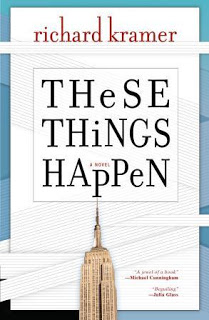
These Things Happen by Richard Kramer
Final Verdict: 3.5 out of 4.0
YTD: 53
Plot/Story:
4 – Plot/Story is interesting/believable and impactful (socially, academically, etc.)
These Things Happen opens with the main character, Wesley, and his best friend, Theo. Both of these young men, teenagers in high school, are special as are, we will quickly learn, all of the characters in the book, in their own way. Theo has been in a race for school class president and Wesley has been there, by his side, as campaign manager and whatever else Theo needs. Things turn out well for the dynamic duo, at least until Theo’s acceptance speech, where some breaking news happens to tumble out of his mouth, in front of the whole school. The repercussions are great, and they send Wesley on a quest to discover more about the people in his life. This quest and the questions he asks, the answers he seeks, will ultimately lead him to become more introspective, to learn more about himself than, perhaps, about anyone else. Over the course of a few days, Wesley’s attempts to connect with his parents result in the start of what might be the most meaningful relationships of his life – but not with the people he originally intended. Wesley’s story is one about friendship and family, about finding one’s self and learning to look at life in new ways, to be open to possibilities, and to never assume to know more than we do, about ourselves or anyone else. This is one of those strange books, like Catcher in the Rye, I’ll Get There It Better Be Worth the Trip, and Jumpstart the World, that belongs in the realm of adult contemporary fiction, even though its main character is a youth.
Characterization:
3 – Characters well-developed.
Perhaps my one concern with this book is its characterization. The message that we are all special and unique, with our own personal, valid life stories, is well taken. However, there is an overabundance of “fabulousness” to these characters – one which is pointed out in the book’s synopsis. The main character Wesley and his best friend Theo are both brilliant, and let each other know it all the time. Wesley’s father and his partner both think the other is smart, funny, amazing. Wesley thinks the same of both of them. Wesley’s mom is talented and intelligent, as is her boyfriend. Everyone in the story, it seems, is super clever and wonderful, except in their own eyes. This says a lot about how we see others versus how we see ourselves, but the “wow” factor of each character was so overemphasized that it, to me, made nobody seem very special at all. That being said, these characters certainly are people, and different ones at that. They are special in their own ways – George, in particular. Character is done best, I think, when it is demonstrated through the various relationships. The strained relationship between Wesley and his father, for instance, or the budding relationship between Wesley and George. The way we see Wesley’s mom, behind closed doors, and the way she comes across in public. Viewing the characters in their different situations adds depth to them and allows us to understand each of them a bit better, even if they haven’t quite figured out themselves or each other just yet.
Prose/Style:
3 – Satisfactory Prose/Style, conducive to the Story.
A carry-over issue I have from characterization has to do with narrative voice(s) in the book. Each chapter is narrated from the perspective of one of the characters, which means our relationship to the narrator changes with each chapter, too. In one chapter, we are with Wesley – seeing things from his point of view. In the next, we are with Theo, or George, or Ben. One would expect, then, a very different voice from chapter to chapter but, unfortunately, the language and style are almost identical, no matter which perspective we are witnessing in any given chapter. Wesley is a great character and, with George, probably the best drawn in the book – I just wish he had been more of a stand-out by being completely different from any of the other characters in the story. Mood and tone do shift, depending on the situation that the narrating characters are in at that point in the story, and the language and style in general are fluid, engaging, and appropriate to the overall tone and level of the story. I found the humor to be current and funny, not necessarily an easy task, and while I am not usually a fan of multiple narrative perspectives, it definitely works for this book, because the essence of the book is not just Wesley’s story, but all stories.
Additional Elements: Setting, Symbols/Motifs, Resolution, etc.
4 – Additional elements improve and advance the story.
These Things Happen by Richard Kramer is a modern take on a modern topic. Thankfully, gay and lesbian fiction is on the rise, both in the adult contemporary and the young adult spheres. There is still a lot of work to be done, but Kramer’s new book happily adds to the genre, and in an innovative way. These Things Happen looks at a variety of homosexual (and general life) issues through the eyes of a heterosexual teenaged boy. What is so fascinating is the fact that three of the main characters are gay, and this story is certainly about their lives, but it is also about the main character, Wesley, and how he begins to come into his own, to understand himself – maybe. Told from the perspective of many of its characters, what the reader learns from each vantage point is that no one is really sure of him or herself – we think we know who we are, but we constantly doubt it. Do others see us as we really are, or as we pretend to be? Can others, those closest to us, know more about us than we know about ourselves? How can listening to and learning about our friends, our parents, our children, give us deeper insight into who we are? This book asks a lot of questions and it answers few of them, but that’s the point – the discovery is ours to make. I can easily imagine These Things Happen becoming an indie/cult classic, someday.
Suggested Reading for:
Age Level: 13+
Interest: Family, Alternative/Modern Families, Friendship, Intergenerational Relationships, LGBT Issues, New York City, Bullying/Violence, Prejudice/Bigotry, Self-discovery.
Notable Quotes:
“I like when someone doesn’t know an answer right off, where what they say first is just a start, that can wind up anywhere. Where answers don’t end things.” (18)
“Sometimes I think I’m like forty different people, sometimes not quite one.” (23)
“If I’m gay, which I am, it’s not because my dad was distant. He wasn’t. And besides, that’s just psychology.” (99)
“He understands tonight, as he might not have before, that to accept what someone wants to give you is, in its way, a kind of bravery.” (215)
“Lying is most interesting as an action when you don’t actually have the need to lie . . . Because it allows you to find out what truth, personally, is for you. Because there have to be more categories, quite frankly, than truth or untruth.” (234)
“It is possible to have an experience and only find out later what it means.” (235)
Others’ Thoughts:
Book Review: These Things Happen by Richard Kramer – As the Crowe Flies (and Reads!)
These Things Happen by Richard Kramer – Shooting Stars Mag
Blog Tour: These Things Happen by Richard Kramer – Dreaming In Books
Review: White Noise by Don DeLillo

 White Noise by Don DeLillo
Final Verdict: 3.75 out of 4.0
YTD: 51
Plot/Story:
4 – Plot/Story is interesting/believable and impactful (socially, academically, etc.)
“This is the language of waves and radiation, of how the dead speak to the living.”
White Noise is the story of Jack Gladney, a professor of Hitler Studies at a small liberal arts college in “Middle America” (I envisioned South Dakota, though it is never explicitly stated). Jack and his (fourth) wife have an interesting relationship – a co-dependency of sorts, wherein they’re drawn together both from a sense of love but also from a fear of dying. They have four children, each of whom is special in some way, particularly the eldest son whose brilliance is in a way emasculating to his professor-father. The family dynamic and the parents’ overwhelming, paralyzing fear of death come to the fore-front as a black chemical cloud is accidentally unleashed in the community. This “airborne toxic event” as it is called, is a physical manifestation for the emotional “white noise” that the Gladneys and, in a way, all Americans are experiencing. All of the technological advancements and innovation have brought us great wonders, but at what cost?
Characterization:
3 – Characters well developed.
The Gladney family reminds me of a real modern family. They are recognizable in a distinctly “now” way, as coinhabitants of a specific residence (although, sometimes, there are multiple parents and step-children who do not all live together so, really, they are not even coinhabitants of a residence, but of a stretched sphere). Parents have lost a certain parental authority. Children have gained a certain dominance over their elders because they are growing up with a firmer grasp of the contemporary technology. All of this is represented by Jack & Babette and their bizarre children. Heinrich, who at 14 is already a skeptic and a cynic who reduces everything to analysis – who cannot wish or wonder or find awe in anything. Steffie is overly sensitive, unable even to watch television shows where people are put in danger or made to look stupid (like reality shows). Denise is sharp and bossy, spotting her mother’s drug problem before anyone else and trying, unlike anybody else, to do something about it. Wilder, though mute throughout the entire book, turns out to be one of the most important family members, particularly as a source of comfort to his neurotic parents.
Prose/Style:
4 – Extraordinary Prose/Style, enhancing the Story.
Combined with the interesting subject matter and the (sad) realism is a great writing style. Dialogue and storytelling are clearly strengths for DeLillo (at least in this novel – I have not read anything else by him). He understands people and contemporary relationships, in particular. This comes across in the way he tells the story, the sense of humor, the movement, the disappointment – it is all there in the language. For a book that is largely about our unwillingness or inability to communicate, DeLillo manages to get the message across loud and clear. White Noise is a masterpiece of postmodern discourse – it is a work of metafiction, cleverly disguised as a family story.
Additional Elements: Setting, Symbols/Motifs, Resolution, etc.
4 – Additional elements improve and advance the story.
This is the book I would love to have written. This is the type of book that I think about all the time, that I have tried to write on a few occasions. Nobody knows how to communicate effectively. Kids create drama to get noticed, parents create drama because they are unfulfilled, bored, unsatisfied – constantly bombarded with messages that we are all supposed to want more, own more, buy bigger, have better. We don’t really know our neighbors anymore, or our co-workers. Drugs are prescribed to treat our problems, other drugs are prescribed to control the side-effects of the first ones. We can’t sleep without pills, can’t wake up without caffeine. We take pictures of pictures and lose all sense of or care for original works of art, because we can keep photocopies of these things, oftentimes more brilliant than the originals, in our back pockets. We are constantly connected to instant-information devices, so we learn nothing and remember nothing, because the answers are handed to us at the touch of a screen. We are becoming something other than human.
Suggested Reading for:
Age Level: 14+
Interest: Mass Culture, Paranoia, Cultural Studies, Contemporary Issues, Neurosis, Anxiety, Family, Higher Education, Technology, Chemical Weapons, Pollutants, Postmodernism, Metafiction, Language
Notable Quotes:
“What good is knowledge if it just floats in the air? It goes from computer to computer. It changes and grows every second of every day. But nobody actually knows anything.”
“Man’s guilt in history and in the tides of his own blood has been complicated by technology, the daily seeping falsehearted death.”
“These things happen to poor people who live in exposed areas. Society is set up in such a way that it’s the poor and the uneducated who suffer the main impact of natural and man-made disasters.”
“Heat. This is what cities mean to me. You get off the train and walk out of the station and you are hit with the full blast. The heat of air, traffic and people. The heat of food and sex. The heat of tall buildings. The heat that floats out of the subways and the tunnels. It’s always fifteen degrees hotter in the cities. Heat rises from the sidewalks and falls from the poisoned sky. The buses breathe heat. Heat emanates from crowds of shoppers and office workers. The entire infrastructure is based on heat, desperately uses up heat, breeds more heat. The eventual heat death of the universe that scientists love to talk about is already well underway and you can feel it happening all around you in any large or medium-sized city. Heat and wetness.”
“Once you’ve seen the signs about the barn, it becomes impossible to see the barn.”
“I am the false character that follows the name around.”
“I feel sad for people and the queer part we play in our own disasters.”
December Random Acts of Kindness


I’m back in action for Random Acts of Kindness again this month! I’ve participated fairly regularly over the past year or so (even during this insanely busy semester), but I didn’t get a chance to participate in November.
Since the holiday season is upon us, I definitely wanted to sign-up again in December and have been excitedly browsing others’ wish lists and marking books I want to buy for some lucky folks – can’t wait to send out emails this weekend!
If you’re interested in joining this month’s Random Acts of Kindness, here are some details:
Please read carefully & follow all rules! Thank you!
- Please sign-up to participate (and by participate, we mean give as well as receive).
- Show off your participation by grabbing the RAK button.
- Create a wish list (on Amazon, Goodreads, or your blog, etc) and post it in the Google Doc located in the R.A.K post.
- If you choose to do a R.A.K for someone, check out their wish list and contact that blogger directly for their information.
- Once you receive a RAK, send an email to [rakbybooksoulmates @ gmail . com] so they can update the Google Doc.
- At the end of the month, SHOW US YOUR R.A.K by making a “RAK Wrap-Up” post. This post should include who you SENT gifts to as well who you RECEIVED gifts from 🙂
It’s a Winter Break Celebration!


Well, I have just completed my first semester in the Ph.D. in English program. It was . . . exhausting, time-consuming, and hard work. But it was also interesting and rewarding. I know that my blog updates over the past few months have been lacking (I’m behind by about 8 or 9 reviews!), but I hope to get caught up over the winter break.
All that being said, I did receive a lot of kind words from people on Facebook, Twitter, and here on the blog – encouraging me to hang in there and to stay calm, and letting me know that they would stick with the blog! You guy ares are awesome! And, as an added surprise this morning, I see that my blog now has almost 100,000 unique hits! That’s nearly 50,000 hits since April of this year! I’m so grateful, and I still can’t believe how much love and attention Roof Beam Reader has enjoyed.
Anyway, to celebrate the end of my first semester and this near-100,000 mark, I’m throwing together a little giveaway. This is to say “thanks” to all of you who have stuck with me during a difficult readjustment period (returning to school after almost 5 years) and also to treat myself, in a way, for finishing the first semester and doing quite well, if I do say so myself!
The Giveaway: Any book of your choice, up to $20 USD from The Book Depository.
Enter by Completing: This Form.
+1 Entry for Following on Twitter (@RoofBeamReader).
+1 for “Liking” Roof Beam Reader on Facebook.
+2 for Tweeting: Check out the Winter Break Celebration Giveaway hosted by @RoofBeamReader & Win a book of your choice! http://wp.me/p1n6kW-12J
Rules:
–Must be a follower.
–Must be 13+ with parental permission if under 18.
–Winners must respond to e-mail within 48-hours or new winner selected.
–Winners chosen randomly through Random.org
-Giveaway ends at 10pm Central Time (USA) on Friday, December 14th.
Book Suggestions:
Here are my favorite reads of 2012, so far. By all means, feel free to choose something else – just thought I’d share some that I’ve enjoyed! What books have you loved in 2012?
That Old Cape Magic by Richard Russo (review to come)
Play it as it Lays by Joan Didion (review to come)
White Noise by Don DeLillo (review to come)
Dinner at the Homesick Restaurant by Anne Tyler
The Woman in White by Wilkie Collins
 Roof Beam Reader