Roof Beam Reader
Adam Burgess
Review: Jack Holmes and His Friend by Edmund White (The Green Carnation Prize)


This is Book #1 for our Green Carnation Prize reading project. For more information on the project and on the Green Carnation Prize itself, please visit This Post.
About the Book:
Format: Hardcover
Published: January 1st, 2012
Publisher: Bloomsbury UK
Description:
“Jack Holmes and Will Wright arrive in New York in the calm before the storm of the 1960s. Coworkers at a cultural journal, they soon become good friends. Jack even introduces Will to the woman he will marry. But their friendship is complicated: Jack is also in love with Will. Troubled by his subversive longings, Jack sees a psychiatrist and dates a few women, while also pursuing short-lived liaisons with other men. But in the two decades of their friendship, from the first stirrings of gay liberation through the catastrophe of AIDS, Jack remains devoted to Will. And as Will embraces his heterosexual sensuality, nearly destroying his marriage, the two men share a newfound libertinism in a city that is itself embracing its freedom.
Moving among beautifully delineated characters in a variety of social milieus, Edmund White brings narrative daring and an exquisite sense of life’s submerged drama to this masterful exploration of friendship, sexuality, and sensibility during a watershed moment in history.”
-From Goodreads.com.
My Thoughts:
Reading Jack Holmes and His Friend is, for me, like visiting an old friend who I haven’t seen in a while. In years gone-by, I have read and enjoyed other White novels, including A Boy’s Own Story and The Beautiful Room is Empty. As with any reunion, though, one notices certain differences. For instance, the two books read previously are both semi-autobiographical (or, as I would prefer to call them, creative non-fiction). This one, though, is a bit more difficult to figure out. The primary character, Jack, is a gay man with aversions to homosexuality. I actually saw quite a bit of myself in him (at first – but only at first!), which was fun, as I usually do not identify at all with fictional gay characters.
Jack has a difficult time coming to terms with is sexuality, though he does eventually accept himself, after attempting, through physical action, therapy, and other methods to “fix” himself and become heterosexual. He also struggles his entire life with being in love with the man (Will) who becomes his best friend. Some readers have found this relationship cliché, but I would argue that 1) something is not cliché simply because it happens often in real life and 2) White handles this yearning, in Jack, with a sense of realism that is not often found in these types of situations—it does not feel like a “puppyish” type of unrequited love, as might be found in YA books.
Readers should also be prepared for quite a bit of masterfully crafted erotic segments, both heterosexual and homosexual. White has always portrayed sexuality and sexual situations in a naked (no pun intended) uninhibited way, and that certainly still holds true. Readers who are expecting a purely “gay” tale, though, will be in for a surprise, as the heterosexual escapades seem, to me, just as accurately and intimately detailed as the homosexual ones.
What I find most appealing about the story, though, is its temporal reach. The novel spans decades and it is fascinating to watch how the friendship between Jack & Will changes over time (as well as how they themselves change), but also to witness the important historical events and movements that take place, particularly the AIDS epidemic and how it impacted the gay community of New York. I did find Jack’s “growth” a bit contrived and forced – I will leave the impetus for that growth out of this review, so readers can discover and evaluate it for themselves; but, I for one would have liked to see that development come from a “purer” place (if that can be said to exist).
Some of the difficulty of this book is in its structure. While the prose is beautiful, the back-and-forth narration, from Jack’s perspective (but in third-person), to Will’s perspective, and then reversed again, is a bit odd and distracting. I understand that White wanted the reader to relate closely to both the gay and straight characters, to experience their world through the eyes of both friends, but I wonder if a simpler, consistent third-person narrator might have been more effective in serving this purpose.
Would I recommend this book? I would, indeed. Is it worthy of The Green Carnation Prize? Well, fortunately, that is not for me to decide! I do see how and why this book made its way onto the short list. White might be breaking-ground with his look at adult male relationships, here. Can a gay man and a straight man be best friends? Absolutely. But if that gay man happens to be in love (obsessed) with his friend? Complications! Those situations and complications do happen, though, and they have not yet been extensively explored in fiction. Although its structure and style might leave a bit to be desired, Jack Holmes and His Friend absolutely has a place on the shelf and adds a certain something to the canon of gay literature. It is also an interesting read for those interested in cultural studies (particularly 1960s/70s New York City), the nature of friendship, and sexuality.

Up Next in Our Series on the Green Carnation Prize Short-List:
December 4th: Scenes from Early Life – Philip Hensher (Ana of Things Mean A Lot)
December 5th: A Perfectly Good Man by Patrick Gale (Mat of MatLee Reviews)
December 6th: Carry the One by Carol Anshaw (Cass of Bonjour Cass!)
December 7th: Moffie by Andrew Carl Van Der Merwe (No review scheduled – please comment if you would like to read/review this book for our project!)
December 10th: Tony Hogan Bought Me an Ice Cream Before he Stole Me Ma by Kerry Hudson (Jodie of Book Gazing)
I Have Been…

I saw Allie post this on her blog A Literary Odyssey. It’s cute and fun and I haven’t had the time/energy to write any reviews lately (sorry!), so I thought I’d have a little fun with this instead.
I Have Been:

{writing}
Essays. Lots of them. Over the past few months, I’ve had at least a 5 or 10-page essay due almost every week. I had a 5-page paper (and a presentation) to do two weeks ago, before Thanksgiving break. Got a tiny bit of respite, then it was another 5-pager due this week, a 15-pager due next week, and another 10-pager due the week after! But, at long last, I can finally see break-time on the horizon…. two more weeks until winter break! Of course, I still work full-time, but it’s something.
{reading}
Lots of scholarly articles and narratology/narrative theory books. Some E.A. Poe and some 20th Century American Lit. Not very much pleasure reading, though. I try to sneak in a short story from Poe once a week (originally, I was trying to do one a day – but that didn’t last long. 3 Days, maybe?). I’m also reading Jack Holmes and His Friend by Edmund White for our Green Carnation Prize Reading Project.
{listening}
To lots of talk radio (I drive a lot and spend about 90% of my drive time listening to 92.7 WCPT – Chicago’s Progressive Talk). Also some of my own personal mixes and, yes, Christmas music!
{watching}
Weeds (Season 4? 5? Whatever the newest season on Netflix is) and some other shows that are in season, like The Big Bang Theory (love!), The Office, Cake Boss, The Daily Show, The Colbert Report, Glee, Family Guy, The Simpsons, and Hot in Cleveland. Yeah, I watch too much t.v.
{looking}
At Christmas wish lists for my family members… dreaming of all the things I wish I could buy them, and thinking about what I’ll actually end up getting ’em. HAH.
{learning}
I’m learning all the time – I do that on purpose. I don’t understand the point of drifting through life living through rote and closing one’s self off to new knowledge and new experiences. I know that sounds preachy and pretentious, but seriously… why get up and go out every day if you’re not going to get anything new from it? But, more specifically, I’ve been learning a lot about narrative discourse, narratology, and various aspects of 20th Century American Lit. I’m working on a research paper for Steinbeck’s Grapes of Wrath, so I’m learning quite a bit more about that particular book as well.
{feeling}
Exhausted, tired, kind of ambivalent about things, to be honest. Everyone warned me that pursuing a Ph.D. in English would be, well, trying. And they’re right. You’re not supposed to work (and certainly not full-time) while pursuing a Ph.D. but, unfortunately, I don’t really have a choice. I’ve also been weighing a few decisions, waffling on certain things, and letting my life get a bit disorganized and out of control. Not in any extreme way, but enough to make me feel anxious.
{anticipating}
The three-week winter break that is coming up soon! I can’t wait to take a little breather from all this schoolwork and from all the driving (it’s a 75-minute drive each way, twice per week, right after a 9-hour work day). I’m also hoping to get some extra workouts in during this time, since it’s been impossible (okay, highly difficult) for me to exercise regularly while I’ve been working and in school full-time.
{wishing}
I would finally win the lottery so that I could concentrate 90% of my energy on my doctoral studies and the other 10% on world travel. 😉
{loving}
My partner! We are celebrating our 6th anniversary today! Also, my family and my friends. I’m loving my new car, but not the payments that come with it. And, as always, I’m loving my books and my music – they keep me calm and sane(ish).
The Green Carnation Reading Project

Hello, Readers!
I wanted to share some information about The Green Carnation Prize. This might be of particular interest to those who participated in last month’s “Literary Others” reading event. I’m also working with a group of book bloggers on a “Green Carnation Project.” Essentially, we’re reading the short-listed books, talking about them, and posting our reviews – and those reviews will be going up next week!
About The Green Carnation Prize:
“The Green Carnation Prize is a literary prize for any form of the written word by an LGBT writer. The prize got off to a great start in 2010 as the first award that celebrated the best fiction and memoirs by gay men. It provoked debate, produced an intriguing shortlist and chose a worthy winner in Christopher Fowler’s ‘Paperboy’. In 2011 it was followed by Catherine Hall’s ‘The Proof of Love’” (the prize also “opened itself to any LGBT author worldwide” in 2011).
About The Green Carnation Reading Project:
As many of you know, I was a panelist for this year’s LGBTQ Category of the Independent Literary Awards. One of the other panelists contacted me with the idea of reading the books that had been short-listed for the Green Carnation Prize, conversing about them, posting reviews for them, and sharing our thoughts with our readers. It sounded like a great idea to me, so I hopped board! All of the books on the short-list this year sound good to me (seriously), so I’m excited to be a part of this and to hopefully share with you all (and the readers of the other project members’ blogs) some great new books/authors!
The Project Readers:
The Short List:
Jack Holmes and his Friend – Edmund White (Read by Adam. Review Date: Dec. 3rd)
Scenes from Early Life – Philip Hensher (Read by Ana. Review Date: Dec. 4th)
A Perfectly Good Man – Patrick Gale (Read by Mat. Review Date: Dec. 5th)
Carry The One – Carol Anshaw (Read by Cass. Review Date: Dec. 6th)
Moffie – Andre Carl Van Der Merwe (Read by …. Review Date: Dec. 7th) *We are looking for someone who would be interested in reading this book in the next few days and reviewing it by December 7th or 8th. If you’re interested, please comment or e-mail me!
Tony Hogan Bought Me An Ice Cream Before He Stole Me Ma – Kerry Hudson (Read by Jodie. Review Date: Dec 8th)
We are all really looking forward to discussing these books, sharing our thoughts with you all, and waiting impatiently to see who will win the prize (will we be able to predict the winner!?). Hope you all enjoy the ride! 🙂
The Ernest Hemingway Audiobook Library! (Simon & Schuster)

I was recently contacted by the Audio division of Simon & Schuster, who let me know that the Complete Works of Ernest Hemingway were about to be released, for the first time, as an audiobook collection. As a fan of Hemingway, I was thrilled. Then, after seeing who they got to narrate these texts, I became even more excited!
Normally, I’m not one to promote for promotion’s sake, but because I’m a regular Hemingway reader and because I know a lot of my subscribers are also fans of the classics (I’m lookin’ at you, Classics Club members!), I thought it was appropriate to share this information.
Here’s a link to an excerpt from The Old Man and the Sea. Other excerpts are available to listen to on the website. Also, if you visit the website directly, you will be able to purchase the collection for 40% off! This is only available until December 15th (and while supplies last), so I definitely wanted to get the word out. It’s a great gift idea for the holidays – either as a treat for you or for a special someone (cough – yours truly? – cough!). 😉
More Info from the Publisher:
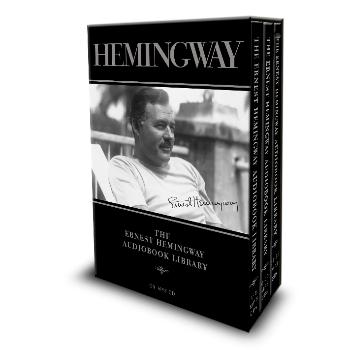
Simon & Schuster Audio is proud to announce the publication of THE ERNEST HEMINGWAY AUDIOBOOK LIBRARY on Tuesday, November 20, 2012. This comprehensive collection brings together all of Hemingway’s novels, nonfiction and short stories. Narrated by an all-star group of actors, the collection offers 133 hours of audio on 15 MP3 CDs and includes an intimate conversation with Hemingway’s last surviving son, Patrick.
“Since 2002, Simon & Schuster Audio has been re-introducing Hemingway’s incomparable body of work to a new generation of listeners, read by some of the finest actors of our generation,” says Chris Lynch, President & Publisher of Simon & Schuster Audio. “Today, the MP3 audio format allows us to offer all of Hemingway’s audiobooks in this beautiful collector’s edition. It is an incredible value for Hemingway enthusiasts.”
The collection includes Donald Sutherland reading The Old Man and the Sea, William Hurt reading The Sun Also Rises, John Slattery reading A Farewell to Arms and The Short Stories read by Stacy Keach. Other actors featured in the collection are: Brian Dennehy, Boyd Gaines, Bruce Greenwood, John Bedford Lloyd, Josh Lucas, Will Patton, Campbell Scott, and Patrick Wilson.
In addition, the collection’s exclusive interview with the author’s only surviving son is as compelling as the productions themselves. Patrick Hemingway talks frankly about his childhood growing up in Key West and reflects on the life and legacy of his father, Patrick’s candid look back is a unique view into the life of one of America’s greatest writers.
Ernest Hemingway did more to change the style of English prose than any other writer in the twentieth century, and for his efforts he was awarded the Nobel Prize for literature in 1954. As part of the expatriate community in 1920s Paris, the former journalist and World War I ambulance driver began a career that lead to international fame. The publications of The Sun Also Rises and A Farewell to Arms immediately established Hemingway as one of the greatest literary lights of his time. His classic novella The Old Man and the Sea won the Pulitzer Prize in 1953. He died in 1961.
Review: Dinner at the Homesick Restaurant by Anne Tyler
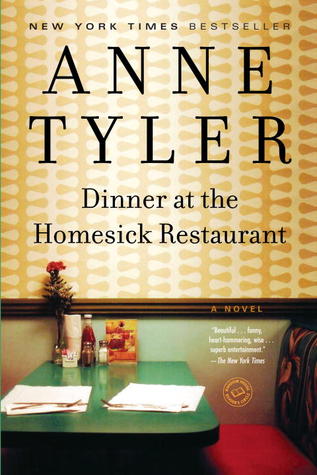
 Dinner at the Homesick Restaurant by Anne Tyler
Final Verdict: 4.0 out of 4.0
YTD: 46
Plot/Story:
4 – Plot/Story is interesting, believable, and impactful.
Anne Tyler’s 1982 novel Dinner at the Homesick Restaurant was a finalist for both the Pulitzer Prize and the PEN/Faulkner Award (1983), and it is not difficult to understand why. The story revolves around the Tull family, which consists of Pearl, an overbearing, somewhat (okay, very) imbalanced mother, and her three children: Cody, Ezra, and Jenny. The father-figure, Beck, abandons the family when the children are still quite young and Pearl spends her life trying to protect her family’s image. She is not in denial about Beck’s abandonment, but she refuses to admit it to her children, to her friend (yes, just one friend) and to her extended family, because that would upset the image that she has cultivated, one of a perfectly ideal family and one which her own family never expected her to achieve. The narrative is told in alternating viewpoints, with a third-person narrator who is, chapter-by-chapter, closely engaged with either Pearl, Cody, Ezra, or Jenny. The narrator remains relatively unbiased, but each chapter does reveal certain of the family members’ own biases, particularly through memory. Cody, for instance, looks back on his childhood as largely traumatic – he felt slighted by his mother, who clearly favored his younger brother, Ezra. Meanwhile, Ezra looks back on his childhood fondly and can’t seem to understand why his family was never able to function well together. Jenny hovers somewhere in-between, clearly troubled and damaged, yet still able to recover – after time – to achieve a somewhat normal life, with a decent family (eventually) and a great career. Ultimately, the story is about the “new normal” of American culture, where women go to work, children begin to fend for themselves, and everyone is dysfunctional in some way or another.
Characterization:
4 – Characters extraordinarily well-developed.
The characters in this book are drawn so well that, even in their horribleness, they are still believable and oddly loveable. At times, their selfishness, lunacy, and anger felt so real as to be laugh-out-loud funny (haven’t we all been so mad, or so sad, that all we could do was laugh about it?). Pearl is an American “Tiger Mom.” She demands perfection from her husband (which drives him away) and from her children (which creates other problems). She is clearly bipolar, at times claiming that her family is the most important thing in the world and then, minutes later, smashing bowls of peas over her daughter’s head. Cody is selfish but in a way that is clearly resulting from jealousy over his brother’s relationship with their mom. He is competitive in everything he does, so much so that he even plots to steal his brother’s wife. Jenny is self-loathing and self-conscious. She is clearly intelligent and capable, but always doubts herself. And Beck, the absent father, is juvenile and self-indulgent. He does send money home for his family on a regular basis, but he leaves them because he cannot bear the pressure of living with Pearl, he cannot live up to her expectations (nor suffer through her very troubling O.C.D.) and, really, just wants to be free to move around, and sleep around, as much as possible. It’s such a small cast of characters, but they are written so well that the story is enlivened and enriched beyond what one might come to expect from a story with such limited focus (one family).
Prose/Style:
4 – Extraordinary Prose/Style, enhancing the Story.
This is the only Tyler novel I have read (and, in fact, this is the second time I’ve read it), and I’m having a hard time figuring out why that is. She’s such a good story-teller; she knows characters and can develop them incredibly well; she has a masterful sense of tone, mood, and pace. On top of all this, her language, prose, and style are almost refreshing in their ease of movement. Although this story is intense at times, the prose moves it along, matching the mood of each scene, adjusting as needed to fit the scenes of suspense, humor, etc. The structure (and the already-mentioned narration) of the novel, alternating viewpoints in every chapter, can sometimes come across (in other works) as pretentious, simplistic, or lazy, but here it is clearly necessary toward achieving Tyler’s end, which is honestly and accurately relaying the “truth” of each character’s reality and memory. Set up in this way, the reader understands the family as a whole, but also how each character fits into it – how they see themselves and how others see them.
Additional Elements: Setting, Symbols/Motifs, Resolution, etc.
4 – Additional elements are present and enhance the story.
The primary themes in the novel are this idea of the “burden of a person’s past,” and also the “family meal.” To this first point, we see that there are multiple histories being examined, one for each of the characters, one for the family, and then the history of each of the family members as seen through the eyes of the others. Needless to say, this book is about personal and familial histories, there’s a lot of it, but it is explored creatively, intricately, and with a remarkable reality. To the second point, the family meal, we see this as a recurring scene throughout. Some of the most touchingly warm and heartbreakingly sad moments in the book occur when the children are eating meals at others’ homes. They see, when having dinner at a friend’s house, for example, how “normal” families function – how “normal” families show love and tenderness toward one another. These scenes are contrasted with ones at the Tull house (I use the word “house” instead of “home” on purpose), where the family meals always seem to start out with the best intentions, but soon go sour. Violent fights, shouting matches, angry insinuations – these are the characteristics of the Tull family meals. From childhood and well into adulthood, Ezra Tull, the family’s most sensitive member and general caretaker, tries his best to get the family to have “one good family meal” – but he never succeeds. In addition to these two main themes are those of alienation and loneliness. Pearl spends her life insulating herself, and her family, from the rest of the world. On the surface, this book seems like just another book about family life, but it’s so much more than that. This is a book every serious reader should experience.
Suggested Reading for:
Age Level: High School+
Interest: Family Dynamics, Sibling Relationships, Single-Mothers, Dysfunctional Families, Comfort Food, Multiple POVs
Notable Quotes:
“When you have children, you’re obliged to live.”
“You think we’re some jolly, situation-comedy family when we’re in particles, torn apart, torn all over the place, and our mother was a witch.”
 Roof Beam Reader