Roof Beam Reader
Adam Burgess
Review: The Marbury Lens by Andrew Smith
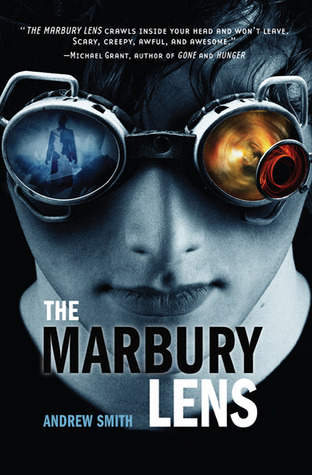
 The Marbury Lens by Andrew Smith
Final Verdict: 3.5 out of 4.0
YTD: 34
This review may contain minor spoilers.
Plot/Story:
3 – Plot/Story is interesting & believable.
Poor Jack. Sixteen years old and still a virgin. Then, in one night, he has the opportunity to lose his virginity with the girl he likes, but chickens out; or, he can join his best friend in a threesome with his girlfriend, but he chickens out. Later that night, he is picked-up by a doctor on a park bench and suddenly whether or not he remains a virgin may not be his choice, anymore. Thus begins an incredibly wild ride, wherein Jack and his best friend, Conner, find themselves phasing in and out of two very different worlds. In this world, they are inseparable, sharing a bond of love like that between two brothers. In the other world, the hidden world seen only through the Marbury lens, they are mortal enemies – victims of entirely different circumstances and determined to survive, by any means necessary. As Jack tries to balance between these worlds, he struggles with the fear and pain which were results of that horrible night with the doctor. He meets a girl, tries to love her, but continues to drift away, like a junkie who can’t fight the desire for his next fix. Jack and Conner, bound not just by their friendship but by what they did before their trip to London – what they did before they were introduced to Marbury, must find a way to come together in both worlds, or risk losing everything.
Characterization:
3 – Characters well-developed.
Usually, I am a fan of the characters in Smith’s stories. He pays attention to characterization and character development because most of the stories (Stick and Ghost Medicine, in particular) are about the characters and their experiences. The Marbury Lens, though, seems to be much more about the story and the bizarre worlds within it than it is about characters; because of this, I feel, the characters are lacking a bit. Conner is probably the most likable and well-developed of the bunch. Jack is interesting, but his back-and-forth perpetual decline seems permanently hopeless – if recovery or stability were ever a possibility (even if it turned out to be false hope or misleading), that would have added a great deal to his depth. Jack’s parents are interesting in their absence, but his grandparents, in their presence, are shallowly evaluated. Jack’s girlfriend, too, is rather dull – and their love story is not very believable, particularly considering the short time Jack & Conner spent in London, and how messed up Jack was (although, much of his time spent with the girlfriend is not shown to the reader directly, because he is simultaneously with her in the “real” world, while also with the boys in Marbury). Perhaps the “real world” characters are less developed, though, because the intrigue is meant to be in Marbury. Jack’s compatriots there, Ben and Griffin, are much more interesting, likable, and real than anyone, save Conner, who Jack might now outside of it. Conner, of course, is present in both worlds, though, which might explain why he is the most interesting of them all.
Prose/Style:
4 – Extraordinary Prose/Style, enhancing the Story.
The story is fast-paced, strange, and disturbing. Its prose matches these elements in various ways. To keep up with the pace (the boys are not in London very long, nor is Jack in Marbury very long, but much has to happen in this time), Smith has constructed the prose into small pieces, like tiny bursts of energy being detonated over and over again. There are some slower moments, such as when Seth is telling his story through Jack, but these are few and far between, and are helpful in keeping the reader from feeling burnt-out or overwhelmed by the rapid-fire sequence of events, particularly the back-and-forth between “real” life and Marbury life. The construction is also linear, but not, which reflects the strangeness of the story. Jack will return from a short visit to Marbury (what seems like a few hours), only to find that days have passed in the real world, and he has no idea where he is or what has happened. Photos, letters, text messages, voicemails and others’ memories will serve to fill-in the gaps for Jack. Ultimately, the pace, style, and construction of the work help to set its tone, which is dark and unrestrained.
Additional Elements: Setting, Symbols/Motifs, Resolution, etc.
4 – Additional elements improve and advance the story.
Paranoia. Guilt. Addiction. Self-abuse. Violence. These are the primary themes of The Marbury Lens. At the beginning of the story, we find a classic case of “boy gets drunk and ends up in the wrong place at the wrong time.” He is abducted and nearly raped, two events which will remain with him forever. But the true haunting comes from what happens when he and Conner find Freddie Horvath, the disturbing doctor, and decide to punish him for what he has done. There is an exploration of cruelty to innocents – from Jack’s experience at the beginning, to Seth’s tale (a ghost who shares his story with Jack, and who suffers brutally for a so-called moral mistake he made when he was a boy, in the late-1800s). Of course, Marbury itself is a place of violence and destruction, where all people are hunted down by monsters and brutally murdered and devoured. What is most interesting, perhaps, is what makes it possible for Marbury to exist – what allows certain people to see through the glasses, when others see only blackness. Jack, Seth, Freddie, Henry, and Conner – they all exist in both places. They can all see Marbury, and the can see so because they all share one common, terrible experience.
Suggested Reading for:
Age Level: HS+
Interest: Violence, Guilt, Paranoia, Addiction, Dystopia, Multiverses, Escapism.
Notable Quotes:
“Mind the gap.”
“What if the world was like one of those Russian nesting dolls? What if we only saw one surface of it, the outside, but there was all kinds of other stuff going on, too? . . . What if you had a chance to see a different layer, like flipping a channel or something? Would you want to look? Even if what you saw looked like hell? Or worse?”
“. . . in Marbury there’s no doubt about the nature of things: good and evil, or guild and innocence, for example. Not like here, where you could be sitting in the park next to a doctor or someone and not have any idea what a sick and dangerous sonofabitch he really is.”
I read this book as a part of the Andrew Smith Saturdays event, hosted by Smash Attack , Not Now I’m Reading, Lady Reader’s Bookstuff and Roof Beam Reader.
There is a read-along of The Marbury Lens currently taking place at Smash Attack Reads.
The sequel to The Marbury Lens (Passenger) will be released on October 2nd, and I will definitely be getting a copy!
Review: Sister Carrie by Theodore Dreiser
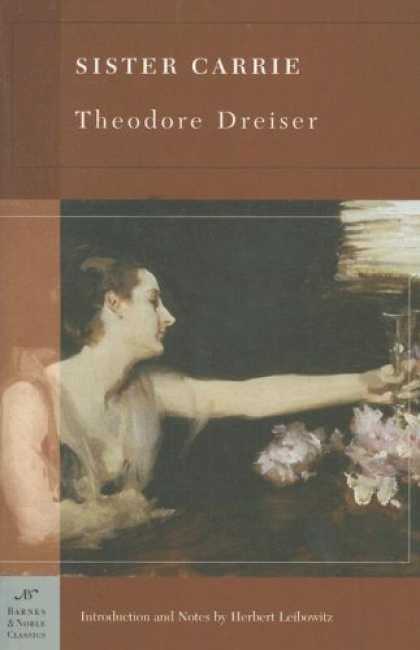
Sister Carrie by Theodore Dreiser
Final Verdict: 3.75 out of 4.0
YTD: 33
Plot/Story:
4 – Plot/Story is interesting/believable and impactful (socially, academically, etc.)
Theodore Dreiser’s Sister Carrie is perhaps the perfect example of American Naturalism. In it, a small-town Wisconsin girl, Carrie Meeber, moves to Chicago to live with her sister and brother-in-law. While on the train into the city, she meets a man named Charles Drouet, and this encounter (characterized by Carrie’s adoration of his fancy clothes and well-to-do appearance) will set in motion Carrie’s entire future. Carrie’s life is filled with example after example of good fortune and coincidence, so that, without taking any real agency of her own, she finds herself elevated from the lowest levels of society (once forced to work in the harshest of factory conditions) to the ranks of wealth and stardom, on Broadway. Concurrently, the life of her second lover, Hurstwood, begins to deteriorate as of the day he meets her. At the start, he is a powerful, charming, and accomplished business man. His wife and children are normal and healthy, although rather self-absorbed. Soon, the powers of fate and destiny converge on Hurstwood & Carrie – their lives are linked and their livelihoods inverted. Hurstwood falls tragically and cannot seem to find his way back, while Carrie rises ever higher, without ever putting in much effort of her own. But, though she ultimately achieves her dreams, she is never happy, never satisfied. She is lost in a world of “cosmopolitan morality,” where success is defined by things and where possessions are consumed at an ever-growing rate, in an attempt to fill an un-fillable void.
Characterization:
4 – Characters extraordinarily developed.
There are two main characters in Sister Carrie, including Carrier herself, as well as George Hurstwood. Although the story’s title would lead readers to believe that the story is all about Carrie, it is not hard to argue that the true main character ends up being Hurstwood (whose decline is ultimately much more interesting than Carrie’s rise). Carrie is naïve, but not inept. She is not exactly a coquette – not immoral, by any means, but she is quite possibly amoral. For most of the book, she lacks completely any agency – she allows others to guide her and care for her. Fortunately, this ultimately works for her, and it is not until near the end of the story, where her relationship with Hurstwood has become interchanged (Carrie becoming the powerful and wealth partner), when she takes a firm action of her own and leaves him to his poverty. The fact that her one self-guided action is to leave Hurstwood when he is down says much about her character, as does the fact that, though she becomes increasingly wealthy and famous, she remains wholly unsatisfied and lonely.
In addition to these main two, there is Drouet, a prominent secondary character. Without Drouet, Carrie’s story could not exist. He is a constant throughout – never changing much, never learning or growing. He does eventually come to love Carrie, but only after she has gone out of his reach (becoming desirable to him after it is impossible for him to have her). Drouet’s constancy allows for the inversion of Carrie and Hurstwood’s situation to be put into perspective – their changes are made clearer in relation to Drouet’s stationary presence. Finally, there are a few prominent tertiary characters, such as Mr. Ames, who is the one person Carrie seems to love and respect most in the world and the one person she wishes most to be like (and be with), but who is also the one person Carrie could never truly understand. Ames is an intellectual – a philosopher and he is entirely without need for commercial things. Carrie is in awe of his ability to be content with whatever he has, because she can never seem to get enough. In addition to those, there are quite a few minor characters (such as Carrie’s sister and Mrs. Vance’s brother). Dreiser’s characterization is brilliant, in that each cast member has a clear and necessary purpose to the story.
Prose/Style:
3 – Satisfactory Prose/Style, conducive to the Story.
The only downfall of this novel, for me, was the prose. Dreiser’s writing was heavily criticized as being pedantic, ungrammatical, and long-winded (even elephantine). Take, for example, the following passages:
“The, to Carrie, very important theatrical performance was to take place at the Avery on conditions which were to make it more noteworthy than was at first anticipated.”
“They had young men of the kind whom she, since her experience with Drouet, felt above, who took them out.”
Clearly, Dreiser was not a master of the poetic. His prose is often clunky and, some would say, cheap or common. Dreiser himself, as well as some of his defendants, assert that his style is actually presented this way as artistic choice – that he was seeking to present “an accurate description of life as it is,” which means narrating in the way common people would think and talk. A poetic or graceful prose, then, would be unrealistic of the circumstances described within Sister Carrie and thus his style makes perfect sense.
Whether or not it was true artistic choice, it comes across as sub-par prose from a journalist-turned-novelist who still had much to learn about writing style. Fortunately, his descriptions and dialogue were generally solid, and his use of concrete and purposeful themes/symbols (the rocking chair, the sea, etc.) throughout help raise the overall tone and value of the prose.
Additional Elements: Setting, Symbols/Motifs, Resolution, etc.
4 – Additional elements improve and advance the story.
William Dean Howells, critic and novelist (and the one man, other than Mark Twain, who was responsible for the success of Adventures of Huckleberry Finn) is considered by most to be the father of Realism. In his explanation of Realism, he stated that it is “nothing more and nothing less than the truthful treatment of material.” There should be nothing sensational, nothing inexplicable in a story, if it is to be considered of literary consequence. (This is, perhaps, why I found his book The Rise of Silas Lapham so incredibly boring, but I digress!). He and other Realists believed that the following principles of life were truth, and thus make up the doctrine of Realism in literature.
– That the world is amoral.
– The men/women have no free will.
– That lives are controlled by heredity and environment.
– That religion’s truths are illusory.
– That the destiny of humanity was misery and oblivion in death.
If one takes these principles into account when reading Sister Carrie, then it becomes clear that not only is Dreiser a practitioner of Realism, but this text might be one of the best examples of theory-in-practice. Each of these five thoughts about life are clearly present in the novel. Dreiser was a true Naturalist, in that he believed we were all drifting along on a sea of pre-determination, destined to end up wherever life would have us end up. The choices we make have very little bearing on what we will be or where we will go, because all of that has been decided for us already (not by God, but by a confluence of fate and chance).
In addition to Sister Carrie being a brilliant example of Realism (if not the best written example), there is also much to examine in regards to the themes of morality, materialism, fate/fortune, cosmopolitan (city) life and even romance. Its place in the canon of American literature is well-deserved, both as an example of a shift in the treatment of women (previous to Dreiser, most “lost” women would end up dead) and in the shift from American Romanticism to Naturalism.
Suggested Reading for:
Age Level: Adult
Interest: Determinism/Fatalism, Naturalism, Realism, American History, Rural-City dichotomy.
Notable Quotes:
“She looked into her glass and saw a prettier Carrie than she had seen before; she looked into her mind, a mirror prepared of her own and the world’s opinions, and saw a worse. Between these two images she wavered, hesitating which to believe.”
“People in general attach too much importance to words. They are under the illusion that talking effects great results. As a matter of fact, words are, as a rule, the shallowest portion of all the argument. They but dimly represent the great surging feelings and desires which lie behind. When the distraction of the tongue is removed, the heart listens.”
“When a girl leaves her home at eighteen, she does one of two things. Either she falls into saving hands and becomes better, or she rapidly assumes the cosmopolitan standard of virtue and becomes worse”
“A real flame of love is a subtle thing. It burns as a will-o’-the-wisp, dancing onward to fairy lands of delight. It roars as a furnace. Too often jealousy is the quality upon which it feeds.”
“Men are still led by instinct before they are regulated by knowledge.”
It’s a Subscriber Celebration!

Are You Ready for an Epic Celebration!?

This Giveaway is Now Closed.
Over the past few weeks, I have been dropping hints/teasers about an insanely epic giveaway coming to the blog. First, let me take a minute to thank some people whom I have met, collaborated with, and been inspired by over the course of this journey. Then, I will explain how this massive giveaway came about.
Thank you, to publishers who have sent me books for review, set up author interviews, sponsored giveaways, etc. Special thanks to:
Simon & Schuster, W.W. Norton & Co, Penguin, Viking, Inspired Quill, Atria, Doubleday, Little Brown, Harper Perennial, and Random House.
Thank you, to authors who have engaged with me, commented on my work, provided guest posts, sponsored giveaways, and made me happy in general. Special thanks to:
Andrew Smith, Kathe Koja, Catherine Ryan Hyde, Robert Dunbar, Brian Farrey, and David Levithan, Arthur Wooten, and K.B. Dixon.
Thank you, to book bloggers who have worked with me on various projects, inspired me to keep going, work harder, be more creative. Special thanks to:
A Literary Odyssey, A Room of One’s Own, Dead White Guys, I Read Banned Books, Esther Hawdon, Owl Tell You About It, and Leeswammes among many, many others.
Just after hitting 3,000 subscribers at Roof Beam Reader, I was contacted by an author with whom I communicate fairly regularly and with whom I have worked in the past. She e-mailed me with a congratulatory note and also said that she would like to give something back to my blog and its readers.
In the e-mail, she says: “It seems like every time I stop by your blog, there is a giveaway happening, or just ending, or just about to begin! You are so generous to your readers, so generous to writers, and so committed to this joyful pursuit we all have in common! It is inspiring and I would love to congratulate you and celebrate with you.” She goes on to say that she will sponsor a 4,000 subscriber giveaway and the prize will be specifically for my USA subscribers.
Well, of course, I was flattered, stunned, grateful, and did not waste a minute in accepting her offer (especially after reading what she would be giving away!). But, I thought I would have to come up with something to include on my own, for international subscribers. I try to make my giveaways open to as many people as possible, always, so I couldn’t just leave out the rest of the world. Enter coincidental contact e-mail #2!
Shortly after reaching about 3,500 subscribers on the blog, I was contacted by a group of colleagues that I have worked with on many occasions and they, too, wanted to do something nice for Roof Beam Reader. Collectively (there were three of them), they decided to offer up an incredibly generous gift to my International readers, since I had mentioned to them that my U.S. readers were going to have an offer all of their own.
So, I coordinated with both sponsors and it was agreed that, when Roof Beam Reader hit the 4,000 Subscriber mark, I would alert them and we would do a combined USA/International HOORAY! giveaway. And that time has come!
The initial sponsor wanted to remain nameless, so the second group decided to do so as well (they wanted me to take credit for this giveaway, as I’ve done so many in the past, but I refused – I could never afford this big of a giveaway, anyway!). Let’s just say, Roof Beam Reader has some amazing, generous angels on its subscriber list, so this is from them to you.
So, as it happens, two very generously donated/sponsored giveaways have come in ALL FOR YOU!!
Giveaway #1 for my USA Subscribers: A Barnes & Noble Nook Tablet (16GB)!

Giveaway #2 for my International Subscribers: A $150 Amazon.com Gift Card!

This Giveaway is Open to the USA and to Any country where Amazon Gift Cards are Available.
Rules:
1. Be 13+ (with parental permission to enter if under 13).
2. Be a subscriber of this blog.
–You can subscribe by e-mail (left-side menu) or through WordPress (if a member).
3. Fill out THIS FORM. Giveaway Closes in 2 weeks (September 15th at Noon Central Time)
4. Winner will need to respond to my e-mail within 48 hours or new winner will be selected.
5. One entry per person. Multiple entries will disqualify you.
You can earn additional entries (see Entry Form) by:
-Following me on Twitter (@RoofBeamReader)
-Liking my Facebook Page (Click Here)
-Tweeting the Following: Roof Beam Reader Subscriber Celebration! Win a Nook Tablet or $150 Amazon.com Gift Card! https://roofbeamreader.com/?p=3533 @RoofBeamReader
That’s it! Good Luck!
Farewell, Jane! (#AustenInAugustRBR)


My-oh-my, how time does fly! August has come and gone, which means our Austen in August event is in its final hours.
I want to thank all of the participants for making this event such an incredible success! I read more Jane Austen this month than I have in my entire life, which is saying something, considering I am currently working on my third degree in Literature!
Ironically, the first text that has been assigned by the Professor of my Narratology class is Austen’s Pride and Prejudice. You better believe I had a little chuckle at the coincidence of this, when I found out about it on Wednesday. I had read P&P (1 ½ times) already, so I didn’t read it for the event – too bad, I could’ve been ahead of the game!
To wrap things up, I just want to point out some of the things that have taken place this month:
Texts I Read: 4 ½
Mansfield Park (50% complete)
My favorite of the bunch was probably Sense & Sensibility, though my thoughts continue to return to The Watsons. I have not been enjoying Mansfield Park much, but I have also been very busy with starting school again (currently reading 5 books simultaneously!), so that distraction/multi-tasking is probably having some impact on my ability to really sink-in and enjoy it.
Linked Posts: 107!
The event is technically not over, yet (here in the midwest we still have about 19 hours to go before the clock and calendar roll over to September 1st) so this number could go even higher. I am still stunned by the level and quality of participation! You can find all the posts Here.
Guest Posts: 6
The Jane Austen Society of North America
The Jane Austen Centre: Bath, England
Author Amanda Grange, Mr. Darcy’s Diary
Author C. Marie Moseley (Pride & Prejudice)
Jane Austen for the Aspiring Writer
Giveaways: 6+
There were many giveaways hosted via the initial sign-up process (announced throughout the event on my blog) and others which popped-up randomly, as people felt the urge to get more involved.
So, a big, big thank you to ALL who committed your time, money, energy, etc. to hosting giveaways, reading texts, writing up reviews/thoughts, writing guest posts and especially bouncing around to other blogs and commenting/interacting – that is really what made this event such a success (and so much fun!).
I would love to hear all of your thoughts on this event, on your reading and experiences with Jane Austen or the “prequel/sequel” works you may have encountered along this journey. Was the event fun? Helpful? If I do something like this again in the future (I will be, so why say “if?”) what kinds of things would you like to see? Do you wish I had done anything different?
Thanks again, everyone – see you next time!
“I declare after all there is no enjoyment like reading! How much sooner one tires of any thing than of a book! When I have a house of my own, I shall be miserable if I have not an excellent library.” — Jane Austen (Pride and Prejudice)
Guest Post: Jane Austen for the Aspiring Writer (#AustenInAugustRBR)
Today’s guest post comes from Alice of Tales of an Intrepid Pantster. Please give her a warm welcome!

On my blog, I post book reviews, as well as posts about learning how to write. In my mind, the two are inseparably linked. An aspiring author can learn a lot from the books that have come before, and I’m certainly not the first to note that, if you want to write, reading will help.
There are a lot of good things a beginning writer can learn from Jane Austen, but, to keep the post concise, I thought I’d narrow it down to what I think is Austen’s greatest strength. Dialogue is something many writers, even published ones, struggle with, yet it seems to come naturally in Jane Austen’s books. Here’s what a writer-in-training can learn from Austen’s example:
1. Every character sounds different.
 Good dialogue varies from one character to the next. Just as you can close your eyes when you’re in a gathering of close friends and pick out who says what, you should be able to take out the dialogue tags (“he said,” “she said”) and still have a good idea of who’s speaking.
In Sense and Sensibility, the Miss Steeles speak imperfect English. They use such constructions as, “If I was to,” and slip “ain’t” into everyday conversation. Their sentences are simpler and more straightforward than the Miss Dashwoods’, which betrays the simpler origins of the former. This leads straight into:
2. Dialogue reveals character traits.
Not all characterization should be explained to the reader. It also needs to be shown, through the character’s choices, actions, and dialogue. Lucy Steele of Sense and Sensibility reveals her less-refined background in her word choices, which better match that of the servants than the highborn characters.
Similarly, in Emma, we’re not merely told that Miss Bates is talkative. We also hear, at length, all of the boring subjects she goes on 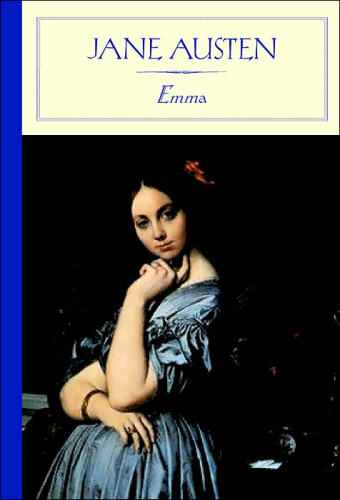 about, and we see Emma deftly extracting herself from these conversations. We know how well-bred Emma is by her able maneuvering of conversations to avoid unpleasant subjects, without upsetting the speakers. Fanny Price in Mansfield Park shows her timidity in conversation long before the narrator mentions it, and Mary Musgrove of Persuasion is never described as a hypochondriac, though it’s clear that’s what she is by how often she complains about her health. Placing the declaration of a character’s death in her mouth was also the most deft way Austen could’ve shown the reader Louisa Musgrove would be okay.
3. Dialogue moves the action.
In Austen’s work, in fact, we hear most plot events through dialogue. People talk about important events, sometimes misinterpreting them to heighten the drama and sometimes merely relating something our perspective characters couldn’t witness. There are also brief asides which indicate what’s happening around the dialogue. In Mansfield Park, characters converse while playing a card game, and much is added to the scene in the speaking character’s interjections of how to play the game.
 In Persuasion, it’s an exchange of dialogue that brings about the conclusion. Anne Elliot is talking to a friend about general opinions on a subject which happen to overlap with her current feelings about Captain Wentworth. She reveals that she still loves him, though not explicitly. She doesn’t think anyone can hear her, or she wouldn’t have spoken so openly. It’s the fact that the right recipient overheard her conversation that she gets her happy ending.
4. Dialogue flows conversationally.
People don’t reveal their innermost thoughts when they speak; they address the topic at hand as diplomatically as the situation calls for. In Austen’s time, that meant women often deferred to men and that social class dictated how openly people could speak. A lot went unspoken, and often not for the same reasons things go unspoken nowadays.
It’s because of these strictures that Austen’s dialogue is so interesting. It’s what isn’t said, what’s between the lines, that creates narrative tension. You read along, hoping, for instance, that Lizzie Bennet of Pride and Prejudice could come out and say she’s feeling more warmly toward Mr. Darcy, and wondering how, despite her limitations, it might be revealed.
Jane Austen’s dialogue isn’t perfect, by modern standards. Her characters make long speeches and declarations that were likely the convention of the time, but that would look out-of-place in modern fiction. There’s more back-and-forth than most contemporary editors would allow. Also, Austen never wrote an exchange between two men without a woman present, because she, herself, didn’t
know what it would sound like. A modern author would be able to research it by watching movies or openly asking her guy friends what they talk about.

Still, considering how well Jane Austen’s books continue to hold up, a young writer-to-be could do a lot worse than to read her books and pay attention to what she does well. Austen didn’t have any creative writing workshops at which to learn to “show, don’t tell,” “write what you know,” and “dialogue always performs more than one function.” She just did these things well, which is one of the many reasons we’re still reading her work.
Thanks, Alice, for stopping by and sharing such a unique perspective on Austen. As a creative writer myself, I appreciate the points you raise regarding Austen’s style and why it works so well. Austenites and Roof Beam Readers, you can find Alice at her blog and on Twitter.
 Roof Beam Reader