Roof Beam Reader
Adam Burgess
Review: The Last Enchantment by Mary Stewart
The Last Enchantment by Mary Stewart
Final Verdict: 3.25 out of 4.0
YTD: 14
Plot/Story:
3 – Plot/Story is interesting & believable.
The Last Enchantment is the third book in Mary Stewart’s Merlin trilogy (which later became the Arthurian Saga, with the inclusion of a fourth book, The Wicked Day). This portion of the trilogy concerns the waning of Merlin’s power, the fulfillment of his final prophesies, and the rise of Nimue as King’s enchantress. Like its predecessors in the trilogy, this book reinvents some of the major elements of the Merlin legend, such as Merlin’s entombment in the crystal cave, Morgause & Mordred’s lives, and Arthur’s betrayal by Gwenevere and Lancelot (Bedwyr).
Characterization:
3 – Characters well developed.
What this installment of the series does better than its predecessors is that it allows for growth and development of the characters. King Arthur’s leadership style and personality are given more attention and some of the minor characters (such as Gwenevere and the lesser Kings) are also clearly drawn, though in a subtle, understated way. The greatest achievement in this regard is with the character Merlin. This, his final phase, is both sad and noble. The relationship he builds with Nimue is touching and heartbreaking. As Merlin’s early prophecies about his own demise begin to come to fruition, the reader cannot help but hope for Merlin’s success, though it would ironically prove him a failure.
Prose/Style:
3 – Satisfactory Prose/Style, conducive to the story.
Stewart is a good writer and satisfactory storyteller. The book is constructed in such a way as to progress the story fluidly and rapidly, without it seeming rushed or impatient. Most of the chapters are short, though there are lengthier portions where more time must be spent on a single subject – these choices are made consciously, however, and prove necessary to appreciating and understanding the more important aspects of the overall plot. The only downfall for this edition of the novel is that it is littered with proofing errors. There are multiple instances (particularly nearer to the end of the book) where words are missing or incorrect (“if” instead of “of”, for instance). These grammar and proofreading issues should have been caught prior to publication, so it is no fault of the others and does not necessarily take away from the reading experience (except for OCD English majors such as myself).
Additional Elements: Setting, Symbols/Motifs, Resolution, etc.
4 – Additional elements improve and advance the story.
How does a man of power and consequence deal with the waning of that power and stature? How does a man of supernatural gifts grieve their loss and find a new place for himself in the mortal world? This final installment of the Merlin trilogy deals with the rise and fall of magical and godly powers, yes, but its message resounds with the common reader just the same. This is a story about the circle of life, one which takes us from birth and discovery of the many wondrous, seemingly inexplicable things around us, to coming of age and learning to question what we see and what we think we know; it leads us to explore the power of healthy manhood and the wisdom that comes with elder years, then forces us to confront old age and a new dependency on others. This is a story about love and friendship, war and peace, land and spirit – it is a story about mistakes made, lessons learned, and the very personal meaning of magic.
Suggested Reading for:
Age Level: High School +
Interest: Fantasy, Mythology, Merlin lore, Arthurian Legend, History, Ancient British History.
Review: Howl’s Moving Castle by Diana Wynne Jones

 Howl’s Moving Castle by Diana Wynne Jones
Final Verdict: 3.5 out of 4.0
YTD: 13
Plot/Story:
3 – Plot/Story is interesting & believable.
Diana Wynne Jones’s Howls Moving Castle came about when a young boy asked the author to write a story about a castle that moved. Knowing that ahead of time added an interesting element to the experience, as it was fun to see how that one small, random request morphed in Jones’s imagination and eventually came out as this very entertaining and surprisingly meaningful book. The story is about a young woman, Sophie Hatter, who is the eldest of three sisters. The book immediately takes on a satirical tone, simultaneously mimicking and mocking the literary fantasy (and particularly fairy tale) traditions of yore. Sophie and her family live in the Kingdom of Ingary, where conventional fairy tale tropes are in effect facts of life. As the eldest sister, Sophie knows she must take care of her family first – probably living to become an old maid while her sisters get to go to the balls, court dashing princes, and study the magical arts. Things begin to change, though, when Sophie is mistaken for her sister by the Witch of the Waste. She is cursed into appearing like a haggardly old woman and she soon leaves town to find a cure, bringing her to Howl’s moving castle. There she meets Howl’s apprentice, Michael, and learns that she has certain magical talent of her own. She eventually helps Howl in a final show-down between good and evil (or, perhaps, bad and worse?) against the Witch of the Waste, and learns that her curse might not have been all it –or she- appeared to be.
Characterization:
4 – Characters extraordinarily well-developed.
Although a traditional young fantasy tale in many ways, Howl’s Moving Castle is very much about a young woman’s coming-of-age. Just as Sophie is learning to appreciate herself – seeing herself as attractive for the first time and exchanging drab gray clothing for brighter hues, she is cursed and becomes a gnarled old woman. Jones is exploring the nature of individuality and self-worth; only by becoming this older woman can Sophie begin to understand and appreciate who she is – a strong-willed, confident, powerful individual. She begins to realize that she is not destined to be just “the eldest sibling” as tradition would have it. Sophie discovers that she is in command of her own fate and that those around her, including her family and new friends, will love and respect her all the more as she embraces who she is and learns to respect herself. The other characters in the story are equally deep, though they may appear flippant or standardized at first glance. Wizard Howl, for instance, is an excellently drawn Byronic hero. Seduction of young maidens is his modus operandi, so much so, in fact, that he is feared throughout the kingdom as the wizard who eats young girls’ hearts (taken literally by the people – which makes him a feared character, although in reality he is quite harmless and endearing, if not more than a bit vain). The reader discovers through Howl’s assistant Michael, that Howl has never truly been in love with any of the women he has courted – and he knows this because Howl always looks so incredibly dashing when he goes out on the prowl. Near to the end of the story, though, we realize poor Howl must have fallen head-over-heels for someone because, for the first time, he is totally disheveled. Ultimately, the characters are much deeper than they first appear to be; when the reader sits back and examines their purpose and their connections to other characters, the development of and sub-layers for each, but particularly the major characters, is quite striking.
Prose/Style:
3 – Satisfactory Prose/Style, conducive to the Story.
One minor point of contention for me was that the smartness of the story did not quite seem to gel with the middle grade reading level of the prose. It is, after all, a middle grade book – so making it readable by the prospective age group is absolutely paramount. While I understand the primary audience is young readers, I couldn’t help but be a tiny (tiny) bit put-off by the sparse style and simple language, when the story itself is so witty and multi-layered. Still, this is the smallest of small complaints because, in reality, Jones does what she sets out to do; she has produced a well-written, well-constructed, well-paced story for young readers, with added elements that give the book richness which older readers will enjoy and appreciate too.
Additional Elements: Setting, Symbols/Motifs, Resolution, etc.
4 – Additional elements improve and advance the story.
Perhaps the most endearing aspect of this book, for book lovers, is that it is rife with literary allusions. Jones references a plethora of authors and stories from the fantasy canon, including J.R.R. Tolkien, Lewis Carroll, L. Frank Baum, and Arthurian Legend, and also from British literature, including Shakespeare and John Donne. These little gems are delightful for those who recognize them, but also work well in the storyline in general, so young readers will appreciate their presence at face-value. This type of sub-context, coupled with the major themes of love and destiny (Sophie is grappling with the fates, fighting to break the fairy tale mold placed on her as eldest sister, though on the surface she has seemed to resign herself to the traditional role) makes for a fascinatingly and surprisingly rich story for young (and older) readers.
Suggested Reading for:
Age Level: Middle Grade
Interest: Fantasy, Magic, Family, Coming-of-Age, Sibling Rivalry, Love, Perception, Fairy Tale, Satire, Jealousy, Destiny.
Notable Quotes:
“In the land of Ingary, where such things as seven-league boots and cloaks of invisibility really exist, it is quite a misfortune to be born the eldest of the three. Everyone knows you are the one who will fail first, and worst, if the three of you set out to seek your fortunes.”
“I assure you, my friends, I am cone sold stober.”
“I must apologize for trying to bite you so often. In the normal way, I wouldn’t dream of setting teeth in a fellow countryman.”
This book was recommended to me by Amanda.
Review: The Crystal Cave by Mary Stewart
The Crystal Cave by Mary Stewart
Final Verdict: 3.5 out of 4.0
YTD: 11
Plot/Story:
3 – Plot/Story is interesting & believable.
The Crystal Cave is the first book in Mary Stewart’s Merlin Trilogy. She based the series on Geoffrey of Manmouth’s Historia Regum Britanniae (History of the Kings of Britain) – a work of now-debunked “scholarship” from the 12th Century. In her Author’s note, Stewart makes it quite clear that she based her story on this text because it was, to her, the most interesting – and because she was not interested in creating a work of scholarship (thus, she did not need to take Geoffrey of Manmouth’s work entirely seriously). This is an important note and certainly asserts the credibility of the author, scholarly text or not. Ultimately, this is a story of Merlin’s boyhood – and it outlines the path he will soon take as prophet, rather than magician. Stewart’s interpretation places all of Merlin’s power in the hands of the gods – making him simply a vessel, with no major magical ability of his own (though he is certainly clever and intelligent). While I am a bit disappointed in the more spiritual / less mystical interpretation of the Merlin story (I much prefer the magic of T.A. Barron or Jane Yolen), I was still fascinated by tale and how Stewart interpreted the various mythological events, people, and places. I am a great fan of Arthurian Legend and the Merlin story, and this solid, literary approach (even more literary than White’s Once and Future King, in my opinion) is an excellent addition to the lore.
Characterization:
3 – Characters well developed.
The downside to Stewart’s approach with Merlin’s character is that it leaves much of the “magic” in the hands of a higher entity. Thus, unlike the Barron or Yolen works, for example, Merlin’s character in The Crystal Cave does not spend much time training or developing in the magical arts, even though he does have a magician tutor (as well as engineering, language and other tutors). To me, this is a disappointment because that type of learning is what I have come to expect with retellings of the Merlin tale. Even without this element, though, the character development and dynamics throughout are so excellent, one becomes taken in and starts to appreciate the story for what it is – a more realistic, “historical” account of the man who was Merlin – and how the lore and legends might have grown exponentially over time. Merlin’s characterization as a bastard prince, coupled with his relationships, then, with his mother (an unwed princess), his grandfather (the king) and his biological father – whom Merlin comes to discover later in the story, all make for interesting sub-plots and help to guide the story of Merlin’s development along. The introductions of familiar characters from legend, such as Uther Pendragon, are also well realized and, though different from other interpretations, work very well in Stewart’s reimagining.
Prose/Style:
4 – Extraordinary Prose/Style, enhancing the Story.
The crowning achievement for this story is without a doubt Mary Stewart’s writing style. There are elements of this piece which hearken back to the epic poets – Virgil and Homer- and which make this story, though modern fantasy-fiction, feel like a weathered text of yore. Simultaneously, though, the language and flow are current, making the story easy to read and easy to follow (Stewart herself explains in the Author’s note how she took great care to update town names and to limit herself linguistically: For instance, where there may have been three or four different names for one town, based on the different people who had settled the territory at the time, she would choose one name – the simplest to read, thus keeping the story moving and effective by not forcing readers to track the less important elements). The Merlin legend is one which has been around for ages and thus which demands a certain respect in storytelling – it must be relevant, but also authentic; it must be told in a way that is somehow reminiscent of ancient folklore, which means largely lyrical – respecting the way ancient stories were not written down, but retold again and again through song and the spoken word. Stewart’s prose does this in a way that no other Merlin text does (at least, not since Sir Thomas Malory’s Le Morte d’Arthur).
Additional Elements: Setting, Symbols/Motifs, Resolution, etc.
4 – Additional elements improve and advance the story.
In essence, this story is about a young boy who was born in a tumultuous time and who has seemingly everything stacked against him. Myrddin Emrys is a bastard child, born without a father in a kingdom constantly threatened. His royal status is ignored because his mother bore him out of wedlock; he is feared because of the tales his mother told about his conception (and because of certain small “talents” he has, which are misinterpreted by those around him; and he is treated with fear, disrespect, and abuse – both by his elders and by his young peers. But it is soon discovered that Merlin is a prophet – a vessel for the gods’ (or God’s) power. He is a seer, who foretells the future – which causes him to be simultaneously feared and revered. Ultimately, he is a boy on a quest to find his father and to do the right things – the things he is guided to do by his conscience and by the higher powers, who are preparing him to be the tutor and caretaker for the greatest King of all Brittania.
Suggested Reading for:
Age Level: High School +
Interest: Fantasy, Mythology, Merlin lore, Arthurian Legend, History, Ancient British History.
Notable Quotes:
“… the gods only go with you if you put yourself in their path. And that takes courage.”
“But I have noticed this about ambitious men, or men in power, that they fear even the slightest and least likely threat to it.”
“I think there is only one. Oh, there are gods everywhere, in the hollow hills, in the wind and the sea, in the very grass we walk on and the air we breathe, and in the bloodstained shadows where men like Belasius wait for them. But I believe there must be one who is God Himself, like the great sea, and all the rest of us, small gods and men and all, like rivers, we all come to Him in the end.”
Review: City of Ashes by Cassandra Clare
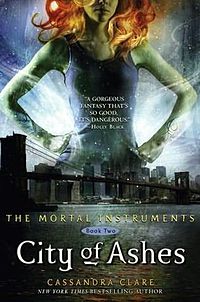
City of Ashes by Cassandra Clare
Final Verdict: 3.25 out of 4.0
YTD: 10
Plot/Story:
3 – Plot/Story is interesting and believable.
City of Ashes is book two in the Mortal Instruments trilogy by Cassandra Clare. This installment picks up generally where book one (City of Bones) left off. The main characters, Clary and Jace, continue to struggle with their confusing sibling-but-not relationship, and to deal with their destructive, villainous father who is determined to crush the Clave, a secret society of Shadowhunters (humanoids with gifts descended from the angels) who are duty-bound to protect Earth from demons. Whereas City of Bones was largely about Clary’s introduction to the Clave and the various supernatural elements which exist in the world, leading to a show-down between herself and her brother, versus their father; book two is much more of an action-adventure, most of which is devoted to the movements and machinations of Valentine Morgenstern (Clary’s & Jace’s father, a Shadowhunter-gone-rogue). Valentine is seeking ultimate power – the likes of which can only be achieved by possessing all three of the Mortal Instruments and Valentine will stop at nothing – will sacrifice anything – to get his hands on these devices. As in book one, the characters discover much about themselves and others as the story progresses. Certain changes happen to the various prominent characters from the first installment – new characters are introduced, while recurring characters make their final appearances.
Characterization:
3 – Characters well-developed.
Clare is on the cusp of great characterization and character development. She certainly has a solid handle on teenage angst and family strife. The interplay between Jace & Clary (and their very odd relationship) is also masterfully done – so well done, in fact, that it is actually a bit unsettling at times. Clare manages to cast some doubts in readers’ minds about the path certain characters might take – but these doubts are shaky at best, and are soon settled, so the mystery which could have added intrigue and tension to the plot was short-lived. Still, the development of the major characters from City of Bones is interesting to watch – particularly as their relationships grow. There are static elements for each of the recurring characters – they do not become quite rounded but are amply oval, at least. Lucian’s relationship with Clary, in particular, as well as the information that comes to light (again, not shockingly) about his feelings for a certain Shadowhuntress, coupled with his leadership over the Werewolf community, are examples of how a few characters become more deeply attached to the story and more intricately drawn. Other main characters, like Jace and Alec, are largely let-downs – characters who have not changed much since the first story, except in regards to the different situations they must face. More could be done with these characters, but they are interesting and fun to watch, nonetheless.
Prose/Style:
4 – Extraordinary Prose/Style, enhancing the Story.
I have said my piece on the Cassandra Clare plagiarism issue, and I will leave it at that, for now (except to say that she ripped a J.M. Barrie quote from Peter Pan this time and changed one word of it, for originality’s sake, I suppose). Those complaints aside, one thing I absolutely enjoy about these books so far is how well-paced and engaging they are. Although there are still moments where Clare’s writing comes off a bit pretentious, one can look past this in City of Ashes, more so than in City of Bones, where Clare’s inexperience (and, perhaps, self-consciousness) was obvious. Her confidence has grown with book two – she seems to know where she is headed and that definitely shows. The language and dialogue are more believable, the structure makes sense and the overall style is cohesive with the story and genre. Some moments – mainly in the battle scenes late in the book- are a bit cliché and tiresome, being so overdone, but for the most part – the book is a fun page-turner. A simple, enjoyable “pleasure” read.
Additional Elements: Setting, Symbols/Motifs, Resolution, etc.
3 – Additional elements are present and cohesive to the Story.
Publisher’s Weekly said that “fans of the smart/chic horror typified by Buffy the Vampire Slayer will instantly fall for this new series.” And they are right. What makes this book – and the series so far- such a hit is that, not only are the stories interesting and well-written, and not only do they rework dark fantasy elements into a new mold, but Clare also seems to understand what young readers these days want: to feel clever, hip, and accomplished, not in the traditional sense (where money used to be status) – now being “other” or “indie” is its own status symbol. The book is littered with sarcasm, dry wit, uber-intelligent teenagers (especially considering they never go to school) and inside-references to other literary references, music, etc. It’s an anti-pop/new-pop culture kid’s dream. In addition to these devices, one can also appreciate the still blasé inclusion of non-issue issues (like having two of the secondary characters be gay – and no one takes issue with it). As I mentioned in my review for City of Bones, having an openly (to the reader, that is) gay character in a fantasy novel – on the protagonist side- has not been exactly typical for the genre, and it is a welcomed presence. The exploration of loss, adult/parent relationships, sibling relationships, adoptive relationships, friendships, and love (particularly “forbidden” love) are also present and add interesting elements to the major plot.
Suggested Reading for:
Age Level: MG, YA+
Interest: Fantasy, Supernatural, Angel Lore, Magic, Good vs. Evil, Family, Friendship, Coming-of-Age.
Notable Quotes:
“Honestly, Clary, if you don’t start utilizing a bit of your natural feminine superiority I just don’t know what I’ll do with you.”
“I guess it’s true what they say. There are no straight men in the trenches.”
“When you love someone, you don’t have a choice.”
Random Acts of Kindess (February Wrap-up & March Begins)
Books I Sent Out:
Harry Potter and the Philosopher’s Stone by J.K. Rowling to Renu at The Page Turner.
We the Animals by Justin Torres and Looking for Alaska by John Green to Jennifer at Jen’s Book Den.
Fight Club by Chuck Palahniuk and The Bell Jar by Sylvia Plath to Pam E. (not sure of blog).
Books Received:
Howl’s Moving Castle by Diana Wynne Jones from Beth.
Save me the Waltz by Zelda Fitzgerald from Jen at Jen’s Book Den.
Clarissa by Samuel Richardson from Laura at The Scarlet Letter.
The Realm of Possibility by David Levithan from Joli at Actin’ Up with Books.
For March:
Here’s My Wishlist!
COMPLETE RULES RE-CAP: Please read carefully & follow all rules! Thank you!
- Please sign-up each month that you can participate (and by participate, we mean give as well as receive).
- Show off your participation by grabbing our RAK button.
- Create a wish list (on Amazon, Goodreads, or your blog, etc) and post it in the Google Doc located in each R.A.K post for the month.
- If you choose to do a R.A.K for someone, check out their wish list and contact that blogger directly for their information.
- Once you receive a RAK, send us an our new email to [rakbybooksoulmates @ gmail . com] so that we can update the Google Doc. IT IS VERY IMPORTANT THAT YOU SEND EMAILS TO THIS ADDRESS!
- E-book participation is limited to files being gifted directly to a person from the e-book store. Amazon’s Kindle Store is set up to allow this, as well as the Kobo store and we believe Barnes & Noble with Nook as well.
- At the end of the month, SHOW US YOUR R.A.K by making a “RAK Wrap-Up” post. This post should include who you SENT gifts to as well who you RECEIVED gifts from.
- OPEN TO EVERYONE including all our International brethren!
Links you will need:
So, that’s RAK, in a nutshell! Hope you’ll join in on the fun.
Don’t forget to sign-up for the Magical March Challenge Event!
 Roof Beam Reader