Roof Beam Reader
Adam Burgess
Somewhere Over the Sun by Adi Alsaid :: Author Interview
 . Adi has graciously agreed to stop by and answer a few interview questions, to help my readers get to know him.
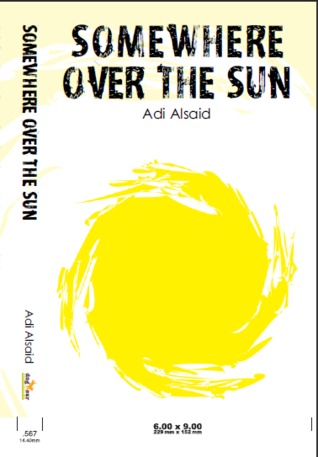 Alan, a spirited young writer with a wandering imagination has discovered that the stories he writes are suddenly coming to life. At the suggestion of his loving father, Alan embarks on a quixotic journey to visit friends and use his new found gift to write them all happier lives. There are a few limitations to his power; he can’t cure diseases, he can’t summon pots of gold, and headaches accompany each reality-infused story he lives out, but the appreciative and optimistic Alan is not deterred from creating fantastical characters and storylines to give his friends more literary lives.
 About the Author:
 Adi Alsaid graduated from the University of Nevada, Las Vegas with a degree in Marketing, but spent the majority of his time there reading and writing fiction. Somewhere Over the Sun is his debut novel and was written in Monterey, CA. He was born and raised in Mexico City to Israeli parents whose love and support made this book possible. Adi is usually unsure of how long he will remain at any given address, but chances are he is living somewhere in the northwestern hemisphere. He hopes this book brings his readers even a sentence’s worth of happiness.
 Aside from reading and writing, Adi is a huge fan of cooking and eating, watching and playing basketball, and listening to music and singing (despite his clear inability to do so).
————————————————————————————
1. We’re here today to spread the word about your new book Somewhere Over the Sun – so tell us about it: Where did it come from? What’s it about? And why do you think people should read it?
The story’s about Alan, a young, imaginative writer who discovers that the stories he writes are suddenly coming to life. Fueled by Alan’s desire to spread joy as far as it’ll go and encouraged by his loving father, Alan goes on a trip to visit friends and write them happier more literary lives using his new-found ability to turn fiction into reality.
It came, as most of my story ideas do, inexplicably and in the middle of the night. I was about to fall asleep and a sentence-long thought forced me to wake up and turn the computer back on so that I could write the thought down before it died. I typed out the sentence, then forget about it for a few months until it turned into an outline and my journey as a professional writer began. More on that later.
I wrote in my author bio that I hope the book brings readers even a sentence’s worth of happiness, and I want people to read my book because I truly believe that there’s at least a morsel-sized smile for everyone within its pages. Obviously, I’m a bit biased, but so far reviews and reader reactions have confirmed this. I tried to bring life out of the mundane, find happiness where it might go overlooked and I think readers will enjoy seeing Alan’s happy-go-lucky ways of turning fiction into reality.
2. We all come from someplace and we all have life experiences, similar and different to others, but how do these things – where you’re from and what you’ve done- impact the things you write and the way you write them?
Oh boy. Huge question. I doubt there’s a way for me to fully answer this, much less succinctly, but I’ll give it a shot (I apologize in advance for any rambling). Fiction is definitely rooted in life. And even with my natural proclivity to have a colorful imagination, I doubt I’d write anything of interest if it weren’t for the life I’ve lead and continue to live.
That life has affected my writing is a certainty. The question of how is impossible to answer in any all-encompassing way, so here’s just a tiny list of all the ways my life has influenced my writing. If I try to expand upon these, we might be here forever, so I hope these nuggets of myself and my writing are sufficient, even without context: I am a happy person. I grew up in Mexico City, but because I attended an international school called the American School Foundation, I found a home in the English language.
In high school, the way to gain love’s affection that most made sense to me was through words and I failed more than once; in college and since I have succeeded. I’ve moved around a lot and am good at goodbyes. I’ve lived in central California. I cook for the same reason that I write: because once I found out I could, found out that I had the ability to learn and the ability to create something literary delicious or literally delicious, why would I not? (more on that here)
3. Can you tell us about how you came to the realization that you are a writer – the moment when you knew that it wasn’t just a hobby, something you did well, but that it was what you were going to do with your life?
That moment wasn’t a hardheaded, heart-chasing “this is my life’s calling” kind of moment. It came out of surrounding circumstances that kind of forced me into the moment. When I was about to graduate from UNLV with a Business Marketing degree, I had a job in my sights which would pay me to travel and set up fundraising call centers for universities. I was good at fundraising and I love to travel, so it seemed like a great fit. I figured that I’d work for the year my visa made me eligible for and afterward I’d either get sponsored for a more permanent visa or I’d cross that bridge when I got there. Turns out, the company wasn’t very keen on hiring me for just a year, and neither was anyone else so I found myself about to graduate with no fall back option. I didn’t want to go back home to Mexico. And then I remembered that little sentence that I had written down in the middle of the night a few months before. I emailed a friend from high school, asked her if she thought I could make a book out of it and before she had said yes, I began planning my getaway to the California coast to write.
It didn’t even fully hit me until after the book was written and I had moved back to Las Vegas that this was now my career. I have a friend who would introduce me to all his film friends as, Adi, the writer and that’s when it started to sink in.
I always knew I was a writer. But until I was in the thick of it, I didn’t realize I would ever be a writer, if that distinction is clear.
4. Now that you’ve told us how you knew you were going to be a writer, can you share with us some of your biggest literary influences – books or authors? Which writers and works have inspired you and influenced your own style, and why?
In a guest post I wrote (found here) titled “You Are What You Read”, I talked about a file I have saved in my computer of quotations and passages from books that I’ve picked up along the way. I think these snippets, as well as all the song lyrics I’ve memorized along the way, lines from movies, have become a part of me. Even
if I’m misinterpreting them or misunderstanding them, they’re there, shaping the way I see the world simply because they’re offering their opinion.
I read tons of R.L Stine when I was a kid, so I’m sure he influenced me somehow. Probably by leading me to Stephen King, who in turn led me to pretty much everything else. It’s interesting I never became a horror writer. I’ve been reading Bill Watterson of Calvin and Hobbes for ages, and if he hasn’t influenced my writing or general life outlook at all, then he’s at least influenced my physical aspect (Calvin and Hobbes sit quietly at the base of a tree on my leg, forever contemplative).
I once tried to write a story specifically trying to imitate Vonnegut’s style, and I’m sure there’s bits of him in my writing that I’ll never shake free. Bob Dylan and Charlie Kauffman, Palahniuk, John Darnielle, Hemingway. Here’s a list of a few more: Influences.
5. Finally, now that your first book has been written and is being published, what would you say you have learned from the whole process, start-to-finish? Was there anything unexpected or particularly challenging?
Most importantly, I think, is that I found out that I could. Before I wrote Somewhere Over the Sun, I specialized in not finishing short stories. I even had the idea to one day release them in a collection called Never-ending Stories.
I realize now how little I knew about the book publishing process. Even when I was writing the book and researching what to do after it was written, I was pretty clueless. I’ve learned how long it takes to wait on agent responses, I’ve learned that self-publishing companies sometimes stop caring about you after you’ve made your payment, I’ve learned that a publishing contract is not enough for a Special Talents Visa (the immigration lawyer practically laughed at me, “You’re 23? You want a visa because you wrote a book? Did you win a Nobel Prize yet? No? Not gonna happen then.”), I’ve learned that social media sites are crucial for authors’ marketing efforts, but that without positive word of mouth it’s hard to get anywhere. And that even with some positive word of mouth, you still have to do some yelling to be heard.
Thanks for helping me yell, Adam.
————————————————————————————
Must Read in This Lifetime
>


“Follows a man’s thoughts and dreams during a single night. It is also a book that participates in the re-reading of Irish history that was part of the revival of the early 20th century.” – Amazon.com
Review: Who is Mark Twain? by Mark Twain
Who is Mark Twain? By Mark Twain
Final Verdict: 3.75 out of 4.0
YTD: 14
Plot/Story:
4 – Plot/Story is interesting/believable and impacful
Who is Mark Twain? is a collection of short stories, essays and letters, published posthumously by Twain’s editors. It encompasses a wide range of political, social, and educational ideals, as well as some insight into Twain’s personal and family life, as well as funny anecdotes about his journey from San Francisco nobody to over-night sensation. As usual, I connected strongly with Twain’s pieces – I tend to be aligned well with his philosophical points of view (when he praises the U.S. Journalists for being irreverent, except where actual reverence is due, as opposed to foreign presses which pay reverence to pretty much everything, I about shouted with joy), but I did disagree with him in one respect: he completely bashes Jane Austen, in the short essay “Jane Austen.” Now, I had heard that Twain wasn’t a fan, and it’s not hard to imagine why – when you compare Twain’s world and work to Austen’s, it’s almost polar-opposite – almost. Twain touches on Austen’s satire and parody, but only briefly – and in a way which indicates that Twain didn’t think Austen really knew what she was doing, and her later critics made it appear as if she was being satirical when, in fact, she really believed what she was writing. Now, I don’t know how far Twain went to familiarize himself with Austen’s works or personal writings – he mentions two books, which he tried to read repeatedly, but couldn’t get into. That’s fine and dandy, but I do think Twain was off on this one, because Jane Austen was a brilliant comedienne who, I believe, truly knew what she was doing and saying.
Characterization:
3 – Characters well developed.
This section really only applies to those works of short fiction in this collection – the essays and letters due have characters, because Twain tends to respond to everything with a story. Still, his characters really shine in stories like “A Group of Servants,” “The Undertaker’s Tale,” and “The Snow-Shovelers” (which was also a brilliant statement on politics and ethics hypocrisy). Some of the strongest characterization, in my opinion, is found in two stories whose main characters are animals: “The Jungle Discusses Man” and “Telegraph Dog.” Here, Twain uses animals in human situations to discuss human nature – which was fascinating (and the first, “Jungle” reminded me of a twisted retelling or foreshadowing of The Lion King, actually).
Prose/Style:
3 – Satisfactory Prose/Style, conducive to the Story.
Twain’s prose is fluid and easy to follow. Whether he is writing a fictional story, a letter to an editor, or a biographical letter to a friend, his language is effortless and his ability with puns and world-play is uncontested (the only class of writers I can compare him to are Shakespeare, Swift, and Vonnegut). I adore the satirists, but they have to be brilliant if they are going to get it right, and Twain definitely gets it right (most of the time). Reading his pieces is like conversing with a charming old friend, who just wants to catch up after the years, chat about how things have been going, and tell you how completely wrong you are about everything, but all the while offering you candy and cigarettes, fluffing your pillow and refilling your drink. He cares deeply about people, and he cares about giving the proper kind of respect to the people who have earned it. All of this, the sentiment of his convictions and virtues, comes across in the tone of the language, and through the undercurrent of the words – the actual words often saying the opposite of what Twain really means.
Additional Elements: Setting, Symbols/Motifs, Resolution, etc.
4 – Additional elements improve and advance the story.
What I enjoy so much about Twain is the way he tackles difficult issues, be they politics, religion, education, or social ideals, boldly and confidently, but with a reassuring and refreshing sense of whimsy and fun, as if to say “there’s no reason to be bothered about any of this, really.” He is serious, but calm – he can put the “smack down” on anybody he finds in the wrong, and he does in quite a few instances in this collection, but one gets the feeling that Twain finds all arguing in general, rather silly – he just wants to live a good life, and to encourage that in others, and he gets most dangerous and powerful when he is writing against any attack on people’s rights to happiness and well-being. He pokes-fun at people in a brilliantly endearing way, but he does the same to himself, which makes the reader comfortable in knowing that, at the very least, Twain is a man who can take an honest look at himself and criticize where critique is due.
Suggested Reading for:
Age Level: High School and above
Interest: Satire, Non-Fiction, Memoir, Auto-biography, Short Story, Politics, History
Notable Quotes:
“I asked the British Government to tell me what head I came under. . . . Now you will never believe it, but I give you my honor that this – this, which you see before you- was actually taxed as a Gas Works.” – Twain discussing taxes imposed upon his published fiction in England, before copyright laws.
“It seemed to sort of recognize me as one of the Friendly Powers – not on a large scale, of course – not like Russia and China and those, but on a – well, on a secondary scale – New Jersey.”
Review: Atlas Shrugged by Ayn Rand

Atlas Shrugged by Ayn Rand
Final Verdict: 1.75 out of 4.0
YTD: 13
Plot/Story:
1 – Unbelievable Plot/Story.
I must preface this review by stating that, having read Ayn Rand’s “About the Author” section, prior to reading this book, I commenced this monster with the complete knowledge that Ayn Rand was a liar and a hypocrite. In her “About the Author” section, she states: “I had a difficult struggle, earning my living at odd jobs, until I could make a financial success of my writing. No one helped me, nor did I think at any time that it was anyone’s duty to help me.” The premise of the book expands on this, in essence demonizing any personal, unselfish acts of altruism or charity, and calling for the overthrow of any government which enacts social welfare programs for the needy, underprivileged, or even mentally/physically disabled. Yet, Ayn Rand herself cashed-in on Social Security (welfare) benefits and was a recipient of Medicare and public aid later in life, when she became afflicted with lung cancer. She reaped the benefits of these services, however, under another name – and through a legal agency.
This introduction is all by way of saying: you cannot take Ayn Rand’s philosophical stance, expounded nauseatingly transparently in Atlas Shrugged, seriously whatsoever; so, naturally, you cannot take the plot seriously either. Still, though I could not agree with the philosophy or so-called morality of the book’s message, I will still review it as a whole, objectively, by viewing it objectively – in a way which, ironically, Ayn Rand, mother of Objectivism, could not view anything in any way whatsoever.
Essentially, the book tells the story of the “human elites” – the small group of men (and one woman) who have reached the pinnacle of human achievement and who, after bearing the burden of society’s injustices for so long, disappear and leave the world to collapse without them. To me, reading the book was a bizarre experience – one which I am grateful for, in a way, in that it exposed me to a type of thinking and belief system which is completely antithetical to my own: it was like Superman being trapped inside the mind of Lex Luthor; it was like Harry Potter being trapped inside the mind of Voldemort. The book is disguised as a type of dystopian murder-mystery, wherein a group of “Freedom Fighters” attempt to overthrow and undermine the atavistic government. The government is supposedly turning the inventors, the big businessmen, the corporate geniuses into slaves – demanding that they become servile to the working class.
Characterization:
2 – Characters slightly developed.
This section, too, almost received the lowest possible rating; the only saving grace for Rand’s characters is that 1) they are clearly (if disgustingly) imagined and 2) I have read worse characterization. Still, all of the characters in this book are absurd grotesques of the virtues and vices of Rand’s mind. The heroes and champions all share the same motives, characteristics, instincts, and supposed laudable qualities – like selfishness, lack of emotional feeling, and assumption that sexual acts are only merited when they happen as the result of the meeting of two “worthy” minds. The villains, too, are the same person with different names. They are all portrayed as soft, bumbling, lecherous, and needy. Any character who believes in kindness toward or charity for their fellow man is a fool and a danger to society. Any character who believes that thousands may die, should they not prove their “right” to life by inventing something or by running a business, is thereby deemed moral and good. It’s an absurd romp-through a tops-turvy la-la-land of philosophical horror, and it is no wonder that Ayn Rand conceitedly snipes at Aristotle in her afterword, because Aristotle, had he read her work, would likely lambast her to no end, and possibly encourage the natives to slip some hemlock in her wine.
Prose/Style:
2 – Prose/Style in need of Development but works.
Oh, where to begin. Fortunately, Ayn Rand is not difficult to read because she writes rather pedestrianly. She has no mastery of prose or language whatsoever, which is perhaps why she later admitted to never being able to amass her riches as a writer. She comes across as a peculiar confluence of Harlequin romance writer meeting undergraduate Philosophy major. At any given time, you may be reading about the heated love-making of two powerful beings, scenes lacking any depth or connection whatsoever and which make you wonder whether Rand ever got any (I sure wouldn’t go near it). Then, inexplicably, the writing becomes that of an essayist who is determined to beat his theory into your head and gives you that same beating over and over and over, in different forms but of the same message (Making money is life’s highest goal and having money is life’s highest achievement). When it gets really strange is when the pounding of that message gets muddled up with the oddly numerous instances of sexual passion – and, also weirdly, that the beating tends to manifest itself in every man brutally dominating, physically and sexually, the one primary female character – she gets it rough from three different men, and loves it every time. What, exactly, is this supposed to tell us about Ms. Rand’s philosophy, I wonder?
Additional Elements: Setting, Symbols/Motifs, Resolution, etc.
2 – Additional elements are present but do not develop the Story.
The reading experience, well, it was awful, horrible, terrible – and enlightening. That people like Ayn Rand exist in the world is something which I would gladly deny or ignore but, if there is one thing to praise about this book, it is that it forces one’s eyes –and mind- open to the possibility of true evil. And it does so unsparingly, not with the touch of an angel’s fingertips on your eyelids, but with a cold iron wrench. You can see, I am pulling no punches, and for a book whose final sentence -after 1200 pages of ideological, polarized and supposedly didactic “story-telling” is as follows, you can, I hope, understand why: “He raised his hand and over the desolate earth he traced in space the sign of the dollar.” Seriously?
The book discusses morality in a fringe, whacked-out way, only made possible by the twisted mind of a sociopath. What is “good” and what is “evil” is reversed, and all binaries are eliminated, so that the world, apparently, can only exist in “actuals” – in clear black and white, either or. Indeed, the “middle-ground” world in which we truly live is laughed at, scoffed at as if mediation, moderation, or compromise is simply an attempt by menials to refuse responsibility or real action. Instead, Rand’s heroes claim total and complete philosophical, economic, and intellectual right in all they believe, simply because they believe it and put it into action – and it is that principal, “action,” in addition to the glory of wealth and private property, which stands as a beacon for what is holy and moral.
Now, to be fair and objective, there were moments of this book that I enjoyed – the swashbuckling ending, for instance, which felt like something straight out of the A-Team – that was fun! I also appreciated Rand’s point that hard work will and should pay off, and that every person should have a meaningful purpose in life, a driving force or goal which inspires and fulfills them. But, where she loses me is when she jumps off from that point into the abyss of selfishness, stating that the only real goals worth having are the ones that are financially rewarding, and which deny any admittance of charity. She says, even in romantic relationships and friendships, that giving for the sake of giving – just being generous- is an act of immorality. Sorry, but not in my book.
It is incredible to read about a type of America wherein people have only emotions or intellect, but not both; an American where people are either superficial and selfish businessmen or wholly altruistic, giving, selfless mystics, but never elements of each. It is even more incredible to learn of an author who would put the formers – the greed, the selfishness, the amassed wealth without concern for the needy, on higher moral ground than the selfless servants of man. Rand scolds the likes of Plato, Aristotle, and even Jesus Christ, in favor of complete and total Capitalist might. It is not hard to see why this book would be a favorite amongst college students, those impressionable youths who are breaking free from their parents, throwing off rules, and heading out to conquer the world – but it is horrifying to think that some of them might actually believe that Rand’s is an acceptable or just way of doing it.
Suggested Reading for:
Age Level: Adults
Interest: Sociopathic Capitalism, Criminal Negligence of Thought, Antipathy, Pseudo-philosophy, anti-altruism, whack-a-doodle world views
Notable Quotes:
“The Utopia of Greed” (Title of Part Three, Chapter Two)
-The one quote, in my opinion, which sums up this entire sham of a novel.
“Do not let your fire go out, spark by irreplaceable spark. In the hopeless swamps of the not quite, the not yet, and the not at all, do not let the hero in your soul perish and leave only frustration for the life you deserved, but never have been able to reach. The world you desire can be won, it exists, it is real, it is possible, it is yours.”
 Roof Beam Reader