Roof Beam Reader
Adam Burgess
The Final Checkpoint! #TBR2019RBR
 And so it ends.
As we head into the final few days of 2019, I wanted to post briefly about the challenge and people’s progress, including my own. First, I’m sad to say that I will not be bringing the challenge back for 2020. I know a lot of people were hoping it would be back again for Year 9, but I’ve decided I’m just not too interested in hosting it anymore, and my attentions here on the blog and elsewhere have turned to other matters.
I’m currently editing my second academic text (a collection of essays of literary criticism to be published early in 2020) and sending out queries for my first novel (which has been completed and revised. If you know any agents looking for LGBTQ Own Voices YA, let me know or send them my way!) So, I wish I could keep this up again another year, but it’s time to say goodbye, or at least goodbye for now.
As to my challenge progress this year, it looks like I’m only going to get through 7 of the 12 books I need in order to “Win.” That’s still a win for me, though, as it’s 7 books that had been sitting on my shelves for ages that I’ve finally read! I enjoyed most of them, too.
Here are the 7 that I’ve finished:
- The House of the Vampire (1907) by George Sylvester Viereck
- The Funhouse by (1980) by Dean Koontz
- Timequake (1997) by Kurt Vonnegut
- Letters to a Young Poet (1934) by Rainer Maria Rilke
- We (1924) by Yevgeny Zamyatin
- Gemini (1975) by Michel Tournier
- Don Juan in the Village (1990) by Jane DeLynn
 Of this list, I would have to say that my favorites were The House of the Vampire, Timequake, and Gemini. (Gemini was pretty stunning. More people should read it, seriously.)
We do have some folks who have commented on the master post indicating that they are finished – outstanding! After the year ends, I will be going back to The Mister Linky to randomly select a winner from all the participant posts this year. Remember, all your linked reviews for completed books from your original TBR Pile list (which I have saved), plus ONE final wrap-up post, will earn you entries into the final giveaway, provided you have linked them all to our Mister Linky by January 14th. I will be selecting the winner on January 15th. To put it simply:
- How to be entered to win: Link up reviews for any/all completed book on your original list before January 14th.
- How to get a bonus entry: Link up a challenge wrap-up post before January 14th.
- How to get a second bonus entry: If you COMPLETED your challenge (at least 12 out of 14 books read and reviewed), leave a comment on this post by December 31 saying so; I will check your links and/or your wrap-up post, if you provide one, and add your name to the “Current Completers” list below.
- One winner will be selected randomly on January 15th and be notified via blog/email.
- Only those who originally registered for this challenge last year and have been participating are eligible to be entered. (I have all original lists saved.)
Current Completers:
If you’re out there and you’ve finished your challenge, be sure to leave a comment letting us know! If you didn’t finish – what kind of progress did you make? 1 of 12? 6 of 12? Even reading one book is a step in the right direction, so if you gave it a shot – good for you!
Which books from your list did you love? Which ones did you hate? Which reading challenges are you looking forward to in 2020?
Young Adult Potpourri
A Mixed-Bag
During the academic term, I typically find myself reading a lot of young adult fiction. Young adult fiction, while often tackling very serious real-world issues, also tends to be highly readable for a lot of reasons, not the least of which is its reading level. These novels are often well-paced, logically divided, and supported by compelling storytelling. All of this works favorably, for me, because it allows me to keep reading even when I’m mired in heavy teaching workloads, committee work, service, and my own research/writing. That said, lately, I’ve found myself being less interested in many of the young adult works I’ve been reading. I’m not sure if this is because I’ve read too much of it and so I feel bored or over-saturated by formulas, or if its because I’m not in the right place to be reading and relaxing at all, so I become less able to concentrate, whatever the story or its potential. Today, I would like to share some thoughts on four young adult/middle grade novels that I did enjoy on some level.
EXILE FROM EDEN by Andrew Smith
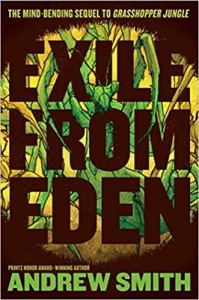 Exile from Eden is the sequel to Andrew Smith’s wildly popular, Grasshopper Jungle. It takes place nearly two decades after the events of the original novel, returning us to Iowa and the Sczerba family. In this installment, however, it is the children, now teenagers, of the original cast who are the protagonists. For years, the unstoppable grasshoppers have wreaked havoc on the United States, and possibly beyond. The world has essentially come to a post-apocalyptic standstill, where almost all technology, communication, and modern amenities have been ended. There is no government, no society, and in fact almost no human beings. This is the world young Arek, and stowaway Mel, enter when the leave their hole at long last, in order to search for Areak’s fathers.
What Andrew Smith continues to do so well in this novel is to describe children in the most unlikely and yet all-too-familiar of circumstances. While the environment and the events of Exile from Eden are mostly unimaginable, his characters’ responses to them, their search for family, identity, and self-worth in the face of the most severe obstacles and challenges, internal and external, are wholly relate-able. Breakfast, the wild boy who is born into the post-apocalyptic world, is an interesting contrast to the “civilized” people who existed before the cataclysm, and it is no surprise that Smith seems to be suggesting that we could, all of us, do with a return to human nature and our basic instincts, primarily the principle: to live and let live. To defy judgement. To be true to yourself. While I enjoyed Grasshopper Jungle quite a bit more than its sequel, fans of the original novel are likely to enjoy this one too.
WAYWARD SON by Rainbow Rowell
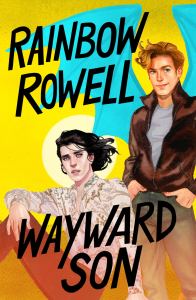 Wayward Son is the sequel to Rainbow Rowell’s delightful Harry Potter-inspired novel, Carry On. (If you’re sensing a theme in these titles, good on you!) I was a huge fan of the original work, in how it reveled in Harry Potter fandom and yet was something entirely original, too. In Carry On, Rowell reimagines the cast as somehow more jaded, more human, and of course adds some interesting and desperately needed realistic characterization, such as openly queer characters and romances. Wayward Son picks up not long after where Carry On ends. While one could call the finale to Carry On happy, or at least successful, Wayward Son makes clear that every choice has its consequences, and the tone throughout this second installment is much bleaker.
Simon Snow, Baz, Penny, and Agatha are back again in Wayward Son. The Chosen One has fallen quite significantly, and now lives as a deformed humanoid, without power. His boyfriend, Baz, is at a complete loss as to how to help Simon heal and find himself again. Enter Penny, who comes up with a brilliant idea for an American roadtrip, where they will visit her boyfriend Micah (that doesn’t go according to plan) and their good friend Agatha (oops, this is sticky, too!) Along the way, they encounter a number of mythological creatures, some good and some bad, endanger themselves and others, and begin to repair, or sometimes end, relationships that have long needed attention. In the end, the power trio, with a surprising new companion, manage to save the day. Simon Snow, with a long road ahead of him, begins his steps toward healing. Wayward Son isn’t as enjoyable as Carry On, for me, but perhaps it is a logical next chapter in the lives of Simon and Baz.
THE TYRANT’S TOMB by Rick Riordan
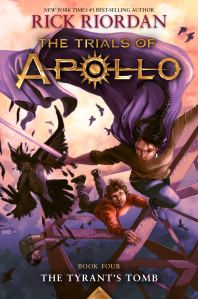 The Tyrant’s Tomb is the 4th installment of the 5-book series, The Trials of Apollo, and it is one of the strongest in the series. In this installment, Apollo (or Lester Papadopoulos in his human form) and Meg, his master and sidekick, head to Camp Jupiter in the San Francisco area, having helped save southern California from being completely scorched by a triumvirate of vengeful, power-hunger former Roman Caesars, including Caligula, Nero, and Commodus. This time around, Nero and Python are on the sidelines, and Caligula and Commodus come to take over Camp Jupiter, with the help of an evil king, Tarquin. As in previous installments, there are mysterious prophecies, talking arrows, loads of sarcasm, old friends and new, and not a little bit of romance. Most importantly, we continue to see Apollo-as-Lester come to terms with what it really means to be human and to experience shame, even guilt, at the way he once acted as a God.
Part of why I love the Rick Riordan books, particularly those post-Percy Jackson, is because of what they do for diverse representation. Riordan seems to have made it his mission to fairly and empathetically include as many different times of people as he can, in completely natural ways. Many of his books have included gay and lesbian characters, characters of color, and differently abled characters, and yet this diversity never reads as tokenism; instead, these individuals are included seamlessly as part of the cast, and their development is typically treated in holistic and believable ways. Apollo, for example, is historically “bisexual” (in today’s terminology), so his romantic interests in men and women are often included, but Riordan also introduces the sexuality, or lack thereof, of different characters in ways consistent with the plot. One character in this installment, for example, is ultimately revealed as what we might call asexual or aromantic, but rather than simply stating these terms and getting into some bizarre description, this aspect of her personality is described through plot events and ultimately by a decision she makes at the end of the story. Riordan’s sensitive, warm embracing of the great variety of humanity and human experiences makes this book, which is already entertaining, fast-paced, action-filled, and hilarious, important and meaningful on another level.
ZIGGY, STARDUST & ME by James Brandon
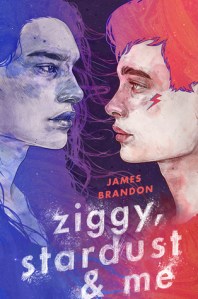 I finished reading Ziggy, Stardust & Me way back in August, but it has taken me until now, four months later, to decide to try and write something substantial about it. My reluctance has been due to the fact that this is one of the best books I read all year, perhaps one of the best in a very long time. I feel reluctant saying that because I know such a statement might suggest that I speak objectively for any reader, but I want to provide a caveat that I felt this book very personally, and I cannot say for sure how everyone will react to this one. Only two other books, Shaun David Hutchinson’s BRAVE FACE and Becky Albertalli & Adam Silvera’s WHAT IF IT’S US have affected me in a similar way, and I know that my thoughts on those two, while generally agreed with, were also very personal and perhaps didn’t carry over to every reader. That said, I do think it goes without saying that, as a topical, current young adult novel with important things to say about family, racism, indigenous peoples, and abuse, not to mention sexuality and coming-of-age, Ziggy, Stardust & Me is a stellar achievement.
The story takes place in 1973. At its heart is sixteen-year-old Jonathan Collins, a gay high schooler who is struggling with his identity, not just because coming out is difficult for everyone, but because he lives in a time and place when homosexuality was still considered deviant, a mental illness. Jonathan is subjected to dangerous psychological treatments, now debunked, and the disapproval of his single, alcoholic father. While dealing with these serious issues, he meets a young man, Web, a member of the Lakota tribe. Suddenly, Jonathan is swept up in romantic feelings he had been desperately trying to stifle or change, and he must also learn what it is like for a native person to live in a white America that remains terribly prejudiced and violent. Despite their differences–race, economics, religion, family, etc.–Jonathan and Dakota connect on a deeply personal, almost spiritual level. Their relationship begins to bring out the best in each of them, and as they cling to each other, they begin to heal and to understand the two separate worlds from which they both come. Ziggy, Stardust & Me is a beautiful told, wonderfully researched, deeply sensitive treatment of young adulthood, race and class, sexuality, and interracial romance.
Find Me by Andre Aciman
“Time is always the price we pay for the unlived life.”
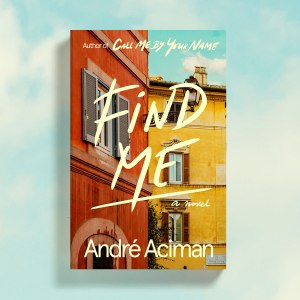 Andre Aciman’s Find Me (2019), the highly anticipated sequel to Call Me By Your Name, has much in common with its predecessor, with some significant differences. Its structure and themes are similar, though much time has passed between the first novel, which revolves entirely around Elio and Oliver, and this one, which begins with Elio’s father, Samuel. One of the most obvious similarities is in the book’s structure.
Like Call Me By Your Name, the sequel is divided into four parts, two of which are longer and two of which are very brief. Instead of each section focusing on a different stage of development in a single romance, though, these four parts deal with different characters and their diverse relationships. The first section, “Tempo,” is also the longest. It is told entirely from the perspective of Samuel, Elio’s father, who meets a beautiful, interesting younger woman on a train. The two strike up an unlikely romance filled with passion and devoted entirely to the philosophy of carpe diem. The second section, “Cadenza,” changes to Elio’s perspective. It is the second longest part of the novel and begins by merging Samuel and Elio’s plot-lines. Elio meets Miranda and sees in his father what his father once saw in Elio himself, the great love and friendship that Samuel told the boy, in Call Me By Your Name, he was so lucky to have found. We learn what has happened to Elio’s mother, though more will be revealed in the end section as well. Also in the second section, Elio meets an older man and begins a relationship with him; it is surprising to both of them, and somehow they also both know, and accept, that the relationship will be entirely real but very brief. Judaism rises as a major connecting theme again, as it was in the first novel.
In part three, “Capriccio,” the reader is taken to America and granted, for the first time in either of the two novels, Oliver’s perspective. We learn what has become of him and his family, what kind of person he is, and how dearly he misses Elio. He is equal parts regret and longing, regret for not having had the courage to stay with Elio originally, and longing to return to their place in Italy and create the life that he is sure was meant to be theirs. This is perhaps the most haunting of the three parts, and the one which most directly recalls the events of Call Me By Your Name, though from a different perspective. It also incorporates references to some of the “afterward” events that take place in part four of the original novel, weaving them into Oliver’s present. The passage of time is significant and heavily pondered.
Lastly, in “Da Capo,” the fourth and final section, Elio and Oliver meet again at last. They had seen each other only once before, about fifteen years after the events of that fateful 1980s summer in Italy. That meeting is recounted in the end of Call Me By Your Name. But after the passage of another half-decade, Oliver at last returns to Italy to find Elio; or, as Oliver so desperately calls out at the end of “Capriccio,” to allow Elio to find him. This section is just 10-pages long, but it deftly reminds the reader what Elio and Oliver’s relationship was like originally and convinces us that the two were indeed longing for each other, waiting for each other, all along. There’s more than a bit of irony in this ending, considering how adamant Elio is about not believing in the concept of soulmates.
Besides the structure of the narrative, Find Me also shares similar themes to the original. Predetermination, soulmates, and Judaism, as mentioned, but also the devotion to erotic realism. To call this work erotic is to invoke the original meaning of the word, which is a realistic, almost naturalistic portrayal of a love without limits. It does not mean that this book is “erotica” by contemporary standards, meaning essentially pornographic; instead, Aciman is still interested in recounting the ways that true lovers do love all of their partner, in every way, shape, and form. The breaking down of barriers to decorum, for example, or privacy. The explicit desire for another’s scent or touch, manifested in the most human and mundane ways, or the near-lustful devotion to a partner’s most basic needs. Part of what makes Call Me By Your Name so interesting is that love-in-naturalism, and it is rewarding to see that Aciman has not abandoned the concept, here, despite the fact that none of the new relationships, neither Samuel’s nor Elio’s, is quite as interesting as Elio and Oliver’s was (possibly in part due to the fact that they each receive one chapter in a four-section book, rather than the entire book.)
Ultimately, Find Me will likely be a rewarding read for those who were fans of the original because it reintroduces us to familiar characters, fills in some of the gaps both between parts three and four of the original, but also afterward, and because it shares many of the same important themes, such as erotic love, outsider/community (Judaism), music and art, etc. On its own, it is not quite as compelling or moving as the original, nor does it strike as deeply. Many may wish it had been more about Elio and Oliver, but in a way, the point of Elio and Oliver’s story was in the universal, and in this sense, Find Me achieves the same goal. Love is love, and we only get one chance at life, so seize the day.
To Be Thankful When
Thanksgiving.
 It’s never been my favorite holiday. Halloween, yes, with all its childish humor, suspended reality, neighborhood fun and friendly competition. Independence Day, too, which is a shock for most people to learn. I’m not a patriotic person, but there’s something about summertime barbecues, a family of friends, and shimmering colors lighting the dark that gets me going. Christmas, of course, has its advantages. Cozy clothes, good food, and giving gifts, not to mention the music and movies that I can’t help but delight in, and the nostalgia that lingers from childhood and past lives. But Thanksgiving?
Have you ever given orders to the morning, or shown the dawn its place,
that it might take the earth by the edges and shake the wicked out of it?
The earth takes shape like clay under a seal; its features stand out like those of a garment.
The wicked are denied their light, and their upraised arm is broken. (Job 38:12-15)
This week in literature class, I discussed with my students the concept of bravery. We had just finished reading Angie Thomas’s The Hate U Give and one student remarked on Starr’s bravery. I mentioned that Starr herself often comments on her lack of bravery, about how she often feels too scared to act. This opened up an interesting discussion about what bravery really is. They came to the conclusion, naturally enough, I think, that if there’s no potential cost to an action, then there’s no bravery required in acting. As such, it’s exactly when we are scared but act anyway, when we are most brave and, ironically, when we feel it the least. We can recognize this bravery in others because we know, intellectually, what it means for a person to act strong when they feel weak; to show courage when they feel fear. We have the benefit, in those situations, of judging the actions themselves, because we cannot possibly feel what the person is feeling inside. But when it comes to ourselves, the feelings come first. So, if we are afraid, even when taking action, it’s that sensation of inadequacy that lingers.
Have you journeyed to the springs of the sea or walked in the recesses of the deep?
Have the gates of death been shown to you? Have you seen the gates of the deepest darkness?
Have you comprehended the vast expanses of the earth?
Tell me, if you know all this. (Job 38:16-18)
I wonder this year if, to be thankful when you feel anything but, is itself an act of bravery. It’s been a very hard year for me. One of the worst, and it’s hard to put into words, or even logical thought, why this is. Nothing extremely terrible happened, but sometime back in January, I sprained my ankle badly. It happened just a couple of weeks after returning home from a trip to Chicago, to see family and friends. In retrospect, I realize now that that injury and its very long recovery had a much bigger effect on me than I acknowledged at the time, which is bizarre because I was absolutely aware of it at the time. Still, it somehow colored the rest of my year, in the way I reacted to life, the universe, and everything, and that color was decidedly umber.
What is the way to the abode of light? And where does darkness reside?
Can you take them to their places? Do you know the paths to their dwellings?
Surely you know, for you were already born!
You have lived so many years! (Job 38:19-21)
Can I find things to be thankful for this year? Sure. But the joy I usually begin to feel about this time is lacking. I try to talk myself into it. You have your health! Yes, despite this terrible cold that persists, I have my health. Despite a relatively unhealthy year and the almost willful destruction of a lot of the hard work I’ve done over the last three years, I have my health. I have a job I love, too. The students seem to strike me with positivity just when I need it most. An unsolicited email thanking me for inspiring someone to read again, and love it. Or comments overheard during break about how much a group of students are going to miss my class, how much they’ve loved it. I have my partner and 13 years of memories with him. Family and friends, though far away, remain present in their way and remind me what it is to have good and loving people in my life. A niece and nephews that I adore, and a completed first draft of a novel that was sitting deep inside of me for a very long time. Music and books and art, and everything else that makes life bearable in the bad times and meaningful in the good. All these things I have to be thankful for, so despite the best efforts of a tired and weary spirit, I’ll remind myself that the good is there.
What is the way to the place where the lightning is dispersed,
or the place where the east winds are scattered over the earth?
Who cuts a channel for the torrents of rain, and a path for the thunderstorm,
to water a land where no one lives, an uninhabited desert,
to satisfy a desolate wasteland and make it sprout with grass? (Job 38:24-27)
Speaking of books, there are two that I want to specifically mention, while I sit here pondering the bravery of feeling gratitude while mired in the depths of despondency. The first is Ocean Vuong’s On Earth We’re Briefly Gorgeous and the other is Ziggy, Stardust and Me by James Brandon. I managed to write some thoughts down for the Vuong when I finished it back in June, but I never managed to get anything down about Ziggy. At the time, I remember tweeting something about finding a book soulmate. Is that possible? It’s like James had written the book I’d been waiting to read for so long. It made me feel more than a little envious, if I’m being honest, because, like Shaun David Hutchinson’s Brave Face, it captured a particular experience and worldview that I thought was uniquely my own. As I wrote recently, though, I’m trying to find the benefits in these connections, even connections yielded from a difficult place, because there’s something about sorrow and loneliness, and pain, that not only allows for but encourages the most fiercely human understanding between people.
Can you raise your voice to the clouds and cover yourself with a flood of water?
Do you send the lightning bolts on their way? Do they report to you,
‘Here we are’? (Job 38:34-35)
Trying to measure up. That’s the thing, maybe. The great and terrible error for us all, but especially for me. To compare myself to anyone else. To wonder if, when, or how I’ll achieve what I intend to achieve. To be satisfied. Buddhism reminds us that there’s the decision to take action, and then there is the action. The first is a start, but there’s no movement to it, and so no satisfaction; in fact, to decide only, but not to do, is perhaps the most painful state of being. To act, there’s the magic. When one lingers in fantasy and best laid plans, there’s nothing left for him but to measure and measure and measure. But like cups of salt being poured atop each other on a kitchen counter, the peak will ever only reach so high before spreading, without form or direction, and falling over itself into nothing. A pile of salt. An empty vessel of gratitude, filled with a thankfulness that never seems more than thought-deep.
Who has the wisdom to count the clouds?
Who can tip over the water jars of the heavens
when the dust becomes hard and the clods of earth stick together? (Job 38:37-38)
The first step? As with anything else, I suppose it begins with attitude and proceeds with action. So, I’ll turn on Christmas music and get out the boxes of decorations. I’ll listen to Judy Garland sing, haunted, “Have Yourself a Merry Little Christmas,” while I put up my tree and turn on the lights. I’ll imagine feeling something different and deeper. And then I’ll do something to stoke that feeling from dream to reality. A lesson on the guitar. A page in the journal. A chapter revised.
To act and be thankful that action is possible.
To try, and accept the effort as enough.
Happy Thanksgiving.
Another Clumsy Chord
The weather is changing.
Do you remember the line from Mary Poppins?
Winds in the east, mist coming in, / Like something is brewing’, and about to begin.
Thanksgiving in the Las Vegas Valley is usually a mild time. The tradition for most is to barbecue because temperatures are usually in the 60s and 70s. My first year here, in fact, it was about 80-degrees and sunny. This feels not like anything that’s “happened before,” though. A cold front has moved in and the winds have begun to pick-up. It is always windy here, so when we get a wind advisory, we know there’s something special going on. Temperatures will drop to the 40s, and there might be up to 24-inches of snow falling in the mountains this week. This is all to say, after a week of being sick and while looking forward to a healthier holiday, the weather seems to be having its little fun with me. Instead of preparing for outdoor adventures, long walks, and a la carte dining, I’m cozied-up inside, candles lit, heat turned on, and donned in fuzzy socks and a puffy sweater.
I’ll spend my time with music, maybe, working on the guitar that so troubles me. It’s a terribly humbling thing, trying to teach one’s self how to play music. I can’t think of anything much more maddening, in fact, except perhaps trying to teach one’s self a new language, when there’s no one to practice it with. The guitar. It still feels awkward in my hands. I don’t know how to sit, how to handle its sleek neck. I haven’t played enough to callous these fingers, yet, and that troubles me. I feel like a failure, though nothing makes me happier than spending time with music. Perhaps not even spending time with books. And this reminds me of a line from one of my favorite songs:
The end of paralysis, I was a statuette
Now I’m drunk as hell on a piano bench
And when I press the keys it all gets reversed
The sound of loneliness makes me happier.
I’ve always been “an emo kid,” comfortable in sadness and loneliness. It’s something I imagined I’d outgrow, eventually, but the truth is, that hasn’t happened. I approach age forty strikingly different from who I’ve ever been, but like those winds in the east, “The threads of [life] unraveling undone . . . I feel what’s to happen all happened before.” As much as I’ve changed, grown, progressed, developed, or whatever word best fits the occasion of growing up, aging, getting older, well–as much as all of that has happened, I remain the same. Comfortable in sadness. Lonely, with all the complications this brings, but not lamenting the fact.
I wonder sometimes if it’s this disposition that brought me to Buddhism. The core philosophy of Buddhism is that one must, in a way, go beyond acknowledging that life is suffering, but to embrace that truth. To eagerly accept that suffering. It was, I’ll admit, a very strange concept for me to understand at first, and I might not be getting it entirely right just yet either. But yes, I think it’s a good thing that my first reaction to the idea that I should be happy to suffer was something along the lines of, “what the fuck?”
Of course, I was getting it a bit wrong. Buddhism doesn’t want us to glory in suffering, or to live as if suffering is all there is, all that matters. Instead, as I understand it anyway, the reason Buddhism places such an emphasis on the power of suffering is that it, more than anything else, connects us to who we are, deep in our being, and to the suchness of others. To understand suffering is to understand people, even at their most complicated and least available. To understand that life is suffering is to know, beyond platitudes, that we are all in this together. That we all experience pain, sometimes a pain that, in loneliness, heartbreak, loss, brings us to our knees and makes us question absolutely everything we’ve ever felt, known, or believed.
Kurt Vonnegut is probably my favorite writer. The sadness in him, expressed through humor, is the deepest humanity I’ve known in another being. He writes,
Be soft. Do not let the world make you hard. Do not let pain make you hate. Do not let the bitterness steal your sweetness. Take pride that even though the rest of the world may disagree, you still believe it to be a beautiful place.
I think he is getting at this suchness of life. The idea that adversity can make us either hard or tender. To choose tenderness is what allows us to reach out and to reach within. Without it, we go hard and cold, we become incapable of absorbing warmth, and if we cannot contain warmth, we cannot express it.
Be soft.
Pema Chodron describes this another way. She writes that,
Bodhisattvas practice ‘in the middle of the fire.’ This means they enter into the suffering of the world; it also means they stay steady with the fire of their own painful emotions. They neither act them out nor repress them. They are willing to stay ‘on the dot’ and explore an emotion’s ungraspable qualities and fluid energies–and to let that experience link them to the pain and courage of others.
The pain and the courage. What is one without the other? What is light without darkness?
For so long, I thought that my way of being in the world was something to be ashamed of. Call it depression, melancholy, or saturnine. Many adjectives have been used, by myself and others, to explain the way I look at the world and the way I’ve acted in it. How liberating, how freeing, to turn the darkness on its head and see it as a beautiful softness. To accept my comfort with suffering, my tendency toward the sad, my hypersensitivity to the unfair, the unjust, and all the pain the recognition of these brings me, and to connect it with the pain and the courage of others.
O Me! O life! of the questions of these recurring,
Of the endless trains of the faithless, of cities fill’d with the foolish,
Of myself forever reproaching myself, (for who more foolish than I, and who more faithless?)
Of eyes that vainly crave the light, of the objects mean, of the struggle ever renew’d,
Of the poor results of all, of the plodding and sordid crowds I see around me,
Of the empty and useless years of the rest, with the rest me intertwined,
The question, O me! so sad, recurring—What good amid these, O me, O life?
Answer.
That you are here—that life exists and identity,
That the powerful play goes on, and you may contribute a verse.
How many ways are there of being in the world? How many of them good?
Thus behold the utter frailty of goodness!
Except for the perfect awakened heart
There is nothing able to withstand
The great and overwhelming strength of evil. (Shantideva 1.6)
To suffer and see suffering; to know pain and want nothing but to save others from it. This is one way.
 Roof Beam Reader