Roof Beam Reader
Adam Burgess
July, July!
Have you heard the song, “July, July!” by The Decemberists? You should.
And what ghosts there do remain
And all the troughs that run the length and breadth of my house
And the chickens how they rattle chicken chains
Though the specifics might be vague
And I’ll say your camisole was sprightly light magenta
When in fact it was a nappy blueish grey
The blood rolls down the drain
Oh what a lonely thing
In a blood red drain

Reading and Teaching
Anyhow, last month was my LGBTQ reading month and it went better than expected. I read a total of 7 books, all of them LGTBQ-themed. This month, I’ve turned my attention to poetry. I’m covering a few different approaches within this larger goal, though. For example, I’m reading two non-fiction texts on poetry and how to read and write it. I’m reading two short collections of poems by individual poets, and I’m reading one anthology. Finally, I will be reading one hybrid novel that contains poetry and is about a young poet.

As I work on my own novel, I find that I’m trying to avoid reading anything else in the genre (LGBTQ YA). I don’t want to be influenced or find myself doubting my abilities. So, instead, I’m pursuing other genres while writing, genres that are far from what I’m doing but still inspiring. I think, when I’ve finished the full draft and move on to edits and revisions, I’ll return to reading within the genre as a kind of research exercise. (“Am I doing what the genre is doing, generally, but in a way that’s unique to me?”)
I’ve become obsessed with Ocean Vuong, after reading On Earth We’re Briefly Gorgeous. I actually started following him on Instagram before reading any of his work, because I found his aesthetic interesting and had heard good things about him. And then reading him blew my mind to smithereens. I spent the last week reading some of his work in places like The New Yorker, as well as reading a bunch of articles about him in The New Yorker, Interview Magazine, The Paris Review, and Poet & Writer. In the interview with Poet & Writer, he commended his freshman English composition course and the community college experience with providing him a foundation experience, a welcoming and motivational environment in which to work with a diverse group of people, all of whom were there for the same reason: to improve themselves, to achieve a goal, and to fulfill a dream. It was a small but beautiful statement on the power of community college education.
All of this is to say, one of the collections on my reading list this month is Vuong’s Night Sky With Exit Wounds. I’ll also be reading Hieu Minh Nguyen’s Not Here (incidentally, I picked up a copy of John Okada’s No-No Boy recently as well, inspired by the disgusting concentration camps our government is operating, dysfunctionally, at the southern border.) I guess I’m on some kind of thematic kick for Asian-American writing.
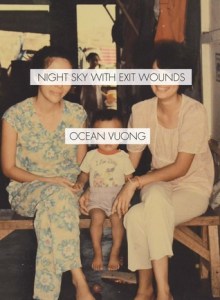
The others on my list this month include the two I am reading right now: Thomas C. Foster’s How To Read Poetry Like a Professor and Word of Mouth: An Anthology of Gay American Poetry, edited by Timothy Liu (whose collection, Burnt Offerings, is a personal favorite). I’m half-way through both of these, and I’m really enjoying them. The anthology is particularly interesting because most of the included poets are new to me.
After the Foster, I plan to read Mary Oliver’s A Poetry Handbook. When I finish the anthology and two poetry collections on my list, I will be completing the month’s project with Elizabeth Acevedo’s The Poet X.
Writing
Speaking of writing: It has been going generally well. I joined Camp NaNoWriMo this month, which is like the regular NaNoWriMo except you can adjust your goal, create cabins to collaborate with others, work on any kind of writing you want (even though it’s an off-shoot of National Novel Writing Month in November, this one is really meant to get you writing whatever you want). The social media accounts also run regular “word sprints” to encourage people to sit and write, as well as offering up a variety of prompts, e-mailed encouragement, etc. My current stats on this WIP are as follows:
- Today’s word count: 2,945
- July word count: 24,492
- Total word count: 34,545
- Chapters: 11 complete of 31 planned
 I’ve been averaging about one chapter a day. I get up early in the morning and head to “my spot,” which is the same spot I used for my 100 Days Journal project. I’ve found that creating and inhabiting one’s own writing space is crucial. Yesterday, after a sleepless night (thanks, insomnia!), I couldn’t get up to write. I tried later in the day and managed only about 1,000 words (about 25-30% of normal) and that was writing additions to a scene in a previous chapter, rather than working on a new chapter. I sat there staring at the “Chapter 11” header, at 2 in the afternoon, and simply couldn’t get anything onto the page. I guess I need my routine. (Is this what they mean by “creature of habit?”)
This morning, though, I managed to get up on time (despite another sleepless night) and got the chapter done. I’m happy with this pace and progress. If I can maintain it, then I’ll have a complete draft done by the end of July and can work on revisions and edits as the new school year begins, when the opportunity for new writing is, let’s face it, not readily available. I get too tired and too burned out from lecturing, grading essays, attending meetings and trainings, etc. I do plan to keep my mornings for myself, though, but rather than working on a lot of new material, I’ll probably be revising and editing, revising and editing. I guess this means, sometime around August I’ll be looking for beta readers. How does one go about doing that, anyway? And what about finding an agent? When is that supposed to happen? How does that happen? Oh dear.
Anyway, my first book, FROM A WHISPER TO A RIOT, recently received this very thoughtful review, and I’m so grateful.
Buddhism
 Part of the reason I began my 100 Days Journal project about 4 months ago is that, in addition to wanting to “force” myself into a daily writing routine, I found I had been struggling with severe depression all year. Since about January, I’ve been in a slump. It’s not unusual for me to have ups-and-downs, but this was a long one, and that “light at the end of the tunnel” we who suffer from depression come to rely on, just wasn’t showing up. Not even a little pinpoint in the distance. I didn’t know what was taking so long to come out of it at the time, but I have my thoughts now. In any case, one of the things I’ve realized is that I’ve been craving a kind of reckoning with myself and my beliefs, for lack of a better word. I’m an emotional and spiritual person, though agnostic and anti-religion. Still, I do always, always look for connections. The bigger picture. The threads that connect all of us. I’m a hopeful person, I guess, and so part of my struggle lately has been finding hope in a time that seems hopeless, perhaps not even worth hoping for. As I thought about what might help me investigate myself and find renewed purpose, I started to learn a little more about Buddhism. Here’s what I wrote on Twitter:
Do I have any practicing Buddhist friends who would be willing to point me to good places to start my reading? History, tenants, meditation, zen, beginners guides? I can look up lists online, but I’d rather have personal recommendations from people living the path. To be honest, I’m looking to connect with myself spiritually, to understand and articulate my own value system. I need a philosophy or “faith,” for lack of a better word, that is without deity, and Buddhism is the closest practice I know of, currently. At my core, I’ve a desire to be driven by kindness and generosity. I’ve seen a lot about Buddhism’s mindful approach to acting and reacting with love. That’s the sort of thing I want to get better at, particularly now when, let’s face it, there’s a revolution of hate happening. Ultimately, even Buddhism might not be for me. It’s possible that no established “religion” will be. But I’d like to learn more about it anyway.
I received some excellent and helpful suggestions, as well as inspiring and motivational comments and conversations. I also discovered that some of my Twitter connections are practicing Buddhists, though I never knew it. What a world of possibilities and revelations can open to us, if only we have the courage to ask! I’ve begun my journey with The Heart of the Buddha’s Teaching: Transforming Suffering into Peace, Joy, and Liberation by Thich Nhat Hanh. So far, it is resonating with me. His style is warm and to the point. He explains a lot of how the history of Buddhism has been corrupted or altered (inadvertently or intentionally), and then gets into the tenants and philosophies, including what they mean and how to practice them independently. I’m excited to continue learning more, and I’ll probably stick with Hanh’s texts for now, though I also hear good things about Pema Chodron. Am I a Buddhist? I don’t know. I take a lot from Christ’s teachings, too, but I cannot be Christian (ask me about that some other time). It may end up the same with Buddhism, though something about this experience so far, and the embracing of human philosophy rather than the supernatural, is appealing to me.
Take a breath, and onward.
A Lesbian Classic & Walt Whitman
I wrap-up my Pride Month reading with two final pieces of fiction, one a classic adult novel of lesbian literature, the other a young adult novel inspired by Walt Whitman. Please feel free to check out the rest of my pride month reads. I had planned to read 5 LGBTQ books this month but managed to read 7, and I wasn’t disappointed at all!
Don Juan in the Village

Jane DeLynn’s novel, Don Juan in the Village (1990), is a classic of lesbian fiction. It follows the escapades and sexual conquests of its female protagonist, a lady Don Juan, as she travels the world and sleeps with as many women as she can. The narrative spans the course of 20 years, beginning sometime in the 1970s and ending sometime in the 1990s. There is a clear and stark, sometimes painful, contrast between the freedom of the post-1960s sexual revolution and the advent of what the narrator labels, “the plague.”
Each chapter is titled with the name of a different place to which the protagonist travels. Within, she describes not just the place she is visiting, but the women—and types of women—she meets there and makes love to. These experiences range from the soft and sensual to the nearly sadistic, but in any case, the narrator is almost always “very wet.” Yes, indeed, the story is that bold, that graphic, that open about sexuality, and female sexuality in particular. As a gay male, these experiences are about as far removed from my own as is possible, and yet the importance of this kind of text, particularly in the cannon of LGBTQ+ fiction, particularly in the canon of women’s literature, and particularly at a time when AIDS was devastating the gay community, is not lost on me.
So, while the writing style did not particularly appeal to me (rather dry, like a kind of Gertrude Stein meeting Ernest Hemingway at the middle of an intersection), it also makes sense: what better way to share taboo experiences to the widest range of readers as possible than in a clinically modernist way, as if “these are the facts, and if you can’t handle them, you’re the problem.” So, upon consideration, it’s an incredibly smart approach by an obviously talented writer. I think many readers will respond to this one, though it wasn’t right for me. That said, readers of LGBTQ fiction and those interested in LGBT literary history, as I am, should not pass it up.
This book is also one of my TBR Pile Challenge reads for 2019.
We Contain Multitudes
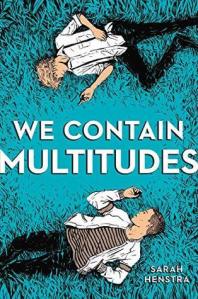
Sarah Henstra’s We Contain Multitudes (2019) is one of those rare novels that catches my attention right away, keeps it word-for-word, line-for-line, and page-by-page, and then upends everything just as I’m wondering if I could possibly love a book more. Somewhere about 75% into the novel (no, let’s be honest, I counted the pages and it was exactly 75% of the way in), the story takes an unexpected turn, one that I was not prepared for and one that I did not appreciate. It felt like my world was shattering. I understand how hyperbolic that must sound. IT’S JUST A BOOK, MAN, you’re probably thinking. Except that’s just it. This wasn’t just a book. This novel, these two young Whitman lovers, these two young Walt Whitmans, indeed, are much bigger than a story.
The novel is told in epistolary form, as a series of letters written between two high school boys, a sophomore and a senior. They are given an assignment to write to each other, typically with some kind of prompt from their English teacher. As they are in different classes, of different ages, and in wildly different social circles, they had never spoken to each other before, though they each knew who the other one is. This is because, in their own way, they are both wildly inconspicuous. What begins as a series of assigned letters, though, quickly drifts away from a mandatory task and into true, good old-fashioned letter-writing. Henstra adroitly creates two different styles and voices that match the two different teenage protagonists.
One struggle is that, given the design, the boys must re-tell each other the events to which they were both a party (otherwise, how would the reader know about them?) That said, even the author recognizes this complication and manages to address it through the characters’ letters as well. This is perhaps the only place where the author’s identity (or narrator’s, if we want to be more academic) can be felt. That said, a benefit to this is that the boys recount their shared experiences from their own perspectives, which turns out to be revealing to the reader, but also to the other person involved. A significant question that comes about, then, is how much can we really know another person?
I won’t reveal what happens at that three-quarter mark, except to say that it crushed me. The book resolves in a mostly satisfactory way, in my opinion, but I personally had been so distraught over the major conflict, that I was—I still am—left reeling. In a way, this speaks to the brilliance of Whitman, first of all, and to the brilliance of this novel and its characters, too. Upon reflection, I realize that Adam Kurlansky is deeper and more complex than he is given credit, and far crueler than I am or could ever be. I realize that Jonathan Hopkirk is stronger and more flawed than he seems, and far more forgiving than I am ore ever could be. And so, in this way, the point is proven: they do contain multitudes. We all do. The poetry is the point, and the poetry is in us all.
I haven’t felt this connected to Whitman or to myself since, well, since reading Whitman. It is not without its pains, nor without its fearsome joys. When I finished reading, I could only think of Whitman’s poem, “To You,” which, unless I’m mistaken, does not make an appearance in this novel. And yet…
Whoever you are, now I place my hand upon you, that you be my poem,
I whisper with my lips close to your ear,
I have loved many women and men, but I love none better than you. O I have been dilatory and dumb,
I should have made my way straight to you long ago,
I should have blabb’d nothing but you, I should have chanted nothing but you.
-Excerpt, “To You” (Walt Whitman)
Thoughts on Two LGBTQ Pride Reads
Like A Love Story
 Abdi Nazemian’s young adult historical fiction novel, Like A Love Story, is the fourth LGBTQ-themed book I’ve read this month. Like the others, it has not disappointed. Every good coming-out-story, like every good coming-of-age story from Little Women to The Catcher in the Rye, manages to do this, to balance a personal, individual story with a unique experience in time and place and the larger issues this entails. What the author does best in this novel is to integrate powerful and accurate portrayals of two difficult events, the Iran revolution and the AIDS crisis, into a story about an immigrant boy’s coming-of-age and coming out. Magically, it is all held together by the unlikeliest but most appropriate of figures: Madonna.
Reza is that immigrant boy. He arrives in New York City, by way of Canada, after his family flees Iran. Reza has always been the good boy, the one his mother can depend on, while his older sister has always been the rebel and troublemaker. But when Reza meets the beautiful punk photographer, Art, and his best friend Judy, everything changes. Reza is thrust into a world that values independence and individuality, and into a sphere that is fighting desperately to survive. Judy’s uncle Stephen is dying of AIDS, and through his example of activism, friendship, patience, and counter-pop culture, Reza, Judy, and Art learn to thrive, to live, and to love.
Like A Love Story is not only a beautifully-written young adult novel, but it is a historically and socially important one. Nazemian reminds the reader just how hard gay and lesbian people had to fight to win their freedoms and equal protections, a fight that continues to this day and that is constantly under attack. The author includes several important historical lessons, weaving them seamlessly into the story of these characters’ lives, so that readers who give this work a chance will find themselves learning critical history that is often overlooked, forgotten, or under-appreciated, while at the same time enjoying an excellent story. At the heart of it are themes of friendship, forgiveness, and first loves, as well as first losses and the reality of mourning. These very human themes are so universal that the reader, while connecting with the fictional of it all, might find themselves relating to a story well beyond their own lived experience.
This is one of the most important and illuminating LGBTQ novels published in recent memory.
Symptoms of Being Human
 The fifth book I read for Pride Month is Jeff Garvin’s The Symptoms of Being Human, a young/new adult novel about a gender fluid protagonist’s coming-out experience. Riley Cavanaugh’s father is a conservative politician in a conservative Orange County, California district, in the middle of a re-election campaign. Riley’s mother is kind and well-meaning, but much of her time is devoted to her duties as a politician’s spouse. Just as the election season is heating up, Riley suffers a kind of panic attack at an important event, after which they are hospitalized for attempted suicide. To ease some of the tension, Riley transfers out of her private Catholic school, where they were tormented, to a public school, where they hope to be better treated. Unfortunately, high school is still high school, conservative areas are still conservative areas, and plans often go sour.
While Riley struggles to figure out who they are, some days feeling like a girl and some days like a boy, and other days not like either one, they also navigate the process of healing from self-harm, dealing with anxiety, hiding a powerful secret from their parents and, let’s face it, an entire district that has the Cavanaugh family under its microscope, and trying to make friends, or at least avoid making enemies, at a new school. Any one of these conflicts would be difficult but trying to deal with all of them simultaneously is beyond unlucky. To help, Riley’s therapist suggests that they start a blog and share privately and anonymously what cannot be shared publicly. To write is Riley’s true therapy, and as it turns out, they are very good at it. Ironically, this talent is what causes the largest crisis of all.
Somehow, Riley finds themselves with a popular blog that only grows in popularity as its presence is picked-up by one of the largest LGBTQ community websites online. Riley receives thousands and then tens of thousands of followers and is bombarded with comments of praise, questions for advice, and plenty of hate mail, too. Eventually, Riley’s identity is discovered, right around the time some of the advice they have given to a transgender teen goes terribly wrong, and suddenly they are thrust, with their secrets, into the glaring spotlight that is a political election season.
The major climax itself did feel unnecessary to me, in an almost troubling way. In my reading, the event felt manufactured to fit a gap in the construction of the narrative, rather than necessarily and organically manifested by the sequence of the story itself. It is also a device so often used in stories of sex/gender diversion that, at this point, it has become cliché. This is not to say the problem is not real, because it is very real and all too common, but the introduction and handling of it (and particularly the “fall out”) are even more important for that reason. This is the one element that pulled me out of an otherwise truly engaging, interesting, and important work that deals with gender fluidity, family, hate crimes, coming-of-age, and mental health.
One of the most incredible things about Symptoms of Being Human is that the author manages to treat Riley Cavanaugh’s gender fluidity with complete honesty throughout the course of the narrative. It is never revealed whether the protagonist was born biologically male or female, nor what their parents assume to be Riley’s sex or gender. This is an impressive feat. The story is well-paced, moving slowly and thoughtfully through the complex areas, then speeding up rapidly during moments of intensity. I was able to read the entire thing over the course of one round-trip flight, and rarely did I want to stop to put it down.
I’m currently reading Jane DeLynn’s DON JUAN IN THE VILLAGE, which will be my 6th book for Pride month (this one features a lesbian protagonists sexual experiences around the world), completing my planned reads for the month, though I hope to get one more snuck in under the wire. DON JUAN is also a book on my 2019 TBR Pile Challenge List. Check out my thoughts on earlier Pride Month reads, ON EARTH WE’RE BRIEFLY GORGEOUS as well as GEMINI and HOLD MY HAND.
On Earth We’re Briefly Gorgeous
The irony is not lost on me that, just a couple of days after claiming that I no longer plan to write formal/lengthy book reviews for this blog, I finish reading Ocean Vuong’s first novel, On Earth We’re Briefly Gorgeous. It would be absolutely thrilling to think that I can articulate just why it is so necessary for me to write a full-length reflection about this novel, but the idea that I can do this book justice is ludicrous. Still, I’ll try my best.
Ocean Vuong is an acclaimed Vietnamese-American poet who has already won numerous prestigious awards, including the T.S. Eliot award for poetry. His collection, Night Sky With Exit Wounds, is one of the highest regarded contemporary collections on the market, which made the anticipation about this first novel all the more extreme. It is rare to see a talented writer in one genre, like poetry, crossover into another genre, like fiction, and even rarer still to find that she or he manages it expertly. Vuong is such a rarity.
On Earth We’re Briefly Gorgeous is marketed as a letter from a Vietnamese-American boy to his mother, who cannot read. Taken literally, this is the case. Little Dog is writing to his mother about all the secrets he has kept, all the memories he has buried, and all the love he carries for his mother and his grandmother, both of whom are reeling from the traumas of war, immigration, loss of language, and Alzheimer’s. So, it is a kind of love letter to these women, to their past, but also to himself as a boy and to his future self, the man who will be made possible. He knows his mother cannot understand the words he writes, the language he speaks, so he shares without restraint and sends the letter to us all.
One of the reasons why I enjoyed and appreciated this novel so much is that it is written by a poet. This is clear not just in the language, but in the shape and delivery of the major themes and ideas. Vuong, through Little Dog, looks at the world through the eyes of the poet and describes what he sees in a way that only a poet could. The mundane is made miraculous, the painful is paradox, and the beautiful is wrenching. He manages to make the reader empathize with a host of characters, from the quietly rebellious protagonist, to his contradictorily abusive yet loving mother, and to his young boyfriend, a country redneck simultaneously terrified of yielding himself to another boy while still capable of treating his lover with the greatest compassion and tenderest care.
What holds it together most, what makes it a masterpiece, is its honesty. Words like “courageous” are often applied to novels like this one, stories that tell of family traumas, of coming-of-age and coming out. But Vuong’s honesty, here, is on a different level altogether. The way he describes his coming out and his growing up, his ever-progressing awareness of self, his first love and loss, moves beyond courageous. It is an act of total surrender, a giving up of everything that the world tells us should be kept to ourselves. In this way, Vuong allows Little Dog to reach the two kinds of readers who most need his story: the readers like Little Dog, who experienced or will experience the unique moments of gay life, of immigrant life, of life as an outcast, that can rarely be discussed in public, if ever. And the readers who know nothing of this type of journey, but who might learn what it means to be the someone else, the one without words or defense in a world that is terribly loud and aggressive. To be the dove in a crow’s nest.
For me, Ocean Vuong’s novel comes at a time when I am re-examining my own life and past. It comes at a time when Eugene Lee Yang releases his beautiful artistic articulation of a similar journey. For me, it seems, a universe of ellipses is falling into place at exactly the right moment, and to read a perfect book in a turbulent and confusing time is perhaps the most miraculous way to think of one’s place in that universe as intentional, purposeful, and necessary.
Notable Quotes:
“The nameless yellow body was not considered human because it did not fit in a slot on a piece of paper. Sometimes you are erased before you are given the choice of stating who you are” (63).
“The children, the veal, they stand very still because tenderness depends on how little the world touches you. To stay tender, the weight of your life cannot lean on your bones” (156).
“To be clean again. To be good again. What have we become to each other if not what we’ve done to each other?” (206)
“The thing is, I don’t want my sadness to be othered from me just as I don’t want my happiness to be othered. They’re both mine” (181).
“The sunset, like survival, exists only on the verge of its own disappearing. To be gorgeous, you must first be seen, but to be seen allows you to be hunted” (238).
June Checkpoint! #TBR2019RBR
 Hello, TBR Pile Challengers!
Welcome to the MID-WAY POINT for our 2019 TBR Pile Challenge! I don’t know about you, but the time seems to be flying for me. I’m already too many weeks into my summer “break” and feel like far too many months in the year have passed.
That said, I have somehow, someway managed to keep pace with this challenge (sort of.) I’ve read and reviewed exactly 6 of my 12 required books. Since I hope to read all 14 on my list, this does put me a bit behind schedule, technically, but “to win,” one only needs to hit 12 of 12, so I’m counting it as pretty good performance thus far, even if my reviews have gotten rather brief.
Progress: 6 of 12 Completed / 6 of 12 Reviewed
As you can see, the more recent reviews are pretty short in comparison to what I usually write, but that’s partly because “book blogging” or “reviewing,” anyway, is becoming less of a priority for me. I still plan to keep up with this blog and sharing my thoughts on the books that I’m reading, but it will likely not be in the form of full-on reviews. I think the next book on my list I want to try will be either The Ascent of Woman or Light the Dark: Writers On Creativity, Inspiration, and the Artistic Process.
Books read:
- The House of the Vampire (1907) by George Sylvester Viereck
- The Funhouse by (1980) by Dean Koontz
- Timequake (1997) by Kurt Vonnegut
- Letters to a Young Poet (1934) by Rainer Maria Rilke
- We (1924) by Yevgeny Zamyatin
- Gemini (1975) by Michel Tournier
How are you doing?
Below, you’re going to find the infamous Mr. Linky widget. If you read and review any challenge books this month, please link-up on the widget below. This Mr. Linky will be re-posted every month so that we can compile a large list of all that we’re reading and reviewing together this year. Each review that is linked-up on this widget throughout the year may also earn you entries into future related giveaways, so don’t forget to keep this updated!
MINI-CHALLENGE #2 WINNER: Lindsay from Three Good Rats! Lindsay chose to receive a copy of OUTLANDER by Diana Gabaldon. Congratulations, Lindsay! Good luck to you all next month, when Mini-Challenge #3 comes around. 🙂
LINK UP YOUR REVIEWS!
 Roof Beam Reader