Roof Beam Reader
Adam Burgess
Considering the Secret of Northanger Abbey
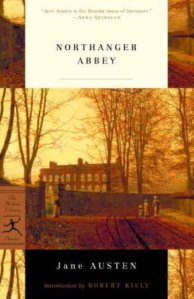 Although I’m not hosting Austen in August this year, I did want to dip my toes into something Austen-related, at least. Old habits die heard! As many of you know, my favorite Austen novel is Northanger Abbey. It is not her best, but I have a special affinity for it, for a few reasons. I recently read an article that takes a different view on its characters, so I thought I would consider it and respond here.
Edward Neill’s “The Secret of Northanger Abbey”is largely a critique on the “imbecility” of the characters in Jane Austen’s novel. Neill refers to each character individually, pointing out their less admirable traits, without paying much attention to what positivity or sensibility the characters might actually bring to the story. The article revolves around negativity, and does not take into consideration multiple-motives or interpretations.
For instance, when discussing an argument between Catherine and Henry Tilney, over Fred Tilney’s actions with Isabella Thorpe, Neill writes, “Catherine’s condemnation of [Fred’s] caddishness seems more accurate than Henry’s blustering indulgence” (Neill 23). However, Neill only allows for Catherine’s behavior as proper in this circumstance, refusing to acknowledge the fact that Henry must first (especially in the time this novel is written, when familial ties are of the utmost importance) align himself with his brother; furthermore, if we look at the novel itself, it is clear that Henry Tilney understands Isabella’s character, as well as his brothers, and he finds them both equally at fault. Henry touches on this sentiment when he responds to Catherine’s one-sided assault against his brother, essentially stating that, in order for one to fret over Captain Tilney’s treatment of Isabella, one would need “first suppose Isabella to have had a heart to lose, – consequently to have been a very different creature; and in that case, she would have met with very different treatment” (Austen 150-51). Thus, Henry does not disagree that the Captain’s behavior leaves much to be desired, but also that one such as Isabella need not expect, nor deserve, any better.
The character “flaws,” as Neill understands them, are not the only aspects of Austen’s novel with which Neill finds fault. He goes on to examine Catherine’s growth as a character, and rather than applauding Austen for allowing Catherine to develop over the course of the narrative, Neill states that the character growth from “imbecility sprouts at an alarming” rate (Neill 24). I would argue, however, the old adage that one cannot truly grow, or appreciate one’s own self-worth, without first making mistakes (or, “it is better to learn from your mistakes, than to be doomed to repeat them.”) Why does Neill find such fault in a character’s ability to learn and to grow – as Catherine does – with each new experience? It is also clear that her most important life experience to-date is happening at this moment in narrative time, when Catherine is visiting Bath and largely responsible for herself for the first time, so it seems natural that this is a time when she would obtain a great deal of self-awareness (as well as social, political, economic, etc.), even rapidly.
The third issue I take with Neill’s reading of Northanger Abbey comes by way of his deconstruction of an interaction between Catherine and Henry. As the two characters discuss their reading of The Mysteries of Udolpho, Neill labels Henry’s irony “self-reproachful,” then goes on to state that Catherine misunderstands Henry’s intention with his statement that he has read the book and thus, must “gain points” with her (Neill 25). Neill seems to think that Henry is mocking her, and, though Tilney does use sarcasm often enough to get his point across, as when he says, in jest, that “nature has given [women] so much, that they never find it necessary to use more than half,” it is also made clear, early in the story, that he does read and enjoy novels (Austen 79). Therefore, I would argue, this scene is not meant to diminish Henry’s nor Catherine’s character; instead, it is Austen’s way of bringing the general popularity and importance of the novel to the forefront.
Neill’s essay is an interesting piece of criticism, and it does have its value. It offers one way of reading the characters in the novel and leaves room for argument and further consideration. Further, it concludes that “Northanger Abbey contains the meaning of Northanger Abbey” which Catherine, mostly by accident, discovers (Neill 29). The article opened up my own reading of the text by making me look more closely at the way Catherine’s character develops throughout the novel, and how it is her stumbling and misinterpretations of situations, or perhaps more generously, her intuition which allows her to become the true heroine of the novel. What does it mean, for instance, that “not only is she not absolutely wrong, she ends by seeming closer to being right than anyone else?” (Neill 28) Neill is correct that Catherine somehow interprets the natures of John Thorpe, General Tilney, and Captain Tilney; however, I would have to argue that, even though she does not, at first, understand the reason for her “gut feelings” about these people, she is the only person to recognize that there is something wrong. Thus, in my opinion, Catherine is no “imbecile.”
Works Cited
Austen, Jane. Northanger Abbey. New York: W.W. Norton & Company, 2004.
Neill, Edward. “The Secret of Northanger Abbey.” Essays in Criticism 47.1 (1997): 13-32.
All work found on roofbeamreader.com is copyright of the original author and cannot be borrowed, quoted, or reused in any fashion without the express, written permission of the author.
The Dystopic Villainy of Book Clubs
 I was recently informed that someone out there on the interwebs has a serious problem with the “Classics Club Spin.” Now, normally, this sort of thing wouldn’t phase me. Different people like and appreciate different things. So it goes and who cares? But then I visited said blog and read the post, a self-congratulatory and sweeping criticism of modern-day “book clubs.” The most intense criticism is saved for the joyful little spin, however, and the rationale is beyond bizarre.
The blog post begins thus: “But there is a strange new trend, a marketing plan for glamorous curators of books. Publishers can now con readers into subscribing to book clubs where the “editors” choose the monthly books for the customers.”
That’s a pretty reasonable critique, save the part of this being anything new. In a way, this trend has been around at least as long as Dickens, who—along with other serial writers—created the market for subscriber-based fiction. That said, the idea that there is a “great con” in a book club is simplistic and dishonest. Do subscribers really not know that editors will be choosing each month’s selection for them? Do they not sign up for the program themselves, and continue it month-to-month so long as they are satisfied? Can they not choose to return the book, or “DNF” it, or read it, love it, and rate it on Goodreads, if they want? Where, exactly, is the con?
But it gets worse.
At this point, the writer goes on to criticize specific clubs.
First is the NYRB Classics Book Club, which she thinks is too expensive. In this, I probably agree, but again, where is the con? Don’t have the money? Don’t join the club. In most cases, these clubs also post their reading selection(s), so guess what? A person could join along as they see fit or not, with different editions and even electronic copies, if they want to save money or choose to avoid certain selections.
Then, The Art of the Novella Subscription Series from Melville House is called out for choosing books that do not count as novellas. The criticism here is that the book club facilitators do not know what a novella is. She indicates that books such as The Awakening and Jacob’s Room are novels, not novellas, and so these editors need to learn what is what before they can earn her loyalty (though at this point, I’m beginning to doubt they would receive it regardless). The intense scorn, based only on two examples, seems inappropriate at best, especially considering the fact that The Awakening and Jacob’s Room certainly come close enough to being novellas. Merriam-Webster defines a novella as “a work of fiction intermediate in length and complexity between a short story and a novel.” Most dictionaries of literary terms further limit the novella to between 17,000 and 40,000 words. Well, The Awakening surpasses the limit by about 6,000 words (45,965) and Jacob’s Room comes in at about 54,000 words. So, in the strictest sense, are they novellas? Perhaps not, but I think more than enough readers and scholars alike would accept that they come close enough and that the reader of short fiction/novellas would receive more benefit than harm from their inclusion, particularly if they are aspiring writers. Maybe I’m just missing the “con” again.
Next on the chopping block is Asymptote Book Club which the author says she has “never heard of” and thereby sarcastically dismisses its claim that it is “the premier site for world literature in translation.” I’m not sure what sort of argument, “it can’t be true because I’ve never heard of it” falls into, but it seems to fit our times. To be fair, though, she’s also not a fan that the choices are “surprises” and that they are selected by an “award-winning team” (“who are they?” she asks. That’s a fair question, but did she bother to read the “about” section, or send an email? “Reader beware” is a nice catch-phrase, but doing a tiny bit of work is also acceptable, especially for someone who finds personal choice and responsibility such a virtue, as will be demonstrated below.) As it turns out, this Asymptote club works with independent publishers with similar missions. I for one can support that.
The final club to be critiqued is the good old-fashioned Book of the Month Club, which has narrowed its monthly offerings down to five (from a previous “catalogue” of options). This club receives the least amount of scrutiny, for whatever reason, but it also serves as the set-up for what the writer introduces next: an incomprehensible and frightfully misinformed view of The Classics Club’s “Classics Spin,”which the blogger deems “horrifying.”
The writer begins by suggesting that participants in the spin “have a problem with choice” and that she herself only bothered to look into it because “some very good bloggers participated in this: otherwise, I’d never have heard of it” (so, again, if this person does not know about it, it must not be important or substantial – what a healthy opinion to have of one’s self).
Ultimately, we arrive at the strangest and most harrowing critique of the entire piece, reserved not for a corporate book club out to make money, but for our small, independent, volunteer-based little club:
Why are people ceding their choices to curators and chance? My husband speculates that people no longer want responsibility. If they do not choose their own books, or if they merely draw a number in a lottery, they have less commitment to the book. If they dislike a book, it’s not their fault. They didn’t choose it. My own theory is that “they” are narrowing our choices to facilitate the despotic politicians of the dystopian future of climate change and disasters. Thinking? Bad. Reading? Worse. Soft addiction to tweeting? Good. Choices? What choices? It’s going to be really, really terrible.
Where to begin? “Ceding choice?” Perhaps, because this writer is only interested in what she already knows, she did not bother to read anything about the Club. You see, Clubbers choose all of their own books, and the spin itself is a self-selected list from one’s own previously compiled list. That means “Spinners” have literally made their own choice twice.
Avoiding “responsibility”? What sort of responsibility would that be? The responsibility we have to ourselves to choose our own books? The responsibility to choose to finish or not finish the book? The responsibility to choose to write about or not write about it? The responsibility to decide whether or not we join the club or participate in any/all of the spins? I suppose each of these things is, yes, a personal responsibility and choice. I’m happy to say, all of these choices are in fact the responsibility of each club member, which is what makes it such a compelling, eclectic, and lively group to be a part of: no one “Clubs” the same way.
“If they dislike a book, it’s not their fault. They didn’t choose it.” Once again, the writer seems misinformed about the nature of the list and the club. The clubber/spinner does choose to put that book on their list, so whether or not they read it is “their fault,” as she writes. How to classify a reading choice as a “fault” or not, though, is beyond me. If someone dislikes a book, they dislike it. There can be any number of reasons why, but in six years I can share this much: no one has ever blamed the fact that they didn’t like a particular book they read for their Classics Club list on the fact that they read it because it was a spin selection. What flawed logic that would be; fortunately, we have escaped it thus far.
But if all of that wasn’t strange enough, her final lines turn out to be the most ridiculous and shameful of all: “My own theory is that ‘they’ are narrowing our choices to facilitate the despotic politicians of the dystopian future of climate change and disasters. Thinking? Bad. Reading? Worse.” So, this writer actually thinks that The Classics Club, which has existed for six years simply because people love to read and write about classic literature, is a kind of totalitarian groupthink in disguise? It takes something beyond a stretch of the imagination to conclude this way, and it starts with total ignorance of the club and its purpose and methods.
To be clear: members of the Classics Club choose their own list of books and set their own pace. They can modify their lists at any time. They also choose their own Spin lists and can join or not, at any time. Members come from all over the world and the moderators are volunteers who spend their own time and resources keeping up the website, social media accounts, etc. The entire purpose is to read, with added encouragement on review and discussion. Anyone who thinks the Classics Club is “facilitat[ing] the despotic politicians of the dystopian future” needs to go back to class.
How does one develop such a strange antipathy for something so simple? I’m not sure, but my grandfather had a favorite saying that comes to mind now: “Any club in which [s]he’s a member is not a club I want to join.” Perhaps these book clubs should consider it a blessing that they do not count “mirabile dictu” among their ranks. And perhaps, if she first became familiar with the things she critiques, she might develop a different perspective on them.
You can read the original post here: https://mirabiledictu.org/2018/08/02/the-glamour-of-book-club-curators/
Edit: She appears to have removed the original post. A new post is here, for those who care: https://mirabiledictu.org/2018/08/06/the-missing-bbc-adaptations-of-george-gissing/
The “Awakenings” of Edna Pontellier
 “She grew daring and reckless, overestimating her strength. She wanted to swim far out, where no woman had swum before.” Kate Chopin’s The Awakening (1899) is the story of one woman’s realization of the world and potential within her. In her Journey, Edna Pontellier awakens to three important pieces of her own being. First, she awakens to her artistic and creative potential. This minor but important awakening gives rise to Edna Pontellier’s most obvious and demanding awakening, one which resonates throughout the book: the sexual.
However, though her sexual awakening may seem to be the most important issue in the novel, Chopin actually slips in a final awakening at the end, one that is hinted at early on but not resolved until the last-minute, and that is Edna’s awakening to her true humanity and role as a mother. These three awakenings, artistic, sexual, and motherhood, are what Chopin includes in her novel to define womanhood; or, more specifically, independent womanhood.
What seems to ignite Edna’s awakening is the rediscovery of her artistic inclinations and talents. Art, in The Awakening becomes a symbol of freedom and of failure. While attempting to become an artist, Edna reaches the first peak of her awakening. She begins to view the world in artistic terms. When Mademoiselle Reisz asks Edna why she loves Robert, Edna responds, “Why? Because his hair is brown and grows away from his temples; because he opens and shuts his eyes, and his nose is a little out of drawing.” Edna is beginning to notice intricacies and details that she would have ignored previously, details that only an artist would focus and dwell on, and fall in love with. Further, art is a way for Edna to assert herself. She sees it as a form of self-expression and individualism.
Edna’s own awakening is hinted at when the narrator writes, “Edna spent an hour or two in looking over her own sketches. She could see their short-comings and defects, which were glaring in her eyes” (90). The discovery of defects in her previous works, and the desire to make them better demonstrate Edna’s reformation. Art is being used to explain Edna’s change, to suggest that Edna’s soul and character are also changing and reforming, that she is finding defects within herself. Art, as Mademoiselle Reisz defines it, is also a test of individuality. But, like the bird with its broken wings struggling along the shore, Edna perhaps fails this final test, never blossoming into her true potential because she is distracted and confused along the way.
A great deal of this confusion is owed to the second awakening in Edna’s character, the sexual awakening. This awakening is, without doubt, the most considered and examined aspect of the novel. As Edna Pontellier begins to realize that she is an individual, capable of making individual choices without being another’s possession, she begins to explore what these choices might bring her. Her first sexual awakening comes in the form of Robert Lebrun. Edna and Robert are attracted to one another from first meeting, though they do not realize it. They unwittingly flirt with each other, so that only the narrator and reader understand what is going on. For instance, in the episode where Robert and Edna speak of buried treasure and pirates:
“And in a day we should be rich!” she laughed. “I’d give it all to you, the pirate gold and every bit of treasure we could dig up. I think you would know how to spend it. Pirate gold isn’t a thing to be hoarded or utilized. It is something to squander and throw to the four winds, for the fun of seeing the golden specks fly.
“We’d share it and scatter it together,” he said. His face flushed. (59)
The two do not understand the significance of their conversation, but in reality, the words speak of desire and sexual metaphor. Jane P. Tompkins writes, “Robert and Edna do not realize, as the reader does, that their conversation is an expression of their unacknowledged passion for one another” (23). Edna awakens to this passion whole-heartedly. After Robert leaves, and before the two have opportunity to truly explore their desires, Edna has an affair with Alcee Arobin.
Though it is never directly spelled out, Chopin uses language to convey the message that Edna has stepped over the line, and damned her marriage. For instance, at the end of chapter thirty-one the narrator writes, “he did not answer, except to continue to caress her. He did not say good night until she had become supple to his gentle, seductive entreaties” (154).
However, it is not only in situations with men that Edna’s passion is flared. In fact, the “symbol for sexual desire itself,” as George Spangler puts it, is the sea (252). It is appropriate that the most concentrated and artistically depicted symbol for desire comes, not in the form of a man, who may be viewed as a possessor, but in the sea, something which Edna herself, once afraid of swimming, conquers. The narrator writes, “the voice of [the] sea speaks to the soul. The touch of the sea is sensuous, enfolding the body in its soft, close embrace” (25).
This is perhaps the most sensual and passionate chapter of the book, devoted entirely to depictions of the sea and to Edna’s sexual awakening. It is pointed out here that “the beginning of things, of a world especially, is necessarily vague, tangled, chaotic, and exceedingly disturbing.” Still, as Donald Ringe notes in his essay, “[The Awakening] is too often seen in terms of the question of sexual freedom” (580).
The true awakening in the novel, and in Edna Pontellier, is the awakening of self. Throughout the novel, she is on a transcendental journey of self-discovery. Edna is learning what it means to be an individual, a woman, and a mother. Indeed, Chopin amplifies the significance of this journey by mentioning that Edna Pontellier “sat in the library after dinner and read Emerson until she grew sleepy. She realized that she had neglected her reading, and determined to start anew upon a course of improving studies, now that her time was completely her own to do with as she liked” (122). That Edna is reading Ralph Waldo Emerson is significant, especially at this point in the novel, when she is starting a new life of her own.
This new life is signaled by a “sleep-waking” metaphor, one which, as Ringe points out, “is an important romantic image for the emergence of the self or soul into a new life” (581). A seemingly excessive amount of the novel is devoted to Edna sleeping, but when one considers that, for each time Edna falls asleep, she must also awaken, one begins to realize that this is just another way of Chopin demonstrating Edna’s personal awakening.
Another transcendentalist link to awakening can be found in the inclusion of Emerson’s theory of correspondence, which has to do with life’s “double world, one within and one without” (Ringe 582). Much of Edna is contradictory. Her attitudes toward her husband, her children, her friends, and even the men with whom she has affairs. These contradictions are encompassed within the idea that Edna was “beginning to realize her position in the universe as a human being, and to recognize her relations as an individual to the world within and about her” (33).
So, Edna’s true awakening is to the understanding of herself as a human being. But the awakening goes further still. She also becomes aware, at the end, of her role as woman and mother. At one point, early in the novel and before this awakening, Edna tells Madame Ratignolle, “I would give up the unessential; I would give my money, I would give my life for my children but I wouldn’t give myself. I can’t make it more clear; it’s only something which I am beginning to comprehend, which is revealing itself to me” (80).
William Reedy describes Edna Pontellier’s character and conflict when he wrote that “Woman’s truest duties are those of wife and mother, but those duties do not demand that she shall sacrifice her individuality” (Toth 117). The last awakening, to this realization that womanhood and motherhood can be a part of the individual, comes at the very end of the book. Toth writes that “Chopin makes the ending attractive, maternal, sensuous” (121). Edna meets with Madame Ratignolle again, to see her while she is in labor. At this point, Ratignolle cries out to Edna, “think of the children, Edna. Oh think of the children! Remember them!” (182). It is for the children, then, that Edna takes her life.
Though the signs are confused, they are throughout the book; with a broken-winged bird symbolizing Edna’s failure, and the sea concurrently symbolizing freedom and escape, Edna’s suicide is in fact a way of her maintaining her independence while also putting her children first. It is ironic that the point in her life when she realizes a mother’s duty, is at the moment of her death. She does sacrifice herself, as she claims she never would, by giving up the chance at all she could have in order to protect her children’s future and well-being.
Spangler explains this when he says, “primary was her fear of a succession of lovers and the effect such a future would have on her children: ‘to-day it is Arobin; tomorrow it will be some one else. It makes no difference to me, it doesn’t matter about Leonce Pontellier – but Raoul and Etienne!’” (254). Edna gives up the newly found passion and understanding, she gives up her art, and her life, to protect her family.
The Awakening is a complex and beautiful novel, filled with contradictions and sensations. Edna Pontellier journeys through life, awakening to the transcendental beliefs of individuality and connections with nature. She discovers sensual joy and power in the sea, beauty in art, and independence in sexuality. However, though some critics claim the ending to be the novel’s downfall, and what keeps it from top status in American literary canon, the fact is that it wraps up the novel in as beautiful a way as it was told all along. The novel ends in confusion and wonder, as it is told.
Edna spends her life, since the awakening, questioning the world around her and within her, so why not remain questioning to the end? Spangler writers in his essay, that “Mrs. Chopin asks her reader to believe in an Edna who is completely defeated by the loss of Robert, to believe in the paradox of a woman who has awakened to passional life and yet, quietly, almost thoughtlessly, chooses death” (254).
But Edna Pontellier is not defeated by Robert. She is the one making choices, as she has determined to do all along. Her death was not thoughtless; in fact, it seems almost pre-planned, a “coming home” to the sea. Edna strips off her clothes and becomes one with the very source of nature which helped to awaken her to her own power and individualism in the first place. Further still, that she goes quietly is not an admission of defeat, but a testament to Edna’s ability to end her life the way she lived it.
Each decision that Edna Pontellier makes throughout the novel is done quietly, suddenly. The dinner party, the move from her home to the “Pigeon House.” There is never any ruckus or chorus, just simple, impassioned change. Thus, the novel’s conclusion is a statement to the enduring power of womanhood and individualism. Chopin is affirming that, even in death, perhaps only in death, one can become and remain truly awakened.
References
Adam W. Burgess, “The ‘Awakenings’ of Edna Pontellier.” Adam Burgess, Writer 03 Aug. 2018. https://adamburgesswriter.com/2018/08/03/the-awakenings-of-edna-pontellier/.
Kate Chopin, The Awakening. New York: Dover Publications,1993.
Donald A. Ringe, “Romantic Imagery in Kate Chopin’s The Awakening” American Literature 43 (January 1972) 580-88.
George M. Spangler, “Kate Chopin’s The Awakening: A Partial Dissent,” Novel 3 (Spring 1970): 249-55.
Jane P. Tompkins, “The Awakening: An Evaluation,” Feminist Studies 3 (Spring-Summer 1976): 22-9.
Emily Toth, Kate Chopin. New York: Morrow, 1990.
Twenty-Four Things About Me
I thought I would have a little bit of fun today with a very old meme that used to go around the blogosphere. The concept is pretty simple, review the categories below and provide four responses that answer the question. It’s a bit of a getting to know you activity. Ready? Set. Go!
4 Things In/On My Desk
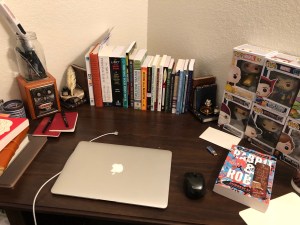
Books.
Laptop.
Funko Pops!
A candle.
4 Things I’ve Always Wanted To Do (but haven’t yet)
Write a book (that is not* a dissertation).
Travel Europe.
Skydive!
Learn a third language (French? Italian?).
4 Favorite Things In My Room/Bedroom
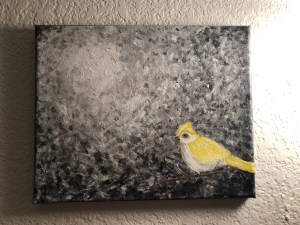
Painting of a yellow bird in a black sky that my sister made me.
Record player.
Vintage globe with hidden bar.
Wizard-themed bookends.
4 Things I Enjoy Very Much At The Moment
Reading.
Walking/hiking.
Writing.
Listening to music.
4 Songs I Can’t Get Out Of My Head
“World Spins Madly on” by The Weepies
“Ready to Get Down” by Josh Ritter
“What’s Left of the Flag” by Flogging Molly
“Thirteen Sad Farewells” by Stu Larsen
4 Things You Don’t Know About Me
I’m very sentimental.
I’m very easily distracted.
I have almost died twice.
I love adventure.
So, there’s a simple and fun way of learning a little bit about me, rapid-fire style! I would love to read some of your responses, too, so feel free to use the comments to provide your own answers and/or share this on your blog and link-up in the comments here so we can visit each other. 🙂
Time to SPIN! #ccspin
 Recently, the original moderators for The Classics Club (including yours truly) stepped down after six years and handed things over to four new individuals. They’re starting their tenure off with a bang, by diving into Classics Spin #18!
What is the Classics Spin? Essentially, clubbers choose twenty books from their classics club reading list and post them by the due date.Then, on “spin day,” a number between 1-20 is revealed, and that is the book you have to read before the deadline (usually the end of the following month). You can choose your books randomly, divide them by categories, or whatever. Part of the challenge, though, is to choose at least a few that you know you’re dreading, just in case this is the opportunity to nudge you toward it.
So, I went mostly with a “random” sort this time, but I did choose at least one book from each of the “centuries” represented on my main club list. Here are the twenty I’ve pulled to play with:
- The Blazing World by Margaret Cavendish
- At Swim, Two Boys by Jamie O’Neill
- The Good Earth by Pearl S. Buck
- The 120 Days of Sodom by Marquis de Sade
- Kim by Rudyard Kipling
- A Vindication of the Rights of Woman by Mary Wollstonecraft (re-read)
- Eugénie Grandet – Honoré de Balzac
- Little House on the Prairie by Laura Ingalls Wilder
- So Big by Edna Ferber
- The Blind Assassin by Margaret Atwood
- Paradise Lost by John Milton
- Dead Souls by Nikolay Gogol
- The Count of Monte Cristo by Alexandre Dumas
- The Bluest Eye by Toni Morrison
- Madame Bovary by Gustave Flaubert
- North and South by Elizabeth Gaskell
- Wise Blood by Flannery O’Connor
- One Hundred Years of Solitude by Gabriel Garcia Marquez
- Metamorphoses by Ovid
- The Mysteries of Udolpho by Ann Radcliffe
I guess I’m hoping for Number 3, Number 5, or Number 8 and probably most worried about Number 20, Number 19, and Number 13 – mostly because of how long they all are; but whatever happens, I’m ready to read! Let’s spin!
 Roof Beam Reader