Roof Beam Reader
Adam Burgess
Martin Luther King’s Last Vision

Today is my birthday, and I spent the early part of the morning reflecting briefly on my life: friendships, accomplishments, goals, marriage, and family. But I’ve also been thinking a lot this morning about the legacy of Dr. Martin Luther King, Jr. It was fifty years ago today–April 3rd, 1968–that he delivered his final sermon at Mason Temple in Memphis, Tennessee.
The opportunity must have seemed both ideal and disconcerting to King, who had spent so many years tirelessly marching forward in the struggle for racial equality in the United States, only to see so little progress. At this point in his life and career, the attention of major news outlets had turned away from his leadership, which must have seemed stalled, in favor of reporting on the more dramatic activities of the black power movement, which was also doing good work and heavy lifting, but in a more obvious way (and as we know, the media loves spectacle).
So, King had turned his attentions to issues of poverty and to supporting the poor and working classes in America. For this reason, I think being invited down to Memphis to speak to the Sanitation Workers in support of their strike for fairer wages and work conditions, must have been promising. But King had another relationship with the city of Memphis, and he surely knew it would not—or could not—be another Selma. Still, he went and, apparently without notes, delivered one of his most powerful, memorable, and moving sermons. The one that would be his last.
A storm raging outside, thunder and lightning crashing in the background, and rain pummeling the tin roof, set a kind of wild and natural rhythm. King stepped up to the podium and addressed a sea of people who had been calling his name: “The nation is sick,” he said. “Trouble is in the land. Confusion all around.” I can only imagine the feeling in the room right then. Here came a group of workers looking for support and leadership and encouragement from one of the world’s greatest inspirational orators, and this is how he begins?
But I know, somehow, that only when it is dark enough, can you see the stars.
But King seemed to know that all of these American problems were related. The struggle for racial equality and worker’s rights. The struggle against poverty and the struggle for peace. Vietnam continued on, and more and more young people died for reasons that were muddy at best. The rich and powerful got richer and more powerful on the backs of laborers and with the help of investments in the military industrial complex. And segregation and its legacy were still pressing issues. Still, King looked at all of this and remarked that he was happy to live in this time, because “we have been forced to a point where we’re going to have to grapple with the problems that men have been trying to grapple with through history, but the demand didn’t force them to do it.” He believed that the time was now, that it was “no longer a choice between violence and nonviolence in this world; it’s nonviolence or nonexistence.” He was throwing down the gauntlet.
Now, what does all of this mean in this great period of history? It means that we’ve got to stay together. We’ve got to stay together and maintain unity.
I look at the world around us today, at the rise in racist and homophobic and anti-Semitic, and transphobic hate crimes, and I wonder, did Dr. King think we would have come together by now? Solved this by now? And why haven’t we? And where is our Dr. King these days? I think about how Dr. King, in that last sermon, chastised the press for only dealing with surface issues and consider what that means today, in this new age of for-profit news driven by monopolies like the Sinclair group which orders its 200 affiliates around the country to read a script about “false news” on the very news stations so many people watch, and trust, because it is their local station.
I look at the world around us today, at our declining status in the international community; at our collective disdain for facts and education; at the anti-intellectualism that folks like Stephen Hawking have been warning us about; and at the bridges, real and figurative, we have been building around our own little bubbles to insulate us, with the help of social media algorithms that keep us locked into our tunnel vision, and I wonder when, or if, we will ever be able to come together and see and think and feel as a people again.
Now we’re going to march again, and we’ve got to march again, in order to put the issue where it is supposed to be.
It seems to take more and more effort to be positive today. But even in his last and perhaps most painful speech, Dr. King looked up and forward:
Well, I don’t know what will happen now. We’ve got some difficult days ahead. But it doesn’t matter with me now. Because I’ve been to the mountaintop. And I don’t mind. Like anybody, I would like to live a long life. Longevity has its place. But I’m not concerned about that now. I just want to do God’s will. And He’s allowed me to go up to the mountain. And I’ve looked over. And I’ve seen the Promised Land. I may not get there with you. But I want you to know tonight, that we, as a people, will get to the Promised Land. And I’m happy, tonight. I’m not worried about anything. I’m not fearing any man.
The very next day, Dr. King was assassinated outside his hotel room in Memphis. There couldn’t be a more startling juxtaposition of hope and despair. Who could continue to march forward when the very voice of faith had been extinguished?
Except, it hasn’t been. We still remember that voice and look to that voice today. And when I ask myself, where is our Dr. King, I have to admit that I’ve been blind. I’ve been taken in by Twitter-storms and negative media reinforcement and “fake news”, and I have overlooked the people.
I look now and see the men and women marching for women’s rights.
I look now and see the teachers marching for their students’ rights.
I look now and see the students marching for their lives.
I look now and see that “in the eyes of the hungry there is a growing wrath. In the souls of the people the grapes of wrath are filling and growing heavy, growing heavy for the vintage” (Steinbeck, The Grapes of Wrath).
So, on my birthday this year, I have just one wish. Perhaps we can all be a little bit more like Dr. King. Despite our fears and doubts and despairs, perhaps we can look to that Promised Land. Perhaps we can open our eyes and our hearts and our minds and our ears; we can listen to each other and look to each other again, not through these arbitrary lenses shaped by ideological forces outside ourselves, but with our own vision. And perhaps we can accept and applaud and champion the voice of Dr. King that still resonates through our youth, the new leaders of our day.
I see and I hear 11-year-old Naomi Wadler, who stood in front of a crowd of 800,000 people to say, “I am here to acknowledge the African American girls whose stories do not make the front pages of every national newspaper, whose stories don’t lead on the evening news.”
I see and I hear 18-year-old David Hogg when he says, “The cold grasp of corruption shackles the District of Columbia. The winter is over. Change is here. The sun shines on a new day, and the day is ours.” And I believe him.
I see and I hear Edna Chavez when she cries, “It was a day like any other day. Sunset going down on South Central. You hear pops, thinking they’re fireworks. They weren’t pops. You see the melanin on your brother’s skin go gray. Ricardo was his name. Can you all say it with me?” And I say it: Ricardo.
I see and I hear Emma Gonzalez’s silence, and I respect it.
We’ve got to give ourselves to this struggle until the end. Nothing would be more tragic than to stop at this point . . . [w]e’ve got to see it through.
There is a future. That future is always to be determined. My wish this year is that our future will be shaped by the rejection of fear, the embracing of love, and a new determination to succeed together in this great human experiment.
Ruth 1 – 1 Samuel 20 #2018BibleRBR
Reading the Bible as Literature
Week Thirteen: Ruth 1 – 1 Samuel 20
Reading Ruth and 1 Samuel together is interesting because, in the first case, we have a book that is almost assuredly made-up some 700-years after the fact by post-exilic writers who were attempting to inject some sanity into the Israelites’ methods of rebuilding their culture and society; and in the second case, a return to an increasingly reliable history, at least in terms of the establishment of monarchy, the lineage of kings, and the tension between the priestly Yahvist sects (anti-monarchs) and the tribal order of kings. To be sure, certain elements of 1 Samuel are likely fiction, or strongly embellished histories, but the dichotomy between the pastoral idyll of Ruth and the history of Samuel is a fun trip to take.
Ruth: In the Hebrew bible, the Book of Ruth is found in a division called “The Writings,” which are treated as literature rather than history. In the Christian bible, however, Ruth is ordered with its chronology. The events take place during the time of Judges, so Ruth is placed right after the Book of Judges. It is likely kept apart from the preceding book because it acts as an important segue to the next four books of kings, and because it is meant to stick out to Christian readers. We learn that Ruth is the great-grandmother of the future King David, which means, of course, that she is also an ancestor to Jesus. It would be extremely important for this information to be highlighted by the early Christian priests, for their early Christian readers; so, even though the book is short, it earns its place as a segmented section. The story of Ruth is also probably made up. At the time it was written, about 700 years after the events and not too long after the return from exile, the Israelites were re-establishing their cultural and societal expectations. One of these was strict exclusion of intermarriage. Whoever wrote this book clearly objected to that policy and intended to demonstrate that not only was conversion to the faith possible, but potentially vital. Ruth, a Moabite woman, being written as the ancestor of David and Jesus, would be a powerful testament to the possibilities in conversion and inter-marriage, especially given how earlier parts of the bible treated Moabite women (as rather salacious seducers of Israelite men).
Samuel and Saul: God raises up Samuel as high priest and judge (a kind of king or ruler, as we learned in the last book) of the Israelites. He is born to Hannah, who had been barren until she promised god that if he would give her a son, she would devote him to god. Over the course of the early chapters of 1 Samuel, we learn that the Israelites and Philistines are still engaged in war, and that the Philistines far outmatched the Israelites in numbers and technology. They eventually manage to rout the Israelites and steal the Ark of the Covenant, in large part because the Israelites had again returned to polytheism and sinful living (adultery, lust, idolatry, etc.). This part of the bible also suggests that it is Samuel who manages to eventually defeat the Philistines permanently, but that cannot be accurate because, later, Saul and even David would still be at war with the Philistines (and they were the ones who would end Philistine rule forever); so, the priestly bias that has appeared in earlier books likely comes into play here, too, in the tension between the power of Samuel (priest and prophet) and Saul (the peoples’ king). Saul, indeed, is anointed king by Samuel, first, but is crowned a second time by the tribes. This dual crowning is likely another priestly invention that attempts to put two histories (one favoring priestly selection/anointing of rulers and the other favoring Benjaminite tribal tradition of selecting a king from among the people) into alignment.
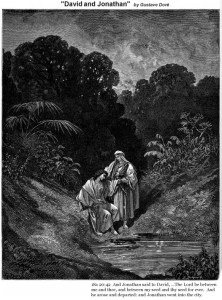
Jonathan and David: I have always loved the story of Jonathan and David. Their “friendship,” as some call it, is rather unique in the bible, and in the old testament in particular. They are really soul mates, as is reiterated on multiple occasions in 1 Samuel: “And it came to pass, when he had made an end of speaking unto Saul, that the soul of Jonathan was knit with the soul of David, and Jonathan loved him as his own soul” (1 Sam 18). This love is spoken of again and again, and in their later parting, they weep and kiss each other. Some readers of certain persuasions have taken this to hint at a romantic relationship. A more accurate reading is probably a political one, where Saul’s heir-apparent to the throne, Jonathan, has allied himself with the handsome, accomplished, and charismatic general, David, with a view to the future. And perhaps it is both. It’s probably impossible to say for certain, either way, what the nature of their relationship was, but we can admit that it is rather special to them in biblical context.
OTHER INTERESTING BITS
Judah: At this point in time, Judah is a border territory under control of the Philistines. And yet, it suddenly makes a strong appearance in these two books, where it had been largely ignored to this point. Why? It’s interesting to compare it to Macedon, a border town in Greece that was largely under control of the Persians. At a certain point, Macedon was not only able to overthrow the Persians, but they took brief control over all of Greece. Judah, too, will do the same by overthrowing the Philistines and taking control of Israel. This is perhaps why writers began to insert certain levels of importance to this tribe, which had been, until then, rather plagued with misfortune (Bethlehem-judah has been mentioned a few times to this point, but always in rather dire circumstances).
Ark of the Covenant: The Israelites take the Ark of the Covenant into war, thinking it will save them because it is the physical embodiment of god’s power. But instead, they lose the battle and the Ark is stolen. This seems to suggest that god’s power is not meant to be wielded by the arms (or whims) of man. It’s also important to note that the Ephraimites, who had been carrying the Ark, never see it again. It will be tribe Judah that recovers it – no coincidence, given their other recent rises in fortune?
Which David Story?: There are two competing origin stories for David which are laid out basically side-by-side and without comment on the tension. The first is that David is selected by god (through Samuel) to be the next King of Israel. Samuel somehow manages to get David into King Saul’s favor, likely through an amenable/pro-Samuel courtier. David then becomes Saul’s harpist and arms-bearer. The other story is that David comes to Saul’s attention after slaying Goliath. David, the youngest in his family, was running supplies for his three elder brothers, who were in the army. When he sees Goliath stomping around, threatening everyone, and yet no one is willing to fight him, he takes the task upon himself. When he wins, Saul tries to find out who he is, which family he comes from, etc., and then he takes him into his court. Again, we seem to have one anti-monarch/pro-Yahvist perspective (Samuel, the prophet, selects the new king) and one pro-monarch perspective (Saul, the king, sees his own successor). 1 Chronicles 20:5 and 2 Samuel 21:19 both seem to suggest that what is really known about Goliath is that he was slain by some unnamed Bethlehemite. So, perhaps a later writer, wanting to elevate David even further and add an element of emotional romance to the story, conveniently reshapes the history into a useful fiction.
#2018BibleRBR Daily Reading Plan: April

Here is my daily reading schedule for April. As mentioned in the original post, this month the reading plan is 1 Samuel 18-20 through 1 Chronicles 1-2. As always, feel free to read ahead, fall behind, or jump around.
I’ll be back again every Sunday with my thoughts on that week’s reading. On April 30, I’ll post a wrap-up for the month plus the reading plan for May.
The Reading Plan for April:
- Apr 1: 1 Samuel 18-20
- Apr 2: 1 Samuel 21-24
- Apr 3: 1 Samuel 25-27
- Apr 4: 1 Samuel 28-31
- Apr 5: 2 Samuel 1-3
- Apr 6: 2 Samuel 4-7
- Apr 7: 2 Samuel 8-12
- Apr 8: 2 Samuel 13-15
- Apr 9: 2 Samuel 16-18
- Apr 10: 2 Samuel 19-21
- Apr 11: 2 Samuel 22-24
- Apr 12: 1 Kings 1-2
- Apr 13: 1 Kings 3-5
- Apr 14: 1 Kings 6-7
- Apr 15: 1 Kings 8-9
- Apr 16: 1 Kings 10-11
- Apr 17: 1 Kings 12-14
- Apr 18: 1 Kings 15-17
- Apr 19: 1 Kings 18-20
- Apr 20: 1 Kings 21-22
- Apr 21: 2 Kings 1-3
- Apr 22: 2 Kings 4-5
- Apr 23: 2 Kings 6-8
- Apr 24: 2 Kings 9-11
- Apr 25: 2 Kings 12-14
- Apr 26: 2 Kings 15-17
- Apr 27: 2 Kings 18-19
- Apr 28: 2 Kings 20-22
- Apr 29: 2 Kings 23-25
- Apr 30: 1 Chronicles 1-2
I look forward to sharing my thoughts on the stories and literary elements of the Bible, as I see them, and I am especially eager to hear what you all find in your own explorations. As a reminder, this is a secular reading of the bible as literature, so any/all respectful thoughts and opinions are welcome. In my opinion, the more perspectives we have, the better!
To share on Twitter/Facebook/Instagram, etc, please use: #2018BibleRBR
The Halloween Tree by Ray Bradbury
 “The town was full of trees. And dry grass and dead flowers now that autumn was here. And full of fences to walk on and sidewalks to skate on and a large ravine to tumble in and yell across. And the town was full of . . . boys. And it was the afternoon of Halloween” (3). Thus, begins Ray Bradbury’s entertaining, eerie, and historically fascinating middle grade novel, The Halloween Tree (1972). At the center of the novel is a group of nine boys, eight of whom come galloping out of their respective houses, doors slamming joyously behind them as they run to greet each other for the start of what should be a raucously fun evening trick-or-treating. When they meet up, however, they soon realize that their dear friend, Pipkin, is missing. And Pipkin never misses Halloween.
Soon enough, the aptly named Tom Skelton, leader of this rag-tag little gang of festive Illinoisans, leads the group to Pip’s house, where they discover their friend disturbingly melancholy. Pipkin is usually the “boy’s boy,” the one who holds the whole group together and who ensures a good time is had by all, every time. But tonight, on Halloween, he seems to be fading fast. What could be wrong with him? And how can this gang of eight help their dear friend before it is too late?
The answer arrives, ominously, at the haunted house near the end of the neighborhood’s main street, where lives a mysterious man named Carapace Clavicle Moundshroud. This beastly specter invites the boys through a rollicking tour of world history, spanning eons of time and a number of cultures, from the ancient Egyptians to the classical French, to Mexican catacombs. Each time and place has one thing in common, though: it is Halloween night and Pip, or some version of him, is there, and he is in trouble.
Bradbury’s prose is swift and exotic, with a lyricism that will be familiar to anyone who has read his adult novels, such as Something Wicked this Way Comes and Dandelion Wine. Somehow, the spooky mystery of his stories is echoed by the fluid but ominous style he employs. The reader is both seduced by and weary of the poetic form applied. Is it a soft and simple beauty, or is it the call of a siren leading us to our doom? The boys’ own adventure is wrapped-up in a similar question. Surely, the young men have a marvelous time. They are whisked along by magic, beginning with a tree filled with pumpkin poltergeists and ending with the discovery of their friend buried alive in another country, at another time. How bizarre to be with these boys, exhilarated by their journey and yet tensely aware of the thread of danger weaving its way through the narrative.
In the end, the boys must decide, together, whether they will sacrifice a part of themselves in order to save their friend. What is a Pipkin worth, to boys like these? What is the price of friendship, and is it ever too great?
I stumbled across this one quite randomly at Barnes & Noble about a month ago. I had never heard of it, but it stuck out to me like a Jack O’ Lantern in the midnight darkness of All Hallow’s Eve – beckoning, take me home! And I did. As a fan of Bradbury, and a deep lover of Halloween (I was married on that day, after all!) I was not let down by The Halloween Tree. I think it is sure to become an annual October read. What a ride! Final Verdict: 3.75 out of 4.0
Notable Quotes
“The Romans cut the Druids, their oaks, their God of the Dead, bang! down! And put in their own gods, eh? Now the Christians run and cut the Romans down! New altars, boys, new incense, new names . . .” (79).
“Every town has its resident witch. Every town hides some old Greek pagan priest, some Roman worshiper of tiny gods who ran up the roads, hid in culverts, sank in caves to escape Christians! In every tiny village, boy, in every scrubby farm the old religions hide out” (85).
“A religion gets big, yes? A religion gets big! How. With buildings large enough to cast shadows across an entire land. Build buildings you can see for a hundred miles. Build one so tall and famous it has a hunchback in it, ringing bells” (91).
“They went down the steps in single file and with each step down the dark got darker and with each step down the silence grew more silent and with each step down the night became deep as a well and very black indeed and with each step down the shadows waited and seemed to lean from walls and with each step down strange things seemed to smile at them from the long cave which waited below” (125).
Judges 3-Judges 21 #2018BibleRBR

Reading the Bible as Literature
Week Twelve: Judges 3-21
This week, we read through to the end of the Book of Judges (3-21), which means we leave off just before the Book of Ruth begins. Judges is where things get juicy again, thank goodness, as the last few books are frankly downright dull. All that changes, though, with the appearance of Samson. What a guy! Long hair, rippling muscles, and blessed by god him/herself to be the champion of Israel. Of course, it is not all easy wins, or fun and games. There are many “judges” (or leaders) that rise and fall throughout the time period represented in this book, and after Samson dies, Israel enters a period without leadership or kings at all. The Israelites also revert back to their old habits of embracing god when it is convenient and then reverting to paganism when they think they’ve worshipped mono-theistically long enough (memories are short, aren’t they?) Of course, god is always watching, and when the Israelites abandon him, he sends in another people to crush them.
Rise and Fall: The book of Judges tells the tales, sometimes very briefly and sometimes in great detail, of the twelve judges, or military leaders, of this period in Israel’s history. Much of the “rise and fall” of Israelite tribes over this period is connected (by the priestly writers who are here, many years later, editing and revising multiple historical tales into some kind of sensible timeline) to the Israelite’s turning away from, and re-acceptance of, the Abrahamic monotheistic god. It was not uncommon for the Israelite tribes, who were settling into their lands, to adopt some of the customs of the locals. There were also many minor and major skirmishes over these years. Later priests, who were both anti-pagan and anti-monarchy, took the opportunity to retell this period of their history from this perspective, essentially warning off their contemporaries from both polytheism and from adopting kingships and hereditary monarchies (which often came with polygamy, too).
Samson: The reason Judges is one of the most “fun” books in the Old Testament is because of the mighty Samson. It is likely that the story of Samson is adapted from mythological sun worship (solar myths) and, only later, in the priestly writings, is Samson given the title of “first Nazarite.” The Hebrew word for Samson is “Shimshon,” which is very close to “shemesh,” or “sun.” And Samson was born in Zorah, just two miles from “Beth-shemesh,” which means “house of the sun” and which was probably the center of sun worship in this region. His life and powers, too, follow the patterns of solar myths. He gets his power from his hair (sun rays) which, when removed (snuffed out) causes him to become weak. His nemesis, Delilah, also fits in, as “lilah” is the Hebrew word for “night.” In other words, following the cycle of the sun, night comes to extinguish the sun. When Samson is blinded, we might think of the stars being darkened in the sky. And when Samson’s hair begins to grow (the sun’s rays rising again), Samson’s power begins to return. It’s a really rather fascinating tale, even without the many other miraculous accomplishments, such as his slaying the lion, his killing a thousand men with an ass’s skull, or his escaping prison by pulling up and carrying the walls of a city over his shoulders. It’s also no coincidence that Samson is listed as the 12th and final judge – in the solar calendar, the 12th month is the last.
The Women: We learn about three interesting and important women in this part of the bible: Deborah, Jael, and Delilah. The first, Deborah, was a rarity indeed. She was the leader, or “judge” of Tribe Ephraim, one of the most powerful Israelite tribes of that age. Indeed, Ephraim of this era is similar to what Sparta was for much of ancient Greek times, an unofficial military leader that is called on to head any unified campaign against common enemies. It is Deborah, with help from Barak, who leads a unified six tribes to war and defeats the Canaanites (King Jabin, specifically). Not long after, Jael, a woman, kills Sisera, another enemy king. In the first two cases, then, we see two women delivering Israel from danger. In the third, however, we get the opposite. The hero Samson falls in love with a Philistine woman named Delilah. Despite all of Samson’s many conquests and heroic feats, it is Delilah who eventually brings him down by seducing him, learning his weakness (after much pestering), and sharing that information with her people.
OTHER INTERESTING BITS
Gideon: In addition to Samson, this part of the bible introduces us to Gideon, one of the most famous names in biblical history. Today, most Americans, certainly, are familiar with the Gideon Bible. In his time, Gideon was probably a king (though the writers indicated he rejected the title; that’s probably not really the case, however, and it is more likely that the priests, who were strictly anti-monarchy, re-wrote this bit of history to suit their contemporary politics). He was the smallest member of his family, which was the weakest clan in the tribe, and yet he was chosen by god to rise up and lead the people of Israel. He does so successfully and leaves a legacy of children, from many wives, behind. His story in many ways reflects that of King David’s, and in both cases the priests would have been troubled by their polygamy and their monarchies. Abimelech later kills all of Gideon’s descendants, except for Jotham, who went into hiding, likely alluding to the peoples’ distaste for the messy process of monarchical lineage.
Anarchy: Judges ends by describing, or summarizing, the rather lawless period recounted in this book: “In those days Israel had no king; everyone did as they saw fit” (21:25). In an ironic way, the priests who were compiling this book and who were so vehemently anti-monarchy are here indicating that, well, being entirely without rulers might also be kind of an issue. That said, when “god’s leadership” is required, the people are still encouraged to trust the word of the high priests, who continued to divine god’s will by referring to the Urim and Thummim, or the game of “yes/no” stones described earlier in the bible.
So long, Reuben: It’s probably important to note that Judges 5 is the last mention of the tribe of Reuben. Historically, it seems, the tribe is now dead or has been entirely integrated into one of the larger tribes.
 Roof Beam Reader