Roof Beam Reader
Adam Burgess
The Cement Garden by Ian McEwan
 Jack is fifteen. He lives with his parents and three siblings, one older sister (Julie), a younger sister (Sue) and younger brother (Tom). The family seems relatively typical, at first, but the children all turn out to have their bizarre, disturbing quirks, which manifest themselves after the unexpected death of their father and slow, sickly death of their mother just two months later. The kids, worried about being separated from one another and taken from their home, commit an almost unfathomable act. They live together with this secret, in demented fashion, until Julie’s slighted boyfriend, Derek, discovers the truth and puts it all to an end. The Cement Garden is comparable only to V.C. Andrews’ Flowers in the Attic but, since these kids act the way they do almost naturally, and certainly willingly, the story is even more perverse and troubling than the horror that Andrews created in her own thriller.
For a short book, the characters were very well written. Each of the children have distinct personalities and identifiable traits. Jack is moody, self-absorbed, and physically (and psychologically) dirty. Sue is quiet, apathetic, and submissive; she is the “documenter” of the bunch, watching everything happen and writing it all down in her journal. Sue is the most observant and understands better than anyone what each of her siblings is like, and what is happening to them all. Tom is a very disturbed young boy, lost without guidance. He loves to dress as a girl (nothing inherently wrong with this, in my opinion, except for the twisted connection it holds to his eldest sister Julie and their mother). Tom enjoys being treated like a baby, nursed and coddled. Julie, the eldest, is a power-crazed beauty. She is seriously disturbed and encourages her brother Jack’s unhealthy infatuation with her, toward a place that should never be reached. Derek, the boyfriend, and the kids’ parents, though minor characters, are also distinguished with independent traits, mostly weaknesses. For example, even when Derek finally takes a stand, it is only because he feels angry and jealous of Julie and Jack’s relationship, not because he means to do the right thing for the sake of it being right.
To me, the story was highly disturbing. It will be hard for many to get through it; fortunately, I have a lot of experience with dark, demented, and disturbing literature (being a Dennis Cooper scholar and William S. Burroughs fanatic). Still, child perversity and incest are not comfortable issues and, had McEwan not been a powerful and masterful story-teller, I probably would have given up on this book. The language is well crafted, though, and the prose flows evenly and smoothly. The story too, is an important one, if hard to witness. Things like this do happen in the real world, though nobody ever writes about it or cares to think of it. So, “thanks” to McEwan’s writing ability (I suppose I should be grateful?), I was able to stay engaged enough to manage through to the end. It was certainly a wild ride – I am just glad I finished it long before bed-time.
The book certainly touches on the darker aspects of family and isolated relationships. It deals with child psychology, aberrant sexuality, fear, and immaturity. What does a group of children do, after all, when their parents die suddenly – with no guidance, no extended family to reach out to, and no nearby neighbors to look toward for support? The children were left an inheritance of sorts, which had been explained to the two eldest in advance so, in their minds, they were surviving in a way their mother had intended, on their own and together. But this isolation creates rather immoral, dangerous situations and one must believe that none of these children will ever develop into healthy adulthood. Is it hard to read? Yes, it is even hard to imagine; but, as I mention above, I believe these types of scenarios do exist, only to be heard of in brief 30-second snippets on the news. It is interesting, if rather gross, to witness these relationships in action, as it were, and to get a glimpse at the “how” and “why” of such situations.
Final Verdict: 3.0 out of 4.0
10 Years of #Readathon!
Hour 15: Quick Update (7:00pm Pacific Time)
Pages Read: 307
Books Completed: 2 (The Story of My Life by Helen Keller & Welcome to Dead House by R.L. Stine)
Books Reading: 1 (Letters to a Young Writer by Colum McCann)
Hour 12 – Midway!
As of this halfway point, I’m failing tragically! I shouldn’t be surprised, because I always fail at these readathons. HA! But, today was the Las Vegas Festival of Books as well as Las Vegas PRIDE, and since I’m brand new to the city, I wanted to go to both. It’s also a GORGEOUS day – 74 degrees and sunny, with a breeze. We are usually pretty darn hot, so today was perfection. Unfortunately, that means, I’ve been away from my books for the last 5 hours. Oh boy.
At this point, I’m home and ready to finish reading Welcome to Dead House. After that, I plan to read Letters to a Young Writer by Colum McCann, which I should also be able to finish today. If there’s time, I’m going to then start reading Stephen King’s The Waste Lands. I’ll be checking in with some other readathon-ers, too.
Mid-Event Survey:
1. What are you reading right now? Welcome to Dead House by R.L. Stine
2. How many books have you read so far? 1.5
3. What book are you most looking forward to for the second half of the Read-a-thon? Letters to a Young Writer (which just showed up in the mail today!)
4. Have you had many interruptions? How did you deal with those? Uh. Well, I started 2 hours late because I couldn’t wake up. Then I read for 3 hours and was interrupted for 5 (see above). I’m not going to kick myself too much because it’s been a FUN day. It’s only 5pm, here, and there are 12 hours left to read. I should be good.
5. What surprises you most about the Read-a-thon, so far? I’m a veteran, having done this 5 or 6 times since the first Dewey 10 years ago. So, nothing has surprised me. The sheer number of participants is amazing, though, and so exciting!
Hour 6 Update
This is hour 6 of 24 in the 10th annual readathon! I’ve only been at it for about 2.5 hours, though, because I couldn’t drag myself out of bed at 5am. Whoops. Anyway, things stand as such:
Pages Read: 77
Books Completed: 1 (The Story of My Life by Helen Keller)
Books Reading: 1 (Welcome to Dead House – Goosebumps #1 by R.L. Stine)
Challenge: 10 Years in 10 Books:
2017: The Hate U Give by Angie Thomas
2016: The Underground Railroad by Colson Whitehead
2015: A Little Life by Hanya Yanagihara
2014: Station Eleven by Emily St. John Mandel
2013: Americanah by Chimamanda Ngozi Adichie
2012: Wonder by R.J. Palacio
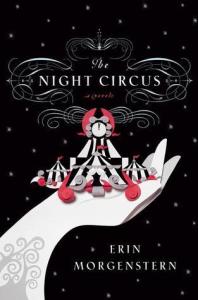
2011: The Night Circus by Erin Morgenstern
2010: The Immortal Life of Henrietta Lacks by Rebecca Skloot
2009: Under the Dome by Stephen King
2008: Paper Towns by John Green
2007: Harry Potter and the Deathly Hallows by J.K. Rowling
Beginning Post
Today’s the day! Dewey’s 24-Hour Readathon is back! I’ll be spending most of the day reading, reading, and reading! Of course, I’ll need to take breaks for meals, I guess, and a walk or two, but from 5am Saturday to 4:59am Sunday, I’m going to read as much as I can!
What’s Dewey’s 24-Hour Readathon! Well, for the last 10 years, it’s been a place for readers and book bloggers to gather together (remotely from our own locations around the world) and read like mad! It’s an introverts dream… a social event catered to what we love best, books, but that we can do from the quiet comfort of our own homes. Amazing.
I think back to the very first Dewey, which I participated in pre-Roof Beam Reader, with great nostalgia. I’ve only been able to participate a few times over this last decade because there always seems to be so much going on for me on the scheduled dates. I can’t believe that it’s still so alive and well. More than 1400 participants this year! Thanks to Heather of My Capricious Life and Andi of Estella’s Revenge for keeping this going!
I’ll be back all day to update this post with my progress and to participate in the memes and challenges that are hosted by a variety of folks who volunteered to steer the fun. I’ll place newest information at the top of the post so it’s easiest to find. Here’s the FIRST meme:
HOUR 0 – Opening Meme
1) What fine part of the world are you reading from today?: Las Vegas, Nevada!
2) Which book in your stack are you most looking forward to? Probably The Waste Lands (Dark Tower III) by Stephen King. (Stack is below!)
3) Which snack are you most looking forward to? This is the first time I forgot to plan for snacks! I’ll probably stick to my usual stuff, cheese, almonds, snack bars, etc. Maybe some chocolate. 🙂
4) Tell us a little something about yourself! I’ve been blogging for over a decade, most of which has been here at Roof Beam Reader. I teach College English & Literature, love the classics, and earned my Ph.D. in American Literature & LGBT Studies earlier this year.
5) If you participated in the last read-a-thon, what’s one thing you’ll do different today? If this is your first read-a-thon, what are you most looking forward to? I don’t think I participated in the last one, except as a cheerleader. But one thing I’ll try to do this time that I didn’t do last time is actually read more. Ha!
Okay. That’s it for now! Here we go, and here’s my stack! Up first: The Story of My Life by Helen Keller.

5 Mini-Reviews: From Willa Cather to Hillary Clinton
I’ll never catch-up on all the reviews I need to write for books I’ve read in the last 5 or 6 months. That’s that. But, I am going to make an effort to catch-up on the recent and then stay current moving forward. I do not intend to write a full review for every book that I read (I just simply do not have the time for that, and sometimes I don’t think the book needs it). Instead, I might write mini-reviews, like the ones below, so that I’ve at least shared some thoughts about my recent reading with you all and so that I have some record for myself, which was the whole point of beginning this book blog almost a decade ago! So, that being said, onto my thoughts for these three most recent reads:
Origin by Dan Brown: 3.0 out of 4.0
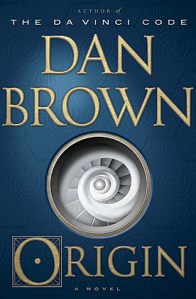
Origin is the latest in Dan Brown’s Robert Langdon series, following Angeles & Demons, The Da Vinci Code, The Lost Symbol, and Inferno. I really enjoy this series. The premises are usually clever and interesting, and of course I love the way the stories are steeped in history (apocryphal or not) and often pit science versus religion. There’s just something fascinating about that seemingly eternal struggle and the lengths to which some people will go to protect their particular worldview (or, in the case of this series, eliminate the “competition” altogether).
That being said, I think Origin is my least favorite of the series. It seemed to me to be trying too hard, and the plot spent a long time stagnating (the “big mystery” is built up for something like 200 pages before going anywhere). This is also the rare instance where I knew from the first few chapters both what the secret was and who the villain was, which made the unfolding of it all rather anti-climactic. I did want to love this book because the topic itself is certainly timely and relevant, but I think that was also part of the problem. It was, for me, too current. It seemed like the imaginative leaps Brown had to take in previous books were unnecessary, here, so the thrill was gone.
There were some things I did enjoy, though. Brown rather sensitively treats a non-traditional romance, for one, and he also incorporates some interesting thoughts from people like Sam Harris. On page 290, for example, he writes: “The term ‘atheist’ should not even exist. No one ever needs to identify himself as a ‘nonastrologer’ or a ‘nonalchemist.’ We do not have words for people who doubt that Elvis is still alive, or for people who doubt that aliens traverse the galaxy only to molest cattle. Atheism is nothing more than the noises reasonable people make in the presence of unjustified religious beliefs.” This particular passage triggered a thought experiment that I haven’t had nearly enough time to ponder; it made me wonder about the natural state of human existence and whether, if left to our own devices, separate from a social environment, would individuals default to religious belief to explain things like thunder, earthquakes, tornadoes, etc? Historically, we know that many cultures have created gods to do just that, but is that a social construct or an innately human one? Dan Brown’s Origins, in this way, did leave me with plenty to think about.
Poe: A Life Cut Short by Peter Ackroyd: 3.5 out of 4.0
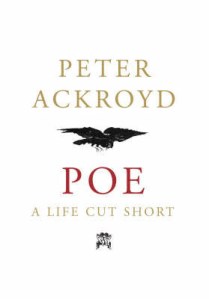
I received this little gem from Melissa, who knows I’m a fan of Poe. To be honest, I didn’t even know this book existed! Peter Ackroyd is a world-class biographer who has won awards for his work on figures such as William Shakespeare, Charles Dickens, Oscar Wilde, and William Blake. I was curious to see what he would do with a figure like Poe, whose life and times are much more a thing of legend than fact. There are so few extant (that we know of) factual records about Poe’s life, and much of what we do know has been exaggerated over the years, in keeping with the gloomy and mysterious aura surrounding the man. The first major post-Mortem written about Poe, for example, was a scathing, hyperbolic account of his personality, addiction, and talents, written by a man whom Poe had eviscerated in the press (as he did so often, to so many). The majority of that “biography” was wildly inaccurate and totally vindictive, and yet it is on this account that many have continued to base their opinions of Poe.
Ultimately, Ackroyd relies heavily on Poe’s works and letters to attempt to uncover the “real” man, beneath the facade. He also uncovers other written accounts of Poe, testimony from people who knew the author at various stages of life, such as former teachers, lovers, school “friends” (that term used loosely because Poe really did not get very close to many people, as he so often reminded everyone), and colleagues. The problem with these records is two-fold: first, that there are so few of them; second, that they are often contradictory. Some were even written or recorded well after Poe’s death, at which point time, distance, and the fact of Poe’s celebrity would all have influenced people’s perceptions. Was the myth making the man, or the man making the myth?
This little book of less than 200-pages is divided into 11 chapters, each focusing on a particular time period in Poe’s life. With titles like “The Victim,” “The Bird,” and “The Women,” it is clear to see that Ackroyd did uncover certain themes and momentous occasions which help to explain who Poe was, what was important to him, and how he became the legend that he is today. By all accounts, Poe was very well-regarded by the literati and critics alike. He was considered, even in his time, as the father of American literature, the first true “American” voice of the new continent, wholly distinct from our British forebears. So, where does the idea come from, that Poe died forgotten, under-appreciated? Well, as Ackroyd explains, Poe himself had a whole lot to do with that final assessment. Ackroyd’s biography is, I think, a must-read for any true Poe fan. Still, someday, I dream of discovering a cache of Poe history that will help illuminate so many of the unexplained questions about Poe, his life, and especially his final days.
What Happened by Hillary Rodham Clinton: 4.0 out of 4.0
 Is my affinity for Hillary Clinton coloring my review? Probably, in part. I admire this woman, I always have, and I found much to connect with and appreciate in her latest memoir about the 2016 election. But, there is so much more to it than the title suggests, and much more than the “liberal media” (ha!) suggested in their never-ending attempts to stir the pot and grab the ratings. It’s pretty disgraceful, really, to think about the way they treated the release of this book, but it’s also completely unsurprising considering the way they have treated Hillary Rodham Clinton for the last 30 years, since she first entered the spotlight as First Lady of Arkansas.
Clinton covers a number of topics in this book, things that are important to her and which should also be important to us. She has a chapter on “Perseverance,” for example, which outlines the long and arduous process of deciding to run, and run again, when she may have much preferred to stay at home with her grandchild and garden. There’s a section on women, including historical influences and current issues for women in politics. There are thoughtful, painful, crucial explanations about how our election process has been compromised by domestic and foreign influences, and warnings about the continuing danger of big money influence in our politics. She talks about the very real divisions in our country and shares some of her thoughts as to why and how these things have come to be, and how we need to self-assess before it is too late.
Finally, though, she ends with a section titled, “Resilience.” She writes about Love and Kindness. She writes about her faith and her continuing attempts to grow and evolve and do better. And she ends with a chapter titled, “Onward Together,” wherein she asks all of us to keep going and keep trying, even when all seems lost, even when we are at our lowest, because that’s when the world needs it most. She closes by quoting Max Ehrmann, who said, “Whatever your labors and aspirations, in the noisy confusion of life, keep peace with your soul” (468). I think Clinton is trying to do just that in writing this book and inviting us into what must have been a terribly difficult time and process.
People who already like Hillary Clinton are bound to like this book, and to experience the deep pain of her loss all over again. But they will also be reassured that their vote was the right one, and in more ways than most of us could have realized in the first place. People who don’t like Hillary Clinton probably won’t give this book a chance; but if they did approach it with a truly open mind and sense of fairness, I think even they would come to see that what she writes about is true and honest, that she admits to many of her failings while raising the alarm about many of our failings, and that it is indeed possible to do both of these things at the same time.
The Art of Being Normal by Lisa Williamson: 3.0 out of 4.0
 I’m so thrilled to be seeing more and more diversity in YA literature, and especially titles with main characters who are transgender, bisexual, and persons of color. Philip Pullman called this one, “a life-changing and life-saving book,” and I can see what he means. For a lot of people, especially young transgender teens who are beginning to understand what their feelings mean and to articulate to themselves just how they are different, books like this are incredibly important. Representation, feeling like you are a valid and “normal” person, rather than some bizarre aberration, can certainly be more than affirming, it can be everything.
Everyone thinks David Piper is gay. He is effeminate, he likes to wear girls’ clothes, he enjoys doing stereotypical girl things. Only his two best friends realize, though, that while David does like boys, he is not gay: he is transgender. When a new kid named Leo shows up to their private school, David feels an immediate affinity for him but can’t explain why. He’s not really attracted to him, and yet he can’t seem to shake the feeling that they share something, that they should be friends. Soon enough, David (and the readers) learn that Leo is different in his own way, too.
The novel is narrated from the perspective of both David and Leo, some chapters being told from one point of view, and some from the other (conveniently labeled “David” or “Leo” to let us know). While I appreciate the subject matter and Williamson’s smooth narrative style, I couldn’t shake the feeling that something was missing, here. I think the goal was to suggest some of the very real struggles that transgender people face in their daily lives and in the transition process, while maintaining an uplifting tone and commitment to a positive and affirming message. This makes complete sense to me, but it seemed to get in the way of the story-telling, somewhat. David and Leo have their struggles, there are definitely some dark elements and disappointments, but for the most part, the characters seem constructed to fit a role rather than to develop a story. I just couldn’t connect with David or Leo, and most of the secondary characters (parents, friends, siblings) seemed there only because they needed to be there (because people have friends and families, so it’d be odd not to write them in?).
The Art of Being Normal is a quick and easy read, oftentimes sweet and sometimes maddening, and it is an important addition to the YA LGBTQ+ library as well as the YA offerings more generally. But it’s not something I would read again.
Death Comes for the Archbishop by Willa Cather 3.5 out of .0
 Oh, my dear, sweet Willa Cather. How do I love thee? Okay, pardon the sap. I do enjoy Willa Cather so much, though. This novel was the September selection for the Classic Book-a-Month Club. I have to say, I’m still not quite sure what to say about it. I always enjoy Cather’s writing style, and this time was no different. She somehow combines naturalism with a rare, auditory elegance. Her descriptions of the land are beyond compare, so much so that her characters almost always come second to the landscape. I enjoyed this one in particular because it is set in the American southwest, a region that I love and that I just recently moved to myself; there was much to relate to.
On the other hand, the story itself felt extremely distant this time. I just couldn’t connect with it, though I recognize it was beautiful and recounts an important history. At the center is the story of two Catholic priests who come to minister to the native people of the greater-New Mexico area. They must learn how to communicate with Native Americans and Mexicans, to tame the land, and to respect local customs while fulfilling their roles as missionaries. The book is split into nine separate sections, each with a particular focus, so that the novel reads more like an extended play with nine acts. To some extent, I appreciated this because it allowed me to focus on each individual scene, beautifully crafted, and to try to appreciate the purpose of that scene as I was experiencing it; on the other hand, unlike the dichotomy set-up by the structure of Cather’s A Lost Lady, for example, I did not find these segments particularly helpful in telling the priest’s story. And maybe that’s my issue. If I were to go back and read this again, I think I would approach it as a story about the land, and not a story about the Archbishop.
The narrative digressions, flashback recollections, and fictional accounts of actual historical figures and events added interesting context and complexity to an otherwise leisurely Cather work. I find in Cather’s works that she wants, more than anything, to tell the tale of a land, a time, and a people, and that is certainly the case here. The Hopi and Navajo people are treated sympathetically, and the recounting of the “Long Walk of the Navajo,” is both important and brave. Cather does not dull her criticism of the American government and rightly calls them to account for the way they treated our native populations, shuffling them around from one increasingly barren and uninhabitable region to the next. She also makes suggestions about the intimate and powerful relationship between religion and politics. Ultimately, I think I’m going to have to read this one again to fully appreciate it, preferably during a break when I can really sink into it.
1 John 3:17-18

Back in September, I went home to Chicago for a weekend to celebrate (and officiate, imagine that!) one of my best friend’s wedding. While I was there, I started talking with my other best friend (yes: I have two. They’re literally the best people. And I do wake up thankful every day for the fact that I can call them both “friend”) about a conversation I had with my husband.
I’m not sure how exactly this topic arose, some discussion about our compatibilities and why we have been together so long, but my husband mentioned that he is a “nice” person, whereas I am a “kind” person. So, on the surface, or until people really get to know us, my husband is the one who seems approachable, friendly, sympathetic, and all things “nice;” On the other hand, I’ve often been told that people are at first intimidated by me, that I seem intense, quiet, and distant, which they (mis)take for judgmental or cold. We learned something interesting about this when, years ago, we were both working at a book store. Once people got to know both of us individually, and then as a couple, we noticed they would go to him to ask for something, because they knew he would be nice about it, but what they were asking for was often something that I would need to do (because they knew I would probably do it, they just didn’t want to ask me… I don’t suppose my sarcasm helped those situations.)
Anyway, I was talking to my friend about this and she seemed not only to agree, but to think that it made a lot of sense. That it created some kind of balance. The conversation has had me thinking about these concepts of kindness and niceness; whether most people tend to be one or the other, and how often is it both? (We all know some people who are definitely neither.) I can think of another friend who is both nice and kind, seemingly as a default; she is one of the most decent people I have ever met. But that seems to me to be truly rare. And I wonder why this is. Does it leave us too vulnerable? Is it too exhausting? Are we too often rebuffed or abused if we are always nice and kind? Do people think this is “fake”?

I do try to be nice, meaning I often find that it takes some effort; but I don’t feel the same about kindness. I don’t often find myself trying to be kind. For me, the “public” nature of niceness, things like friendliness and openness, and even looking people in the eye, takes work. I’ve begun to wonder if that is a part of my introverted personality and something that I can switch “off” in certain scenarios. With my students, for example, I turn “on” in a significant way, and become much more extroverted. On the other hand, kindness, I think, seems to be a deeper and less mutable part of me. I’m probably sometimes too empathetic, and getting even more so as I age, if I’m being honest. There are any number of times that I can recall trying to make someone else’s day or time or experience a little bit better, even at the expense to my own welfare. If I have something and you need it, I’m going to give it to you. If you need a ride or help moving or whatever, and it’s my only day off in 10 days, I’m still going to be there. If someone I don’t know passes away and I’m asked to the wake by a colleague or mutual friend, I usually end up going (even though this has always felt extremely awkward to me). Where does kindness come from? Niceness? Are they both learned traits? Do we start with certain degrees of each and then expand or contract depending on our own experiences?
Recently, I read Hillary Rodham Clinton’s new book, What Happened, and she shares some similar insights into this question. She seems, like me, to struggle sometimes to project the image of “niceness” and empathy, while internally she is a deeply compassionate and concerned person. This might be one of the reasons I have always admired her beyond the work she has done, and beyond her incredible work ethic and rich knowledge about so many complex issues. Instead, I respect her simply due to this connection with another person of a similar type. Unlike me, Clinton is a religious person. And I pondered that, too. Where do niceness and kindness and morality all come together? There seems to be some kind of “golden rule” at the center of most major religions, though I would never agree that one must be religious in order to be a moral or ethical person. Still, I’ve read the Christian bible a number of times and a verse comes to mind:
“But if anyone has the world’s goods and sees his brother in need, yet closes his heart against him, how does God’s love abide in him? Little children, let us not love in word or talk but in deed and in truth.”
Somehow this passage speaks to me about the truth and value of kindness. This is not to say that the passage is instructing us away from niceness–not at all. But, what I see is that contrast between speaking and doing. Between thinking and acting. Between sympathizing and empathizing. To me, the formers often apply to the nice person. A shoulder, a conversation, and even an acknowledgement of your suffering; all of these are to be found in the nice person. But the kind person is the one who keeps his heart open in order to act. The kind person loves by example, by commitment, and by following through on what is needed most, when it is needed most, and especially, without design or expectation for reward or reciprocity.
 Nice is the person who feels bad when a friend’s car breaks down or when they see a stranger caught in the rain. Kind is the person who doesn’t mind when his day is disrupted by that friend in need or who offers his umbrella to the stranger.
When mother used to say, “be nice,” to the kid everyone picked on, she meant stop picking on him. When Ellen DeGeneres ends her talk show every day with, “be kind,” she means be the sort of person who never would have thought about hurting that kid in the first place.
For some of us, it is easier, or more natural, to be one or the other. I guess I’m trying to learn how to be both.
October Book Swap
For about two years (wow!), I’ve been participating in a private book swap with about 15 friends/participants. The host schedules about 3 swaps per year, so every few months we get a new partner, time to shop, and time to ship. I have participated in every round so far because it is just so much fun to shop for books and personal gifts for someone who loves these sorts of things just as much as I do. Something I’ve neglected to do, though, is share my own gifts from others (except in our private group page where we all talk.) I would like to change that from now on!
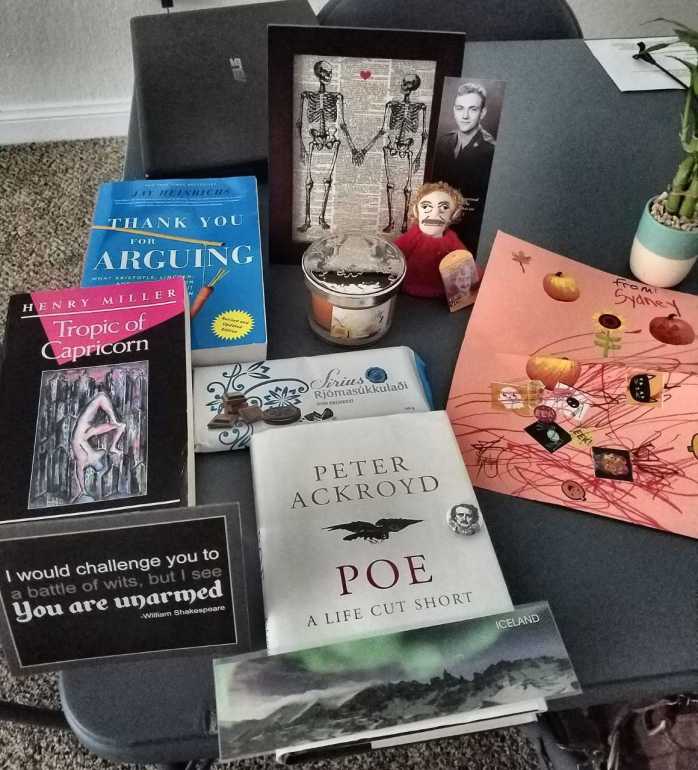
This swap, taking place in October, was a fall/Halloween theme. Now, Halloween is my favorite holiday – my husband and I even got married on that holiday! I’ve been lucky to get swap partners in the past who have been thoughtful enough to think about not just me, but my anniversary. This year, as you can see, I got an awesome framed decorative “skeleton couple,” which I have set out for the season (but to be honest I’ll probably keep it out all year). In addition, I receive three awesome books from my wish list: Thank You for Arguing; Tropic of Capricorn; and Poe: A Life Cut Short. I’ve already read the Poe book, and it was good! It put me in the mood to see The Raven, John Cusack’s film from about a decade ago. I usually watch it once per year, around Halloween of course.
I also received two cool bookmarks, one from Iceland (along with Icelandic chocolate!) and one of a young Kurt Vonnegut, along with a Kurt Vonnegut doll. As plenty of people know, Vonnegut is one of my all-time favorites (he and Poe are probably my two favorite male writers). I’m so grateful for all these gifts, plus a pumpkin candle that smells absolutely incredible (we have been watching Halloween-themed movies since October 1st and light it for the viewings — atmosphere!), and a personalized drawing from my swap partner’s daughter (which is now hanging up in my office, using the little Poe magnet I also received in this swap! See it sitting there on the Ackroyd book?) And of course, the card is perfect.
When people ask why book blogging is so great, why I continue to bother with it, this is a great example. It’s not about the gifts (although giving and receiving are both great); it’s about the community. I’ve known some of these folks for almost a decade, now, and whether or not we’re all still keeping up with our blogs isn’t even the point. Wherever we are in the world, and we are everywhere, the connections we first made through our love of books and writing about books has gone so much farther and deeper than that. It’s not anything I ever expected to happen, but I’m sure grateful for it.
 Roof Beam Reader