Roof Beam Reader
Adam Burgess
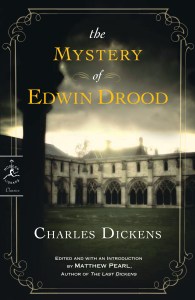
The Mystery of Edwin Drood by Charles Dickens
 Plot/Story:
4 – Plot/Story is interesting/believable and impactful.
The Mystery of Edwin Drood
 Characterization:
3 – Characters well-developed.
As I mention above, Dickens seems to have developed a stronger sense of true characterization in his later career. His earlier novels employ many literary devices, such as grotesques and caricatures, which are in a way cutely identifiable as “Dickensian” but which are, to me, sometimes rather annoying. While Dickens does lash out vehemently against the Philanthropists (as he does in other works) here, he is blunt and direct in the approach; he does not exactly employ a character and warp that character into representing Dickens’s vision of “The Philanthropist” but, instead, just bashes the group as a whole. There is a Philanthropist in the novel, and he does embody many of the elements which Dickens has stated in the narration are deplorable, but he is more a character than a caricature. Dickens does a great job of differentiating the many different characters, even those who come in near the “end” and are not well understood because the story is cut off prematurely. The characters are described in such a way as to be identifiable, with familiar ticks or physical quirks. Their slang and dialects are distinct, as are their mannerisms and features. What would have perhaps enhanced the characterization further, other than having completed the novel, would be a bit more time spent on development. Drood, for instance, who we pretty much understand, is not really missed when he disappears. This is a shortcoming, since he is the crux of the plot and the one person (aside from, perhaps, his “Pussy” – Rosa) whom we should care about. Similarly, Neville, the supposed antagonist, is relatively underdeveloped compared to the minor players – like Durdles and The Deputy. John Jasper, Mr. Crisparkles, and Mr. Grewgious, however, are all very well done.
 Prose/Style:
4 – Extraordinary Prose/Style, enhancing the Story.
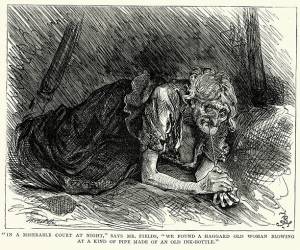
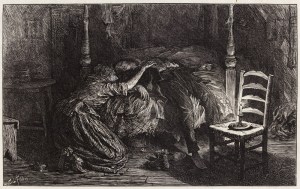
I mentioned previously how impressed I am with Dickens’s apparent growth from his earlier works to this one, in terms of his prose and style. I am easily annoyed by some of his trademark characterizations and burlesques, but seeing what he does here in Edwin Drood makes me extremely interested, and much more compelled, to read more of his late works, like Our Mutual Friend and Bleak House or Hard Times. This was also visible in Great Expectations, though I think it is most prominent here. Dickens employs a rather straightforward style, and his prose is much more conversational and accessible, though still beautifully wrought. He introduces snippets of letters and song or poetry to break the monotony of prose, which advances the story quite well and adds a welcome and entertaining level to the story. This edition also includes original illustrations which are beautifully done and allow the reader a pictographic point of reference, as it were – an image of the scene, with characters drawn in the style of the times, wearing the clothes and expressions of the period. I was highly receptive to their inclusion.
Additional Elements: Setting, Symbols/Motifs, Resolution, etc.
3 – Additional elements are present and cohesive to the Story.
What I found most intriguing about this novel is the personality which Dickens gives the work overall. I am deeply saddened that the book was never completed, because I truly believe it may have been one of his crowning achievements. Dickens was always a writer who exposed social injustices, particularly in regards to poverty and religion, having experienced a childhood of nearly absolute deprivation; but he gets even more personal with this work. Many believe the character, John Jasper, to be a re-imagining of Dickens’s feelings toward his embarrassment of a son, Sydney, who racked up enormous debt in Dickens’s name and was ultimately banished from the Dickens home. Also, it is believed that one of Dickens’s great regrets was marrying so young – which is clearly expressed in the tormented relationship of Edwin and Rosa, which is eventually broken off, mutually, by the two. And, of course, as I mentioned above – Dickens’s mental anguish and torment since his brush with death, intensified perhaps by his (likely) use of opium, are all present within the text. The amount of “self” which Dickens exudes in this work is touching and painful, like a scarred wound, unveiled at last by an old writer to his loyal but ignorant readers. It is almost as if Dickens was writing his own eulogy – a farewell in swan’s song, putting his mind at rest before the long, terrible, and permanent final rest.
Final Verdict: 3.5 out of 4.0
Notable Quotes:
“The cramped monotony of my existence grinds me away by the grain.”
“Circumstances may accumulate so strongly even against an innocent man, that directed, sharpened, and pointed, they may slay him.”
“Stranger, pause and ask thyself the question, canst thou do likewise? If not, with a blush retire.”
Austen In August: Year 5! (Call for Participants)

Welcome to the sign-up post for AUSTEN IN AUGUST, an annual reading event celebrating one of literature’s greatest writers! This event was inspired by a Twitter conversation that took place five years ago between three founders of The Classics Club. We’ve had ever-growing participation and excitement over these last four years, and I hope this year will see that trend continued!
Call for Volunteer-Participants: I am currently looking for people who would like to host/sponsor a giveaway or provide a guest post. If you’re interested in doing either (or both) of these, please fill out this form. One of the reasons this event is so great every year is because of the awesome content provided by our participants and partners – I know this year will be no different! Please submit your participation request by July 5th so that I have plenty of time for scheduling. I’ll be responding as your requests come in.
 So, why is Jane Austen so interesting? Pemberely explains: “Jane Austen is very resistant to being classified as part of a literary “school”, or being placed in any customarily-defined literary period — partly because none of the obvious available terms, “18th-century, “Romantic”, or “Victorian”, would appropriately describe her. Almost all of the major figures who were literarily active in the period 1800-1837, and who are currently deemed worthy of remembering (i.e. are “canonized”), fall into one of a few categories — either they launched their literary careers before 1800 (Burney, Edgeworth); or they were part of the Romantic movement (or were more or less strongly influenced by romanticism, or wrote in self-conscious reaction to romanticism); or they did most of their writing and publishing after 1837 (e.g. Dickens). Jane Austen is the conspicuous exception who does not fit into any of these categories.”
The Goal: To read as many of Jane Austen’s works (finished or unfinished) as you want or are able to, during the month of August. Biographies, audiobooks, spin-offs, and re-reads also count. I will post throughout the month on different subjects, as well as with my own reviews of the Austen books I finish. We will be offering giveaways, guest posts, and other shenanigans, all of which are meant to inspire a great, interactive event. If you are going to participate, you can read any of Jane Austen’s novels, a biography about her, or any contemporary re-imaginings (such as Austenland or The Jane Austen Book Club, for example). All posts will help you qualify for prizes, which I’ll explain in a later post!
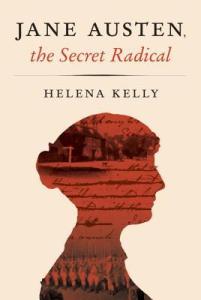
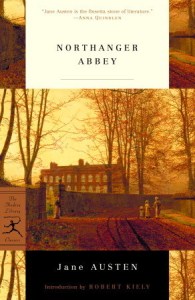 If you want to sign-up to join us as a reader during the Austen in August, simply leave a comment stating such! Maybe include some of the books you hope to read. I will be hosting a read-along of Northanger Abbey as the August selection for the Classic Book-a-Month Club. I also plan to read Jane Austen: The Secret Radical by Helena Kelly. I’ve long argued that Austen was more politically aware than people allow; Kelly’s book has received some harsh criticism for suggesting as much. I’m looking forward to reading her arguments to see where we agree or disagree about Austen. I know, for example, we probably agree about the importance of Mansfield Park.
Sign-ups are open throughout the month of July. If you sign-up after July 31st, you can still participate, but may not be eligible for some of the early giveaway prizes. To Share/Discuss on Twitter and Facebook, Use Hashatag #AustenInAugustRBR. Please also post the button somewhere on your blog (maybe in an announcement post or on your blog’s side-bar) so that we can spread the word, gather excitement, and encourage participation. The more of us reading Austen together, the better!
Tricks by Ellen Hopkins
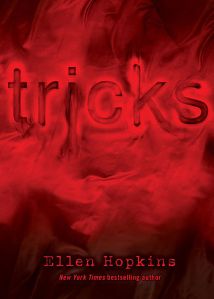 Tricks is the separate but interwoven and common-themed stories of five average teenagers, between the ages of 15-18. Eden is a genuinely nice person, though not nearly as much of a repentant Christian as her Pentecostal-Priest father and sycophantic mother would want her to be; she falls in love with a boy who, though decent and Christian, is outside their uber-stringent faith and, because of this, she gets shipped off to a religious youth prison, where the parents hope to have the devil exorcised out of her (because a teenager falling in love out of wedlock must equate to possession). Seth is a gay teen, about to graduate from a rural Indiana high school. He falls for an older man in Kentucky who eventually deserts him and, after delicate letters between the two are disclosed to Seth’s father, he is kicked out and forced to give himself up to older men in order to keep himself housed and fed.
Whitney seems to come from the most stable place. She lives in Santa Cruz, CA with her mother and sometimes with her father (who spends most of him time in San Francisco, on business). She has an older sister who is on college and who tends to steal the lime-light; but Whitney meets a nice boy who treats her right, until she gives him her virginity. After that, she is never quite the same. She becomes vulnerable to the types of advances that a handsome, well-practiced pimp might play on her. Ginger has had a horrible life, since about the age of ten, when her hooker mother started selling Ginger to her clients as well. Ginger is still a decent girl, though, who loves her grandmother and who does all she can to help take care of her mother’s other children, since no one else will. She escapes with her girlfriend (lesbians – to clarify), only the escape isn’t much of an escape at all. Ginger is forced to turn herself into her mother in order to survive.
Finally, we have Cody, a well-meaning, typical teenage boy – he has friends, girlfriends, and a dopey job. He likes sex and gambling and driving around in his car. He has a troubled younger brother, but a great mother and step-father. Then, the step-father passes away, the house is threatened to be taken from them, Cody’s gambling problem leads them further and further into debt and, suddenly, Cody realizes he must find ways – even the most horrifying and degrading ways to a teenage boy – to care for his family. These five characters are “the tricks.” They all find their ways – willingly or not – from their hometowns across the country (Indiana, Idaho, California) to the breeding ground of sin and depravity, Las Vegas. Here, their separate stories are woven into one harrowing song.
Each of the characters’ stories is well-developed and believable, though terrifying and sad in its own way. While it can be a bit difficult to follow the timeline, since each small chapter is a new narrator, it is still possible to distinguish between the two male characters, for instance, and the three females. Still, much of this is due in part to the scenery and the characters surrounding them, not to mention the subject matter. When sexuality is one of the main forces, it makes it much easier to recall which character is in play at the moment. The characters’ language and tone –dialect, slang, inflection, vocabulary, etc. – were nearly identical, though they were all from different social, religious, and economic backgrounds and from different parts of the country. This was, in my opinion, one failing of the novel. That being said, each of the characters did show some growth (negative or positive) throughout their own portions of the book. Each character changed in some way, and so was distinguishable from his or herself when comparing the start of his or her journey to the end of it. Had this not been accomplished, I do not know whether the book would have served much purpose at all; fortunately, the argument is moot because the characters did experience much, and changed in many ways, even though it was hard to tell who was talking when (I sometimes had to flip back a few pages to see the name of the speaker at the start of the segment).
I was intrigued by and happy with the prose and style over-all. The narrative is broken up into little pieces of intermingling story-telling. Each character’s story progresses in time but the stories are split up so that the characters have equal speaking time, and so the reader gets to see where each character is and what he or she is doing as time moves forward. Also, it is written in a type of free-verse which, fortunately, is actually just free prose. There are interesting short poems that start each chapter and that (I noticed after two or three) contain a one-sentence subject matter indicator taken from each poem. Also, the final line from one story becomes the entrance line and/or theme for the next character’s story. It was all quite cute – I’m not sure how else to put it. It works very well, it is engaging and it moves the story along very well. Though the entire book also appears to be written in verse, due to the structure, it is not. Given the sensitive subject matter and the need to connect each of these individual characters with an over-arching thematic element, I think the style was a good choice – it allows the book to work as a cohesive collection rather than a hodgepodge of inter-connected but spliced short-stories.
I truly enjoyed the many ways which the book’s structure allowed the story to work together as one larger element. The short poems and creative threads which wove from one story to the next, though the characters had nothing to do with one another, was great – because the characters were all dealing with the same issues: survival, sexuality, abuse, and making adult choices. Being a J.D. Salinger fan, I cannot help but think how horrified he would be to read a work like this, which places young adults in such dangerous, precarious situations, with no real hope in sight. A majority of the five characters do not “get out” of their situations and this, in a way, makes the book hard to like. It also garners a great respect for the author. The subject matter she delves into here is not fun or light-hearted, so one would hope for a happy resolution, at least, particularly since the subjects are children. Hopkins knows, though, that un-happy endings do happen, particularly to these groups of children impacted in such a way – forced to sell their bodies to survive; caught in an inescapable web of drugs and abuse; lost to any chance at resolution or reunion with their families. As an end note, I can understand why parents would not want their children reading this book. It is scary and it is dangerous. If I were a parent, I would be horrified to learn that my children were exposed to these types of themes, this type of language. That being said, if I were a teenager – I would absolutely pick up a book like this, in part because of the dangerous elements and also in part because I was a teenager like these teenagers; I knew kids who were in trouble, kids whom no one knew how to talk to, whom everyone whispered about. Perhaps, if I had more exposure to responsible literature, done for a purpose and not just to be shocking or pornographic, I might have had a better understanding of what was happening around me; of how to deal with it; of where to get help.
Final Verdict: 4.0 out of 5.0
The Sorrows of Young Werther by Johann Wolfgang von Goethe
 Johann Wolfgang von Goethe’s The Sorrows of Young Werther
Though this has been criticized by some, I appreciate the epistolary structure of this novel. I also like that to each of Werther’s letters, a response must be guessed or imagined, because none of the letters Werther received are included. I have a difficult time deciding why I like that we only get access to Werther’s side of the conversation, but I think it is because no other character has much to do with what is going on inside Werther’s head. In fact, even Lotte, the reason Werther “sacrifices” himself in the end, is only an excuse for the sacrifice and not the actual, root cause of Werther’s sorrow. Also, something I found particularly irksome throughout the first half of the novel, but which ultimately I find pleasing, is the lack of any type of characterization, even for those characters who play a larger role, such as Lotte and her husband Albert. At first, I found it difficult to engage with the novel because of this but, upon reflection, I realize the necessity. After all, this novel is about Werther’s state of mind, so the development of any other character would largely detract from the work’s purpose. In addition to this distraction, one must also realize that Werther is a rather arrogant, self-centered person who is not very concerned about anybody else (even Lotte, when it comes down to it). Werther is entirely engrossed in his own pleasures, his own happiness, and his own despairs; thus, to focus even for a moment on anyone else’s personality or achievements would decrease the importance that Goethe had been placing on Werther’s own self-involvement.
The novel closes by introducing a rather omniscient “narrator,” who is not to be mistaken for Goethe’s narrator (this can also be a bit tricky throughout the novel, when “narrator comments” are footnoted). The Narrator seems to be viewing things from the outside, to be evaluating Werther’s life and letters as a bystander, a researcher; however, he does also seem to have some connection to the characters, some insight into their emotions and actions. Does this make him unreliable? Perhaps. I also find the act of introducing a portion of the book as belonging to the Narrator, and including that Narrator suddenly into the plot-line, not just unreliable but also distracting. While having the Narrator there to explain some of Werther’s actions and emotions, to guide the reader through Werther’s final days rather than have Werther write them in letters per usual (and this may have seemed more appropriate to Werther as, when one is ending one’s life, does one really write a letter about all the actions he is taking, all the steps covered, tasks completed?) is probably necessary, I found it a harsh break from the rest of the novel and, at the point where I would most liked to have been connecting with the main character, I felt most separated. I did also find the many pages devoted to Ossian’s poem (Werther reading the translation to Lotte) indulgent and unnecessary. Finally, though I understand and partially agree with the under-development of the other characters, I also believe this could have been a rich novel and a gripping story, equally honest to mental torment as this novel, had the plot and characters been more flushed out.
It is difficult for me not to give this novel a better rating, because I know I am supposed to love it. Still, I found faults, the main problem being that I could not really connect with the story because the majority of its format was guarded, and the final chapter was such a break from the rest that I felt displaced when I could have begun to surrender. The Sorrows of Young Werther
Final Verdict: 3.5 out of 5.0
Reading Poe, Part 2: Gold-Bug, Ligeia, Maelstrom
Today, I continue my short discussions of/reactions to Poe’s works. I’m still engaged with his complete short stories, and will be for a while. After finishing these, I’ll move on to his poetry. Each of these stories, like those in Poe 1, are categorized under Tales of Mystery and Horror.
“The Gold-Bug” (1843)
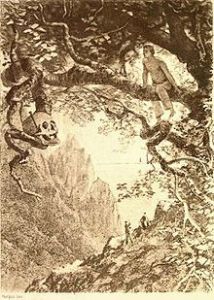 William Legrand is bitten by a gold-colored bug. It seems that this bite might be poisoning him in some way, causing him to go insane. His servant, Jupiter, notices the changes in Legrand and becomes fearful; so, he recruits Legrand’s good friend (the narrator, who remains unnamed) to come to his aid. What follows is a mysterious adventure of secret messages and buried treasures that ultimately leads to the unearthing of a dark and disturbing secret. The Gold-Bug is interesting because it combines Poe’s thrilling storytelling with his style from the “tales of ratiocination”, creating a plot that is both intellectually stimulating and a bit creepy. I thought it was fitting that story is set in South Carolina (and that the main character is originally from New Orleans). It adds an element of southern Gothic before the southern Gothic was actually a genre. It’s no surprise to me that The Gold-Bug was a grand prize-winning story, one that Poe was actually paid quite well for (unlike much of his other writing, which earned him disturbingly little!). This was my first time reading it and I was pleasantly surprised. It’s a reminder that I’ve still got much to learn from Poe, as do we all. Rating: 4.25 out of 5.
“Ligeia” (Sep 1838)
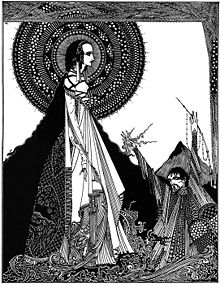 Ligeia is one of my all-time favorite Poe stories. I think this must be my 5th or 6th time reading it, and I’m not bored of it yet! In this story, the narrator’s wife, a poet who composes a poem, “The Conqueror Worm,” within the narrative itself, dies of illness. He remarries but soon the second wife falls ill as well. As the narrator watches over Lady Rowena’s body, he notices that she begins to transform physically into the form and countenance of the original wife, Ligeia. This is also one of the stories that Poe revised regularly throughout his lifetime. It was originally published in 1838, and many believed that first production was fueled by opioid hallucinations and meant to be a kind of satire. It would be interesting to get my hands on copies of each of the revised versions, if still extant, to see how, where, and why Poe made changes. I think it’s particularly interesting to think about why Poe includes “The Conqueror Worm” in Ligeia. The poem actually appears in part or in whole in a number of other Poe works, and was only included in a revised version of Ligeia. Poe seemed perturbed by the idea (a 19th-century convention) that death was something beautiful and sacred, as opposed to simply a natural and ugly ending to life. By including it in the story Ligeia, it might serve to suggest that Ligeia’s first death is in fact final, and that her phantom reappearance after Rowena’s death is just a trick of the narrator’s mind (influenced by drugs). It would also reinforce his philosophy more prominently in a popular work, thus reaching a wider audience. Rating: 5 out of 5.
“A Descent into the Maelström” (Apr 1841)
 It’s funny; for the longest time, I thought I had read this story years ago. But upon reading “this time,” I realized that I was completely unfamiliar with it, which means I probably never did read it in the first place! This one falls into the “ratiocination” stories and tells of a man recounting his experience surviving a shipwreck and massive whirlpool (what they call a “vortex” in the story). Descent reminds me quite a bit of Poe’s novel, Narrative of A. Gordon Pym, in its use of nature as antagonist. The awe of natural forces, especially the unknown and uncontrollable forces, acts as a kind of foil for both scientific inquiry but also the psychology of fear (evoked with pathos: “You suppose me a very old man, but I am not. It took less than a single day to change these hairs from a jetty black to white, to weaken my limbs, and to unstring my nerves”). Poe also uses the story-within-a-story device here, a strategy that is somewhat of a staple in his works (it adds some intellectual and creative intrigue, which was right up Poe’s alley). Ultimately, Poe uses the terror of the story to also explain scientific realities of physics in, ironically, an attempt to perhaps encourage a more rational reaction to our natural world as opposed to a fearful, emotion-based response. As an exploration of Poe’s style and psyche, this story is quite interesting, but as a story itself, it’s not quite one of my favorites. Rating: 4.25 out of 5.
 Roof Beam Reader