Roof Beam Reader
Adam Burgess
On Angels and Demons and the Rest of Us

Today I, like so many others, woke to the news that there had been another mass shooting in the United States. This one at a gay night club in Orlando. As the morning advanced and news continued to roll in, we quickly learned that more than fifty people had been killed, and another fifty, at least, injured. The largest mass shooting in the nation’s history. We do not know too much about each of the victims, yet, though we are sure to hear that there were men and women, gay and straight, young and old, white people and people of color. Fifty people who had gathered to dance and laugh and love, slaughtered. Fifty families, fifty circles of friends, who will grieve, mourn, and be permanently changed by the act of a single madman.
I continued to read and watch in horror and dismay as more details arose; the killer seemed to be motivated by homophobia; the killer seemed to be Islamic; the killer used an automatic assault rifle; the killer had been flagged as suspicious three years earlier. News reports were monitoring terrorist networks to see who would take responsibility. Meanwhile, leaders began to make their statements; prayers were offered and condolences given.
Suddenly, as with all the major mass shootings in the United States, recently, and there have been many, I was sucked into the debates about fault. “It’s Islamic extremism,” some said. “It’s homophobia,” others responded. “It’s guns,” I heard. We, most of us, know, of course, that there are rarely simple answers for such heinous crimes. Does religious zealotry often play a role in mass killing? Yes. Does bigotry and prejudice fuel hatred? Yes. Does easy access to guns make it simpler to act out religious “cleanses” and other hate-filled acts? Yes.
Who or what is to blame when these terrible things continue to happen? Certainly there are demons among us: angry, terrified, misguided individuals who are psychologically imbalanced, ignorant, and indoctrinated to believe there is only one acceptable way of being. This has always been the case, and it is the case everywhere. Every culture, every country, at every moment in time has had its small share of people who are what most of us consider evil. They may feel justified in their hatred, they may feel vindicated by their interpretation of a particular religious or moral belief, or they may be motivated by a perceived personal slight or danger, a belief that they, somehow, are explicitly threatened by the life and freedoms of another individual or group. These are the world’s demons. They are only a very small portion of the population, they are roundly condemned by the majority, and the majority is almost always, without fail, offended, confused, heartbroken over their actions. So, how do they continue to commit these acts, and how do these acts continue to worsen, to be more tragic than the last?
In contrast to this minority, there are those who devote their lives to helping and advocating for others. In the LGBT community, that includes religious leaders, politicians, and celebrities who use their microphone to appeal to the better natures of their audiences. It also includes the personal allies, mothers and fathers, siblings and friends who join PFLAG, who vote, who offer safe haven to youth in need. Those who actively march, rally, and fight to make a difference. And these kinds of people, the courageous who take up the fight on behalf of the powerless, have also existed at all times and in all places. They are the ones who risk their own lives and reputations in standing up to fear and prejudice and evil wherever it manifests itself; they were conductors on the Underground Railroad; they were Germans and Austrians and others who hid Jewish families from the Nazis; they stood in front of tanks in Tiananmen Square. But these angels, too, are in the minority.
In the struggle between these forces, between the demons who thrive on committing evil acts in their desperate attempts to make the world conform to one creed and the angels who fight selflessly to ensure that all people can live equally in freedom and safety, we find a battle of the simple few. A tiny minority of people on one side, and another tiny minority on the other. It is in the rest of us, the vast majority of people in the middle who are generally good and who condemn these evil acts, where we can find answers and solutions. Whose side are we on, after all?
What if, instead of responding to these tragedies with philosophical questions, whispering to each other, vaguely, “how could this happen?”; what if we instead stood up together and shouted: “This will not happen again.” What if our first reaction wasn’t interrogatory, unsure, detached, but commanding, fierce, and engaged? What if, when we saw our leaders participating in events held by ideologues who preached “death to gays” or banning people of certain races and religions, we did not sit idly by and think about how bigoted they are, but instead proclaimed: You will no longer lead us.
It is with the rest of us wherein lies the power. It is with the rest of us wherein lies the possibility for change, because we are the majority. Decent, fair, good people: we are the majority. The angels and demons among us will continue to struggle, but it is the rest of us who have the ability to tip the balance. We can continue to do nothing, continue to be distracted, aloof, self-involved, and thereby allow the demons to continue their assault. Or we, too, can get involved, speak up when enough really is enough and demand that those who claim to lead us begin to actually act in the best interests of us, all of us, to keep us safe. I have to admit that I have not been an angel, though I’ve been witness to their work, been inspired by them and all they’ve done to make others’ lives just a little better, a little more equal.
And I’ve been horrified by these tragedies, from Aurora to Newtown to Charleston; saddened by the fact that more than 300,000 Americans have been killed by guns in the last decade. But whether these tragedies are motivated by fear, hatred, religion, mental illness, or some other factor does not matter. What matters is that we can find a solution. We can make it harder for these things to happen. We know that approximately 90% of Americans already support gun reform and more than 70% of NRA members do, too. And we also know that our leaders have been unwilling to listen to us, either because they have been bought by lobbyists or because they fear political backlash. We know by now that they will do nothing until they have no other choice. After all, if the slaughter of twenty children in a grammar school did not move them to action, what will? So, it is up to the rest of us, those of us who have been sitting despairingly in the middle, to force that choice. We have to pick a side.
What will I do now? Today, I’ll watch old movies and have a bit of a cry. I’ll eat some bad food and go for a run. I’ll try to step away from my usual responsibilities for a moment, to take a breath and appreciate the fact that I’m here, that I’m alive and healthy and lucky enough to have a family that is filled with good people; lucky enough to have friends who are good people; lucky enough to be married to a good person.
I’ll reflect on all this, the bad and the good, and make a decision to fight for the good, because it is worth it and because, despite our silences, our losses, our questions and confusions and dismay, the good still outweighs the bad. I will refuse to be distracted by the same recycled rhetoric that seeks to place the blame rather than find solutions. I will not hate who they want me to hate, fear who they want me to fear, or accept the red herrings they plant to keep us idle.
Tomorrow, I’ll get back to work. I’ll continue to do what I’m fortunate enough, now especially, to do: study, research, and write about LGBT literature and history. I’ll continue to do my very small part to raise awareness about the long, complex, inspiring history of queer people, because as more is known about us, perhaps fewer people will fear and hate us.
In the days ahead, I’ll make calls, send e-mails, write letters and send faxes to my local, state, and federal representatives, expressing my dismay at the fact that we still have done nothing to make this country safer. I’ll ask them to have courage, to be strong, and to work with others, anyone and everyone, to get us back on track. I will remind them that this is an election year and that they are accountable to us. And I’ll encourage everyone I know to do the same, because we, all of us, should have the right to feel safe in our churches, our movie theaters, our schools.
In the coming weeks, I’ll attend Chicago Pride for the first time. I’ll stand with friends, strangers, gays, lesbians, straights, allies, families, and others who want to celebrate life and freedom. We’ll march and laugh and sing and refuse to fall prey to terror’s ultimate goal: acquiescence. I will not be intimidated by those who cannot understand the simple fact that some people are different, by those who do not wish to understand it, and by those who would do anything, even the unthinkable, to force others to live only as they see fit.
I will celebrate life and my loved ones. I will celebrate those whom we have lost.
I will demand change from those who are supposed to be protecting all of us, but who have been failing us miserably.
I will live, and I will speak.
Back to the Classics 2013

- A 19th Century Classic: The Memoirs of Sherlock Holmes by Sir Arthur Conan Doyle
- A 20th Century Classic: Orlando by Virginia Woolf
- A Pre-18th or 18th Century Classic: Emma by Jane Austen
- A Classic that relates to the African-American Experience: Beloved by Toni Morrison
- A Classic Adventure: Don Quixote by Miguel de Cervantes Saavedra
- A Classic that prominently features an Animal: Henderson the Rain King by Saul Bellow
Optional Categories:
- Re-read a Classic: Animal Farm by George Orwell
- A Russian Classic: The Brothers Karamazov by Fyodor Dostoevsky
- A Classic Non-Fiction title: A Brief History of Time by Stephen Hawking
- A Classic Children’s/Young Adult title: The Princess Bride by William Goldman
- Classic Short Stories: Welcome to the Monkey House by Kurt Vonnegut
Jane Austen and the Art of Walking
Jane Austen & The Art of Walking
by
Adam Burgess
(One of the most interesting motifs in Austen’s works is “the walk” or “the journey.” Jane Austen was herself very fond of walking, and she also enjoyed creating heroines who would find numerous occasions to take a stroll, either by themselves or in company.
 As Dorothy Wordsworth noted in a letter dated 1792, walking was “both socially and spatially the widest latitude available to women contained within these social strictures, the activity in which they find a chance to exert body and imagination.”
It is perhaps not surprising, then, that some of the most important moments in Jane Austen’s novels do take place during, or are in a way inspired by, a walk. What is different about Austen’s heroines, however, is their willingness to flout social decorum in terms of when, how, how far, and with whom to walk. This is particularly true in Pride and Prejudice and Persuasion.
Pride and Prejudice:
The following is an extract from Pride and Prejudice. In the scene, Miss Bingley comments on the fact that Elizabeth Bennet has walked all the way from her house at Longbourn to Netherfield, and in bad weather nonetheless:
“’She has nothing, in short, to recommend her, but being an excellent walker. I shall never forget her appearance this morning. She really looked almost wild.’
‘She did indeed, Louisa. I could hardly keep my countenance. Very nonsensical to come at all! Why must she be scampering about the country, because her sister had a cold? Her hair, so untidy, so blowsy!’
‘Yes, and her petticoat; I hope you saw her petticoat, six inches deep in mud, I am absolutely certain; and the gown which had been let down to hide it, not doing its office.”
‘Your picture may be very exact, Louisa, said Bingley; ‘but this was all lost upon me. I thought Miss Elizabeth Bennet looked remarkably well when she came into the room this morning. Her dirty petticoat quite escaped my notice.’
‘You observed it, Mr. Darcy, I am sure,’ said Miss Bingley; ‘and I am inclined to think that you would not wish to see your sister make such an exhibition.’
‘Certainly not.’
‘To walk three miles, or four miles, or five miles, or whatever it is, above her ankles in dirt, and alone, quite alone! what could she mean by it? It seems to me to show an abominable sort of conceited independence, a most country-town indifference to decorum.’
‘It shows an affection for her sister that is very pleasing,’ said Bingley.
‘I am afraid, Mr. Darcy,’ observed Miss Bingley, in a half-whisper, ‘that this adventure has rather affected your admiration of her fine eyes.’
‘Not at all,’ he replied; ‘they were brightened by the exercise.’” (Austen 26)
 This streak of independence in Elizabeth, and its demonstration of her care for her sister, is what will stoke the initial spark in Darcy’s eyes. Later in the book, important walks will take place again. In Chapter 56, for instance, Lady Catherine visits the Bennet family and shares surprising and crucial information with Elizabeth during their stroll together.
Later, Mr. Darcy comes to visit and the entire cast takes a walk, but Elizabeth and Darcy separate from the group. This gives them the opportunity to advance their relationship, after Elizabeth expresses her gratitude for Darcy’s help in the embarrassing and unfortunate “Lydia situation.” In the next chapter, the two will promenade once more, after which Darcy decides the time is right to seek Mr. Bennet’s consent to wed Elizabeth.
Thus, the walks are crucial to the story. Not only do they set Elizabeth apart from other women of the time, within and external to the story, by demonstrating her independence and progressive nature vis-à-vis her willingness to walk “inappropriately,” but the walking spaces also provide opportunities to advance the plot.
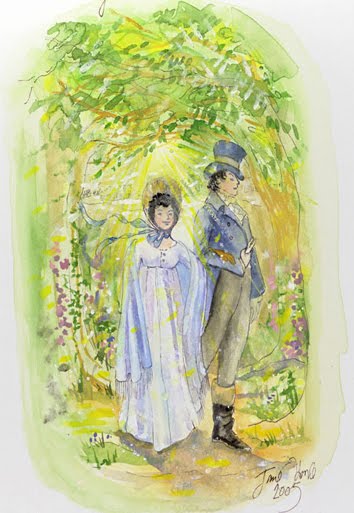 The only other narrative device to rank as highly in importance is, perhaps, the epistolary moments that allow for characters’ true feelings to be explained in straightforward fashion (something Darcy, especially, is apparently incapable of doing in person!). It is the walk, however, which in this novel (and others, such as Persuasion), allows for and gives rise to character growth and development.
Ultimately, walking in Austen’s narrative spaces accomplishes three important things: It creates the opportunity for important conversation; it allows a heroine to observe and reflect on her situation, possibilities, and future; and it lets the characters respond to the world around them. Whether it is Elizabeth and Mr. Darcy or Anne and Captain Wentworth, the walk is, above all, a chance to clear the air between courting characters and to progress the romantic elements of the plot.
Critical Linking: What’s New?
Greetings, Readers!
The last month or so has been a busy but exciting one! I’ve published a bunch of fun and (hopefully) interesting and edifying articles over at About.com’s Classic Literature site. Here are some of the highlights:
Resolved to Read the Classics: 10 Resources for the New Year!
A lot has been happening here at Roof Beam Reader, too! For example, I’ve begun the Year of Giveaways, which we kicked-off with Ursula K. LeGuin’s A Wizard of Earthsea. You can read more about this monthly event by clicking here.
In addition, we wrapped-up the 2014 TBR Pile Challenge (winner to be announced on February 15th) and began the 2015 TBR Pile Challenge! We have 210 participants this year, which is outstanding!
Hello, Readers!
In 2014, I was fortunate to have received dozens and dozens of books, from publishers, friends, authors, and contests. Among all of these acquisitions, however, were a number of duplicates.
So, in 2015, I’ve decided to feature one of these duplicate books each month, and offer that book as a giveaway to one of you! Yes, it’s The Year of Giveaways!
This month, the spotlight is on: All the Light We Cannot See by Anthony Doer!
 Description:
Marie-Laure lives with her father in Paris near the Museum of Natural History, where he works as the master of its thousands of locks. When she is six, Marie-Laure goes blind and her father builds a perfect miniature of their neighborhood so she can memorize it by touch and navigate her way home. When Marie-Laure is twelve, the Nazis occupy Paris, and father and daughter flee to the walled citadel of Saint-Malo, where Marie-Laure’s reclusive great-uncle lives in a tall house by the sea. With them they carry what might be the museum’s most valuable and dangerous jewel.
In a mining town in Germany, the orphan Werner grows up with his younger sister, enchanted by a crude radio they find. Werner becomes an expert at building and fixing these crucial new instruments, a talent that wins him a place at a brutal academy for Hitler Youth, then a special assignment to track the resistance. More and more aware of the human cost of his intelligence, Werner travels through the heart of the war and, finally, into Saint-Malo, where his story and Marie-Laure’s converge.
If you would like to win a copy of this highly acclaimed book, here’s what you need to do:
Rules:
- –Must be an e-mail or WordPress subscriber.
- –Must be 13+ with parental permission if under 18.
- –Winners must respond to e-mail within 48-hours or new winner selected.
- –Winners chosen randomly through Rafflecopter.
- -Giveaway ends at 11pm Central Time (USA) on the last day of the month.
Enter by Completing This Rafflecopter Form
 Roof Beam Reader