Roof Beam Reader
Adam Burgess
Thoughts: Extract from Captain Stormfield’s Visit to Heaven by Mark Twain

Extract from Captain Stormfield’s Visit to Heaven by Mark Twain
Final Verdict: 3.5 out of 4.0
YTD: 37
Extract from Captain Stormfield’s Visit to Heaven is a satire of Elizabeth Stuart Phelps Ward’s The Gates Ajar, which was published in 1868 and became widely popular at the time. In that religious novel, the protagonist-narrator, Mary Cabot, discusses her ideas of the afterlife with her widowed aunt, shortly after the main character’s brother has been killed. The author had lost her mother, stepmother, and fiancé in short order, during the American Civil War, and wrote the book as a sort of coping mechanism, and also as a way to reach out to women readers in similar situations. She claimed that the book was divinely inspired (“The angel said unto me, ‘Write!’ and I wrote”), and its positive views of heaven, one wherein families and friends would be reunited (a newish concept, not based in the true vision of heaven, as explained in the Bible) would later inspire other writers, such as Emily Dickinson.
Although Twain began writing the book sometime around 1868, it was not published for the first time until 1907, just a few years before he died. It was the last of Twain’s works that would be published in his lifetime and it clearly reflects Twain’s disillusionment with the promise of heaven and a “happily ever after.” Twain, like Ward, suffered great losses in his life. His wife and his daughters all died in relatively quick succession, and Twain struggled in his later years with depression and anger. Although always a satirist, the themes in his stories became much darker, more biting and anti-religious, as his own sadness and heartache grew.
Captain Stormfield, though comic and seemingly light in tone, clearly demonstrates Twain’s darker outlook on life and the afterlife (or lack thereof). The main character is Captain Elias Stormfield, who is traveling on a ship through space, chasing comets and other vessels from distant planets. He becomes lost along the way and ends up at the gates of heaven. But, as it turns out, he’s at the wrong entrance (which is realized only after much discussion with the gatekeepers, who must evaluate maps for days on end before they can locate our tiny, miniscule, germ of a planet, Earth) and must be transported to the correct gates before he can be admitted to the afterlife.

The bottom line is this: Twain uses humor to poke fun at how very silly are our beliefs in heaven. The evolution of this “new heaven” came about during and after the American Civil War, when so many people were in need of comfort; they found this comfort in the belief that loved ones would be seen again in heaven. This new heaven is the one we, most of us, think about today – so that evolution clearly held true, though Twain mocked it from the start. Twain seems to be calling out these fantasies as exactly that: fantasies. He had no illusions of being able to meet his wife and daughter in heaven again, and that stark view of life and the afterlife certainly affected his writing and his temperament.
But it is not just the vision of heaven he mocks, but also the way we perceive greatness in the here and now. Nearly everyone is present in heaven, from Napoleon to Socrates, King Henry VIII to Shakespeare. But, as Stormfield’s guide, Sandy McWilliams, explains – those great and influential figures from history, be it the epic poet, Homer, or the prophet Mohammed, if lined up end-to-end, might still come up at the rear, behind average, everyday folks who were capable of so much but were never afforded the opportunity to be great. Earth’s heaven is also geographically similar to the physical earth, but when a new arrival goes looking for someone to talk to in his home region, say England, he might soon discover that the majority of souls wandering that region do not speak English at all, because the history of that land is so ancient, and our perceptions of it always so “now” – so self-centered.
Captain Stormfield learns soon enough that heaven is not what he expected it to be. Although he does don a halo and wings, and sits on a cloud playing a harp, he soon realizes that to do this forever would be madness. How boring would it be to sit in one place for all eternity, strutting strings and smiling at people?
In this short story, Twain asks us to re-evaluate our conceptions of celebrity, fame, and power, to keep our tiny little planet and our tiny little lives in perspective – to, in effect, check our egos at the door.
Suggested Reading for:
Age Level: High School+
Interest: Humor, Satire, Atheism, American Literature, History.
Notable Quotes:
“Well, when I had been dead about thirty years I begun to get a little anxious.”
“Inside of fifteen minutes I was a mile on my way towards the cloud- banks and about a million people along with me. Most of us tried to fly, but some got crippled and nobody made a success of it. So we concluded to walk, for the present, till we had had some wing practice.”
“It’s the sensiblest heaven I’ve heard of yet, Sam, though it’s about as different from the one I was brought up on as a live princess is different from her own wax figger.”
“You have got the same mixed-up idea about these things that everybody has down there. I had it once, but I got over it. Down there they talk of the heavenly King–and that is right–but then they go right on speaking as if this was a republic and everybody was on a dead level with everybody else, and privileged to fling his arms around anybody he comes across, and be hail-fellow-well-met with all the elect, from the highest down. How tangled up and absurd that is! How are you going to have a republic under a king?”
Review: Winger by Andrew Smith
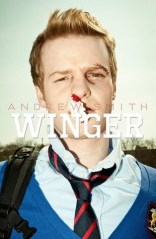 Winger by Andrew Smith
Final Verdict: 4.0 out of 4.0
YTD: 36
Ryan Dean West is Winger, so nicknamed for the position he plays on the high school Rugby team. He is fourteen years old and, being intellectually gifted, is already heading into his junior year of high school. He begins the new school year as a resident of Opportunity Hall, the “reject” wing of his school campus’s dormitories. How did such a bright kid end up in exile? Take one part smarty-pants, one part wild boy, and two parts bad judgment, and there you have it! Living in Opportunity Hall with Chas, the school’s biggest bully, as a roommate sucks, but it is not the biggest of Winger’s problems. And the fact that Chas’s girlfriend is totally lusting after him is bad, but still not the worst of it. That one of Winger’s friends posts pictures of his band-aided scrotum on the internet and another is gay (how do you deal with that!?) definitely causes Winger some anxiety, but these are still not the worst of his issues. No, the worst part is, he’s in love. Not so bad? Well, it is if you’re in love with your best friend. And it’s really bad if your best friend is a girl two years older than you. Two years might not seem like such a big deal to those of us who are now counting our birthdays in decades instead of years, but when you’re young, two years feels like a generation, especially when another guy, an older guy, your best friend, in fact, is competing with you for the same girl’s attention. Winger is a classic coming-of-age story for the new era. It is smart, daring, honest, and dangerous.
One of my favorite things about Smith’s books has always been the characters. Smith clearly knows and understands his characters inside and out. No one in the story is there for the sake of being there – they are all integral to the story’s plot and progression, be it for comic relief, emotional growth, romance, sexual awakening, or whatever else. Winger is no exception to this mastery. The main character, Ryan Dean, is not the greatest guy in the world; in fact, he does some pretty lousy things. But he’s growing up. He stumbles and he learns. He says stupid things, but reflects on them later. We get annoyed with him, sometimes, but we root for him because we can see and remember our own journeys to adulthood reflected in his. The bullies, too, Chas and Casey Palmer, are equally rounded – they are not all bad, and they are not just there because every protagonist needs an antagonist. They have their stories and histories, too, and they are equally important to this world that Smith has created. Although the story focuses on the students, Winger and his friends, Smith also captures the best and worst of adulthood. There are teachers (Mr. Wellins!) who live in their own little obsessive worlds, trying to make their students see what they see in the things they love; there are absent parents and clueless mentors; there are even unlikely romances between creepy hall directors who ultimately let their residents down in the worst possible way. This mixed bag of characters, their individualities, and their interconnectedness with one another and with the main story itself all help to create a story world that is believable and engaging, hilarious and terrifying – just like life.
When you have a favorite writer, the anticipation that builds when waiting to read his or her new book is a peculiar experience. You know you love what they do, but part of you is always dreadfully afraid that the new book might disappoint. When you’re a self-identified “reader,” there are few things more terrifying and heart-breaking than to be let-down by your favorite writer – it is a fear that few people can know or understand. So, headed into this reading experience, having loved every single one of Andrew Smith’s published works to date, had me simultaneously nervous and excited. I discovered Smith when I received an advanced copy of his book Stick from the publisher, for review. Immediately after finishing it, I bought every one of his books. And I’ve enjoyed all of them. Smith has a distinct voice, a poignant style, and a raw and daring point of view. It is remarkable, then, having already known what Smith was capable of, that Winger has blown my head right off. Smith clearly cares deeply for this story – the language and style are creative and distinctive, without being distracting. Smith understands people, but it takes a great storyteller to metamorphose that understanding into a readable, enjoyable story. He does this in traditional ways, sure, but he also adds unique signatures to his prose and form. For example, Winger carries on conversations with himself – something we probably all do – but has it ever been so realistically employed in prose? I don’t think so. The cartoons, too, add a fun element to the narrative, but also add to the reader’s understanding of the main character/narrator’s personality. Sometimes his deepest feelings, though caricatured through comic, come across most pointedly in his drawings. The dialogue, the jokes, the sarcasm, and the descriptions, too, are without flaw.
This year, I have been fortunate enough to have read some great young adult fiction from some of the most popular, award-wining writers. Although the YA genre is not my particular specialty, I do enjoy it and read it often; in the last 5 months, I’ve read works by Rick Yancey, David Levithan, Lauren Myracle, Cassandra Clare, and Rick Riordan. I’ve enjoyed, to varying degrees, all of their books and have found much to praise about each writer. But Andrew Smith stands unequivocally head-and-shoulders above the rest, and Winger is in a league of its own. It is not uncommon to read blurbs and reviews that claim such-and-such book is THE book of the year – for whatever reason. I have made a point, on this blog, to write my unbiased opinions of books, based on my own criteria – the things that work for me when reading a story. I’m not sure I’ve ever, in a review, suggested that anyone go out and buy a book. But there’s a time for everything, and this is that time. Winger is the first book this year to capture my attention from the start and hold it to the end. It’s the first story to tug at my heart, my soul, and my funny bone, and to make me believe that this story and the characters in it are real. If you’re a lover of YA fiction or coming-of-age stories, or if you are, like me, someone who just loves a good story and will dabble wherever you need to in order to find it, then, for crying out loud, go experience Andrew Smith’s Winger.
Suggested Reading for:
Age Level: 13+ (Language, sexuality, violence).
Interest: Coming of Age, YA, Boarding School, Friendship, Loss, LGBT, Bullying.
Notable Quotes:
“Nothing ever goes back exactly the way it was . . . things expand and contract – like breathing, but you could never fill your lungs up with the same air twice” (7).
“Getting through my world was like trying to swim in a pool of warm mayonnaise while carrying two bowling balls” (328).
“I wrote this all down, and I tried to make everything happen the exact same way it did when I was seeing it and feeling it – real time – with all the confusion, the pressure, and the wonder, too” (411).
“Things get tough. And you’re supposed to grow up. And it’s all a bunch of bullshit” (411).
“It felt like it was going to snow, and the clouds hung so low and white that I couldn’t even see the tops of trees around me. It looked like there was a pillow over the face of the world” (423).
“Almost nothing at all is ever about sex, unless you never grow up, that is. It’s about love, and, maybe, not having it” (438).
“The same words that make the horrible things come also tell the quieter things about love” (439).
The Classics Club Spin #2!

The Classics Club Spin!
Well, I attempted to play the first Classics Club Spin and completely failed (didn’t even OPEN the book). And… I’m one of the moderators of The Classics Club! Shame on me.
Anywho – school is out for the summer, so I have much more free time. Which means I’m going to take another crack at this and, this time, I am determined to read my Spin Book!
Directions:
- Go to your blog.
- Pick twenty books that you have left to read from your Classics Club List.
- Try to challenge yourself: list five you are dreading/hesitant to read, five you can’t WAIT to read, five you are neutral about, and five free choice (favorite author, rereads, ancients — whatever you choose.)
- Post that list, numbered 1-20, on your blog by next Monday.
- Monday morning, we’ll announce a number from 1-20. Go to the list of twenty books you posted, and select the book that corresponds to the number we announce.
- The challenge is to read that book by July 1, even if it’s an icky one you dread reading!
My Book Spin list for the Classics Club:
Five I Am Dreading:
1. The Castle of Otranto by Horace Walpole
2. The Mysteries of Udolpho by Ann Radcliffe
3. Moll Flanders by Daniel Defoe
4. Madame Bovary by Gustave Flaubert
5. A Portrait of the Artist as a Young Man by James Joyce
Five I Am Excited About:
6. Don Quixote by Miguel de Cervantes
7. The House of Mirth by Edith Wharton
8. At Swim, Two Boys by Jamie O’Neill
9. The Memoirs of Sherlock Holmes by Sir Arthur Conan Doyle
10. Kim by Rudyard Kipling
Five I’m Neutral About:
11. Henderson the Rain King by Saul Bellow
12. A Room With a View by E.M. Forster
13. Youth by J.M. Coetzee
14. Brave New World by Aldous Huxley
15. The Portrait of a Lady by Henry James
Five Free Choice: Totally Random Selections!
16. The Blind Assassin by Margaret Atwood
17. Wise Blood by Flannery O’Connor
18. Metamorphoses by Ovid
19. Vile Bodies by Evelyn Waugh
20. The 120 Days of Sodom by Marquis de Sade
The Prize: A fun reading experience!
TBR Pile Checkpoint #5 – May Progress!
Congrats to this month’s winner: Jean of Howling Frog Books!
Hello, TBR Pile Challengers!
It is May 15th and we are now at Checkpoint #5 for the 2013 TBR Pile Challenge! Can you believe we’re almost half-way through our challenge? Congrats to all those who have been keeping pace and making some progress – it has been great to see all the discussions on Twitter, Facebook, and your blogs!
Where I’m At: I have already read 9 of my required 12 books. I can’t believe I’m almost done! I plan to read my next book, The Memoirs of Sherlock Holmes, very soon, and I will be reading Persuasion in August, so that will bring me to 11 of 12! I might actually be able to read all my alternates this year, too.
Progress:
Book #1: O Pioneers! by Willa Cather
Book #2: The Alchemyst by Michael Scott
Book #3: Orlando by Virginia Woolf
Book #4: The Gunslinger by Stephen King
Book #5: The End of the Affair by Graham Greene
Book #6: Sodom on the Thames: Sex, Love, and Scandal in Wilde Times by Morris Kaplan
Book #7: A Streetcar Named Desire by Tennessee Williams
Book #8: Shine by Lauren Myracle
Book #9: Gods and Monsters by Christopher Bram
My favorites so far have been Orlando, A Streetcar Named Desire, and O Pioneers! but, I’ve been very lucky so far with my choices – they’ve all been good! What have been YOUR favorites, so far? Any surprises?
Below, you’re going to find the infamous Mr. Linky widget. IF you have completed any reviews for books on your challenge list, please feel free to link them up here so that we can easily find your posts, encourage one another, see what progress is being made on all these piles, etc. Also, feel free to link-up to your own checkpoint post, should you decide to write one (not required – but feel free!)
Giveaway!: This month’s checkpoint comes with a giveaway! Be sure to link-up your reviews (or a checkpoint post) by the deadline. Every link you post (provided it is new to this month – no posts/reviews used previously!) will earn you one entry into a random drawing. The prize is a book of your choice, up to $15 USD, from The Book Depository!
Link-up Your Reviews for April 21st – May 20th:
Review: The 5th Wave by Rick Yancey
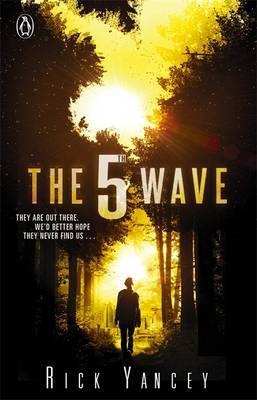 The 5th Wave by Rick Yancey
Final Verdict: 2.5 out of 4.0
YTD: 35
Plot/Story:
3 – Plot/Story is interesting and believable.
Rick Yancey’s The 5th Wave is a young adult sci-fi dystopian novel that has been carefully constructed to check off all the boxes of the new “classic” post-apocalyptic genre of YA fiction. In it, we find the main character, Cassie, on a quest to save her younger brother after they have been separated from each other during the 4th Wave. Cassie’s family, like so many other families, has been decimated, leaving her entirely alone. As she navigates the dangerous and deserted middle United States, she encounters a young man named Evan who might turn out to be her personal savior, or her biggest nightmare. In the meantime, her first crush – Ben Parish- has been taken to a secure military base, where children between the ages of 6 and 16 are being trained as soldier-warriors. They are given the tools they need to identify the enemy and the skills they need to end them. But, in the end, the question of “who is the enemy?” turns out to be much more complicated than anyone could have imagined and the answer brings Cassie and Ben racing toward each other and toward the same goal, though they don’t even know it.
Characterization:
2 – Characters slightly developed.
This section contains spoilers.
To begin with, Yancey, like many other YA dystopian writers before him, makes a smart choice in centering his story on teenagers and children. We all want to root for young heroes – we want to see them overcome their struggles and survive despite the lack of guidance and protection that comes with having lost their parents. Yancey also cleverly introduces a muddled love interest – an intergalactic Romeo and Juliet scenario that should tug on everyone’s heart strings. Except it, like many of the other relationships in the book, falls flat. Cassie is totally in lust with Ben. Evan is totally in lust with Cassie (okay, maybe in love, a little bit). Ben doesn’t really know Cassie exists, but he conveniently helps to save her little brother, which brings them all together – the result? Nothing. 450 pages of build-up on a sidelined teen romance that goes absolutely nowhere, except that we are to assume Evan disappears to make way for Ben (in a future sequel?). On the other side, we have the villains who are essentially villains for villainy’s sake. This is, in my opinion, the least satisfying type of “bad guy.” Sure, the Silencers need bodies (apparently) and thus have a motive for their bad deeds but it is established by one of their own that the Silencers could have lived on Earth in peaceful coexistence with humans. They just didn’t want to do that – too confusing? Ultimately, these formless, bodiless consciousnesses floated through space for thousands of years to get to Earth, where they could unite their minds with human bodies, except they don’t really want or like their human bodies. Ultimately, it felt as if a bad guy was needed and alien villains haven’t been used on a grand scale in a while (considering all the zombie/vampire/supernatural stories lately), so it was a simple and “uniquely retro” solution. In the end, the one-dimensional bad guys and the relatively depthless good guys (aside from a few interesting ones, like Sam and Evan whose points of view we only get once, sadly, and Ringer, who we see only as a secondary character) created rather shallow relationships and motivations. Their stories lacked substance which kept me from caring too much about what happened next and, unlike Ender’s Game or The Hunger Games, does not leave me wondering about the sequel books.
Prose/Style:
3 – Satisfactory Prose/Style, conducive to the Story.
Yancey certainly knows how to tell a story. His use of language is great – engaging and effective. Some of the choices he makes, though, such as the multiple points of view, do not seem to be entirely necessary or helpful. Each chapter is from a different character’s perspective and, in some ways, this was required due to the fact that Cassie and Ben, the two protagonists, were in different locations and developing their two divergent stories, to be later united at the end; however, I think a third-person narration might have done more for the story. Take, for instance, the lack of uniformity – all of the chapters were wildly different lengths so a moment might be spent with one character, and then dozens of chapters with another. Also, some of the most poignant perspectives, such as that of Sam and Evan, were glimpsed only briefly, which was disappointing. Ultimately, the narrative’s style – the ease and naturalness of the prose – is definitely strength, whereas the form and structure were not as well-crafted. The first portion of the narrative drags on for quite a while and the latter part flies by. Uniformity and balance, plus some careful cutting and focus, could have tightened up the plot and allowed Yancey’s talents as a storyteller to shine a bit more brightly than it did.
Additional Elements: Setting, Symbols/Motifs, Resolution, etc.
2 – Additional elements are present and cohesive to the story.
The 5th Wave by Rick Yancey is perhaps one of the most hyped, most anticipated young adult books of 2013. It is being described as Ender’s Game meets The Host and as The Hunger Games meets Close Encounters, among other combinations. In keeping with the trend, I would add my own comparison: The 5th Wave is Battle Royale meets Invasion of the Body Snatchers. The problem with all of these comparisons, though, is that they spawn from a sense of the derivative. While the story and some of its cast were interesting, what the narrative lacked was a true sense of purpose and meaning. There might be multiple messages, here – don’t always do what you’re told just because someone in a position of authority says so. Things are not always what they appear to be. Only the strong survive. Luck matters. These are all great, simple additives for stories, but they don’t hold up too well as major themes. Aliens invade, almost everyone dies, but a few fight back – this might work well in the movies, particularly if a romantic or emotional subplot is infused into the action, but a good book needs more than goodness for goodness sake.
Is The 5th Wave a good read? Absolutely. It is actually the epitome of a great summer read – filled with action, suspense, aliens, and friendships formed in the face of great adversity. But is The 5TH Wave “the Young Adult book of the year,” as some have claimed? No, I think not. I would much sooner give that title to Andrew Smith’s Winger. Still, if you’re a fan of this genre, if you enjoyed The Hunger Games, Divergent, and the like, then the odds are you will like this one, too. It might not be the most profound book in the world, but it is an entertaining read – not a bad way to spend a summer afternoon.
Suggested Reading for:
Age Level: 13+ (Language, sexuality, children in adult situations, graphic violence).
Interest: Dystopia, Post-apocalyptic, Science Fiction.
Notable Quotes:
“And it occurs to me that there’s no real difference between us, the living and the dead; it’s just a matter of tense: past-dead and future-dead” (113).
“There’s more than one kind of bullshit. There’s the bullshit you know that you know; the bullshit you don’t know and know you don’t know; and the bullshit you just think you know but really don’t” (149).
“It’s why a kid army makes sense. Adults don’t waste their time on magical thinking” (242).
“The fire in my chest grows white-hot, spreads over every inch of my body. It melts my bones; it incinerates my skin; I am the sun gone supernova” (263).
“I thought the only way to hold on was to find something to live for. It isn’t. To hold on, you suave to find something you’re willing to die for.” (281).
“1st Wave: light’s out. 2nd Wave: surf’s up. 3rd Wave: pestilence. 4th Wave: Silencer. What’s next, Evan? What is the 5th Wave?” (351).
“I am a shark who dreamed he was a man” (360).
“When the moment comes to stop running from your past, to turn around and face the thing you thought you could not face – the moment when your life teeters between giving up and getting up – when that moment comes, and it always comes, if you can’t get up and you can’t give up either, here’s what you do: Crawl” (419).
“It’s the strong who remain, the bent but unbroken, like the iron rods that used to give this concrete its strength. Floods, fires, earthquakes disease, starvation, betrayal, isolation, murder. What doesn’t kill us sharpens us. Hardens us. Schools us” (446).
“It’s almost dawn. You can feel it coming. The world holds its breath, because there’s really no guarantee that the sun will rise. That there was a yesterday doesn’t mean there will be a tomorrow” (456).
 Roof Beam Reader