Roof Beam Reader
Adam Burgess
Thoughts: The Magic Fish by Trung Le Nguyen

I had grand plans of writing this review in fairy tale style, inspired as I was by Trung Le Nguyen’s adaptations of classical fairy tales to share this beautiful story. But, alas, I’m not the wordsmith Nguyen is, and definitely not the artist! So, please accept humble words filled with rapturous praise for The Magic Fish, which was one of my Top 10 favorite reads in 2020.
To begin, when I read graphic novels I’m usually more drawn to either the story or the artwork. There are plenty where I think the two work very well together, even complement each other, but this might be the first time I’ve read a graphic novel where I equally enjoy and appreciate both elements to the same degree. The story itself follows a young boy of Vietnamese descent who is being raised in the United States. It is very similar to the author’s own life story. Nguyen, growing up in the American Midwest, learned Vietnamese and English at the same time, Vietnamese at home and English in school and with his friends. As a boy, he and his parents would visit the library once per week and spend time reading to each other. Nguyen’s favorite stories were fairy tales and he soon learned that some of the English-language fairy tales, those most of us growing up in the United States would know, were very similar to ones that his parents learned as children in Vietnam. They had wonderful conversations about the similarities and differences between western/English-language fairy tales and those from Vietnam, and in doing so, began to communicate with one another in two languages, sometimes switching back and forth to use the words most appropriate or familiar in the given moment. It was a kind of hybrid language that is perfectly embodied in this graphic novel. It’s a fascinating, beautiful personal narrative that informs this fascinating, beautiful graphic novel.
The protagonist, young Tiến, uses the fairy tales that he and his family know and love, across the two cultures, to bridge a personal gap between them: to explain to his parents that he is gay. Nguyen explains that, while writing the story, he imagined that each character had a different vocabulary informed by their life experiences. These vocabularies were navigated through shared cultural stories, fairy tales. And Nguyen brings this richly to life not just in his words and images, both of which are stunningly crafted, but in the truly seamless presentation of the two as a single narrative. This is not a story told through two devices; it is an experience gifted to the reader through a cohesive vision, expertly executed.
The heart of this graphic novel are three fairy tales, including two versions of Cinderella (the German and the Vietnamese) and The Little Mermaid. Also incorporated into the plot, though, are concepts such as traditional coming out and coming of age in America, the immigrant experience, issues of colonization and empire, post-war identity, and so much more. What on the surface might look like another wonderfully illustrated children’s story is in fact a powerful, delicate, and uniquely rendered story about a queer, Asian American boy’s life, his family, and their heritage, not to mention language itself.
I was utterly captivated by this one. At a time when I’m donating bags and bags of books to libraries and charities in a fit of “winter cleaning” and pandemic stir-craziness, The Magic Fish has found its place on my forever shelf.
Synopsis:
Real life isn’t a fairytale.
But Tiến still enjoys reading his favorite stories with his parents from the books he borrows from the local library. It’s hard enough trying to communicate with your parents as a kid, but for Tiến, he doesn’t even have the right words because his parents are struggling with their English. Is there a Vietnamese word for what he’s going through?
Is there a way to tell them he’s gay?
A beautifully illustrated story by Trung Le Nguyen that follows a young boy as he tries to navigate life through fairytales, an instant classic that shows us how we are all connected. The Magic Fish tackles tough subjects in a way that accessible with readers of all ages, and teaches us that no matter what–we can all have our own happy endings.
About the Author: Trung Le Nguyen, also known as Trungles, is a comic book artist and illustrator working out of Minnesota. He received his BA from Hamline University, majoring in studio art with a concentration in oil painting and minor in art history. He is particularly fond of fairy tales, kids’ cartoons, and rom-coms of all stripes. The Magic Fish is his debut graphic novel.
Thoughts: Bye-Bye Blue Creek by Andrew Smith
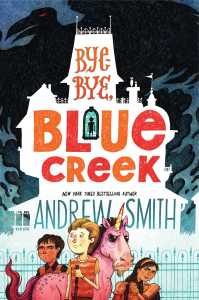
Sam Abernathy’s story, prequel to the Winger novels, has quickly become one of my favorites among Andrew Smith’s works. Although the books are middle grade level, they are rich with wisdom, wit, and curiosity. The first in the series, The Size of the Truth, gave us much background on a beloved character from the Winger novels, and this second book (in what I hope will be a series?) continues to follow Sam as he grows up, enrichens his friendships, learns to overcome fear and prejudices, wanders rudderless through his first crush, and even meets his hero. In other words, he lives a life so many of us remember with both fondness and awkward embarrassment, our youth and the universal elements of it that we almost all share.
Where The Size of the Truth does an excellent job of introducing us to Sam and his world, Bye-Bye Blue Creek, as the title suggests, shows us how Sam is preparing to say goodbye to all of that. And the reader, like Sam, having gotten to know these characters and this quaint little town in the last book, must also learn how to say farewell to them all. One thing Smith seems to be suggesting is that, no matter where or when we are in life, one thing we all must face at some point, perhaps at many points, is the need to say goodbye to what we know and love. And even when the next step is necessary, exciting, and a great adventure, it is sure to come with a bit of fear and apprehension, and even regret over what we’re leaving behind. There are a few very important lessons we learn when we’re young, and this one is perhaps one of the most difficult and most significant.
Beneath the larger themes is a riot of a tale involving a mystery house, a mystery boy–strange indeed!-and a long-lost history of Blue Creek, involving Sam’s own father and the haunted house down the street. Can Sam and his friends get to the bottom of the mystery? As the weeks quickly race by toward Sam’s final goodbye, they scour the library and investigate the past in order to understand the present. And while they do so, they learn a little bit more about themselves, their families, and one another.
Andrew Smith does it again. One definitely needs to read The Size of the Truth before this one, if the story and its call-backs are to be fully understood and appreciated; fortunately, I can highly recommend both.
Thoughts: Mexican Gothic by Silvia Moreno-Garcia
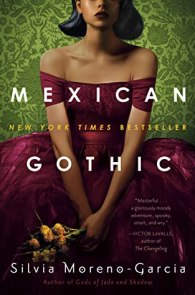
Every year around Halloweentime, I try to devote at least a week or two to “spooky” reads. This last Halloween season, I read a little collection of haunted poetry, along with The Only Good Indians by Stephen Graham Jones and Shirley Jackson’s The Haunting of Hill House, which I had assigned to my students. The last among these was Silivia Moreno-Garcia’s Mexican Gothic, a breakout hit this year, and I was very much looking forward to reading it.
I’ll start by saying, I might be spoiled by psychological thrillers, like Shirley Jackson’s works. I find that I’m less interested in traditional horror that is filled with supernatural bogeyman, and more interested in the scary things that our subconsciousness’ conjure. Perhaps because of this, I struggled with Mexican Gothic, whose villain is certainly a fresh invention and yet fits into the more traditional role of scary bad guys.
On the other hand, as historical fiction about 1950s Mexico, with family and romance at its heart, the story is quite charming and interesting to read. I found Moreno-Garcia’s characters and atmosphere provocative and compelling. Her exploration of women and men, femininity and masculinity, and the horrors of eugenics, is ultimately more interesting–and horrifying–than the haunted house/ghost story that is the primary vehicle. And perhaps that was the intention. We see, unfortunately, much of the West’s last decade (and further) mirrored in the supremacist themes that sour the soil upon which Mexican Gothic’s haunted house, High Place, is built.
The story begins with a young woman, Noemi, and her father in metropolitan Mexico. They are wealthy, popular, and even powerful. Then, glamorous Noemi, aloof in her world of rich dances and ever-changing academic and career interests, receives a letter from her cousin, who has been swept away by her new husband to the in-laws home on an abandoned silver mine, in a struggling rural village. Noemi’s letter is scrambled, confused, and filled with foreboding danger. It is a cry for help, and Noemi is an unlikely hero.
What unfolds is an inventive haunted house tale that puts at its center a battle of the sexes, and two distinct mindsets: the villainy of an old and backwards view of European superiority versus the championing of progressive equality, a view that all are capable and there is no such thing as inherent worth or racial supremacy. These two foils unfold amidst a bizarre poison that infects High Point’s patriarch and has been passed down, generation to generation, for hundreds of years. As Noemi and her cousin enter the picture, the time has come for this evil to pass again into the next generation, and if it succeeds, it will trap them both forever.
Mexican Gothic is an important story with a, to me, unfortunate villain; and yet, that villain is wildly imagined and certainly unlike any I’ve read before. Overall, I think the book is a success more so for its politics and psychology than its primary story, but I can understand why many will be pulled in by that as well. Those who enjoy traditional horror novels will likely appreciate this one.
January Theme: Tao Te Ching
Happy New Year!
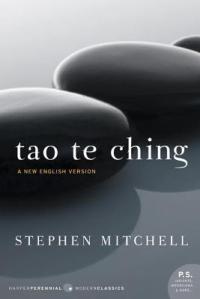
You may remember from my post in December that, this year, my themed reading is World Religions. The first text is Stephen Mitchell’s translation of the Tao Te Ching, A New English Version published by Harper Perennial. The Tao Te Ching is a central text to Taoism (Daoism), but as a secular Buddhist, I’m very much looking forward to beginning the new year with this seminal text from Lao-tzu.
Known as The Book of the Way, the Tao Te Ching (pronounced Dow Deh Jing) is a selection of short verses that are meant to offer balance and perspective. Its primary goal is to help readers and practitioners “to work for the good,” with skill that becomes effortless when one becomes in sync with the Tao, or the basic principle of the universe. Is there a better way to begin a new year than in pursuit of a “serene and generous spirit”? I certainly can’t think of one.
Not much is known about Lao-tzu, though some believe he was a contemporary of Confucius (551-479 B.C.E.). He left little information about himself, his life, or even his work, though some believe he may have served as an archivist. Others imagine he was a hermit, but if this was true, he was a hermit deeply concerned with humanity and society, or at least the welfare of others. What is most important, I suppose, is this text of ancient Chinese wisdom, which is really human wisdom, that he left behind for the benefit of individuals and of all mankind.
My edition of the Tao Te Ching contains 81 short verses. Since there are 30 days in January, that comes out to about 2.5 verses per day. Here’s a general plan for reading that I hope to follow, and I offer it to any who might be interested in joining me this month.
- January 1-January 9: Chapter 1 through Chapter 20
- January 11-January 16: Chapter 21 through Chapter 41
- January 17: Mini-Update Post
- January 18-January 23: Chapter 42 through Chapter 62
- January 25-January 30: Chapter 63 through Chapter 81
- January 31: Wrap-Up Post
P.S. Don’t get scared by the number of chapters. Each “chapter” in the book is less than one page long.
Roof Beam Reader’s 2020 Year in Review
Welcome to My Reading Year in Review!

This year sucked in most ways, let’s be real. But one area of my life that was decidedly un-sucky was my reading. I had a goal of reading only a dozen or so books, because I knew how busy my schedule was going to be this year. Then, wouldn’t you know it, a pandemic struck and reading became not just more possible, but so very, very necessary. So, here’s what happened in my year of reading:
- Number Of Books Read: 85
- Number of Re-Reads: 7
- Genre Read Most: Poetry and Asian/AAPI Lit.
- Best Book You Read in 2020? How to Be an Antiracist by Ibram X. Kendi or Caste by Isabel Wilkerson
- A 2020 Book You Enjoyed from an Indie Press: 900 Miles by E.J. Runyon
- Book You Were Excited About & Thought You Were Going To Love More? The Only Good Indians by Stephen Graham Jones
- Most surprising (in a good way or bad way) book you read? The Magic Fish by Trung Le Nguyen (thoughts should be up in January!)
- Book You “Pushed” The Most People To Read (And They Did)? On Earth We’re Briefly Gorgeous by Ocean Vuong
- Best series you started? Best Sequel of 2020? Best Series Ender of 2020?
- New Series: Probably The Last Herald-Mage trilogy by Mercedes Lackey
- Sequel: Bye Bye Blue Creek by Andrew Smith (sequel to The Size of the Truth) (thoughts should be up in January!)
- Series Ender: The Tower of Nero by Rick Riordan (end to The Trials of Apollo) (thoughts should be up in February!)
- Favorite new author you discovered? The poet Jericho Brown.
- Best book from a genre you don’t typically read? Green Lantern: Legacy by Minh Le or The Prince & the Dressmaker by Jen Wang (comic/graphic novel)
- Most action-packed/thrilling/un-put-down-able book of the year? Dune by Frank Herbert
- Book You Are Most Likely To Re-Read Next Year? The Song of Achilles by Madeline Miller (still need to review this one!)
- Favorite cover of a book you read in 2020?
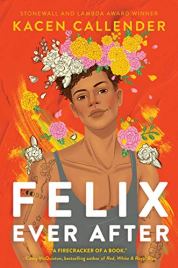
- Most memorable character of 2020? Felipe from Here the Whole Time by Vitor Martins (thoughts coming in February!)
- Most beautifully written book read in 2020? Swimming in the Dark by Tomasz Jedrowski
- Most Thought-Provoking/ Life-Changing Book of 2020? How to Be an Antiracist by Ibram X. Kendi
- Book you can’t believe you waited UNTIL 2020 to finally read? The Three Musketeers by Alexandre Dumas
- Favorite Passage/Quote From A Book You Read in 2020?
- “I ventured to believe that the function of the border wasn’t only to keep people out, at least that was not its long-term function. Its other purpose was to be visible, to be seen, to be carried in the imaginations of migrants deep into the interior of the country, in the interior of their minds. It was a spectacle meant to be witnessed by the world, and all of its death and violence was and continues to be a form of social control, the way that kings of the past needed to behead only one petty thief in the public square to quell thousands more.” –From Children of the Land by Marcelo Hernandez Castillo
- Shortest & Longest Book You Read in 2020?
- Shortest: Burnings by Ocean Vuong (40 pages)
- Longest: Dune by Frank Herbert (892 pages)
- Book that Shocked You the Most? The Lover by Marguerite Duras
- OTP OF THE YEAR (you will go down with this ship!):
- Favorite Non-Romantic Relationship of the Year? Felipe and Caio from Here the Whole Time by Vitor Martins
- Favorite Book You Read in 2020 From An Author You’ve Read Previously? Closer to Nowhere by Ellen Hopkins and Bye-Bye Blue Creek by Andrew Smith
- Best Book You Read in 2020 that You Read Based SOLELY On A Recommendation From Somebody Else? Homegoing by Yaa Gyasi
- Best 2020 debut you read? The Magic Fish by Trung Le Nguyen (thoughts coming in January!)
- Best World-building/Most Vivid Setting You Read This Year? From the Land of Green Ghosts by Pascal Khoo Thwe
- Book That Put A Smile On Your Face/Was the Most FUN To Read? The Princess Bride by William Goldman
- Book That Made You Cry Or Nearly Cry in 2020? Citizen: An American Lyric by Claudia Rankine
- Hidden Gem Of the Year? The Magic Fish by Trung Le Nguyen or Here the Whole Time by Vitor Martins
- Book That Crushed Your Soul? An Indigenous People’s History of the United States by Roxanne Dunbar-Ortiz
- Most Unique Book You Read in 2020? The Lover by Marguerite Duras
- Book That Made You the Most Mad (doesn’t necessarily mean you didn’t like it)? A Promised Land by Barack Obama (thoughts coming in March!)
- New favorite book blog you discovered in 2020? Oops, I did it again. Forgot to explore!
- Favorite review that you wrote in 2020?
- Best discussion/non-review post you had on your blog?
- Best event that you participated in (author signings, festivals, virtual events, memes, etc.)?
- Best moment of bookish/blogging life in 2020?
- Most Popular Post This Year On Your Blog (whether it be by comments or views)?
- Post You Wished Got A Little More Love?
- Best bookish discovery (book related sites, book stores, etc.)?
- Did you complete any reading challenges or goals that you had set for yourself at the beginning of this year?
- NOPE! I failed my only planned challenge, Back to the Classics.
- One Book You Didn’t Get To In 2020 but Will Be Your Priority in 2021?
- The Last Love Song: A Biography of Joan Didion by Tracy Daugherty
- Book You Are Most Anticipating For 2021 (non-debut)?
- Later by Stephen King
- 2021 Debut You Are Most Anticipating?
- The Prophets by Robert Jones, Jr. and Let’s Get Back to the Party by Zak Salih
- Series Ending/A Sequel You Are Most Anticipating in 2021?
- None that I know of.
- One Thing You Hope To Accomplish Or Do In Your Reading/Blogging Life In 2021?
- I would like to keep up the pace of posting one or two reviews per week, which I began in Sept/Oct.
- A 2021 Release You’ve Already Read & Recommend To Everyone:
- None. I’m out of the loop!

 Roof Beam Reader