Roof Beam Reader
Adam Burgess
The Second 10 Days #100DaysJournal
A quick update on my 100 Days Journal project.
First, I’m happy to announce that, yes, I’m still going! It’s very rare that I can stick to any kind of time commitment-based project. I don’t know why. The structure is actually helping me this time, though, and I think my positive success (so far) is in large part due to the fact that I’m accomplishing writing as a part of this project.
My reading challenges, for example, often suffer because a) I’m going to read no matter what, so why force myself into constraints about what type and how much? and b) I end up doing too much reading for my writing habits to keep up with, find myself with a stack of books to review, and decide to throw my hands up and say, “forget it!”
In my first 10-day checkpoint review, I noted that I’d been doing a lot of self-criticism. I think I’m still doing that, but something else has happened, too. While I’ve been noting a lot of places where I continue to struggle, fail, or disappoint myself, the tone of those criticisms has changed somewhat. For example, I often added a little more explanation about why I was failing at something, or how I might improve. So, perhaps one of the benefits of this journaling project might be to combine self-reflection with self-improvement. There’s an idea!
I’ve also found that I’m writing a lot more about my goals, and manageable ones at that. Just this morning, for instance, I wrote 5 things I would like to achieve by the end of the year. Some of them will be terribly difficult, one or two of them super easy. It seemed helpful to make a list for myself so I could see what really is important to me right now, what will make me feel like a success, and where I can find a balance between “easy” improvements/accomplishments and more challenging ones.
Here are the last 10 prompts:
- Day 11: If you could solve one big world problem, what would that be?
- Day 12: When you feel bored, where does your brain wander to?
- Day 13: If you weren’t concerned with what other people thought, what would you like to be doing with your life? (this was a zinger!)
- Day 14: What did you want to be growing up? Why?
- Day 15: Describe your earliest memory.
- Day 16: Where in the world do you have no desire to travel? Why?
- Day 17: When are you happiest in relationships?
- Day 18: If you could choose jobs for your child, which would you choose? (I had to work around this one, since I’m not a parent.)
- Day 19: What don’t you have enough time to do? Why?
- Day 20: What is something not many people understand about you? (this one was painful.)
Working from prompts has been really helpful, but to be honest, I modified almost every single one of them in some way, or found a way to answer the prompt while also writing about whatever was already on my mind that day. It’s been an interesting exercise in thoughtful synthesis, so far! Onward!
Feel free to follow along with my #100DaysJournal project on Twitter!
Steering the Craft by Ursula K. Le Guin
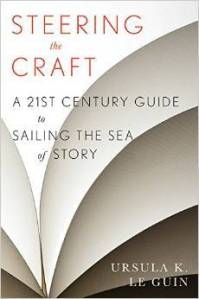
Ursula K. Le Guin is a fantastic writer. I thoroughly enjoyed A Wizard of Earthsea (it was the University’s common read a few years ago. I really should read more of the series!) and have always wanted to read more of her work. So, last year, I picked up a couple of her books on writing, including this one and Conversations On Writing. I haven’t read the latter, yet, but I’m looking forward to it after having finished Steering the Craft.
The title is of course a metaphor for writing. Le Guin approaches the writing process with a wonderful sense of humor and beautifully helpful analogies to life and other messes, er, situations. What I find most helpful about the book is its design. First, each chapter is a distinct topic, important to the writer (the writer of fiction, primarily.) Unlike some fiction writing guides, however, Le Guin does not focus on the big-ticket items, like character. Instead, she moves in on things like grammar, voice, and point of view. Then, within each chapter on a single topic, she breaks things down into a few components: A) thoroughly enjoyable narratives on what she means by the topic, including definitions and her own explanations plus relationships/experiences with the topic; B) helpful examples from excellent sample pieces, like Jane Eyre, that help her illustrate what she means and gives the reader-writer a better idea of how someone does “this thing” well; and C) one or more practice exercises so that the reader-writer can test out their new knowledge in a practical way, and get to doing the work of writing, which is why she should be reading the book in the first place.
So, the book is not just a guide to a writing, but it is also a prompt for writing, too.
Another helpful element is the appendix, where Le Guin gives all sorts of useful advice about how to form and run and participate in a writing group, be it in person or online. She outlines some of the most helpful guidelines and articulates some of the problems and pitfalls, too. This might not be necessary for everyone (many reading are probably solitary writers, although, as Le Guin makes clear, that’s a habit worth breaking), but even if the reader-writer is already experienced in writing groups and/or has no current interest in them, they might find helpful information for themselves, here.
Finally, Le Guin is just fun. She’s brilliant and entertaining. She treats the reader-writer like a peer, not a customer or some “noob” to the scene. Reading the section on “the sound of your writing” and realizing that Le Guin has her audience in mind, just as she encourages the reader-writer to have his audience in mind, is a great way to begin, as it demonstrates her ethos in the most effective way. She tells, shows, does, and then asks the reader-writer to do the same. This is a teaching method I’ve been practicing myself for years, and it was seriously comforting to see a master writer doing the same. I’m eager to get back to her fiction, but also, especially, her Conversations On Writing.
Circe by Madeline Miller
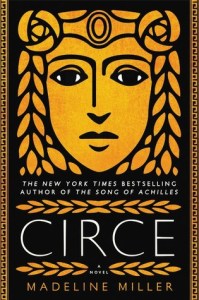
Have you ever read a book that left you feeling completely stunned? It happens to me rarely, but when it does, I have this thing where I can’t do anything with my thoughts afterward. I can write about a good book, even a great one. I can write about a bad book, even a terrible one. But sometimes, a book completely knocks me out, and I can sit on it for days, weeks, even years without ever being able to articulate a damn thing about it. That’s what happened to me with Madeline Miller’s Song of Achilles. You won’t find a review for it here, because I simply could not do it.
So, it was with excitement and strange terror that I returned to Miller once again for her highly anticipated and well-received follow-up, Circe. This one, like Song of Achilles, explores the life of one mythological character in great detail, imagining her life “behind the scenes” of the sparse details we get from classical storytelling. What Miller did so brilliantly in her first novel, exploring the more interesting elements of a well-known hero, Achilles and his lover, she does again here with Circe, who is treated to centuries’ worth of imagined biography.
I will say that I did not respond to Circe in the way that I responded to Song of Achilles. I’ve been wondering how much of this is simply biased, considering I am and was more interested in and more familiar with Achilles’s story in the first place. His story, and particularly told in the way Miller chose to tell it, through the eyes of his lover, is something I’ve always wanted to read. I wasn’t as familiar with the mythology of Circe, nor did her story draw me in as deeply or passionately. It’s an unfair comparison, perhaps, because I felt intimately connected to Song of Achilles, and not necessarily because the book was “better.” In fact, Miller here writes one of my favorite lines from any book I’ve ever read: “[T]here are rare moments when another soul dips near yours, as stars once a year brush the earth. Such a constellation was he to me.”
Objectively speaking, though, I do think Achilles is a masterpiece, and that Circe is wonderfully well-done. The prose is not quite as interesting, this time, and the story does not move at the same pace. Indeed, because so much seems to happen in such a long period of historical time, but so shortly in narrative time, it sometimes feels oddly wind-swept and slightly disjointed, though never out of control. Miller knows what she is doing, and the story is powerful, interesting, and even joyful in its terrible sadness. The choice of Circe as protagonist is brilliant, too, because she is able to think and feel and interact with mortals in a way that Greek mythology does not allow of its gods, who are always (and to an extent must be) completely unconcerned with human needs, desires, pains, et cetera. (Rick Riordan has been playing with this, too, in his latest series re-imagining the god Apollo as a mortal teenager living in the contemporary era.)
To be fair, I find I’m still left spoiled by–wrecked by–Achilles. This might always be the case and, in the interest of full disclosure, I have to admit that my experience with it must have, on some level, colored my reading of Circe. That said, Circe is a compelling novel whose reception is well-deserved and easy to understand. It’s also a particularly powerful statement in our time, as we confront head-on issues of gender and power. Miller crafts a flawed and sometimes ignorant hero whom I knew little about and for whom I struggled, at first, to champion; in the end, she convinces me.
Notable Quotes
“In a solitary life, there are rare moments when another soul dips near yours, as stars once a year brush the earth. Such a constellation was he to me.”
“Humbling women seems to me a chief pastime of poets. As if there can be no story unless we crawl and weep.”
“I thought: I cannot bear this world a moment longer. Then, child, make another.”
“I will not be like a bird bred in a cage, I thought, too dull to fly even when the door stands open.”
The Funhouse by Dean Koontz

I can’t help comparing Dean Koontz to Stephen King. This is unfortunate for Koontz, because he simply cannot compete. I suppose that’s harsh and maybe even unfair criticism, but there we have it.
The Funhouse begins with a somewhat interesting premise that is muzzled by completely uninteresting characters. There’s a man, a sexy, charming bad boy who works for a carnival, and a young woman living under the suffocating influence of her mother, a religious zealot (of course this young woman will eventually become her mother, but no matter?) They run off together, he turns out to be not just a jerk but a monster (for real) and they have a baby. This baby… is it human? Is it a demon? Mom and Dad each see that baby a little differently, one is terrified of it and determined to kill it. The other adores it and would do anything to protect or avenge it.
So, I guess that sounds like a wild ride, and it is. It also all unfolds in the first section of the book. The rest of the novel deals with a younger generation who must deal with the repercussions of their parents’ fall-out and that first “abomination” of a baby, which may or may not be alive. Or evil. But then again, it might be a different evil baby that is now a man, even though its pseudo-step-siblings are still children. Who knows? Does it matter?
I suppose this simply was not the book for me. The elements I tend to enjoy about thrillers and horror novels are the epic battles between good and evil. The struggle for internal strength over weakness, to find the light in the darkness and somehow overcome, survive. Even when elements of the supernatural are introduced, I find myself willing to go along for the ride, provided the other elements are treated well and fairly, and without much cliché (to be fair, King also does sometimes fall into the clichéd.) That said, the good versus evil in this particular story doesn’t work for me the way it does in King’s novels, for example, because the evil seems to be too supernatural and too pure (“I need a bad guy. What’s the grossest, most evil, inhuman, irredeemable bad guy imaginable? I’ll use that!”).
Even the good, the flawed characters, are indeed flawed human beings, which is normally a positive trait in my opinion. Heroes who are too pure are just as boring as villains that are completely evil. Each of these lacks internal conflict and any real motivation. So, one might want to root for these kids, especially, but one gets distracted with moral lessons about sexual purity and religion and family. One also gets distracted by the unfortunately histrionic and melodramatic writing.
Ultimately, much like the young woman at the start of the story who suffocates beneath her mother’s Christian mania, I found myself choking on forced themes, mediocre prose, and uninteresting conflict. Where King’s evil tends to be rooted in humanity, even when it is supernatural, Koontz’s is just monstrous. There’s no reason to fear it, because it’s too unreal to care about. It was too fantastic, I suppose, to mean anything. But for some, that might be fun.
March Checkpoint! #TBR2019RBR
 Hello, TBR Pile Challengers!
Welcome to our third checkpoint for this year’s TBR Pile Challenge! We already have more than 110 reviews/checkpoints linked up on our Mr. Linky, which is insane! Well done to all of you! I hope you continue to read and share and discuss all your favorites (or least favorites) from this challenge.
As for me, I’ve made the tiniest bit of progress since last month, which is that I actually managed to write my thoughts for Book #2, and those thoughts go live on March 17th. I’ve read another 5 books (and written reviews for most of them, too!) but, unfortunately, none of the selections were on my TBR Challenge list. Whoops.
Progress: 2 of 12 Completed / 2 of 12 Reviewed
So far, I’ve read 2 of my 12 required books. I do plan to start Book 3 very soon, and I plan (really, I do!) to read all 14 of the books on my list this year, the main 12 plus my 2 alternates, so getting a jump-start on this list before spring semester began was important. I think I’ll read something non-fiction, next, since I’ve read two novels already. Perhaps Light the Dark, to help re-ignite my writing as well. Then again, I’ve really been eyeing Rilke’s Letters to a Young Poet the last few days, and I also have found myself in a bit of a reading rut, comparatively speaking, so I’m thinking Vonnegut might be a good choice (he’s always a knockout for me.) What to do!?
Books read:
- The House of the Vampire (1907) by George Sylvester Viereck (reviewed)
- The Funhouse by (1980) by Dean Koontz (review goes live on March 17)
How are you doing?

Below, you’re going to find the infamous Mr. Linky widget. If you read and review any challenge books this month, please link-up on the widget below. This Mr. Linky will be re-posted every month so that we can compile a large list of all that we’re reading and reviewing together this year. Each review that is linked-up on this widget throughout the year may also earn you entries into future related giveaways, so don’t forget to keep this updated!
MINI-CHALLENGE #2 is coming next month!
LINK UP YOUR REVIEWS!
 Roof Beam Reader