Roof Beam Reader
Adam Burgess
Movie Review: Before the Fall #AustenInAugustRBR
Please welcome Amelia from the Central New Jersey Jane Austen Society of North America!
 When Adam asked for submissions for this year’s Austen in August I knew I wanted the excuse to finally rent and watch “Before the Fall.” I had been looking forward to watching the movie when I first heard about it a few months ago. It turned out to be the perfect lazy weekend morning movie.
“Before the Fall” is set in the beautiful Blue Ridge Mountains in Southern Virginia. We are first introduced to Ben Bennet, a well to-do attorney. While we are watching Ben get ready for his day, Lee Darcy is finishing up his work shift as a welder. Lee has a drinking problem; we learn from a clerk that every day after work Lee stops in and picks up a six pack of beer.
Why does Lee drink? We get a hint of this when a young, attractive man gives Lee a knowing look and Lee flashes back to being left in a car when he was a boy. His father left him to go into a gas station bathroom with another man. Lee is clearly trying to drink away his desires as he quickly downs a beer in the store parking lot.
Back home Lee is confronted by his neighbor Tina Collins. Lee’s girlfriend Cathy has confided in Tina that Lee is drinking. Lee gets angry and fights with Cathy who falls and gets hurt. Tina calls the cops and Lee is charged. This charge brings Lee and Ben together. This meeting in the courtroom is the Assembly Room scene in the novel. Ben says something about Lee without knowing that Lee was standing right there.
The two meet again when Ben throws a party for Chuck Bingley. Bingley and Lee are friends, they deliver meals to the homebound together. Bingley brings Lee to the party, Lee is clearly uncomfortable, especially after a run in with Ben’s friends Lyle and Kittner.
Ben’s best friend is Jane Gardiner. Jane is instantly taken with Bingley and him with her. He invites them to go hiking thinking Jane and Ben a couple. They agree and meet to go hiking with Bingley, Lee, and Cathy. During the hike, Cathy gets Ben to admit he’s gay and then proceeds to question his lifestyle since he’s not flamboyant. No sooner does Ben tell her that not all gay men are flamboyant than Lyle and Kittner show up, both of whom are colorful.
You might be wondering where George Wickham is in all of this. He was Lee’s lawyer and is pursuing Ben. Ben, of course, is taken with Wickham. As the viewer we know that he’s shady and when Ben finally learns the truth about Wickham he’s heartbroken.
 While Ben is being pursued by Wickham. Jane and Bingley are falling in love. There is a trip to his cabin, where there is no running water. An awkward run in between Ben and Lee, and another homophobic Q&A with Cathy. After this disastrous trip, Ben convinces Jane that while Bingley is a good guy, he’s beneath her and she could never be happy with him.
At the same time Ben is building a friendship with Lee. He’s discovering more about him and slowly falling in love. At the cabin he found Lee’s journal and he starts to look into Lee’s case. He questions Tina, who admits she may have lied and she tried to tell Wickham but he dismissed her.
Ok this is running a bit long so to wrap this up, Lee overhears Ben admit to splitting up Jane and Bingley. Lee lays into Ben and insults him. Ben finds a way to clear Lee’s name in the assault case and also get Wickham into trouble. Jane and Bingley get back together. Cath confronts Ben about trying to make Lee gay. Lee tells Ben he’s leaving the state. Lee and Ben meet up on a hiking path and after some really quick deep thinking Lee finally admits he loves Ben.
I liked many aspects of this movie. I enjoyed the modern take on the story and the characters. I liked that both Lee and Ben were a combination of Darcy and Elizabeth. Neither one was too like their namesake and split the roles for a nice twist. I also enjoyed the fact that Jane and Bingley were still Jane and Bingley, the adorably cute couple that appear in so many of the movie adaptations. This is also true for Lyle and Kittner, the perfect male Lydia and Kitty. I didn’t care for Cathy, the role or the actress. She was the only part that didn’t work for me. I liked the idea of Cathy but how she fit into the story just didn’t work for me overall.
This wasn’t just a retelling of Pride and Prejudice, it was a movie focused on some of the social issues we are seeing in our daily lives like the prejudice of sexual orientation. We see Lee struggling with being a gay man, it’s not something he feels comfortable admitting which is why he drinks. He’s torn between being what society expects of him and what he wants for himself. Cathy is the role of society and he’s is sort of shoved down our throats. I don’t think anyone who chooses to watch this movie really needs that, the more subtle aspects would have been enough. Like the novel, also deals with issues of class and how we view those of a higher or lower social class. I would have liked to have seen a more diverse cast, but you can’t have everything you want in some movies.
I’m suggesting this movie to anyone who likes Jane Austen adaptation movies, Lifetime movies, and indie films. I think it’s worth the watch, especially on a lazy weekend morning.
Watch the trailer:
10 Austenesque Writers #AustenInAugustRBR
Please welcome Jessie from Dwell in Possibility!
It’s a truth universally acknowledged, that six completed novels by Jane Austen is simply not enough. Or at least it’s a truth acknowledged by every Janeite. Once you’ve read (and reread) all of her oeuvre, you may be at a loss as to what to read next.
While there can be no replacement for her wit, genius, and talent, there are some authors whose works are reminiscent of our beloved Jane’s. If you are looking to fill the Jane Austen void in your life, these Austenesque writers may just do the trick.
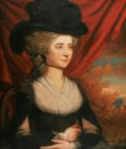 Frances (Fanny) Burney (1752-1840)
Jane Austen herself was a great admirer of Fanny Burney. The idea for the title of Pride and Prejudice even came from Burney’s novel Cecilia. There can be no greater recommendation than that! Burney’s eighteenth-century comedies of manners are sparkling and effervescent reads. Her lively dialogue, outrageous secondary characters, dashing heroes, and lovable heroines should be tempting to Jane Austen enthusiasts. It’s also interesting to look for the ways in which her writing served as inspiration for Austen.
A Good Place to Start: Evelina
 Maria Edgeworth (1767-1849)
Maria Edgeworth was another of Jane Austen’s favorite authors; Jane even sent her a copy of Emma before it was published. There’s something thrilling about reading the books she grew up with. Like Austen, Edgeworth’s works feature social satire, strong heroines, and marriage plots. Her novels focus on morality and explore the broader themes of politics, religion, gender, and race.
A Good Place to Start: Belinda
 Emily Eden (1797-1869)
Emily Eden is a lesser-known nineteenth century writer, whose work is imbued with a vibrant intelligence that many Janeites should find appealing. Eden also counted Austen among her favorite authors. Discovering her novels is like uncovering comedic buried treasure. Emily Eden’s writing showcases shrewd psychological insight and clever social commentary.
A Good Place to Start: The Semi-Attached Couple
 Elizabeth Gaskell (1810-1865)
If you were to cross Jane Austen with Charles Dickens, you would get Elizabeth Gaskell. In fact, Gaskell even wrote for the magazine that was published by Dickens. Her works highlight Victorian era social and economic issues and explore women’s roles. There’s also plenty of romance and glimpses of everyday life. North and South features a love story that is reminiscent of Pride and Prejudice, while Cranford looks at life in a small English village, and Wives and Daughters tackles familial relationships and unrequited love.
A Good Place to Start: North and South
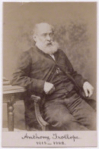 Anthony Trollope (1815-1882)
Sometimes referred to as the male Jane Austen, Anthony Trollope wrote highly readable, character-centric, domestic novels. The prolific Victorian novelist was adept at creating nuanced, complex characters that face everyday problems and grapple with life’s big questions. Many of his works also explore courtship and marriage, yet unlike Austen, he offers insight into the male perspective as well as the female. Trollope’s novels are full of gossip, politics, and social interactions that are still relevant to readers today.
A Good Place to Start: Doctor Thorne
 Mrs. (Margaret) Oliphant (1828-1897)
Mrs. Oliphant was a huge admirer of Jane Austen; she even wrote about the author’s life and works in her capacity as a literary critic. Her own novels are light reads full of clever observations of Victorian life. Mrs. Oliphant masterfully weaves subtle irony, social satire, and sparkling dialogue. This bestselling Victorian author- although less known today- is worth seeking out.
A Good Place to Start: Miss Marjoribanks
 Angela Thirkell (1890-1961)
Angela Thirkell’s charming pastoral comedies provide amusing slices of English life before and during WWII. Similar to Austen, her plots often center on matchmaking and marriage, along with the common occurrences of day-to-day village life. Thirkell is certainly an author who drew inspiration from the past. In fact, she set her novels in the fictional English countryside of Barsetshire originally created by Anthony Trollope. Her fully drawn characters, engaging dialogue, and witty observations make for enjoyable reading indeed.
A Good Place to Start: Wild Strawberries or High Rising
 Georgette Heyer (1902-1974)
She’s known as the Queen of the Regency romance for a reason. Georgette Heyer has a keen eye for period details, as well as a huge talent for replicating Regency slang. Heyer’s novels vividly bring to life the world in which Jane Austen lived and wrote. Her novels are laugh-out loud funny and full of ridiculous hijinks and plenty of romantic entanglements. Many of her heroes are just as swoon-worthy as Mr. Darcy himself, while her heroines are intelligent, quick-witted, and strong. Luckily, Heyer was incredibly prolific, and she left a wealth of works to choose from.
A Good Place to Start: The Grand Sophy
 Barbara Pym (1913-1980)
Barbara Pym was a popular mid-century writer whose works sadly fell out of fashion- and out of print- for several decades. Often referred to as a modern Jane Austen, Pym’s novels capture the everyday lives of women with superb wit and insight. Like Austen, she writes about the small section of society in which she was a part. Her comedies are populated with middle-class characters: vicars, academics, “spinsters,” and office workers. Pym brilliantly finds the humor and the value in the mundane.
A Good Place to Start: Jane and Prudence or Excellent Women
 Jude Morgan (Tim Wilson)
Jude Morgan is the pseudonym used by English author Tim Wilson. His Regency historical fiction follows in the grand tradition of Georgette Heyer. With witty banter, clever heroines, and stellar writing, Morgan’s novels are sure to appeal to readers who can’t get enough of the Regency era.
A Good Place to Start: An Accomplished Woman
10 Bonus Austenesque Reads
These books may give you an Austen vibe:
- The Female Quixote, Charlotte Lennox (1752)
- The Woman of Colour: A Tale, Anonymous (1808)
- The Blue Castle, M. Montgomery (1926)
- Diary of a Provincial Lady, E. M. Delafield (1930)
- Cold Comfort Farm, Stella Gibbons (1932)
- Miss Buncle’s Book, D. E. Stevenson (1934)
- The Makioka Sisters, Jun’ichirō Tanizaki (1943)
- The Pursuit of Love, Nancy Mitford (1945)
- I Capture the Castle, Dodie Smith (1948)
- A Suitable Boy, Vikram Seth (1993)
What writers remind you of Austen? Do you have a favorite Austenesque book?
Jessie has been an avid Janeite since she first picked up Pride and Prejudice at the age of eleven. When not reading or watching period dramas, she can be found blogging at Dwell in Possibility.
Themes of Persuasion #AustenInAugustRBR
Please welcome Brianna from The Book Bug Reviews, with a guest post about the major themes in Persuasion. Be sure to read through to the end for a special giveaway (open only to Austen in August participants)!
Austen in August: The Top 3 Themes of Persuasion
By
Brianna Gunnarson
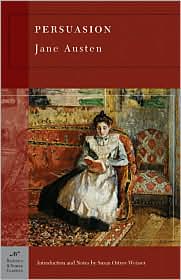
I am so excited to be doing a guest post for Austen in August! Jane Austen was the first classical author I ever read and she happens to be one of my favorite authors ever! So when the opportunity to read Persuasion presented itself I couldn’t refuse.
There are so many amazing themes to Persuasion that I could discuss, but I have decided to highlight three of them that really stuck out to me.
First: A character’s reaction to loss reveals their true self.
Jane Austen uses loss as a way to build her characters. She reveals who they really are by putting them through painful situations. I happen to love this approach to writing. My philosophy when creating characters is if you want to see what a character is really like, break them and put them back together. But don’t take my word for it. Let me show you how the expert does it.
- Anne loses her mother and the love of her life. Her grief silences her voice. Rather than voice her pain she seeks to serve the needs of everyone else and to alleviate the pain of everyone around her, often to her own disadvantage. At her core Anne is a self-sacrificing character.
- Musgrove loses her wayward son. She ignores the fact that her son died and simply moves on with life. When forced to confront the reality, she lies to herself and everyone else about how he was a good boy. She changes her reality in order to make it bearable. She is a weak minded character.
- Captain Benwick loses his wife. He becomes shy and seeks to drown his emotions in extensive amounts of poetry. The pain that Captain Benwick experiences is not something that he is able to face directly and so he seeks the words of someone else to express it.
- Sir Walter Elliot loses his wife. He becomes vain and foolish. Sir Walter seems not to care at all for the loss of his wife as he ignores all the things she contributed to keep the family safe and he proceeds to put them into debt.
- Elliot loses his wife. He immediately starts trying to court his cousin Anne as a means of securing his future. He cares little for her loss as he cares for no one but himself.
- Smith loses her husband, her wealth, and her health. She seeks to find joy in the small blessings of life and despite her intense pain and poverty she experiences great joy in her life.
Loss reveals the true underlying aspect of someone’s character. Are they considerate, selfish, vain, tender, foolish, or kind? Austen expertly builds a diverse cast through the repeated experiences of loss.
Second: Is it better to be easily persuaded or to stand firm in one’s opinion?
The title of the novel is Persuasion and thus it is one of the major themes of the book. Austen doesn’t come out and say exactly what she thinks about this but gently provides examples of the benefits and limitations of being persuaded or standing firm.

Easily Persuaded
Pro: Mary is easily persuaded out of her negative assertions about herself. This means that when she has talked herself into a miserable state Anne can help her see happiness in her life and to be thankful for all of life’s blessings.
Con: Anne is persuaded by her family and by her dear friend Lady Russel to give up her engagement to Captain Wentworth, who she deeply loves. The result is seven years of regret and misery.
Not Easily Persuaded
Pro: Anne is not able to be duped by Mr. Elliot when he tries to pressure her into marrying him. She is able to stand firm in her decision, despite there being some strong enticements such as taking her mother’s place as Lady Elliot, saving her ancestral home, and gaining a large fortune.
Con: Louisa refuses to be persuaded by anyone so when she foolishly jumps off a ledge she nearly dies. The extent of her injuries change her life forever. She no longer has the vibrant energy she once had and as such much relinquish much of her active life-style.
Perhaps Austen’s point is not that one should be firmly camped on either side, but that one should use good judgement for all circumstances. Take wise counsel but do what you believe to be best.
Third: Class mobility.
In Austen’s day, class hierarchy was clearly defined. There was royalty, nobility, the middle class, and the lower class. Each individual knew where they belonged in the social organization and in general a person didn’t move up or down on the ladder. If you were born in the lower class that is where you stayed.
Despite these clearly defined categories, Austen’s society was changing. If an individual worked hard they could change their social status. And thus we have arrived at one of the major themes of Persuasion. Austen uses navy men as a way to explore whether or not someone really could change their social position.
Sir Walter Elliot, Anne’s father, firmly believes that one cannot change his social standing, and uses this reasoning as a firm rejection of Anne’s betrothed. If you are in the elite social class then you must stay with your own people or risk tarnishing yourself, family, fortune ect. But despite Sir Walter having the highest rank in his county, he is also the most foolish man. He spends beyond his means, driving his family into debt and out of their ancestral home.

Enter Admiral Croft. The Admiral embodies Sir Walter’s worst fear. He is a man who has earned his own fortune rather than inherit it and Sir Walter believes that he is a man of barbaric taste and appearance, because that’s how all sailors are supposed to be. But when Anne finally meets the Admiral she is shocked to find that he is in fact, in possession of better manners than her vain father. Furthermore, he is responsible with his finances and seeks to improve the Elliot’s estate while he is their tenant. Admiral Croft is in every respect a better man than Sir Walter Elliot, and lacks only the official title to be able to lay claim to the social status of gentry.
Austen’s ideas about social class, may at first seem to have no relevance to today, but that would be an oversight. Today’s social classes may not be as clearly defined, but if there is still a hierarchy. Depending on your race, economic standing, education, and sex you may have more or less mobility and access to resources in today’s society. Austen reveals that those who believe they are entitled to a certain status in society often do not deserve it at all, and even though someone may not at first appear to fit the mold, if you have the skills you can move through any hierarchy and should be allowed to do so.
Conclusion
Jane Austen was a brilliant woman who used the guise of a romance to explore ideas of loss, persuasion, and class mobility. Thank you to Adam at Roof Bean Reader for allowing me to guest post. I am honored to have gotten to share my ideas about Austen’s work.
What other themes stood out to you? Post it in the comments! We would love to hear from you!
Citations
Austen, J. (2007). Persuasion. New York, NY: Barns and Noble Inc.
 Giveaway: One copy of What Would Jane Do?: Quips and Wisdom from Jane Austen
To be considered: Winner must have commented on the master post for the event by August 7th, stating their intention to participate in Austen in August. To be entered in this giveaway, leave a comment on this post, sharing something about your love/appreciation/whatever for Jane Austen. Why are you here?? 🙂
Giveaway opens August 8th and closes at 10pm CST on August 13th.
Diary of a 21st Century Janeite #AustenInAugustRBR
Diary of a 21st Century Janeite
by Jorie Story | @joriestory | Jorie’s tCC List
For Austen in August 2017
*NOTE: Portions of this guest post were previously published on Jorie Loves A Story. In regards to language, I’m a dyslexic writer who writes in a hybrid style of AmeriBrit English as a way to offset my dyslexia and fuell my own literary voice. Ancestrally, I am British and bookishly I am definitively an Anglophile.
August 2014
I am not sure when the exact moment occurred in my childhood, but I started to feel a kinetic bond with Jane Austen, to the brink I knew once I started to read her beloved works, … I would become a Janeite. She simply had a convincing way of expressing life as it was lived during her own era, of the minute details of ordinary life intermingled with the reflections of a keen observant eye. My first forays into Austen’s canons was a bit of a hit/miss for me, as I began originally with “Sense & Sensibility”, although I attributed this false start due to what had been on my mind and heart at the time I had first picked it up.
I purposely have been seeking out after canon sequels and/or re-tellings of the collective works of Jane Austen as I wanted to reacquaint myself with Austen through self-directed studies and step back through a door I had not yet fully opened.
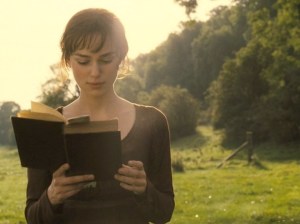 It was not until Keira Knightley’s edition of “Pride & Prejudice” (adaptation) where I was able to ascertain the focus I wanted to garnish for Austen, as I nestled into a pocket edition of Pride. A full fortnight passed, and I was anxiously worried that the film might leave our cineplex, only to be relieved that it hadn’t and I promptly found myself elated by what was unfolding in front of me! As it began, I noted the creative liberties, but I also had the re-collective memories of what I had read, as it nearly felt for the first half of the film, that I was both reading a subtext of narration alongside the live action!
Knightley’s motion picture will always hold a special place in my heart, despite what others might express on her behalf. I already ruminated previously that Colin Firth’s mini-series would be my most adored adaptation, but there is always room for adaptations that draw a measure of liberty with their scope.
I felt (at the time) as I read “Sense & Sensibility: A Latter Day Tale” during #AustenInAugustRBR, I was one step closer to my goals of reading through the breadth of Jane Austen and the authors who are as transfixed on her legacy as I am myself. Except to say, the opposite happened – I took a full absence from reading anything remotely Austen!
Somewhere in the early 2000s
 I still remember my excitement about the film adaptation of ‘Sense & Sensibility’ being released starring Emma Thompson. At the time, I had become aware of her growth behind the camera inasmuch as her intention to seek out different roles which enriched her life as an actress. I was dearly curious about how she approached this film and I still remember what my Mum did to surprise me – as I was contemplating a future in film-making (at the time) – I remember I came home one day finding a lovely bundle awaiting me!
She had found an exclusively lovely edition of the novel, as well as the full screenplay and story of how the adaptation of 1995 had been produced. It was my intent to read the book, then the screenplay, and lead into watching the motion picture! Alas! I had to give in to the fact that my mind couldn’t yet settle into Austen’s brilliant prose, and I tabled the idea for awhile.
I remember feeling Austen might be a bit out of my depth at the time – there were moments where I had tried to pick up her collective works, finding myself unable to attach myself into her words & narrative. Other times, I would pick up one of her stories and not only would I feel so rooted into the pages of her thoughts, but I could speak in a pattern of speech similar to hers once I had put the book down. Almost as if my heart and mind were still remembering the synchronicity.
October 2009
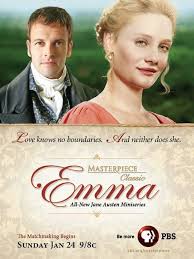 Being an appreciator of PBS, I was wholly enthused by the adaptation of ‘Emma’ arriving during the Autumn I was feeling an inclination towards resuming my readings of Jane Austen. I even remember wanting to read ‘Emma’ ahead of this adaptation – in the end, I watched the first few serial installments as they first aired before recognising I was short-changing myself. I truly needed to read the book first before I fully aligned myself back into the adaptation.
I was so caught up in the moment of watching the series, I had forgotten how much I dearly wanted to read the stories and then, follow through with how they were adapted. My internal conflict was so intense, I had to turn away from the tv and pretend it wasn’t airing – as I felt I had rushed getting back into the afterglow of Austen without fully giving myself the background of how Austen’s narratives were so strongly conceived as to give flight to their own ruminations outside of the modern adaptations.
Books and motion pictures walk hand-in-hand in my life, despite the fact that I am generally a purist, in wanting to read the book prior to watching the motion picture and/or limiting myself to which sequel authors I want to become engaged in reading, as I always feel they should honour the canon.
September 2014
I had the opportunity to interview an author on behalf of his Jane Austen after canon entitled “A Jane Austen Daydream”. At the time, I felt like I was living inside my own ‘Austen daydream’ because I hadn’t fully crossed the bridge between girlhood wonderment, adult curiosity and a Classical soul striving towards personal literary enlightenment. I was also a member of The Classics Club who was struggling to find her feet inside the challenge she had set down for herself to utilise a passage back into the origins of Literature whilst re-establishing her bookish muse for the Classical authors who charmed her mind by their enchanting worlds and strong characters.
August 2013
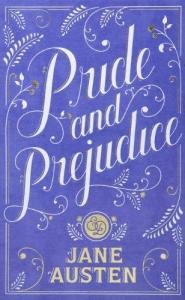 Participating in my first #AustenInAugustRBR felt surreal – I had hoped to launch my blog in time to join the book blogosphere event but when I realised I had made it into the even itself, it nearly felt as if I had stepped through a new door where the bookish regularly meet-up and chatter about the stories which give them the most joy to read. I had earmarked myself to focus on “Pride and Prejudice” as this was my first Austen novel I quite literally devoured, savoured and spent a considerable amount of time contemplating long after I put the book back on my bookshelf. I knew I wanted to start to read the sequels & re-tellings – including the Jane Austen Mysteries, which in of themself are not directly tied to one particular story.
I wanted Pride to serve as a proper starting off point to entertain sequel authors for the first time in my reading life! I sought out everything that my local library could give me, and came to appreciate the offerings long before I ever could read them! As soon as I checked them out, one by one, I would love over their covers, inlets, and read the synopsis, awaiting the day where I could dive into the heart of their stories!
The story of Pride and Prejudice, will always be rather dear to me, because of Elizabeth Bennett. I feel as though from the very first opening chapter until the closing of the last, I am walking in Ms. Elizabeth Bennett’s shoes. Struggling at times to understand the indifference of her family, and the qualms that beseech a singleton whilst attempting to understand the opposite sex. She is bemused and befuddled by the man named Darcy, who from the onset makes no attempt to gain her attention, and has an ill-view of her family overall. She is a second daughter, in a family of five, who is deeply attached to the love and affection of her father, and is at times, more at quells with her mother, who tends to put the family in a bad light when out in public; due to the nature of her outbursts that do not always comply with the social norms of the day in which they live.
It’s Elizabeth’s determination not to settle for someone less than her equal and a man of quality, that makes me endeavoured to love her! She stands firm in her beliefs, at all costs, and she isn’t quick to acknowledge a grievous mistake or misunderstanding, but her heart and spirit, does not allow her not to oblige a concession when the need arises that she has to omit a fault made on her own behalf. She lives strong and loves deeply. And, I appreciate that she is completely true to herself throughout the sequence of her life we are given to seeing her. She is a woman who is sorting out how to live and how to proceed forward in her life, by not limiting her options, nor settling for what she knows will be wrong for her heart. For in marriage, as Ms. Bennett and I both know, one must lead forward with one’s heart, and be entwined in true love for the relationship to last forevermore. – quoted from my review of “Pride & Prejudice”
August 2017
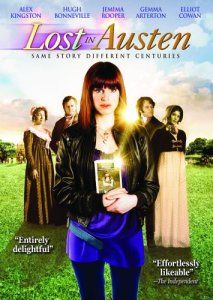
I took a chance on re-watching ‘Lost in Austen’ which I had seen earlier in 2013 whilst attempting to read more Classical After Canons for Austen. I loved how I felt lost inside a bubble world of where Jane Austen was being acknowledged both in a serious and humourous light – it was about how our affinity for an author can either remain a healthy curiosity or an obsession where we might need to take a step back from overindulging!
 Being a 21st Century Janeite doesn’t have a path to follow – we each alight inside Ms Austen’s world(s) at a pacing which suits our own individual needs and curiosities about her collective works. For me personally, I have felt so wholly attached to her on a personal level (as there are bits of her life’s story & writerly path which I can relate too) I think part of me has held myself back from reading her as quickly as I perhaps ought to have over the years. Not to rush the joy of her stories – but perhaps not have lengthened out my ‘meeting’ of her works spilt between my twenties and thirties!
One reason I am attracted to Jane Austen’s writings is how she has a keenly supreme sense of observation which matches her equally desirable sophisticated wit! I love how she etches out her living reality into works of fiction which lay down a foundation of how life was once lived but also, readily observed from the ‘outside’. She took to her pen to carve out characters and stories which not just cross-relate to the reader who finds them (even centuries later) but they are written on a level of literary intuitiveness for knowing what readers are seeking out of a particular style of narrative.
I have a penchant for relationship-based Romances inasmuch as I love getting dearly attached to generational sagas. This cross-love of mine threads well into Austen’s works – as she had her own particular niche of identifying what we are most curious about as fellow humans who are seeking to understand human behaviour, patterns of relationships and the curious undertones of duty and responsibility in extended families.
I am also a girl who lives a step outside of her own time-line – I prefer vintage over modern (ie. everything from home furnishings to desiring to pen my stories on my lovely vintage Royal typewriter), I’ve been a postal mail correspondent since I was eleven, I appreciate the creativity of old world arts & crafts (ie. currently: I knit) and I fancy the old fashioned way in how we meet those of whom we wish to court. I even love how there are still ways in which to meet (potential) suitors through moderated services of match-making wherein once two people connect, they can correspond ahead of meeting in person.
There is something quite special about Jane Austen. Even if we are taking a route which only makes sense to ourselves back into the folds of her literary works whilst embracing a few modern writers’ visions as well (which feel as if they’re in step with paying homage to the canons) – one thing which remains eternally true, is how classically relatable Ms Austen has become universally inspiring each of us in turn.
I’m still evolving as a Janeite – yet part of what makes me a Janeite will always remain. I, first and foremost, appreciate the dedication of Ms Austen, of whom followed her own instincts and wrote the stories which gave her the most joy to create. She didn’t parlay into what was readily popular, but instead chose the stories which percolated out of her own heart and imagination; giving her a freedom not many writers have today.
Austen & After Canon Bibliography via Jorie Loves A Story:
- Pride & Prejudice by Jane Austen
- Love At First Slight by J. Marie Croft
- Sketching Character by Pamela Lynne
- Sense & Sensibility: A Latter Day Tale
My gratitude to Adam of Roof Beam Reader for allowing me the grace of participating this #AustenInAugustRBR with a Guest Topic of my choice! Bless you, Adam and thank you for uniting all of us: Austenites & Janeites, together!
Jorie’s Question to Participants in Austen in August:
Which stories by Austen do you most relate to yourself? How do you approach your own passage back into Jane Austen’s muse and the after canons which have been writ out of writers’ conjoined passion for granting new insight into Austen’s collective works and/or character lives?
The Folio Society Loves Jane! #AustenInAugustRBR
 Please welcome back to Roof Beam Reader, THE FOLIO SOCIETY!
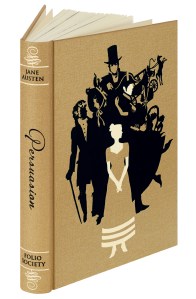
The Folio Society’s collector’s edition of Jane Austen’s Persuasion features stunning images by artist Deanna Staffo. Her illustrations are perfectly suited to the book’s tone, particularly that which shows Captain Wentworth dropping his pen while writing his letter to Anne – one of the most significant, highly charged scenes in literature, and one of the most beautiful of love letters.
This hardcover title features a stunning cover design; the slipcase reproduces one of the novel’s most famous lines. Prize winning author Siri Hustvedt contributes a new introduction that examines the notion of ‘persuasion’ as part of the 18th-century New Rhetoric philosophy that would have been familiar to Austen readers. She also charts the social changes revealed by the story, particularly the conflict between the long-established but moribund Elliot family and Captain Wentworth, who made his fortune in the Napoleonic Wars.
The Folio Society’s Persuasion is published in series with Pride and Prejudice, Sense and Sensibility, Emma and A Memoir of Jane Austen. Retail value: $59.95 Only available on www.foliosociety.com
GIVEAWAY:
The Folio Society has generously offered to giveaway a copy of their beautiful edition of Persuasion to one lucky Austen in August participant!
To be considered, you must have signed-up for this event on the master post. Please also leave a comment below expressing why you’d like this edition of Persuasion. Good luck!
Giveaway opens on August 5th and will close at 10pm CST on August 11th.
 Roof Beam Reader