Roof Beam Reader
Adam Burgess
Bout of Books 10: Master Post
 (Scroll down for daily updates.)
Reading list:
Below is the list of books that I’ll be choosing from this week. I doubt that I’ll get through all of them, especially as some (Frye, Woolf) are pretty dense. I hope to complete at least three books this week, including the first two listed and also The Demon-Haunted World which I started a month or so ago but had to sideline while finishing up the semester. If I get more than that accomplished, then great!
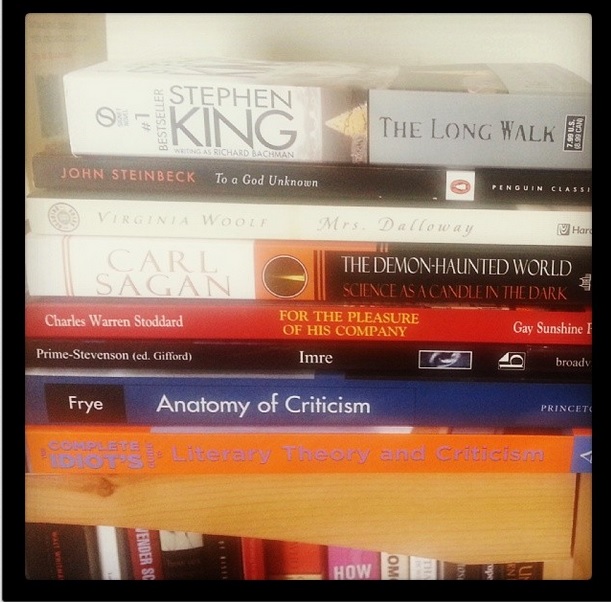 • For the Pleasure of His Company, Charles Warren Stoddard
• Imre: A Memorandum, Edward Prime-Stevenson
• Anatomy of Criticism, Northrop Frye
• The Long Walk, Stephen King
• To a God Unknown, John Steinbeck
• Mrs. Dalloway, Virginia Woolf
• The Demon-Haunted World: Science as a Candle in the Dark, Carl Sagan
• The Complete Idiot’s Guide to Literary Theory & Criticism, Steven J. Venturino
Goals:
• Read at least two books for my summer course (titles 1 & 2 above)
• Join some of the Twitter chats
• Visit other participants, including host blogs (competitions & such)
Updates:
Monday:
Pages read: 90
Books finished: None
Titles experienced: 2- For the Pleasure of His Company and The Demon-Haunted World
Tuesday:
Pages read: 276
Books finished: 1 – For the Pleasure of His Company
Titles experienced: 3- For the Pleasure of His Company, The Demon-Haunted World, and The Book Thief
Wednesday:
Pages read: 280
Books finished: None
Titles experienced: The Book Thief
Thursday:
Pages read: 149
Books finished: 1 – The Book Thief by Markus Zusak
Titles experienced: 2- The Book Thief and Rebecca by Daphne Du Maurier
Friday:
Pages read: 60
Books finished: None
Titles experienced: Rebecca
Saturday:
Pages read: 0
Books finished: None
Titles experienced: None…. bad, Adam. 😦
Sunday:
Pages read: 291
Books finished: None
Titles experienced: Rebecca by Daphne du Maruier and Salem’s Lot by Stephen King
Total pages read: 997
Total books finished: 2 – The Book Thief and For the Pleasure of His Company
All titles experienced: 5 – The Book Thief, For the Pleasure of His Company, Rebecca, Salem’s Lot, and The Demon-Haunted World.
*Note: I borrowed the general format for this post from Heather at Between the Covers.
Bout of Books: I’m In!
Hello, Readers!
 The semester is winding down (one week to go!) and I am very much looking forward to spending more time with you all very soon. I will be teaching and taking one course this summer, so there will still be plenty going on for me out there in the “Real World,” but I think I’ll manage to get much more accomplished here on the blog, too.
That being said, I’m taking this opportunity to sign-up for Bout of Books, for the very first time! The event takes place during the first week of summer break — a perfect time to celebrate a little “freedom” by reading a whole bunch of pleasure/just for fun books that I’ve had to put on hold for months and months. Woo!
I should also note – Austen In August will be back this year! I plan to post the sign-ups and guest contributor forms sometime in early June, so be on the lookout for that. 🙂
Here are the details for Bout of Books:
The Bout of Books read-a-thon is organized by Amanda @ On a Book Bender and Kelly @ Reading the Paranormal. It is a week-long read-a-thon that begins 12:01am Monday, May 12th and runs through Sunday, May 18th in whatever time zone you are in. Bout of Books is low-pressure, and the only reading competition is between you and your usual number of books read in a week. There are challenges, giveaways, and a grand prize, but all of these are completely optional. For all Bout of Books 10 information and updates, be sure to visit the Bout of Books blog. – From the Bout of Books team.
While this list is in no way official, here are some of the books I’m thinking of reading during “The Big Bout”:
- Anatomy of Criticism by Northrop Frye
- The Long Walk by Stephen King
- Mrs. Dalloway by Virginia Woolf
- Death Comes for the Archbishop by Willa Cather
- To a God Unknown by John Steinbeck
So, is anyone else participating this year? Any thoughts from past participants on how to organize your time, posts, etc.? If you are planning to participate, what books are you looking forward to reading?
Ten Influential Books in My Life
Yesterday, Jillian of Random Ramblings posted her “Most Influential Books” and asked me if I would share mine, too.
I really love her particular spin on this, which is that we share without giving any sort of explanation whatsoever. It’s harder than it sounds! When I love a book, I want to tell everyone why & try to convince them to read it. But, I can also see the beauty in sharing these favorites and allowing others to discover them completely on their own, and maybe fall in love with them for their own reasons.
So, here is a list of 10 books that have affected me greatly, for various reasons. I desperately want to say something about each of them, but I will refrain. I challenge you all to give this a shot on your own blogs, and I especially challenge you to read a title from this list that you haven’t, yet!
In no particular order:
- The Catcher in the Rye by J.D. Salinger
- The Confidence-Man by Herman Melville
- The Giver by Lois Lowry
- The Mayor of Casterbridge by Thomas Hardy
- Harry Potter and the Sorcerer’s Stone by J.K. Rowling
- Dream Boy by Jim Grimsley
- The Perks of Being a Wallflower by Stephen Chbosky
- The Grapes of Wrath by John Steinbeck
- Adventures of Huckleberry Finn by Mark Twain
- Tender is the Night by F. Scott Fitzgerald
Care to share any books that have had a profound affect on your life?
Thoughts: Grasshopper Jungle by Andrew Smith
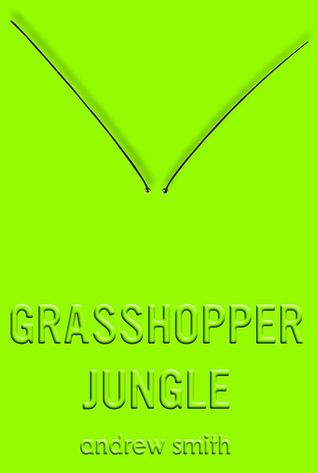 Grasshopper Jungle by Andrew Smith
So, this is the way the world ends. Not with a bang, but with a …uh… clacking-buzzing sorta sound? Yes, I think T.S. Eliot would be proud of Andrew Smith’s newest wasteland, which is to say, an average, all-American, small town in Iowa. Of course, this small town just happens to be infested with gigantic, horny, insatiably hungry grasshoppers. Luckily, there is one historian present to witness and record the strange happenings that lead up to the end of the world: Austin Szerba. Our narrator-historian is a corn-fed teenager just as horny and insatiable as the unstoppable grasshopper army. Okay, to be fair to the cannibalistic insects – Austin is probably hornier than they are. But at least he doesn’t eat everybody. Young Szerba hilariously, but adeptly, graces his readers with the histories of a town, a family, a friendship, and the founding of a new world order.
Here’s the thing, though. The premise of the book, as outlined above, might sound a bit ridiculous. And, in spots, it’s far from believable. This is because it’s rooted in science-fiction which, by its very nature, is not meant to be entirely realistic; yet, we know that much of science-fiction has indeed anticipated our actual scientific discoveries and technological advancements (anyone notice that Star Trek had tablets and wireless communication devices decades ago?). On the surface of Grasshopper Jungle, then, is an action-packed coming-of-age story with groovy, original and horrifying science-fiction elements. Dig deeper, though, and you’ll find that Smith is asking some seriously profound questions about life, power, love, independence, and responsibility.
So, maybe mutated humanoids-turned-insects who breed like there’s no tomorrow (‘cause there ain’t, folks) isn’t your bag. This book is still probably for you. Why? Well, because of everything else that Andrew Smith gives us in this book.
For example, we are saved from totally wigging-out over the nasty self-inflicted bug invasion at the core of the story by the presence of three very real, very believable, and very human protagonists who happen to be mired in a wonderfully messed up ménage à trois. Robby loves Austin. Shann loves Austin. Austin loves them both. It’s confusing and it’s painful. It’s erotic and it’s maddening. It’s teenage life in the Midwestern United States, where a young man is coming to terms with his sexuality, his family history, and, yeah, the realization that he just might be the destroyer of the world, the savior of it, and the chronicler of the whole damn thing, too. Holy shit.
What else can I say about this book? Andrew Smith understands young adult males like few writers out there today. He also has a superhuman ability to weave incredibly fantastical tales with deeply moving stories about the human experience and what it is like to grow up feeling different. After Stick, and Winger, and so many other incredible books, it is impossible to deny that Smith has a cosmic connection with the teenage male psyche and all that comes with it. So if you are prepared to enter that deeply disturbing, sometimes heartbreaking, but always hilarious world of the teen boy mind, then you will find no better avenue than this.
Suggested Reading For:
Age Level: Young Adult+
Interest: Science-Fiction, Coming-of-Age, Sexuality, LGBT, Friendship, Dystopia, Family, Fictional History. Midwest USA, Corn.
Notable Quotes:
“We never heard sirens in Ealing. It’s not that bad things never happened here, it’s just that nobody ever bothered to complain about it when they did.”
“History does show that boys who dance are far more likely to pass along their genes than boys who don’t.”
“I was on the conveyor belt toward the paper shredder of history with countless scores of other sexually confused boys.”
“Good books are always about everything.”
“History never tells about people taking shits. I can’t for a moment believe that guys like Theodore Roosevelt or Winston Churchill never took a shit. History always abbreviates out the shit-taking.”
“History shows that an examination of the personal collection of titles in any man’s library will provide something of a glimpse into his soul.”
J.K. Rowling Can Say What She Wants
 By now, many readers and book bloggers are likely aware of a controversial statement that was made recently by J.K. Rowling, author of the Harry Potter series, in an interview with a British entertainment magazine, Wonderland. In the interview (conducted, amusingly enough, by Emma Watson, the young and talented actress who plays Hermione in the film adaptations of Harry Potter) , Rowling allegedly indicates that two of the main characters, Ron Weasley and Hermione Granger, probably should not have ended up together after all, even though theirs was the primary romance in the series.
“I wrote the Hermione/Ron relationship as a form of wish fulfillment. That’s how it was conceived, really,” says Rowling. “For reasons that have very little to do with literature and far more to do with me clinging to the plot as I first imagined it, Hermione ended up with Ron.”
I have been asked numerous times over the last few days for my reaction. The difficulty, for me, is in deciding which “cap” to put on in my response. Are you asking me as a fan of the series? Or are you interested in my interpretation of this as a scholar of literary theory? Are you curious about how I think about this as a critic and a reader? Or are you wondering about how I react to this as a writer who considers Rowling a master craftsperson? There are so many ways to respond to this particular type of revelation, and while these categories are not necessarily mutually exclusive, I can certainly find possible “pros” and “cons” from each perspective. I will do my best, though, to shape one coherent general response.
 This statement has unleashed reactions similar to those which arose after Rowling indicated that another of her major characters, the Hogwarts Headmaster and Wizard-extraordinaire, Albus Dumbledore was gay. Fans then, and now, split along lines of outrage at Rowling apparently “changing” the stories, on the one hand, and excitement over the added depth (or possible reaffirmation of some fans’ original interpretations or desires about the characters), on the other hand. These kinds of reactions have much more to do with reader-response than with the quality or integrity of the text itself. Reader-response theory tells us that each reader is going to react uniquely to a book (and to each reading of that book) based on the personal experiences, opinions, background, etc. that she brings to the text at the time of reading. So, does this mean that people who (re)read the books after learning about Dumbledore or about Rowling’s shaping of Ron & Hermione’s relationship might read the books in a new way? Possibly. Do these things harm the text, or change it? Not in the slightest – they just complicate the reading (for some).
In that first revelation, Rowling was accused by many of being a “coward” for not introducing Dumbledore’s homosexuality into the stories themselves, instead choosing to “drop it” on us in an interview after the fact. My reaction was quite different; in fact, I had already read Dumbledore as a gay man, especially in the penultimate and final books (The Half-Blood Prince and The Deathly Hallows) where we learn much more about Dumbledore’s past. But even excluding the clues which Rowling clearly dropped in the novels (and yes, they are clearly there, but it is not surprising or “wrong” if some readers overlooked these) there are two other problems I have with this negative reaction:
First, why does a character’s explicit heterosexuality or homosexuality need to be spelled out at all? Most readers do not expect all elements of a plot or of a story’s characters, to be explicitly given to us – part of the fun in reading is in discovering these things. Perhaps Rowling anticipated that more of her audience would have picked up on the nuances than actually did or perhaps she was asked a simple question (“did Dumbledore ever fall in love?”) and she gave a simple answer (“Yes, with a man named Grindelwald”).
Second, fans of the fantasy genre, in particular, should be accustomed to the fact that fantasy writers, particular those of complex, intricate, time-spanning series’ such as this one, often know much, much more about their characters and stories than they are ever able to incorporate into the series themselves; sometimes the additional information comes out in addenda – reissued editions, companion pieces, etc. Just look at all of the supplementary Tolkien works that take place in the lands of Middle Earth which have been released post-publication of the Lord of the Rings series!
Ultimately, I think it is Rowling’s right and privilege, as the author, both to reveal as much or as little as she wants about her characters and also to change her mind as she sees fit. She is not changing the story, after all, just our understanding of how she came to imagine it and to craft it. To add insult to injury, for some, is the fact that Emma Watson, our Hermione-incarnate, seems to agree with Rowling:
“I think there are fans out there who know that too and who wonder whether Ron would have really been able to make her happy,” says Watson.
 So, the story writer and the woman who played the character for ten years and who knows her (Hermione) with an intimacy second only to Rowling herself, both agree that the relationship at the heart of the series might not be such a fairy tale. And? Sir Arthur Conan Doyle once killed-off his famous detective, Sherlock Holmes, only to later change his mind about that. Mary Shelley, who wrote Frankenstein when she was very young, later looked back on the book with embarrassment and a completely different political perspective. Writers have regrets, they rethink things, and they talk about it. So what? The outrage and hubbub are, in my opinion, just a tad overblown and largely unnecessary. Sure, the series is the most popular of its kind in perhaps ever, so of course anything slightly controversial regarding it will become a topic of intense, heated, and sometimes hilarious social debate. But, hey, at least Rowling didn’t follow her first instinct, which was to kill Ron. Authorial intent is interesting in so far as it generates discussion and gets readers asking new questions, but, ironically, the reality is in the fiction – that world has already been created for us and must be taken as presented.
Let’s just enjoy the brilliance of the stories and the world that J.K. Rowling created. We can and will react to the books in our own way, so why not let people – yes, even the author- say what they feel needs to be said about them. In the end, all that matters is the experience you have with the books. There is no right or wrong about that.
 Roof Beam Reader